Sycamore

We have a big sycamore Acer pseudoplatanus at the bottom of the garden. It stands about 35 metres from the rear of the house and screens us from the back gardens in the next street. Our house is one of four linked terraced dwellings now standing on the site of a large orchard formerly the grounds of an older semidetached house to the south of us. Our terrace was built around 1905 and I calculate that the sycamore must be about 100 years old now. The main trunk is divided, and it has the general air of a weedy self-seeded arriviste. When we moved in it had a large elliptical scar on the west side of the trunk where it had lost a substantial branch.The bare surface of the wound was peppered with opportunist woodworm holes. Over the 28 years since we arrived the rolled edges of healthy bark have slowly grown in and have now almost closed the gap. 

I have allowed an ivy to elbow its way in and it now has a trunk as thick as my arm running up the eastern aspect of the sycamore trunk. The strangling stems have surged upwards and out onto the main branches while the upper growth has undergone that change in leaf shape and branch pattern that occurs in ivies with maturity. It flowers profusely in the autumn, feeding the last of the nectar-eaters, followed by dark berries. Although the overall effect looks a bit like neglect, I am persuaded that the ivy is good for the garden biome. 

A nest box, half-smothered in ivy leaves, is used annually by blue tits. There is a venerable bowling club next door and I acquired the box at their summer fair sale of work. It was made by one of the club members. In the winter I bring it down to clean it out and remove any potential birdy parasites. I worry about finding little starved nestling corpses inside but so far have always found only an empty cup of moss and feathers supported by grass with a few strands of interwoven plastic objets trouvés. When the nest is removed it forms a perfect cubical cast of the bottom of the box. As instructed by the RSPB I scrub it out with hot soapy water and put fresh wood shavings in, but the tits always chuck them onto the ground in spring. 

The sycamore was introduced to Britain around 1500 and has self-seeded itself everywhere. The wood is white and fine-grained and is used in the construction of musical instruments and kitchen work surfaces. As with lime trees, aphids infest it in the summer. The leaf sap contains far more sugar than the other nutrients the aphids need and so they excrete the unwanted sticky waste onto any surfaces below. In our case this is shade-tolerant laurels and camellias. The sugar deposit then grows an unsightly black mould. I hope the aphids help feed our dwindling Edinburgh population of swifts. Along with sticky aphid waste the tree produces a profusion of whirligig seeds which spin down in late summer. In turn legions of seedlings emerge on the lawn and in the borders the following year. I regularly miss a few and uprooting the older saplings can be strenuous. 

The Acer family is renowned for spectacular autumn colour – but not the common sycamore. One of the first hints of autumn is sycamore leaves developing black fungal spots. These have a yellow halo and are not unattractive. However, the leaves then turn a dull grey-brown and are shed in colossal numbers, forming drab rustling drifts everywhere. All-in-all the sycamore is quite a humdrum run-of-the-mill sort of tree. Which brings me to the subject of etymology.

Scientific names are an inconsistent mixture of Latin and Greek and that doesn’t really matter as long as the name is officially agreed. Acer is the genus and pseudoplatanus is the specific or species name for the sycamore. Even here the tree gets let down a bit from hinting that it is just a ‘pseudo’ plane tree, a species that it superficially resembles. 

The common name of sycamore is more interesting and also relates to a resemblance. In the Bible creation myth Adam and Eve are introduced to sin by disobeying God and eating fruit forbidden to them from the tree of the knowledge of good and evil. In Western culture this is usually portrayed as an apple which Eve offers to Adam after eating some herself. In fact the seductive fruit was originally one unknown in northern Europe, called the sycomore fig. Early Christian teachers felt the impact of the story would be lessened by using a tree unknown to the faithful and substituted the more familiar apple – which was also considered highly desirable.

The fig leaf, useful in censoring offensive artistic subjects, has a three-lobed structure which the acer leaf was thought to resemble. The name was therefore transferred to the humble pseudo-plane acer.

Distant Sycamore

The Black Spot
Autumn Brown Turkey Fig

Our Grapes

The Parthenocissus quinquifolia aka ‘Boston Ivy’ was a mistake. I had been inspired by a villa we stayed in in the Loire near the village of Paulmy. We stayed in the converted stables of a large chateau and the building was clenched in the exuberant embrace of this ‘ivy’. It is of course more of a vine (in the European sense) than an ivy and quite rampageous. How suitable for the extension I thought. How like a French chateau it will look. What wonderful autumn colour we will have. I was vaguely aware it was different from the maple-leafed tricupidata which covered the walls of our family farm. That ‘vine’ produced jaw-dropping reds in autumn – then dropped the lot for the winter.

With some regret and considerable difficulty I removed the ancient ceanothus from its position at the base of the west-facing wall. It had become a tree rather than a shrub and had taken to rubbing itself vigorously against the wall in the wind, wearing a deep furrow in the soft stone. I planted the parthenocissus in its place and stood well back. Gardening is like setting off really slow fireworks. There is a long wait before your plantings take off. In the case of the Boston Ivy the wait was shorter than usual.

Within a few seasons the Boston thug was up the wall and over the roof. It invaded the guttering and dropped swags of attractive feathery foliage everywhere like the hanging gardens of Marchmont. Little bunches of blue grape-like berries appeared in late summer. It proved impossible to keep pace with its advances. My friend John came round for a drink in the garden. He had to part the lianas to get onto the terrace. “Wow! It’s like a French chateau out here!” he offered spontaneously.

I had begun to think I should douse the flames of this particularly successful launch before we sustained serious damage to the fabric of the house. Actually, I had trouble finding the fabric of the house. About this time we had a gift of a real grape, a ‘Black Brant,’ from other friends, with a cheery, ‘There’s a challenge for you.’

I dug out the Bostonian and planted the Brant. I should point out that I have a history of over-optimistic plantings. Around the terrace we have a big fig (Brown Turkey) planted directly into the ground and an olive, a lemon, an orange and two lavenders all in large pots. Of these, only the fig produces sensible fruits. Intense feeding of the citruses this year has resulted in lots of blossom but only stunted produce. The olive does produce tiny olives that eventually turn black. I suppose like Dr Johnson’s analogy the wonder is not that it is done well but that it is done at all.

Anyway, the grape flourished and was much less thuggish than the ivy. I played at viniculture, carefully cutting it back in the winter (nice job for a frosty day) and tying in the shoots as they emerged from the black skeleton of branches in the summer. A few seasons came and went before it began to flower. By this time I had it neatly trained along the wall below the gutters and had begun thinking of Keats around September time.

The Brant does produce blue-black grapes in profusion and they have a lovely pale bloom. They are small, a bit bigger than a pea, and taste sweet. They are full of pips though. The Brant is very late-maturing and the grapes only start darkening in late October. I ‘harvest’ them now, in November. To be honest, it gives me most pleasure when it is cut back to its basic winter framework with its black, shredding bark. Every now and then I ponder whether it should really have been a passion flower or even a Magnolia grandiflora, but it’s a bit late now for more fireworks.

October 2020

It’s the ‘backend’ and the geese have been arriving for weeks now. They are seeking out our balmy southern climes for their winter break. The first time their honking calls draw your eyes skywards to their ragged V formations is a punctuation mark in the seasons. Have they just come in from Iceland off the North Sea or are they on their new daily commute from shore to field? Flying at 24,000 feet must have its problems with oxygen supply, but the cold air at passenger jet altitude helps cool their labouring flight muscles.

Before the turkey arrived from the New World and took over Christmas we ate geese – and before that we presumably ate wild geese. Their arrival must have been a winter bounty to our ancestors. Latterly years of ‘sporting’ slaughter diminished their numbers to perilous levels. The mechanic on our farm was a fisherman and a shooter. He took great delight in informing me that, as a young man, Sir Peter Scott used to shoot over the Solway marshes. Conservation efforts have resulted in a recovery in goose numbers and the grumbling has begun from other land-users. In places like Islay there is now a huge biomass of birds to sustain. Geese are grazing animals and get through large quantities of grass, but the necessity to rise instantly should a predator appear means they cannot afford the luxury of a heavy, efficient digestive tract. Instead they rapidly extract the most accessible nutrients before the rest is somewhat wastefully discarded back onto the field. Culling of barnacle and white-fronted geese occurs on Islay. In fact a large chunk of Islay is owned by the RSPB who manage most of their land for the benefit of the geese.

Scotland’s meagre population of red-billed chough are resident on Islay all year round and are only just clinging on at about 50 pairs. The RSPB keep grazing livestock to encourage them. Throughout the year the chough depend on foraging for invertebrates among the sheep droppings and cowpats. The first chough I ever saw was on Islay with my artist friend Jim Dalziel. The aerial acrobatics and ‘keeyah’ calls among the sand dunes were magical and I treasure the watercolour he did of them. More recently, as if the lack of food and habitat wasn’t bad enough, these birds have developed a form of congenital blindness due to their limited genetic diversity. It’s a recessive gene which is lethal to the affected nestlings.

Here, on the east side of the country, you can stand on the shore at Aberlady Bay and see squadrons of pink-footed geese coming in. It is genuinely one of the great wildlife spectacles. Numbers in that roost peak at about 30,000 before the birds disperse inland. At the other end of winter their noisy departure lifts the spirits with the promise of lengthening days and eventually some warmth.

Other bird species have also suffered a crash in numbers – but for more mysterious reasons. Starlings, song thrushes, house sparrows and latterly greenfinches have all had problems. When we first moved into our house 28 years ago there was a cheerful colony of house sparrows hanging around the back garden. They were always there and reminded me of being at home on the farm – but then, quite suddenly, they were gone. It gave me a thrill this year to see sparrows return to the garden for the first time in 25 years. It was actually more enjoyable to me than my recent garden life-tick of a nuthatch; an inevitable addition to the list as this interesting bird continues its astonishing northerly advance.

Sadly, there is little sign of a recovery in the greenfinch numbers. Trichomoniasis, allegedly from dirty bird feeders, has done for them. I always notice the occasional nasal ‘zwee’ call these days because it was once so familiar but is now so uncommon. Assuming the usual malign human influences don’t underlie these avian malthusian problems, the recent population fluctuations must be the result of some kind of bird plague. In which case, there’s a grim irony to the autumn arrival of all these healthy birds who find us wandering about below them in our masks, assiduously avoiding any close formation.

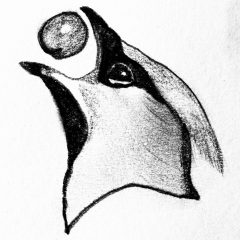
Islay Choughs. JPR Dalziel