Venus in Blue Skies

Drawing the bedroom curtains at 7am this morning Venus was un-missable, gleaming in the south east sky like the headlight of some UFO. Lying above and to the right of the un-risen Sun she is presently the ‘Morning Star’ but her dazzling beauty in the dark blue, pre-dawn sky is soon engulfed by the light from the rising Sun. She is still up there of course, moving westwards to set invisibly before the sun chases her down below the western horizon. Venus is the second brightest object in the night sky after the Moon. She can cast shadows and can, rarely, be visible in broad daylight.

Mercury and Venus are inferior planets, closer to the sun than we are, lying within the Earth’s orbit, and therefore they never appear in the middle of the night when our bit of the Earth, with us on it, faces away from the Sun and the two inner, inferior, planets. Observed from Earth Venus is never more than 47° (maximum elongation) away from the Sun and therefore appears to follow our star around. Galileo first observed that Venus showed ‘phases’ like those of the Moon; cycling in appearance from a crescent to a half-disc, to full disc and back again. This proved to him that Venus orbited the Sun, not the Earth, and got him into a lot of trouble with the Vatican. Venus is at her brightest at maximum elongation from the sun when she is a half-disc.

As Venus continues her (Venusian) year’s journey around the Sun from where she is at present she will eventually appear to the left, the east side, of the Sun and become instead the ‘Evening Star’. Venus moves more rapidly around the Sun than we do and she will then overtake us to become the Morning Star once again.

The Greeks did not realise that these two phenomena reflected the same heavenly body so they called the Morning Star Phosphorus and the Evening Star Hesperus (see under Henry W Longfellow’s Wreck of the Hesperus and Groucho Marx’s Lydia the Tattooed Lady). The Romans did realise this ‘star’ was one object but retained the temporal differentiation as Lucifer (the light-bringer) in the morning, and Vesper in the evening.

Venus is almost exactly the same size as Earth and is one of the four rocky ‘terrestrial” planets. She rotates very slowly in the opposite direction from Earth, so slowly in fact that a Venusian day is longer than a Venusian year. Her dense atmosphere is 96% CO2 and with a mean temperature of 464°C she is the hottest planet in the Solar System. She presents a featureless, dazzling surface to the Earth. Even with a good telescope the surface is disappointingly devoid of detail. Also, she has no moons – while Jupiter has several and Saturn has jaw-dropping rings that were created when one of its moons disintegrated. These latter two monster ‘superior planets’ are farther away from the Sun than we are, outside Earth’s orbit, which means they can be visible in the darkest part of the night. At the moment the two gas giants are close together in the early night sky.

To the naked eye the most obvious heavenly bodies are the Sun and Moon and the planets Mercury, Venus, Mars, Jupiter and Saturn. The total, seven, was a significant number to the Romans, to whom the planets also represented the gods. Originally the days of the week were named after the god-planets: dies Solis (Sunday) dies Lunae (Monday), dies Martis (Tuesday), dies Mercurii (Wednesday) dies Iovis (Thursday), dies Veneris (Friday) and dies Saturni (Saturday).

Living in the pagan north, some of our days were renamed in honour of the Norse gods, giving us Tiw’s day, Woden’s day, Thor’s day and Freya’s day. The French stuck with Imperial Rome and used mardi, mercredi, jeudi and vendredi for Tuesday to Friday. The romance languages use some version of sabbath (shabbat) for Saturday and ‘The Lord’s Day’ for Sunday, giving us sabato and domenica in Italian and sabado and domingo in Spanish. The now slightly disgraced tenor Placido Domingo’s name means ‘peaceful Sunday’.

Although all the planets lie broadly on the ecliptic (the plane of Earth’s orbit around the Sun) Venus’ orbit is slightly inclined compared to the Earth which means she does not always pass exactly between us and the Sun. When she does, this is called a transit of Venus and allows astronomical measurements to be calibrated, so that things like the size of the Solar System can be calculated. Captain Cook sailed to Tahiti in 1768 to observe a transit of Venus, then went on to explore the east coast of Australia. Exoplanets outside our solar system can be sought by measuring the slight decrease in luminosity of distant stars as a transit occurs.

https://en.wikipedia.org/wiki/2012_transit_of_Venus

The astrological sign for Venus is a circle surmounting a cross. It is also the symbol for female – a concept that has become controversial recently. As well as being the most striking planet, Venus is of course the Roman goddess of beauty, love and desire, the equivalent of the Greeks’ Aphrodite – and the diseases of love are named after her.

La bohème

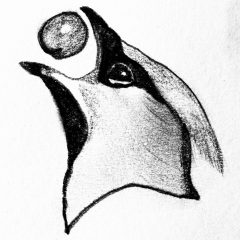
The Bohemian Waxwing Bombycilla garrulus is a beautiful bird. They breed in the northern conifer zones of the ‘Western Palearctic’ where they are insectivorous. In winter they migrate from the arctic cold and change their diet to berries, mainly rowan and hawthorn. In November they arrive in central and western Europe to overwinter. A shortage of berries can result in huge irruptions of birds further south and west although the precise balance between population and food source is not fully understood. In these irruptive years they arrive in eastern Britain in large numbers and disperse westward as they consume the available berries. Much of the fruit has fermented and, despite having a famously large and efficient liver, the birds can become intoxicated. They have little red waxy beads at the tips of their secondary flight feathers which gives rise to their English name – but why ‘Bohemian’?

The Birds of the Western Paleartic Volume V

Bohemia is the Westernmost part of the Czech lands, now the Czech Republic. It was part of communist Czechoslovakia and its capital city is Prague. The French word bohémiens was used to refer to the French Roma people in the mistaken belief that they had come from Bohemia. In fact the Roma originate in northern India. The French also used the term gitans for them, a word more familiar from the blue-packaged Gitanes cigarettes, which feature the silhouette of a gipsy dancer.

In time bohémien evolved to mean a lifestyle of artistic and moral freedom. Bohemians adopted a kind of voluntary poverty in pursuit of creative fulfilment. They had a flexible approach to marriage, law and hygiene. If you were an aristocratic type you might simulate this lifestyle by joining the better-off haute bohème. The romantic image of impecunious creativity and uncontrollable gipsy passion features in several operas. Carmen is referred to as a bohémienne. Puccini’s opera La bohème is about impoverished Parisian poets and artists, starving in their frozen garrets. One of them falls for a doomed consumptive seamstress. It would seem the waxwing is neither a gypsy nor a starving poet.

The German term Böhme doesn’t necessarily mean ‘from Bohemia’ either. They use it as ‘French’ is used in English to indicate exotic foreign species – as in the French Partridge (the Red-legged Partridge) or French Yellowhammer (the Cirl Bunting). It implies a migrant, in the case of the waxwing, a winter one. The waxwing is therefore a Bohemian because it wandered to Germany from foreign parts. In Germany in the past these birds were eaten.

Zwei tote böhmische Seidenschwänze by Lucas Cranach The Elder 1530

It has taken a long time settle both the common and scientific names of the bird. Conrad Gessner in 1555 named the bird Garrulus bohemicus which is literally ‘Bohemian Jay’, although they are not jays. John Ray in 1678 adopted this term but mistranslated it as the Bohemian Chatterer. In fact the waxwing is a rather silent bird. Thomas Pennant changed the name again to the Waxen Chatterer because of the peculiar flight feathers, but in time waxwings were removed from the chattering classes altogether and put into a genus of their own called Bombycilla. The waxwing’s plumage is soft and silky. The common name for waxwings in Germany is Seidenschwanz which literally means ‘silk-tail’. Translating this into the clumsy Latin used by scientists we get Bombycilla; but the bird has never been able to shake off the chattering thing altogether. The species name retains garrulus.

In my childhood copy of the Observer’s Book of Birds the waxwing and the Golden Oriole face each other on opposite pages. Two fabulous exotics firmly in the never-to-be-encountered category; but in November 1988, about 3 years after my interest in birds was rekindled by a colleague, there was an irruption of waxwings in the UK after a long gap of about 15 years. No smartphones with birding apps were available so we used a telephone service called Birdline Scotland to get our information about rarities. You called in and received a message along the lines of:

“Welcome to Birdline Scotland. Thursday: Late evening update. In Lothian, 25 waxwings at Longniddry Railway Walk; still present this afternoon. Park near the station and walk east. The birds are feeding on hawthorn hedges.”

Inevitably the chance to add such a prize to your life list made you a bit twitchy until you had the opportunity to go for them. If the birds were still there it wasn’t difficult to find them because inevitably there would be a group of birders gazing at them. If they were still there.

Waxwings are gregarious and have a superficial similarity to starlings in flight. Their flight is fast and direct with long pointed wings. They are not particularly shy, presumably because they spend most of their time in vast uninhabited pine forests. The red waxy tips are not easy to see but the paler colour and the unique crest is obvious compared to Sturnus vulgaris. The wing markings that are visible are the white and yellow edgings to the primaries and the bird has a square, yellow-tipped tail with a ‘chestnut vent’. They are strictly arboreal and often turn up in supermarket car parks and public parks where berry-bearing trees and bushes have been planted. In winter it is always worth checking any flocks of good-sized birds in trees because they may not be starlings.

After I added waxwing to my life list at Longniddry there were further substantial arrivals in later years. A cotoneaster hedge in a friend’s front garden once drew a flock and we were able to watch them moving back and forth from the hedge to nearby trees and drinking water from the roof gutters. Their diet of berries makes them messy visitors. I have them on my ‘garden list’ as well.

The most unexpected sighting I’ve had was while doing a ‘portable’ ultrasound scan in one of the oncology wards at the Western General Hospital. I was accompanied by a junior trainee. As we approached the ward along an upper corridor I noticed a flock of birds in the large sycamore that stood outside. This old tree had somehow survived the various building programmes since the Western began life as Craigleith Hospital and Poorhouse in 1868. It dawned on me that these birds were a pale colour and had crests. They were close enough to convince my junior that we were indeed witnessing some unusual ornithology.

So why call this blog The Bohemian Waxwing? Apart from the fact that I like waxwings and that the concept of Bohemianism appeals to me, the scientific name can be abbreviated to B. garrulus – something that, unlike the waxwing, I am prone to do.

Equinox and Solstice

We used to frequent a restaurant in Kingussie. It was in the High Street and in the olden days you could park in front of the council offices across the road. We often went there in autumn and emerging from the car, having just pulled off the A9, the cold Highland air and smell of birch wood smoke sharpened the appetite.

All the seasons have a distinct smell. At the moment we have the damp fungal odours of fallen leaves decaying to mush while the last scents of summer have blown away. I find myself looking forward to the first frosts clearing the air completely, leaving it smelling of nothing but the occasional garden bonfire and, here in Edinburgh, the breweries. That yeasty smell still reminds me of returning for autumn term and meeting old friends in warm pubs.

These olfactory signs of the earth’s journey around the sun are inseparable from the pineal ones of changing day length. After all, it is the change in day length and declination of the sun that underlies everything else. A graph plotting day length throughout the year has the form of a sine wave with a peak in summer and a trough in winter. The implication of this type of curve is its effect on our perception of the rate of change. There is little change at the peaks and troughs but rapid change during the upwards and downwards slopes. The word solstice means ‘the sun stops’ and from late May to the end of July, around the peak of the sine wave, there is little perceptible change in the times of sunrise and sunset. The day lengthens slightly for a month then shortens slightly for a month, but it is always daylight when we wake up and always light at bedtime. It is this effect that makes it seem like the sun has paused at its zenith for a couple of months.

In the tropics, between Cancer and Capricorn, where day and night are roughly equal all year round, the sun sinks suddenly and vertically below the horizon and night rapidly follows day with little twilight. Living in the ‘far north’ as we do, the situation is more complicated than the simple time that elapses between sunrise and sunset. In Edinburgh, a graph of light levels rather than simply the time between sunrise and sunset shows that around midnight in summer, when the sun dips briefly below the horizon, there is still enough light bending round the earth to create a continuous ‘gloaming’ between sunset and sunrise. At the summer solstice the peak of the daylight graph goes off the chart as it is never truly dark. In Shetland it is even more pronounced and is called the ‘simmer dim’. In St Petersburg they have the ‘White Nights’.

At the other end of the year, in the depth of winter, from late November to late January the days are cruelly brief and the nights are truly dark because the sun spends most of its celestial journey sunk far below our horizon. It rises late, appearing briefly in the southern sky and shines at us almost horizontally at midday. This makes window blinds paradoxically more useful in winter than summer in northern latitudes. The shallow angle of the sun’s rays also makes the effect of clouds more pronounced in winter. If cloud cover is complete, the sun’s rays have to pass through much more of the stuff to reach the ground than in summer. Cloudy winter days are extra dark and we find ourselves putting the lights on at noon.

In winter, when still working in a windowless radiology department, I left home before 8am and returned after 6pm. This meant that for a couple of months it seemed to me to be dark all the time. Early February was a landmark, because that was the first time I found myself leaving the department in daylight since the previous November. Now that I have retired I notice the slight improvement as January wears on. We are more aware of sunrise and sunset in winter because we are awake to witness it.

The steepest slopes of the day length graph are seen between the solstices, in spring and autumn. Unlike at the solstices, these times are associated with pronounced changes in day length. These periods of rapid change encompass the equinoxes when day and night are equal in duration over the entire planet and the sun sits directly over the equator. The further north you are, the faster the change in day length. In Scotland the day lengthens or shortens by nearly 5 minutes a day around the equinoxes. Some parts of Greenland experience a 15 minute change in day length at those times. Unlike winter and summer, every day seems to bring a change in the light.

By chance our street runs almost exactly east to west. The back of our house faces south and the front, north. At the equinox the sun shines directly along the street at sunrise and sunset. As summer comes in, the points of sunrise and sunset migrate north, narrowing the angle between the two until their maxima at the solstice. The summer sun floods through the the windows on the north side of the house early in the morning and once again in the late evening. The reverse happens in autumn as the points of sunrise and sunset migrate south and the nights ‘draw in’ leaving the north side of the house sunless for six months.

A right parhelion or sundog due south of the house on the morning of 3rd January 2009. The real sun is over to the left and not in shot. There was another sun dog to the left of the sun but too widely spaced to capture in one frame. Sun dogs are caused by refraction of the sun’s rays by ice crystals in the upper atmosphere.

These changes in daylight are astronomical and precise but the organic sensations down here on earth are out of sync with our star. My grandfather used to say, “As the day lengthens, the cold strengthens.” The seas around Britain take time to warm up and time to cool down. The ground has less thermal inertia than the water but it also takes time to adjust to the energy coming from above. This means that spring is colder than the equivalent time in autumn and the chill can extend well into June. After the summer solstice things finally start to warm up. Similarly, mild days in autumn can extend well into November as they have done this year. We are only about 6 weeks away from the winter solstice now but maximum temperatures are still in double figures. However it is also wet and windy, what Robert Louis Stevenson called ‘this dog’s weather’, from which there was no relief until after Christmas when proper cold set in. In RLS’s day this meant Duddingston Loch freezing over sufficiently thickly to allow skating. He described watching the skaters from the hill as they lit their torches at dusk. It must have been beautiful – but the loch rarely freezes now:

https://en.wikipedia.org/wiki/Edinburgh:_Picturesque_Notes

Duddingston Loch frozen over in January 2010.

In Scotland we pay for our lovely long summer days with with the seemingly endless darkness of December and January. If only we could bank the excess daylight of summer, wasted on us while we sleep, and use it instead to dissipate the winter gloom.

Hallowe’en and Bonfires

My Presbyterian family – father was an Elder of the Kirk and mother had strong beliefs – had a deep suspicion of anything that smacked of Catholicism or idolatry. Celebrations of Easter and Hallowe’en came under those categories. The other Christian feasts and fasts were a total mystery. We didn’t fast or feast – although we did stretch a point at Christmas despite it seeming to be a mass. As a family we leaned towards the old Scottish approach to Christmas in regarding it as just a normal working day. There wasn’t much choice on a farm anyway. My mother was acutely uncomfortable telling us about Santa Claus. She thought that if she lied about Father Christmas we wouldn’t believe her when she told us about Jesus. As soon as we questioned whether an old man actually came down the chimney with presents for us she told us he didn’t exist. We were able to debunk Christmas for our peers after that. New Year, free of any problems of faith, could be celebrated with impunity. We had a drink at midnight in front of the TV then straight to bed. New Year was always the bigger celebration in Scotland anyway.

Easter in its Christian manifestations featured too many crucifixes, thorns and blood for Presbyterian tastes. We observed it purely as a festival of chocolate confectionary with its own obscure pre-christian themes of rabbits and eggs. Hallowe’en and Bonfire Night were of more uncertain origin. What was Hallowe’en anyway? I don’t think I was aware then that it was a compression of ‘All Hallows Evening’ far less what ‘All Hallows’ was. From recent reading it seems that the following day, November 1, is All Saints or All Hallows Day. Whatever that means.

As children we were keen to take part in what looked like fun events but I suspect my lifelong aversion to group ‘fun’ originates in awful Hallowe’en and Christmas children’s parties. My mother was not going to tolerate the mess of genuine ducking for apples but we were allowed to kneel on a chair, leaning genteelly over the back and drop forks from our mouths in an attempt to spear apples floating in a bucket on the floor. We also had ‘false face’ masks for added ‘fun’. Occasionally we would attempt to go ‘guising’ but living as we did on a farm a mile from the nearest town there was little scope for visiting neighbours or having them visit us. We would sometimes get dressed up and visit our friends who lived in the nearest farm half a mile away. There we could perform our party pieces and receive nuts or small chocolates in return. I can vividly remember the acrid taste of the moustaches my mother drew on our upper lips using the ersatz Camp Coffee. For the uninitiated, Camp Coffee is a sticky syrup made from chicory essence and flavoured with a tiny amount of coffee. It was made in Glasgow and featured on the label a Highland officer being served coffee by an Indian servant. The officer was seated outside a tent.

Of much more significance at Hallowe’en was the business of creating a turnip lantern. The farm turnip crop was harvested into a huge muddy pile outside the main byre ready to feed the cattle spending the winter there. We clambered over this mound to select a good one. I vividly recall my chagrin on carving my first pumpkin lantern for our kids to discover that pumpkin flesh was soft and easy to core out. Not so the small unyielding Scottish turnip. A huge effort was required even to cut the ‘lid’ off and flatten the base. With aching fingers the wooden flesh was scraped out using an old spoon and a depression created in the bottom to hold the base of the candle. The most important thing was to make sure that the hole in the lid was directly above the candle flame – otherwise the flame would burn the turnip lid creating a really unpleasant smell. The leering face carved into the front was better left imperforate otherwise the October breeze would blow your candle out. A string handle was attached to the body and threaded through the lid for security. It had to be long enough so the candle flame didn’t burn your fingers. The point of the lanterns was lost on us – not that we ever considered that. It was a ritual that required observance. Maybe that was what Presbyterianism lacked. Ritual. After a few days the wrinkled dehydrated turnip with its sooty, half-cooked lid was a sorry smelly sight.

Hallowe’en did seem vaguely Christian with its emphasis on saints, despite the whiff of devils and witches which still hung about it. Bonfire Night by contrast seemed to be purely political. What I didn’t appreciate as a kid was that ‘gunpowder treason and plot’ was also linked to religion – as all politics was then, and often still is.

On the death of Elizabeth I without issue in 1603, James VI of Scotland became James I of the United Kingdom. At the state opening of parliament on November 5th 1605 a group of disaffected provincial Catholics, who had hoped for greater religious tolerance under the new protestant king, placed 35 barrels of gunpowder in the undercroft of the House of Lords. It would have been enough to reduce it to rubble, killing the king, members of his family, the Lords, the most senior judges and the bishops of the Church of England. The plotters intended to kidnap the King’s daughter Elizabeth who was not present at the ceremony and place her on a new, Catholic, throne. A letter gave the plotters away. Guy Fawkes was discovered in the undercroft guarding the explosives and was arrested. The other plotters fled but were captured and subsequently hanged, drawn and quartered. In an act passed in 1606 and only repealed in 1857 it was compulsory to commemorate the failed regicide (remember, remember). The tradition of lighting bonfires, burning Fawkes in effigy and letting off fireworks started soon after.

How disappointing those fireworks were in reality compared to the dazzling packaging by Aurora, Rainbow or the more prosaic ‘Standard’. The biggest rocket usually sported a red plastic cap to differentiate it from the smaller blunt-ended variety but invariably it turned out to be little different from the others. The display of begonias and echeveria having been lifted from the beds outside the hall windows we half-buried a milk bottle in the bare earth and launched the rockets from there. It seems unusual now but I remember the ground often being frosty – however we were living at 600 feet above sea level.

It is known that early christians converted pre-existing roman or pagan celebrations to their own purposes and there’s a great deal of wisdom in making sure the new religion did not deny the faithful the chance for a time-honoured party. Vestiges of the old ways persisted in the British Isles well into the twentieth century. Young men would blacken their faces and adopt disguises then go round their neighbours demanding food and playing tricks. It was bad luck to deny the guisers their ransom.

Our bonfires celebrate the death of a traitor 400 years ago, but it seems bonfires at this time of year are not new – or even Christian. November 1, Samhain, was seen as the beginning of winter in the Celtic religions and even further back there is evidence that some neolithic monuments are aligned with sunrise on November 1. It is a liminal festival reflecting a time of transition and supernatural events. In practical terms it marked when the cattle were brought down from high pastures for the winter. There would be insufficient food to maintain livestock for the whole winter and animals would be selected for slaughter and consumption.

It was also thought by the ancient ones that the spirits of the dead might roam free on Hallowe’en and visit the homes they once inhabited. The evergreens, like the holly, the ivy and the weird parasitic mistletoe, had significance for pagans and there is a theory that the burning of dead deciduous leaves released the spirits from their summer home so they could return, via the medium of smoke, to the holly and the ivy for the winter. It’s interesting that we still hang mistletoe at parties and sing Christmas carols that contain references to these old beliefs…