My Presbyterian family – father was an Elder of the Kirk and mother had strong beliefs – had a deep suspicion of anything that smacked of Catholicism or idolatry. Celebrations of Easter and Hallowe’en came under those categories. The other Christian feasts and fasts were a total mystery. We didn’t fast or feast – although we did stretch a point at Christmas despite it seeming to be a mass. As a family we leaned towards the old Scottish approach to Christmas in regarding it as just a normal working day. There wasn’t much choice on a farm anyway. My mother was acutely uncomfortable telling us about Santa Claus. She thought that if she lied about Father Christmas we wouldn’t believe her when she told us about Jesus. As soon as we questioned whether an old man actually came down the chimney with presents for us she told us he didn’t exist. We were able to debunk Christmas for our peers after that. New Year, free of any problems of faith, could be celebrated with impunity. We had a drink at midnight in front of the TV then straight to bed. New Year was always the bigger celebration in Scotland anyway.
Easter in its Christian manifestations featured too many crucifixes, thorns and blood for Presbyterian tastes. We observed it purely as a festival of chocolate confectionary with its own obscure pre-christian themes of rabbits and eggs. Hallowe’en and Bonfire Night were of more uncertain origin. What was Hallowe’en anyway? I don’t think I was aware then that it was a compression of ‘All Hallows Evening’ far less what ‘All Hallows’ was. From recent reading it seems that the following day, November 1, is All Saints or All Hallows Day. Whatever that means.
As children we were keen to take part in what looked like fun events but I suspect my lifelong aversion to group ‘fun’ originates in awful Hallowe’en and Christmas children’s parties. My mother was not going to tolerate the mess of genuine ducking for apples but we were allowed to kneel on a chair, leaning genteelly over the back and drop forks from our mouths in an attempt to spear apples floating in a bucket on the floor. We also had ‘false face’ masks for added ‘fun’. Occasionally we would attempt to go ‘guising’ but living as we did on a farm a mile from the nearest town there was little scope for visiting neighbours or having them visit us. We would sometimes get dressed up and visit our friends who lived in the nearest farm half a mile away. There we could perform our party pieces and receive nuts or small chocolates in return. I can vividly remember the acrid taste of the moustaches my mother drew on our upper lips using the ersatz Camp Coffee. For the uninitiated, Camp Coffee is a sticky syrup made from chicory essence and flavoured with a tiny amount of coffee. It was made in Glasgow and featured on the label a Highland officer being served coffee by an Indian servant. The officer was seated outside a tent.

Of much more significance at Hallowe’en was the business of creating a turnip lantern. The farm turnip crop was harvested into a huge muddy pile outside the main byre ready to feed the cattle spending the winter there. We clambered over this mound to select a good one. I vividly recall my chagrin on carving my first pumpkin lantern for our kids to discover that pumpkin flesh was soft and easy to core out. Not so the small unyielding Scottish turnip. A huge effort was required even to cut the ‘lid’ off and flatten the base. With aching fingers the wooden flesh was scraped out using an old spoon and a depression created in the bottom to hold the base of the candle. The most important thing was to make sure that the hole in the lid was directly above the candle flame – otherwise the flame would burn the turnip lid creating a really unpleasant smell. The leering face carved into the front was better left imperforate otherwise the October breeze would blow your candle out. A string handle was attached to the body and threaded through the lid for security. It had to be long enough so the candle flame didn’t burn your fingers. The point of the lanterns was lost on us – not that we ever considered that. It was a ritual that required observance. Maybe that was what Presbyterianism lacked. Ritual. After a few days the wrinkled dehydrated turnip with its sooty, half-cooked lid was a sorry smelly sight.
Hallowe’en did seem vaguely Christian with its emphasis on saints, despite the whiff of devils and witches which still hung about it. Bonfire Night by contrast seemed to be purely political. What I didn’t appreciate as a kid was that ‘gunpowder treason and plot’ was also linked to religion – as all politics was then, and often still is.
On the death of Elizabeth I without issue in 1603, James VI of Scotland became James I of the United Kingdom. At the state opening of parliament on November 5th 1605 a group of disaffected provincial Catholics, who had hoped for greater religious tolerance under the new protestant king, placed 35 barrels of gunpowder in the undercroft of the House of Lords. It would have been enough to reduce it to rubble, killing the king, members of his family, the Lords, the most senior judges and the bishops of the Church of England. The plotters intended to kidnap the King’s daughter Elizabeth who was not present at the ceremony and place her on a new, Catholic, throne. A letter gave the plotters away. Guy Fawkes was discovered in the undercroft guarding the explosives and was arrested. The other plotters fled but were captured and subsequently hanged, drawn and quartered. In an act passed in 1606 and only repealed in 1857 it was compulsory to commemorate the failed regicide (remember, remember). The tradition of lighting bonfires, burning Fawkes in effigy and letting off fireworks started soon after.
How disappointing those fireworks were in reality compared to the dazzling packaging by Aurora, Rainbow or the more prosaic ‘Standard’. The biggest rocket usually sported a red plastic cap to differentiate it from the smaller blunt-ended variety but invariably it turned out to be little different from the others. The display of begonias and echeveria having been lifted from the beds outside the hall windows we half-buried a milk bottle in the bare earth and launched the rockets from there. It seems unusual now but I remember the ground often being frosty – however we were living at 600 feet above sea level.
It is known that early christians converted pre-existing roman or pagan celebrations to their own purposes and there’s a great deal of wisdom in making sure the new religion did not deny the faithful the chance for a time-honoured party. Vestiges of the old ways persisted in the British Isles well into the twentieth century. Young men would blacken their faces and adopt disguises then go round their neighbours demanding food and playing tricks. It was bad luck to deny the guisers their ransom.
Our bonfires celebrate the death of a traitor 400 years ago, but it seems bonfires at this time of year are not new – or even Christian. November 1, Samhain, was seen as the beginning of winter in the Celtic religions and even further back there is evidence that some neolithic monuments are aligned with sunrise on November 1. It is a liminal festival reflecting a time of transition and supernatural events. In practical terms it marked when the cattle were brought down from high pastures for the winter. There would be insufficient food to maintain livestock for the whole winter and animals would be selected for slaughter and consumption.
It was also thought by the ancient ones that the spirits of the dead might roam free on Hallowe’en and visit the homes they once inhabited. The evergreens, like the holly, the ivy and the weird parasitic mistletoe, had significance for pagans and there is a theory that the burning of dead deciduous leaves released the spirits from their summer home so they could return, via the medium of smoke, to the holly and the ivy for the winter. It’s interesting that we still hang mistletoe at parties and sing Christmas carols that contain references to these old beliefs…

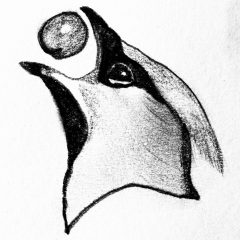
 The Bohemian Waxwing