We moved to our present terraced townhouse in autumn 1992. The front of the building was smothered by a huge clematis montana that extended onto our second floor balcony and also onto our neighbours’ balcony to the east. Squirrels lived in it and made dreys there.
In June of the following year it erupted into bloom. It flowers later than the commoner montana sp. It was immediately apparent that the flowers had a very unusual scent – of chocolate. In fact it was almost overwhelming when approaching the front door. This became a much anticipated annual event quite apart from the floral spectacle itself.
Over a decade later, in late June, we were about to drive to Fife to catch the car ferry from Rosyth to Zeebrugge. A classic (for Edinburgh) torrential summer downpour started. I had a quick final look around the house before leaving and was appalled to find water coming through the drawing room ceiling above the bay window. The neglected clematis had finally blocked the gutter running around the balcony. There was nothing to be done but to put a bucket under the leak and hope there was a dry spell for the next two weeks.
Cutting it back and clearing the gutters that autumn was a big job and I ignored the sage advice when dealing with a very mature plant – which is to take half away one season and leave the rest to the next. To avoid the extra work I simply cut it all back to first floor level and carted away an enormous amount of pruned branches and leaves. I refer to this sort of activity as ‘hackenbush’ in homage to Groucho and the waste as ‘prunage’ on the basis I like putting ‘age’ after verbs to make a noun.
The following spring I waited nervously for signs of life. I was relieved when shoots appeared from the stumps and grew rapidly for a few weeks. Unfortunately, and quite suddenly, they wilted heralding the demise of what was once a magnificent specimen. There was nothing to do but remove the rest of it and learn the lesson. June was never the same after that.
At the time I had no idea what variety the montana might be. I’d never heard of a chocolate-scented clematis. Thanks to the internet I eventually identified it as the variant wilsonii using the brilliant expedient of googling ‘chocolate scented clematis’. Duh..
I found a supplier in the West and ordered two plants as insurance. I trained them over a metal arch on the east wall of the back garden and used it to frame a bench.
C. montana wisonii on the arch, scented deciduous azalea to the right and rosa ‘Fantin Latour’ to the left. All have a very nice smell. ‘Starry’ flowers
Although the new plants’ flowers do smell faintly of chocolate they do not seem to have the power of the original – which is very disappointing as it is otherwise just a late flowering C. montana. In a fit of horticultural enthusiasm I have twice taken multiple inter-nodal cuttings in successive years, all but one of which have died of fungal affliction – and the sole survivor is not looking too great this year. Reading around the subject I have perhaps left taking the cuttings too late. I feel defeated by it now and regret promising friends a rare scented clematis, an offer I find I cannot fulfil. I would have settled for even one survivor to plant in the front garden and mitigate my crime. Perhaps in time it would have grown to be a nuisance to someone else.
As I write, in keeping with the aphorism, March is showing leonine tendencies having been peacefully ovine at the outset. My birthday is located at the beginning of the month on March 4th, which is “the most commanding day of the year,” according to our old dairyman. A pun that was never quite funny enough.
Spring is the time for meteorological aphorisms and coming from a farming background these sayings had some practical significance. Now that I have substituted gardening for farming there is still some utility in knowing what to expect. My grandfather would say, “February fills the dyke, be it black or be it white,” alluding to the tendency for huge amounts of precipitation of either type in that month. There is a codicil to that saying of which I was unaware as a child; “But if it be white, It’s the better to like.”
This year we had both. Dreadful Somme-like mud and flooding followed by hard frost and heavy snow – which was certainly preferable. When walking an energetic Vizsla conditions underfoot are crucially important and it made me think of another longed-for sign – March dust. The lengthening day, the waxing of the Sun’s power as its angle to the Earth steepens added to a bit of wind-induced evaporation produces that welcome indication that the land can be worked again. The blackened sods pale and the mud on tarmac and paths slackens its grip. Dust blows about in the dazzling light. At least that is the theory. Climate change may modify these old adages.
Miniature daffodils, possibly a variety of Narcissus asturiensis
Not having to ‘work the land’ these days, such considerations are less relevant to an urban existence. Perhaps they are less important to farmers too as so many cereals are now sown in the autumn to germinate before winter and so get off to a flying start in spring. To a gardener the progress of the early year is marked instead by flowers.
It’s important to have something to cheer you in the depth of winter, but to me there’s something slightly depressing about winter jasmine and its screaming yellow successor, forsythia. I much prefer witch hazel with its little streamer-like petals and fantastic orangey smell – and it looks so nice with a bit of snow on top.
Witch hazel in snow
Another mood-enhancer in the shortest days is winter (or sweet) box, Sarcococca confusa. Oddly, its scientific name means ‘flesh berry.’ The sweetness refers to the exotic scent of the inconspicuous flowers which are borne in mid-winter. I planted it at the front door to greet winter visitors and in the back garden as evergreen punctuation. Its habit is looser than Buxus but vigorous even in quite deep shade. Sarcococca originates in South East Asia and our Chinese neighbour says the scent makes her nostalgic.
The spring sequence of herbaceous plants that exploit the light passing through bare deciduous trees begins with winter aconites and snowdrops. Our snowdrops are spreading rapidly through the lawn but I haven’t the heart to mow them down before they die back naturally. This makes for great untidiness in late spring and early summer.
Iris reticulata emerging
Iris reticulata is found from the Caucasus to northern Iran and is presumably an alpine species. The flowers are evanescent and the leaves very fragile. Like the muscari grape hyacinths it is a welcome relief from all that yellow. Apart from the omnipresent snowdrops, I have more hellebores than any other winter flowering perennial. Most of these are the early-flowering ‘Christmas Rose’ types whose drooping heads have to be tilted up to see their full splendour. The later-flowering Lenten Roses don’t seem to do so well with me. I like to cut off last year’s leaves to get the full benefit of the flowers.
‘Home of the Happy Helebore’
Daffodils are underrated in my opinion, probably because they are ubiquitous. I like the green ‘non-scent scent’ of the big ones. Many dwarfs and poetica species are properly scented. One miniature daffodil has been following our family around for a very long time. Originating in my grandfather’s farm – which is now lost under the satanic mills of Grangemouth oil refinery – they were introduced to several of our family’s gardens. They are very short, with swept-forward tepals and coronae. The leaves are greyish green. I think they are a variety of Narcissus asturiensis but this is an amateur ID. They did not appreciate the woodland nature of our garden and I am now on a salvage mission, growing them on in pots with fresh compost every year in the hope that they will grow forth and multiply.
Returning to shrubs, the witch hazel is now past – although we have excellent autumn colour to look forward to. The hybrid Camelia x williamsii is just getting into its stride. Old photographs show it as a shin-height shrub when we moved in 28 years ago. It is now towering over us. I suspect it is the variety ‘Anticipation’ and it was always a favourite of our daughter. The huge peony-like flowers drop off without wilting in a strange unnatural way, carpeting the ground in puffy pink blooms. I once floated a few of the shed flowers in a bowl as a table decoration for a dinner party. It intrigues me that another member of the family, Camelia sinensis, is the source of tea. The shrub flowers and is hardy even in Scotland. Scottish-grown tea is available.
Magnolia x soulangeana
The gaudy star of the show, waiting in the wings, is our magnolia. Magnolias are ancient plants from the dinosaur era and they evolved before bees. The theory is that they were pollinated by beetles. They have a strong association with France. Magnolias as a group were named in honour of the French botanist Pierre Magnol (1638 – 1715). Our variety is a Magnolia x soulangeana. This is not quite so ancient having been bred by Étienne Soulange-Bodin, a doctor and cavalry officer in Napoleon’s army. He was superintendent of the Empress Josephine’s gardens at Malmaison.
I desperately wanted a magnolia of my own having suffered from magnolia-envy for many seasons. I bought the potted sapling at Hopetoun Garden Centre. The label said it had pale lemon, almost pure white, scented flowers. It did not prosper in its first location, so I moved it. Although it did flower and the blooms were spectacular I noticed that some branches had died. Despite this, vigorous shoots remained and I persevered. The tree gained in strength and began flowering profusely. Being red/green colourblind it took me a while to notice that the flowers had changed in character and now had a red flush at the base of the petals and no scent. It eventually dawned on me that the tree had been taken over by the rootstock it had been grafted onto.
One of the original huge Magnolia x soulangeana flowers
We are past the vernal equinox now and the clocks have been put forward for arcane reasons I can never understand. Something to do with the milking and Scottish schools… At least in this lockdown year there was no boozy dinner party to compound the effects of ‘losing an hour’ as my mother used to call it. April is imminent. So often a ‘cruel’ disappointing month relapsing into cold weather and damage to the tender shoots of recovery. April ‘showers’ are such a euphemism. Perhaps, like last year, we will be lucky and have one of those warm springs that comes on all summery and incongruous before the leaves are fully out.
When a colleague learned I kept a diary he asked, ‘What do you write in it? Cornflakes again today?’ ‘No’, I said, ‘It’s all about you actually!’ That wasn’t too far from the truth at the time – but why keep a journal at all unless you are Pepys, Boswell or Chips Channon? I kept one intermittently as a child, as do most people. Recently I transcribed my 11-year-old experiences from 1965. For their entertainment I sent it to a friend who had shared many of those events.
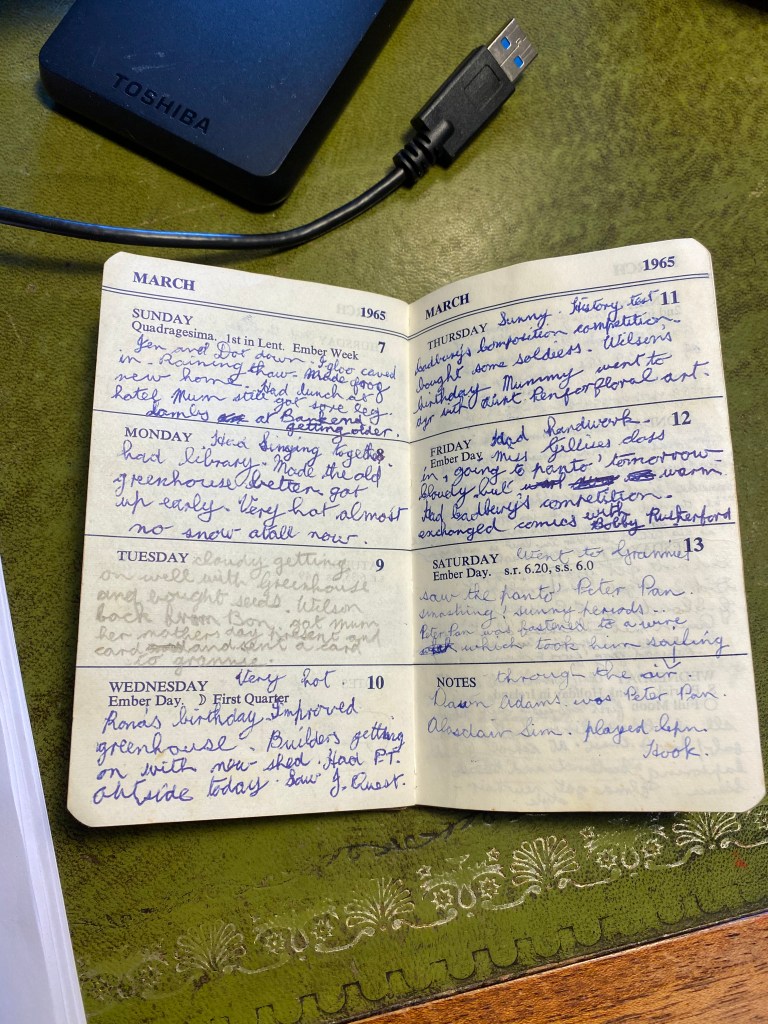
A Complimentary Diary, 1965Made frog new home. Wilson back from Bonn. ‘Smashing’ panto – Alastair Sim played Captain Hook
My diary-keeping stuttered on into the Seventies. I kept a record of a secondary school trip to Norway for the amusement of my fellow travellers. I also have a complete diary for 1973 and a chunk of 1974 straddling years one and two of medical school. The rest of university was a shameful chaos and mercifully went unrecorded.
I did try to keep journals of holidays on the basis that these would be more interesting than the quotidian routine, but they are mostly incomplete. As soon as matters became enjoyably complicated the logging of events tended to lapse. Frustratingly, my account of a 1977 student elective in New York stops after three weeks with six more action-packed weeks to go. In any case, the quotidian is not necessarily less interesting than foreign jaunts.
One’s distant, undocumented, memories get hauled out randomly at dinner parties, over drinks in the pub or just for the contemplation of that inner eye that is the bliss of solitude. They are then put away again, on each occasion having mutated slightly towards your preferred version of the past. Eventually they can become complete fabrications. I have heard junior colleagues quote me using words I know I would never have used. Their pleasure in this false recollection makes it difficult to contradict them.
Even further back, my brothers and I have incompatible recollections of many shared childhood events. Some of this is simply differences in what an individual chooses to retain, but often there is a conflicting version of the raw facts of the matter. History is written by the victors of course and I feel a diarist need only be true to himself. The experiences of others around you can only be inferred. Diaries are inevitably more valuable as insights into the author’s personality than as sources of hard historical truth – but at least a contemporary written account has the chance of reflecting the truth better than a disembodied anecdote regurgitated decades later.
My earliest attempts at making a record have proved quite disturbing to read. Apart from the inevitable cringe factor, scenes are depicted of which I have absolutely no recollection. Names appear, confidently written, of people I cannot now recall. Even worse, I have discretely used initials to represent some of them making identification even less likely. I had assumed that all my memories would revive if prompted by the written word – but they don’t. Some things are stubbornly locked in the past and no amount of CPR can resuscitate them.
In my early thirties life became more settled. At the time I was thinking about writing fiction and wanted to base that on experience. The problem is I never shook off my conviction that history and biography are more interesting than made-up stuff. I could see that writing fiction releases you from the yoke of facts, perhaps allowing a greater truth to be portrayed. I decided to make a record of life, work and people as fodder for some future creative process as yet unspecified. Very soon it became an obsessional end in itself. 34 years and millions of words later I’m still gathering information.
1986 to 2020
A scriptwriter friend of mine expressed scepticism that I could have sustained this effort for that length of time and demanded proof. I fetched 2008 from the shelf as that was the year we travelled to Australia to visit him. I opened it at the page describing our arrival in Sydney. ‘You won’t be able to read it anyway, my handwriting is appalling,’ I said handing it over. ‘On the contrary,’ he said, ‘I can read it perfectly well.’ He asked how many words I thought the diaries represented. As a proper writer who earns his living by words, logo-metrics are of interest to him. After a quick count to derive the average number of words-per-page we calculated the total stood at approximately 5 million. ‘That’s a hundred film scripts!’ he said.
Mindlessly, I have recorded everything without prejudice. Cornflakes, jokes, anecdotes, births, deaths, rites of passage, children’s first words, sickness, all the striking or mundane events of life and work. I take my diary everywhere with me. After all, one should always have something sensational to read on the train.
My diaries as they stand are more a set of lecture notes than deathless prose. I assumed the narrative could be filled out later to make it readable. Having done that a couple of times for smaller projects I discovered that this process more than doubles the volume of verbiage. Even with incomplete and unreliable recall the dried-out facts expand dramatically when hydrated by grammar and a few adjectives.
But no matter how recently the pen has crossed the paper there remains the question of veracity. Even recording current events more or less as they occur, the moment you write something down you impart a self-flattering spin to it. A diary is always subjective, never objective. One of my favourite diarists, Jeremy Clarke who writes ‘Low Life’ for the Spectator, says of his partner:
I would like to say much more about her only she forensically analyses every mention I might make of her in these columns and measures it against something she calls ‘truth’.
What then should be done with this unreliable archive and the thousands of hours of pointless effort it represents? My wife’s grandfather’s World War I experiences were consigned to the fire by his widow. Perhaps a bonfire of the vanity project is what is called for.
For contrasting journal-keeping techniques I would recommend:
Hugh Johnson on Gardening The best of Tradescant’s Diary
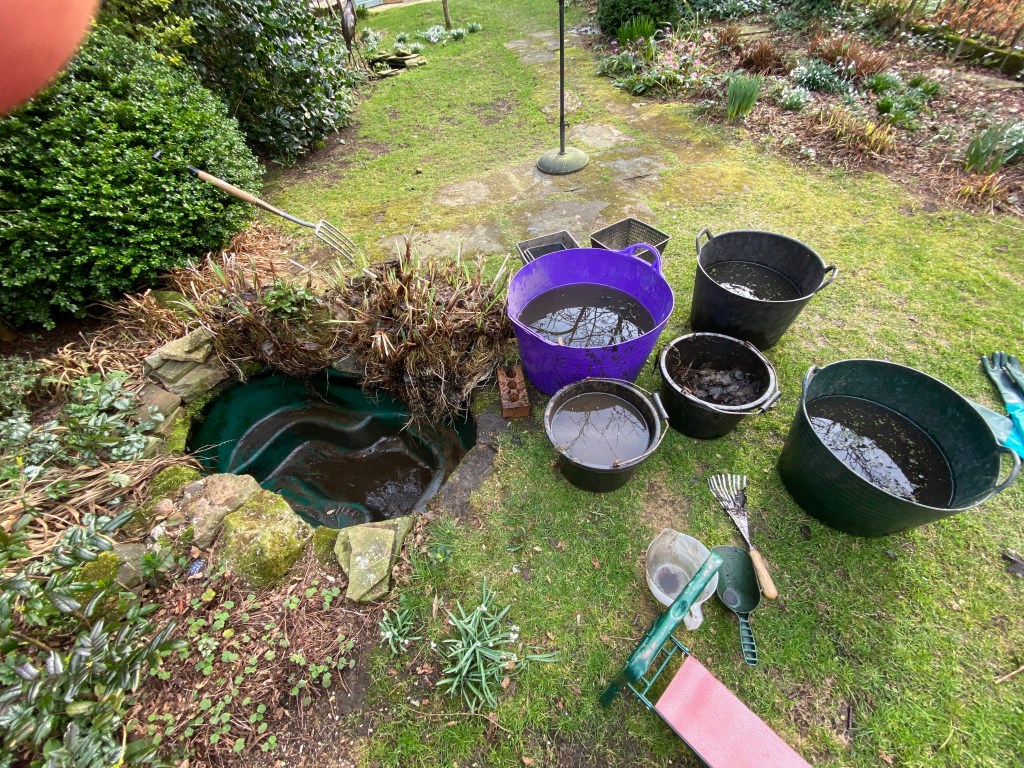
This week I have been cleaning out our two garden ponds. It’s the first time I have done this with the current pond iteration. The more established of the two had become completely choked with the matted roots of Iris sibirica and Caltha paulstris, the marsh marigold. When I hauled the root balls out, the water level dropped about 15cm. Spring is supposedly the best time for this unpleasant chore and I had noted at least one frog moving about near the surface indicating that spawning was imminent.
At the bottom, as I reached the deepest layer of slime, sludge and decaying leaves I discovered 7 hibernating frogs. Adult frogs overwinter in ponds in a state of torpor, absorbing enough oxygen through their skin for their meagre requirements. Smaller juveniles apparently prefer to hibernate al fresco under stones and logs. I removed all the solid waste, refilled with clean water and inoculated the mix with a couple of trugs of the old water I had reserved. I also returned the drowsy frogs to their watery beds. I found no evidence of my pond snails – just the rather repulsive freshwater crustaceans that feed on decaying detritus.
Pond #1
Our garden frogs were already in residence when we moved into our house in 1992. The sellers informed us the frogs had arrived as a couple of bucket-loads of spawn from another garden pond in nearby Dick Place. We inherited two square ponds about 100cm x 50cm in area which were situated under an old laburnum. I decided to keep the ponds – and the tree. I covered the ponds with a stout wooden frame enclosing heavy-duty square-mesh sheep fencing and pegged it to the ground. The children later used these unyielding structures as a handy platform from which to catch frogs. They never ate any laburnum seeds.
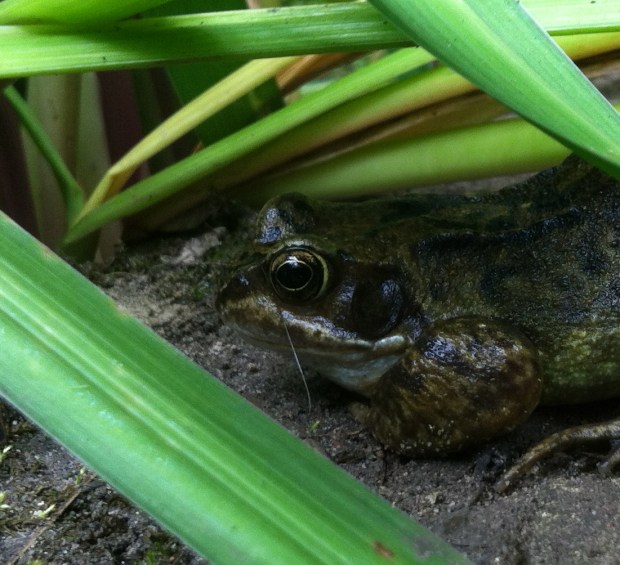
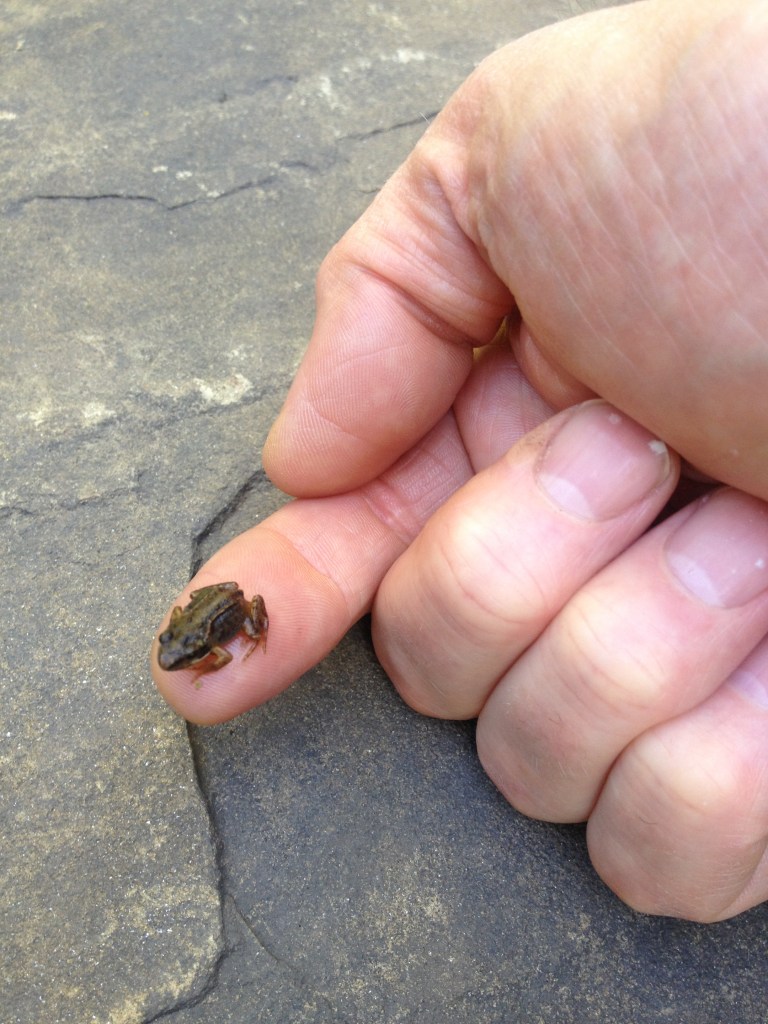
We had huge numbers of the amphibians in those days. They came in all sizes from tiny tail-less quadrupeds, recently emerged from the water, up to large greenish females. Mowing the lawn in late summer was nerve-racking as I tried to avoid chopping up tiny froglets. The bigger frogs were liable to give you a start by leaping out of the border while you were weeding – or splashing into the ponds for refuge.
Older offspring James was very keen on dinosaurs, as most boys are, and insisted on bedtime readings of his vast library of dinosaur data. We all learned a lot about dinosaurs. Included in that material was information about amphibians, and the etymology of the name. At nursery, his class was asked if they knew what amphibian meant. James piped up that it came from the Greek ‘amphi bios’ meaning ‘double life’.
Frogs are ‘good gardeners’ and keep down the army of invertebrates intent on munching your plants. However there is something unsettlingly human about them – they are homunculi with long legs and bandy arms. All they lack is a cranium. Instead, their heads are all eyes and mouth like some genetic experiment gone wrong. And then there’s that pulsing throat…
Mr Jeremy Fisher
After a while I gave up on those old ponds. I had a much bigger D-shaped pool constructed against a boundary wall, filled in the original ponds and grassed them over. The new pond was huge with a flat-topped wall surrounding it. My idea was that you would sit on the wall to observe the aquatic flora and fauna. Perhaps, if you were a princess, you might kiss a frog in thanks should it retrieve your crystal ball from the depths.
At the planning stage I had not considered that frogs might be disinclined to use a raised pond. They needed to climb up the ivy alongside the pond to get into the water which never worked well. Unlike toads they are not good climbers. Worse, I didn’t bother with an electricity supply, pump and filter so the seasonal accumulation of leaves eventually produced a nasty toxic, anoxic, brew. Everything except the plants died – including some sticklebacks I’d introduced. I created a further small ground-level pond to try to maintain a little frog-friendly habitat.
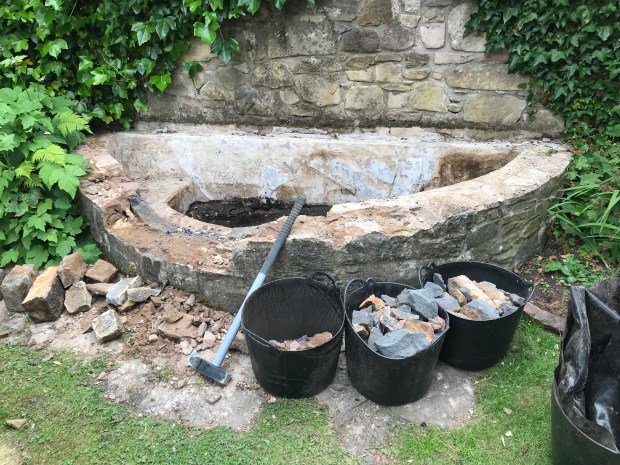
A couple of years ago I admitted defeat and abandoned the 20-year old raised pond. It was impossible to clean or maintain. Despite repointing, the external masonry had deteriorated. Below that layer of stone was a well-constructed breeze block and cement infrastructure, so strong that a huge effort was required over some days to demolish it using club and sledge hammers. Before the destruction, to maintain frog facilities, I reverted to two small ground-level ponds.
Pond Folly
Our next door neighbours used to have their own large pond which would seethe with mating, croaking, frogs at this time of year. It must have offered many frogs a winter refuge. However, when they became grandparents, they filled in their pond for fear of accidentally drowning their descendants. For several seasons after that in a pathetic demonstration of amphibian nostalgia, the frogs continued to lay spawn on the grass where the pond had been.
Numbers of frogs in our garden have dwindled drastically from their peak at the end of the last century but I was cheered to find those sleeping princelings in their slimy beds this week. More microcephalic heads have appeared in the other pond which I haven’t yet tackled.
In an echo of our own plight a nasty virus, Ranavirus, is killing frogs but I have a feeling habitat loss is the main problem in our own little domestic crisis. At the moment I am trying to rebuild our population of Rana temporaria. There was plenty of spawn last year although some of it proved infertile. I am concerned that I don’t see many juveniles about. For a few years, hoping to increase the survival rate in the tadpole derby, I gave them flaked aquarium fish food to eat. Some say raw mince works better. I have witnessed them feasting on a drowned blue tit fledgling.
Frogs take three years to mature and I hope the younger ones, which hibernate under logs, stones etc rather than at the bottom of ponds are still about somewhere and will reappear along with the invertebrates as the weather warms up. There is some debate over the lifespan of frogs but they seem surprisingly long-lived with a quoted range of 4-15 years. If that is the case our current residents may simply represent a relict population at the senile end of the bell curve. I hope not.
Herons have an enormous appetite for ‘puddocks’.* Their chest feathers disintegrate into a powder that defends them against the sliminess of eels and the like. If they have been fishing in your waters they leave a scum of this powder on the surface like talc. Our local herons must know all the ponds in Edinburgh and turn up in gardens to help themselves to the copulating hordes; an amplexus nexus.
One spring, when daughter Milly was quite small and our frogs were legion, my friend Willie and I were standing at the parlour window observing a heron polishing off its oblivious victims. Like me, Willie is a birder and we were content to watch the giant grey egret at work. Milly on the other hand was appalled. We explained to her gently that this was simply nature taking its course and carried on observing the proceedings, not paying much attention to her. Suddenly the back door flew open and a furious Milly charged out into the garden brandishing a broomstick over her head shouting, “Get away from our frogs!” The huge bird leapt into the air and flapped off before she could reach it. I now use a makeshift cage of plant trellis to protect our remaining assets during the mating season.




 The Bohemian Waxwing