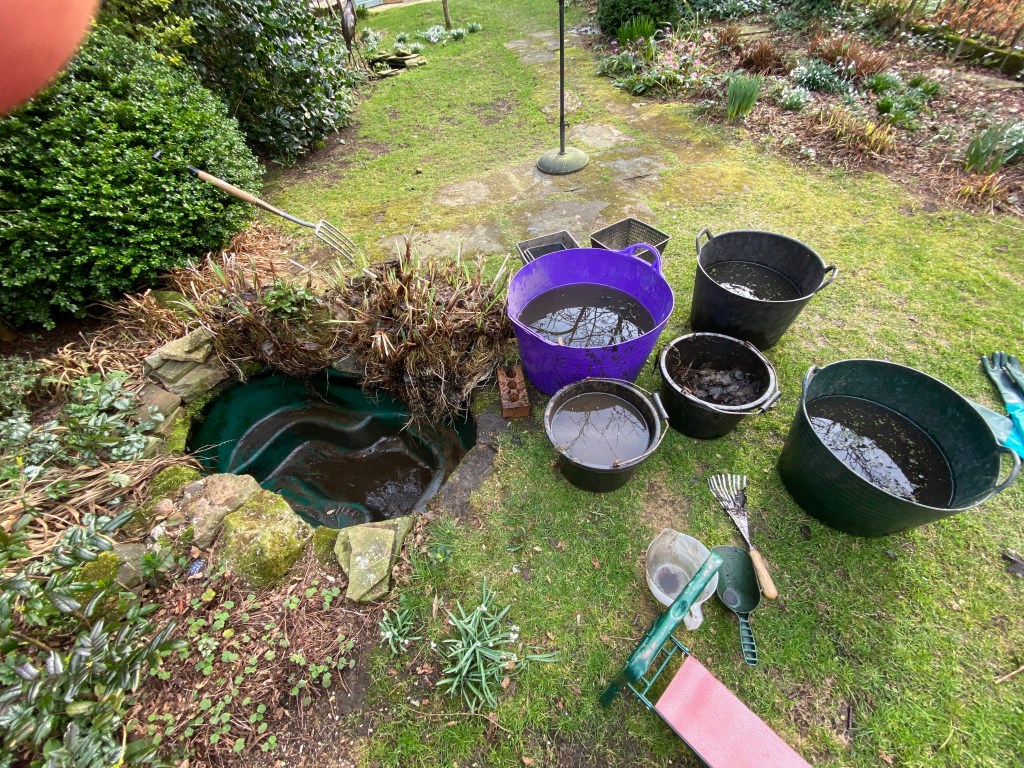
This week I have been cleaning out our two garden ponds. It’s the first time I have done this with the current pond iteration. The more established of the two had become completely choked with the matted roots of Iris sibirica and Caltha paulstris, the marsh marigold. When I hauled the root balls out, the water level dropped about 15cm. Spring is supposedly the best time for this unpleasant chore and I had noted at least one frog moving about near the surface indicating that spawning was imminent.
At the bottom, as I reached the deepest layer of slime, sludge and decaying leaves I discovered 7 hibernating frogs. Adult frogs overwinter in ponds in a state of torpor, absorbing enough oxygen through their skin for their meagre requirements. Smaller juveniles apparently prefer to hibernate al fresco under stones and logs. I removed all the solid waste, refilled with clean water and inoculated the mix with a couple of trugs of the old water I had reserved. I also returned the drowsy frogs to their watery beds. I found no evidence of my pond snails – just the rather repulsive freshwater crustaceans that feed on decaying detritus.
Our garden frogs were already in residence when we moved into our house in 1992. The sellers informed us the frogs had arrived as a couple of bucket-loads of spawn from another garden pond in nearby Dick Place. We inherited two square ponds about 100cm x 50cm in area which were situated under an old laburnum. I decided to keep the ponds – and the tree. I covered the ponds with a stout wooden frame enclosing heavy-duty square-mesh sheep fencing and pegged it to the ground. The children later used these unyielding structures as a handy platform from which to catch frogs. They never ate any laburnum seeds.
We had huge numbers of the amphibians in those days. They came in all sizes from tiny tail-less quadrupeds, recently emerged from the water, up to large greenish females. Mowing the lawn in late summer was nerve-racking as I tried to avoid chopping up tiny froglets. The bigger frogs were liable to give you a start by leaping out of the border while you were weeding – or splashing into the ponds for refuge.
Older offspring James was very keen on dinosaurs, as most boys are, and insisted on bedtime readings of his vast library of dinosaur data. We all learned a lot about dinosaurs. Included in that material was information about amphibians, and the etymology of the name. At nursery, his class was asked if they knew what amphibian meant. James piped up that it came from the Greek ‘amphi bios’ meaning ‘double life’.
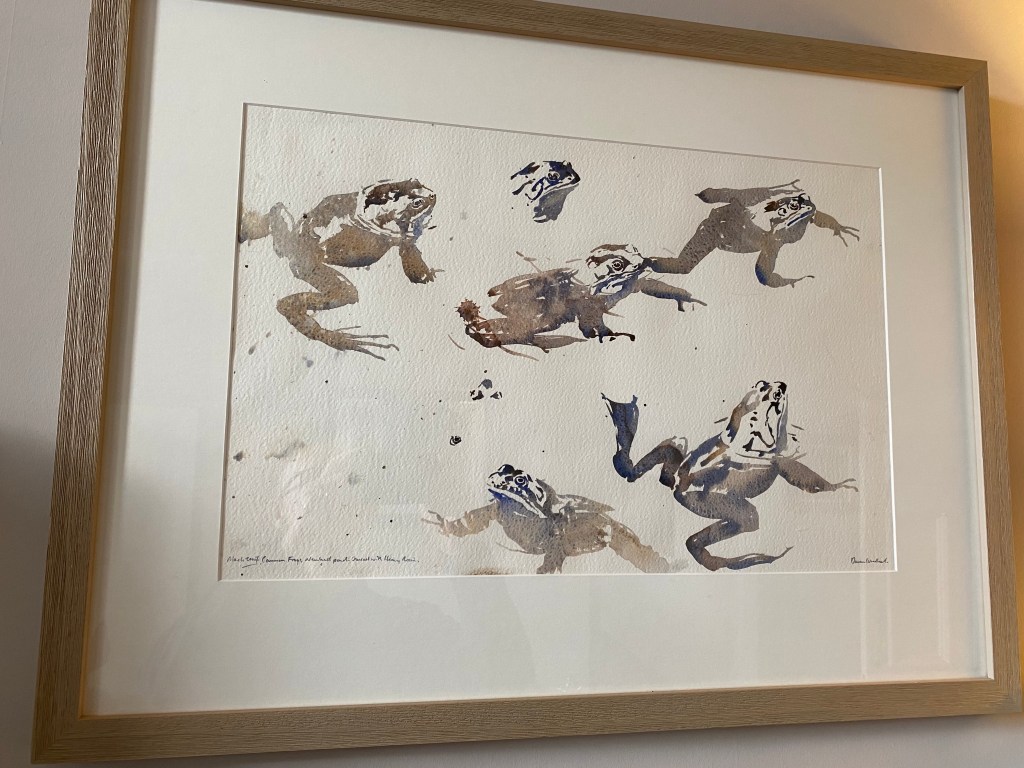
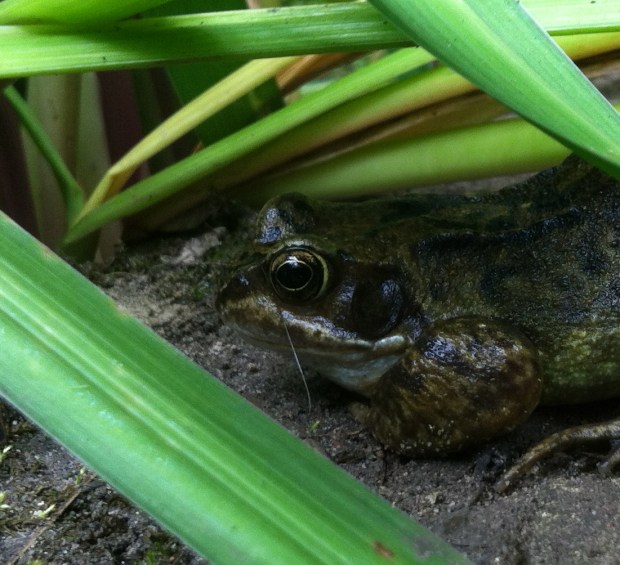
Frogs are ‘good gardeners’ and keep down the army of invertebrates intent on munching your plants. However there is something unsettlingly human about them – they are homunculi with long legs and bandy arms. All they lack is a cranium. Instead, their heads are all eyes and mouth like some genetic experiment gone wrong. And then there’s that pulsing throat…
After a while I gave up on those old ponds. I had a much bigger D-shaped pool constructed against a boundary wall, filled in the original ponds and grassed them over. The new pond was huge with a flat-topped wall surrounding it. My idea was that you would sit on the wall to observe the aquatic flora and fauna. Perhaps, if you were a princess, you might kiss a frog in thanks should it retrieve your crystal ball from the depths.
At the planning stage I had not considered that frogs might be disinclined to use a raised pond. They needed to climb up the ivy alongside the pond to get into the water which never worked well. Unlike toads they are not good climbers. Worse, I didn’t bother with an electricity supply, pump and filter so the seasonal accumulation of leaves eventually produced a nasty toxic, anoxic, brew. Everything except the plants died – including some sticklebacks I’d introduced. I created a further small ground-level pond to try to maintain a little frog-friendly habitat.
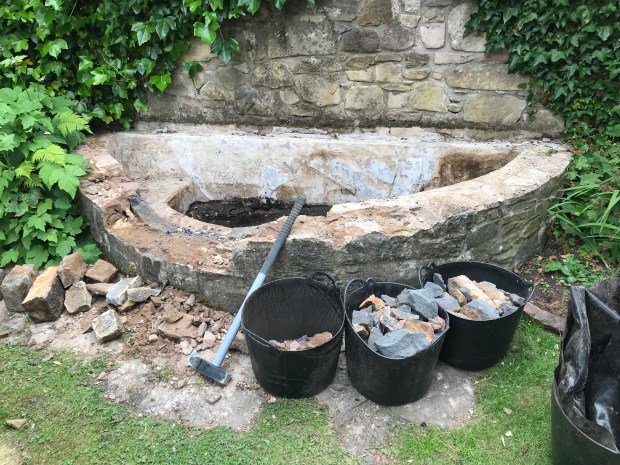
A couple of years ago I admitted defeat and abandoned the 20-year old raised pond. It was impossible to clean or maintain. Despite repointing, the external masonry had deteriorated. Below that layer of stone was a well-constructed breeze block and cement infrastructure, so strong that a huge effort was required over some days to demolish it using club and sledge hammers. Before the destruction, to maintain frog facilities, I reverted to two small ground-level ponds.
Our next door neighbours used to have their own large pond which would seethe with mating, croaking, frogs at this time of year. It must have offered many frogs a winter refuge. However, when they became grandparents, they filled in their pond for fear of accidentally drowning their descendants. For several seasons after that in a pathetic demonstration of amphibian nostalgia, the frogs continued to lay spawn on the grass where the pond had been.
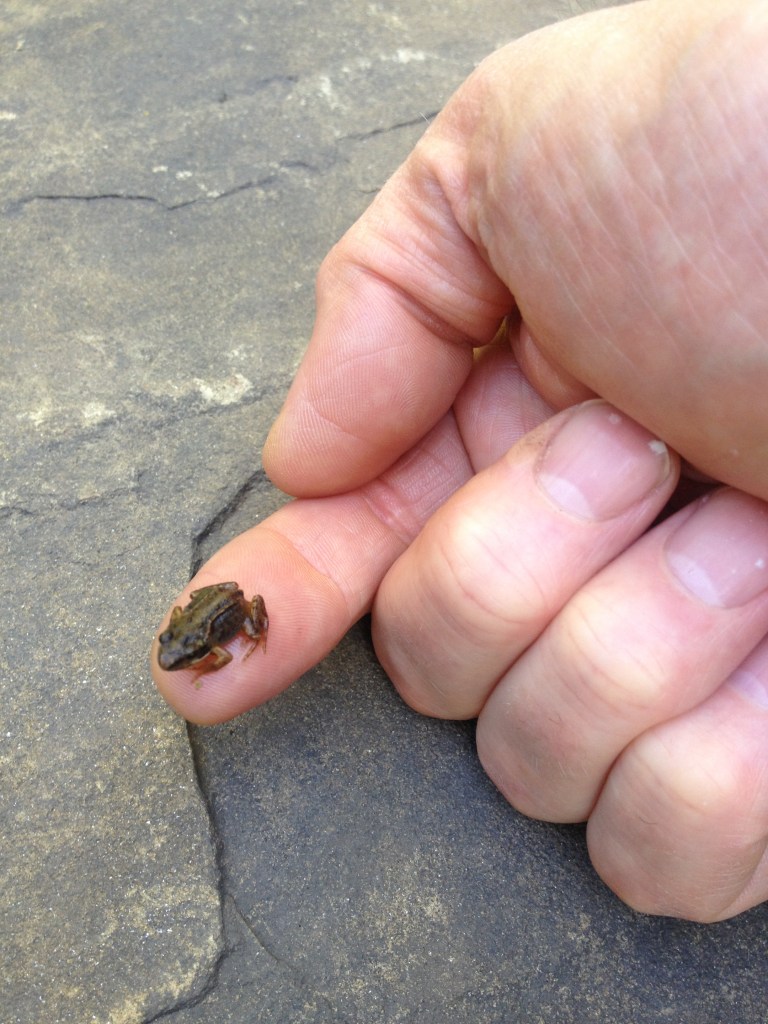
Numbers of frogs in our garden have dwindled drastically from their peak at the end of the last century but I was cheered to find those sleeping princelings in their slimy beds this week. More microcephalic heads have appeared in the other pond which I haven’t yet tackled.
In an echo of our own plight a nasty virus, Ranavirus, is killing frogs but I have a feeling habitat loss is the main problem in our own little domestic crisis. At the moment I am trying to rebuild our population of Rana temporaria. There was plenty of spawn last year although some of it proved infertile. I am concerned that I don’t see many juveniles about. For a few years, hoping to increase the survival rate in the tadpole derby, I gave them flaked aquarium fish food to eat. Some say raw mince works better. I have witnessed them feasting on a drowned blue tit fledgling.
Frogs take three years to mature and I hope the younger ones, which hibernate under logs, stones etc rather than at the bottom of ponds are still about somewhere and will reappear along with the invertebrates as the weather warms up. There is some debate over the lifespan of frogs but they seem surprisingly long-lived with a quoted range of 4-15 years. If that is the case our current residents may simply represent a relict population at the senile end of the bell curve. I hope not.
Herons have an enormous appetite for ‘puddocks’.* Their chest feathers disintegrate into a powder that defends them against the sliminess of eels and the like. If they have been fishing in your waters they leave a scum of this powder on the surface like talc. Our local herons must know all the ponds in Edinburgh and turn up in gardens to help themselves to the copulating hordes; an amplexus nexus.
One spring, when daughter Milly was quite small and our frogs were legion, my friend Willie and I were standing at the parlour window observing a heron polishing off its oblivious victims. Like me, Willie is a birder and we were content to watch the giant grey egret at work. Milly on the other hand was appalled. We explained to her gently that this was simply nature taking its course and carried on observing the proceedings, not paying much attention to her. Suddenly the back door flew open and a furious Milly charged out into the garden brandishing a broomstick over her head shouting, “Get away from our frogs!” The huge bird leapt into the air and flapped off before she could reach it. I now use a makeshift cage of plant trellis to protect our remaining assets during the mating season.
*a puddock is a frog in Scots.

 The Bohemian Waxwing
The excellent Mr Woodhead . . .
LikeLike