Ash die-back seems to get little attention in the news media. This disease is going to kill 80% of Britain’s ash trees, cost billions, and threaten native species that are dependent on the tree.
Ashes in an advanced state of decline on the Mortonhall Estate, Edinburgh
It is caused by a fungus Hymenoscyphus fraxineus, which originated in Asia. It has little effect on Chinese ash species but the European ash evolved without exposure to it and the effects have been devastating over the last 30 years. The disease first emerged in the south east of England. While it may have arrived naturally, we were importing thousands of infected ash saplings from Europe up until 2012.
Badly affected young tree in the foreground with a healthy-looking older specimen in the background on the right.
The fungus invades the nutrient channels in the wood and the tree’s response to this results in the channels becoming blocked. The branches distal to the blockage die. Dormant buds proximal to the affected branch sprout, giving the typical appearance of bare branches with new growth close to the trunk. Dark diamond-shaped patches develop on the dead branches. Young trees are affected most severely. Older trees show some early resistance but eventually die. Once you know the signs, it is obvious the disease is everywhere. Newly-established trees planted at great expense for their amenity value are succumbing.
Weeping ashes are not immune.
A small number of our native ashes appear to be resistant but recovery by the spread of these varieties will take at least 50 years. The cost in terms of loss of the beneficial effects of the trees and clearing away the dead ones has been estimated at £15 billion by the Woodland Trust.
Within my school year group, my 17th birthday in March 1971 was rather late compared to my peers. Many others had passed their driving tests by the time I was eligible. This was an almost unbearable delay to me, desperate as I was to escape from the farm and hit the roads. I had been entertaining other plans involving motorcycles and Heinkel bubble cars – both of which one could drive aged 16. Thankfully my parents resisted – otherwise I probably wouldn’t be around to write about it. In the 1970s road deaths among young people, and young farmers in particular, were common. A farming family that sat opposite us in church consisted of two sons and a daughter. First one son, then the other were killed in car accidents and the father wore a black armband to church from that time onwards. I used to watch him dozing through the sermon beside the two women and wonder how he had borne the loss. My older cousin, also a farmer, liked fast cars and had come within a whisker of disaster on a few occasions.
Obviously such considerations of mortality meant nothing to me as I was convinced, like all young men, of my skill and invulnerability. I was sure I would survive. My father started out teaching me but having driven cars on single track roads and fields since age 11 I was prone to drifting into the middle of the road which unnerved him and an instructor was engaged. He said I was clearly competent but years of unsupervised driving had left me with a lot of bad habits to unlearn before the test. One habit I kept quiet about was secretly driving on public roads long before it was even legal for me to hold a provisional licence.
The day of the test came and I sat it in the family Hillman Hunter Estate. During the test we passed our business offices in Ayr road. My father came out just at that moment and waved to me. I remembered that waving to people during the test was a fault and ignored him. I passed at the first attempt.
At 1500cc the rear wheel drive Hillman was lacking in power but could be put into a very satisfactory and predictable sideways slide on corners if you threw the back end out then steered into the skid. I also double de-clutched in rally style – something I actually had to do on the milk tanker I drove because it lacked a synchromesh gearbox. We started going on very long evening expeditions all over the county instead of doing our homework. We discovered pubs we thought no one would know us in and played darts and drank beer without fear of detection by parents or police. We thought.
My friend Davy had met some girls at the ‘French Summer School’ for music and language students held at West Linton. The summer after passing my test these girls turned up at a similar event in Cumnock and Davy thought we should take them to Ayr and show them the bright lights of Ayrshire. On the way there we were overtaken in humiliatingly easy fashion by a Jaguar saloon and feeling my honour impugned I set off after it as fast as the Hillman’s 1500cc could manage. Even with the accelerator flat to the floor we were struggling to keep the Jaguar in sight – then I noticed an odd noise and smoke began to rise out of the footwell. I had succeeded in blowing the engine. We walked to a phone box and summoned assistance from home. Later dissection revealed I had melted the shell bearings onto the big ends. With a fleet of milk lorries to service and maintain we had a large garage on the farm and three mechanics: the head engineer Bill Bunce, a second in command and an apprentice. Bill had three daughters and I had an absentee (for business reasons) father so we had spent a lot of time chatting in the garage and going on fishing expeditions together. The Hillman had to go to the garage and have Bill rebuild the engine.
Undaunted, we borrowed a milk lorry and used that for the next evening’s excursion. Some locals spotted two youths and two girls crammed into the cab and called the police assuming the lorry had been stolen. Fortunately the police didn’t find us. The upshot of the blown engine was that my father was without his everyday practical farm transport and he decided that I should have my own car to avoid this happening in future. I began looking through the papers for a likely candidate and found a 9 month old Mini 1275GT for sale in a garage in Kilmarnock. Dad was too busy as usual so Bill and I set off to have a look at it.
Bill was a massively built Londoner with a matching large personality who loved everything mechanical. He also loved dogs, guns and fishing. He walked into the showroom and announced to the startled salesman, “Is this where you get the bargains?” We looked at the mini. It was white, had the Clubman grille with red ‘go faster’ stripes and ‘1275GT’ running along the sides. The seats were black and the interior smelt strongly of stale cigarettes. It had belonged to a salesman and had done 15,000 miles in just 9 months. It was priced at £750 and I loved it. Bill had a look inside the engine compartment and did a couple of circuits inspecting the bodywork. He said it was very high mileage and we weren’t interested at that price. To my consternation he turned and walked away. At that the salesman dropped the price to £730 and we did a deal.
Adrian, a friend of Davy’s, had been trying to remember the name of David Coleman as in Sportsnight with Coleman (https://youtu.be/2Im_FnXiCHg) and groping for the right word, came up with ‘Sportsnight with – Faceneck’ for reasons known only to him. I suppose it was his version of thingummy. The ridiculous name stuck in Davy’s mind and we ended up calling the car Faceneck. It amused us at the time.
FaceneckOn her way to Norway with her Cibié spots
By today’s standards the car was not fast, taking about 12 seconds to reach 60 mph and it struggled to get over 90 mph tops. However the sensation of your backside barely clearing the road and a driving position that forced your knees up round your ears was fun. The gearbox was awful, like stirring a box of rubber balls with a stick – and the engine would overheat in summer. You could get round this to an extent by turning the heating up full blast and opening the windows. My father reluctantly accepted this fait accompli and phoned up his insurers to discover that fully comprehensive cover for me was going to cost £250, about a third of the price of the car. His detachment from the whole process was such that it was only when he borrowed the mini to take our cleaning lady home that he discovered its performance. “You be very, very careful in that car,” he warned me afterwards.
Faceneck featured a ‘racing handbrake’. Basically there are no ratchets until the brake was fully on making it a pull-on pull-off brake. A binary bake. This allowed you to do handbrake turns. You threw the wheel right or left and pulled on the handbrake sending the car into a huge spin, doing a 180º to face in the opposite direction. You then pressed the button on the handbrake which instantly fully released it. I garaged the mini in one of the free bays in the hayshed behind the house. The shed is visible in the front view photograph filled with hay bales. One night in the early hours after the usual late night chat with pals I decided to practice handbrake turns on the tarmac surface in front of the shed. It was all going brilliantly until on the fourth or fifth attempt my headlights picked up my pyjama-clad father furiously signalling me to stop. It was apparently difficult to sleep through handbrake turns.
At age 17 such a vehicle was intoxicating. I drove everywhere as fast as possible at the limits of adhesion and timed myself over various regular routes. My father now had his estate car back but very soon the mini was in the garage. I started in a low-key way, skidding on ice and ending up in a ditch on my way home from rehearsals for the school play. My cast-member passenger was very understanding. Things progressed from that point onwards. I went through fences, over fences and finally rolled the car over completely having gone up and embankment on a tight bend. That repair involved Bill ordering an entire new body shell from British Leyland and reglazing the windows. My mother once borrowed the car to go shopping and while parked the Dowager Marchioness of Bute reversed into it with her Rolls Royce. As a result, when I sold Faceneck, the only original parts left were the seats, the engine, the wheels and one of the doors.
Amazingly, I was allowed to bring the car to school and park it with the teachers’ cars. As I had done throughout my school days I always went home for lunch. On returning for the afternoon session I did get into trouble for demonstrating to my fellow pupils how I could generate wheel spin changing from first to second gear as I entered the playground.
Eventually even my father’s patience and detachment ran out and I was told the car had to go. His exact words were, “You’ve had your beard, you’ve had your long hair and you’ve had your sports car. It’s time to settle down.” I was 20. At that time I was sharing a flat in Watson Crescent with Hans Kubon a Norwegian dental student. The cost of living was so high and the exchange rate so extremely weighted in favour of the Krone that Norwegians could buy cars and even flats with their grants. Hans wanted to buy Faceneck. Accordingly, we arranged to travel together on the ferry from Newcastle to Bergen. After a pleasant holiday staying with Hans and his parents in Kråkenes, I left the car behind.
In 1989 I was completing my last Senior Registrar attachment at the Western General before taking up my consultant post. We had to go to the Northern General on a Friday afternoon to do the plain film reporting. As I was leaving one evening I noticed a white Mini Clubman approaching the exit. I checked the number plate: it was SCS 730J. The car was waiting in a queue to join the traffic on Ferry Road. I rushed over and tapped on the passenger window. The woman driver reached over and wound it down. “Sorry to bother you,” I said, “But where did you get this car?” “I bought it off a Norwegian dental student when he went back home,” said the lady, who turned out to be a nurse in the hospital. “This was my first car!” I exclaimed, overcome with excitement, “I sold it to that dental student.” The lady beamed. “I’ve had it ten years. My husband hates it but I love it!” At that point the queue moved forward and she had to say a hasty goodbye. I watched Faceneck disappear down Ferry road.
Haytime at Crofthead in the mid-Sixties. Big cousin and younger brothers on top, me at the wheel.
Every summer we made close to 100 acres of hay. My father disapproved of silage which he thought tainted the milk. In Ayrshire, at around 600 feet above sea level, we made our hay in July. The tractormen did the more skilled tasks of mowing and baling, but working the cut hay and gathering it in was anyone’s job. Bales of hay are heavier than straw, oblong in shape, and secured by ‘binder twine’ which burned your fingers if you let them slide along the cord. Usually it was better to dig your fingers into the bale to lift it. Until your hands toughened up, dried thistles or grass stems under your fingernails were an unpleasant hazard.
The baler would chug along, dropping bales at intervals across the field as it consumed the lines of hay. As children we were too weak to lift bales but we got a few pennies for rolling them together into heaps. This made it easier for the men to fork them onto trailers or the old milk lorries that were drafted in for the season. Later a bale ‘sledge’ was acquired which was towed behind the baler. It consisted of a wooden platform with stout steel prongs mounted behind it that supported the bales until the miniature stack was complete. The task of arranging the bales into a triangular pile resting on these forks at the back of the sledge was brutally physical and was conducted in a choking cloud of dust and flying fragments of dry grass. The ram on the baler rocked the whole rig back and forth making it difficult to keep your balance. Once a pile of 10 bales was constructed, a lever at the side released it onto the field. This had to be done sharply to avoid the pile tipping over. The process then began again.
I started driving tractors at 9 and cars and lorries at 11. Aged 9 I was insufficiently heavy to depress the clutch on a tractor using gravity alone. I had to brace myself against the steering wheel and push down with all my strength. On the way back up, with the spring resisting, controlled engagement of first gear was tricky. The accelerator on a tractor was a lever mounted on the steering column and it stayed wherever you put it, fixing the revs. My favourite tractor was our ancient ‘wee grey Fergie’ (Ferguson TEA 20) which had 4 forward gears and was quite fast. You started it by depressing a brass button with the inner side of your right lower leg and pushing the gear lever into ‘S’. It also had a ‘Ki-Gass’ button which I never understood. I loved the smell of fresh hay and diesel.
At first I simply drove the lorries or tractors between the piles of bales in the fields, stopping at each one so that the two-man team could fork them up to whoever was building the load. The older lorries’ gearboxes lacked synchromesh so I learned early how to double declutch to changing down smoothly. This was useful later when driving cars at rally speeds around country roads. As I got older and stronger I graduated from driving to load-building, learning to lock the bales together like laying bricks.
Bales varied in length and some of the longer ones needed slammed into any gap that was slightly too small. Kneeling down, this took considerable strength and timing, especially when the team with the pitchforks were trying to bury you in more bales. I never made it to pitchforker status. The relentless parade of tractors and lorries shuttling from field to hay sheds meant that the men with the pitchforks were in constant action. In addition to strength and stamina, timing was needed to get the bales onto the top as the load rose higher.
Whoever had built the load would also drive it back to the farm for unloading and storage in the hay sheds. There was an element of taking responsibility for your construction skills. On the lorries we simply relied on gravity to hold the bales in place but the biggest tractor-drawn trailer loads overhung the sides and were so tall they often had to be roped to cope with the big sways caused by negotiating ruts at the field gates. This made riding on top of such loads quite exciting. Even if the load held – and sometimes it didn’t – the branches of nearby trees would threaten to brush you off your perch.
On really hot days little whirlwinds would pick up loose hay and deposit wisps of it onto the tops of nearby trees. Rain usually meant work was suspended. As a small child I remember sitting on top of the last load of the day along with the men in the pitchfork team as it left the field. As it started to rain, one of the men lifted a bale out to create a space for me. I jumped in and they placed the bale across the hole for shelter. It was very pleasant to ‘coorie-in‘* as my refuge swayed back and forth.
Before baling, the hay needed to be sufficiently dry to stop the shed turning into a massive compost heap. The weather was critical to this. While it takes only three consecutive dry days to cut silage (which is preserved by fermentation) at least two weeks of dry weather are needed to get any significant acreage of hay. This rarely happened. In the worst years prolonged rain could turn hay that was almost ready into a blackened mess fit only for burning. My father sometimes called Prestwick Airport to get an indication of what was coming towards us over the Atlantic. If it was rain, you might bale hay that wasn’t quite ready rather than lose it altogether. The longer the mature hay lay in the field, the less its nutritional value.
The tractor men ‘opened’ the fields of long grass by cutting the ‘end-rigs‘ next to the hedge first, then cutting the rest of the field into long rows. After the top layer of grass had begun to dry the rows needed turned over. The older turning machines used the movement of their wheels over the ground as a source of power. Later I used a more modern ‘Acrobat’ rake with 4 large yellow wheels of sprung tines which rotated by being dragged over the ground. Set separately these would pick up two rows of drying grass and flip them over individually. By rearranging the 4 wheels into a single line the Acrobat could be converted into a rake for clearing any residual hay left after all the bales had been removed. Whether turning or raking, it took a long time to do a whole field. A cleared field was described as ‘redd‘. Clearing up at the end of a day was getting ‘redd-up‘ as in; ‘We’ll need tae get redd-up, it’s lowsing time‘. Lowsing or loosing probably refers to the unyoking of horses or oxen at the end of a day’s work.
One summer while turning a field, I noticed a hint of putrefaction as I reached the end rigs next to the hedge. Returning to the same place on the following set of rows the smell got stronger. The next time it was detectable far from the hedge and became quite overpowering. I stopped to investigate. Over the hedge, trapped in a ditch by thorns, was a black-faced ewe, still alive, but with her hindquarters seething with maggots. It’s a distressing image I cannot seem to erase from my mind. A couple of seasons later I had a parallel experience – but this time the smell was sweet. As I approached the source it was obvious that it emanated from a huge mound of wild honeysuckle, its yellow flowers covering the hedge.
Once turned and dried on the reverse side, the maturing hay needed ‘tedding’ – using a tedder of course. These machines were power-driven from the PTO (Power Take-Off) on the tractor and their job was to throw two rows of drying hay into one large row, fluffing it up in the process. This allowed the sun and wind to further dry the hay ready for baling. The machine I favoured had two horizontal rotating wheels with large tines attached. We called this process ‘wuffling’ as one make of tedder was actually called a ‘Wuffler’. Once, when enthusiastically experimenting with how fast I could turn round on the end rigs, I miscalculated and wuffled the hedge. Bits of hawthorn flew in all directions and I bent some of the armatures. Our engineer had to straighten them with a welding torch and a hammer.
Later on as a teenager I would spend the summer mornings working in the dairy, loading milk bottles into crates as they came off the bottling plant, or get up at 4am to deliver milk for one of the roundsmen. After this very early start the dairy was finished by the afternoon and it was time to go to the hay fields once any morning damp had dispersed. My mother would bring refreshments out to us. It was lovely to take a break and sit on a bale under the shade of a tree eating sandwiches and taking tea from a flask. The men got a beer. It was good for morale. If it remained dry with no early dew, work would continue far into the evening, making escape to the pub before closing time increasingly difficult.
During the day, priorities might change and my father, who was supervising it all, would sometimes stop me working in one field in order to go to another or help out elsewhere. The constant drone of the tractor engine and the noisy machinery were like white noise. You stopped noticing it after a while. Paradoxically the racket and monotony of traversing a field over and over again allowed your mind to wander.
My father had a powerful whistle which he could deliver without using his fingers – something I never mastered. This was how he got my attention if I was working on a noisy tractor. Hearing his whistle, I would look up and see him in tweed cap, waistcoat and rolled-up sleeves, waving at me from the gate. He died when I was in my third year of medical school and while I was in a bit of academic trouble. The year after that, I was working a field when I thought I heard a whistle. Automatically, I looked down the rows to the end of the field, which was – of course – deserted. It was like a waking version of those dreams where you discover someone you loved and lost is still alive. My dreams about my late father finally stopped a few years ago and I no longer wake up just as I am demanding to know why he has kept his survival a secret from us for so long.
Building the hay into the corrugated iron sheds was tough. Each shed was divided up, by the girders supporting the roof, into several sections or ‘dasses‘ (another Scots word). These sections were stacked to the roof in turn. Open wooden trunking was placed on the floor of the dass to allow it to be ‘blown’ later. As the dass rose, the space under the curved metal roof got smaller – and hotter. Reversing into the shed was tricky and the men would amuse themselves by shouting false instructions at us:
‘Up the hill!’
‘Naw, doon the hill!’
‘Back, back, back, come on! Oh Christ you’ve hit it!’
The last dass in a shed was completed using an elevator to take the bales up through a small opening high in the gable end. In summer the roof was hot to the touch and the atmosphere inside suffocating. It was easy to overwhelm the unseen team in the shed by loading the bales too quickly onto the elevator. More shouting was required.
Inevitably, no matter how dry the hay was, it tended to heat in the shed; the same process that takes place in a compost heap. In an attempt to stop this happening a huge power-driven, heated, fan was mounted on a tractor to blow air into the trunking at the bottom of the dass. Steam would emerge from the openings in the gables in a satisfying way. The noise of the tractor engine droning on into the evening is associated in my mind with late summer, as too the glorious peace that ensued when the engine was cut, leaving just the sound of swallows twittering on the telephone wires.
Throughout the rest of the year the hay sheds were our playgrounds. We would build houses out of the bales or jump off the top of one dass onto loose straw on the lower one next to it. There is no recreational value to be had from a silage pit.
*snuggle in.
My mother Edith with a hay cart at Bearcrofts, near Grangemouth, before the War.
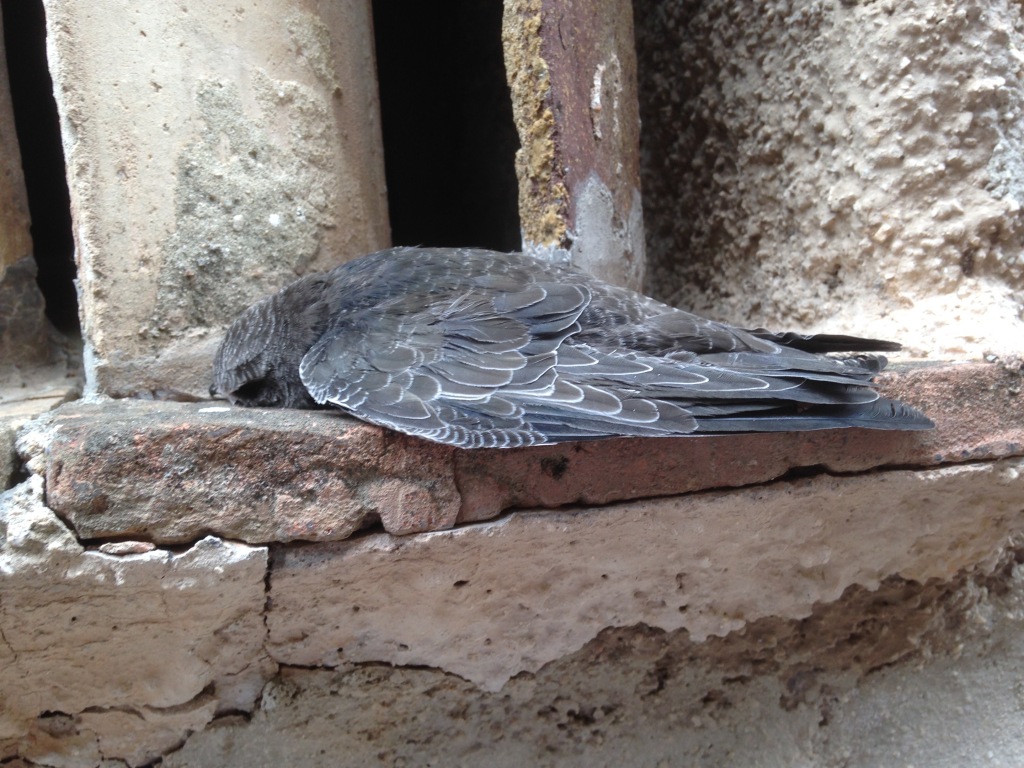
Common swift casualty, Tourettes-sur-Loup, Provence July 2014. The pale edging on the wings indicates a juvenile.
If any bird typifies Edinburgh in summer it is – or at least was – the swift. There are no house martins or swallows in the centre of the city; swifts are the only insect hunters we see overhead. The beginning of summer is marked by their arrival in May. We enjoy them for just three short months before they head off, juveniles first, in mid August. This spring, of 2021, was exceptionally cold and their appearance was delayed beyond the 15th of May, the date when I expect to look up and see one overhead. Their wings are long and stiff with a short ‘arm’ and long ‘hand’. They generate propulsion on the downstroke and the upstroke. Head-on, the wing action has a striking ‘whirling’ appearance as if the wings were rotating. Famously, they eat, sleep and mate in the air.
Swifts have very short legs and tiny feet. Indeed, they were once thought to have no feet at all – hence their scientific name Apus (a-pus, no feet). Apus apus, the common swift, is one of those select species that was so good, they named it twice. Convergent evolution has resulted in superficial similarities between swifts, swallows and martins but swifts are more closely related to hummingbirds. They also look a bit like smaller versions of the nightjars that precede them on the taxonomic list. The huge alpine swift with its white belly and wingspan of close to 2 feet is something else. I have seen and filmed one in Scotland, an experience I will never forget.
Swifts live up to their name. They are the fastest of birds in level flight, reaching 70mph. Peregrines can achieve greater speeds but only in a power dive. Swifts winter in Africa and are masters at using the winds associated with weather fronts to aid their movement. They won’t hunt in rain while they are in Europe and will fly hundreds of miles around bad weather to find food. They pack the insects into pellets in their throats to transport back to the nest. Swifts nesting in the west of Scotland have been tracked flying to Loch Neagh in Northern Ireland to feed. If the weather is bad and no food is available, the young birds in the nest will go into a state of torpor for up to 48 hours. Hummingbirds can perform the same trick.
When I moved to an upper flat in the New Town in 1979 I became much more aware of these birds. The top floor rooms had coom* ceilings with large single-pane skylights set into the pitched roof. I could watch swifts traversing that patch of sky from my bed – or my bath. Later in the season, ‘screaming parties’ of speeding swifts would hurtle through the airspace above the gardens at the rear of the tenement. I watched them from the common stair windows.
Gangs of screamers would pass low overhead at a beer garden we favoured in Morningside. I found the strange noise atmospheric and never unpleasant. Even then, 40 years ago, the numbers were no match for the fathoms of swifts and hirundines you see over urban areas in France and Italy but now they are even less common. This year I have only witnessed one small party over a friend’s garden, but they were a welcome sight. The most reliable place to see them locally seems to be over the tenements of Marchmont where presumably there are suitable sites for nests. Once airborne, juvenile swifts can stay aloft continuously for 10 months or more without ever touching down.
Historically, swifts nested on cliffs, in caves and in holes in trees. A small colony in the Cairngorms still does this. Deforestation meant a move to the towns where they used spaces under slates and eaves to nest. Swifts mate for life and re-use the same nest site. The nest is made from feathers and other detritus collected on the wing. Sometimes the nest material is eaten by clothes and carpet moths during the 40 weeks it is abandonned by the birds. Even more unpleasant are the huge blood-sucking ticks that have evolved to parasitise the birds. The equivalent size in a human being would be a shore crab crawling about in our underwear.
The reason the numbers in Edinburgh are so seriously diminished is uncertain. The lack of insects is a possibility, as witnessed by the current dearth of fly squat on the front of our cars. Increased affluence has perhaps resulted in Edinburgh repairing the more crumbly bits of its ancient built environment, reducing possible nest sites.
My office at the Western General Hospital and the coffee room next door looked onto a large enclosed area surrounded by the original 1865 Victorian sandstone hospital building, including a clock tower. The clock was correct twice a day. As usual in the NHS, the enclosure had been crammed with later, cheap, flat-roofed buildings including the dining room and kitchens. A pair of swifts nested in a hole in the wall below the clock tower opposite our offices. Probably the site of some old pipework, the hole was small and situated about 10 feet above the flat roofs. The birds would fly straight into this tiny aperture at top speed and I enjoyed watching them come and go.
Swifts prefer to launch themselves by dropping from a perch using gravity to increase airspeed. The lore is that swifts, with their tiny legs, cannot take off from a flat surface. Once, while eating lunch, I saw a swift exit the hole then plunge downwards crashing onto the flat roof. I was already preparing a rescue mission in my mind. ‘Watch!’ I said confidently to my colleagues, ‘It won’t be able to take off’. As I said this, the fallen bird whirred its wings and rose into the air with little apparent effort. Most texts now specifically say that they can take off from the ground. One winter morning I came to work and glanced out of the window to see that the hole had been cemented up. Not all maintenance is an improvement.
Now, in early August, the michaelmas daisies, buddleia and Japanese anemones are in flower. Soon the swifts will slip away and the children will return to school. The days are already noticeably shorter and today it felt a bit chilly out of the sun.


 The Bohemian Waxwing