
The successful identification of birds is not confined to knowing their physical appearance. Knowledge of birdsong is often the clincher when confronted by a mystery creature. Knowing the songs – and the more difficult calls – is a huge help in working out what you are looking at. Modern smartphone birding apps often include recordings of the songs, but you mustn’t use these to lure a bird into the open! Birds exist within a tight energy economy, especially when breeding, and making them waste energy pursuing a phantom rival is not fair.
In the prior paper-only era, field guides often included ridiculous English renditions of songs, which were meant to help you with ID. ‘The song may be rendered thus: “Prithee-come-thither-thou-varlet!” ‘ That sort of thing. The onomatopoeic impressions of songs with their umlauts and strings of consonants which replaced such nonsense in the field guides are little better – and less funny. Some bird names, notably the cuckoo and chiffchaff are onomatopoeic in themselves. The scientific name of the corncrake (Crex crex) is another example. Whatever aids you employ, there is no substitute for going out and learning the songs for yourself.
It is late spring now, and birdsong is at its peak. I’ve never been sure that birdsong fulfilled a purely pragmatic territorial or pair-bonding function. For me it always had that element of joie de vivre. I thought I might go over some of the easier songs should you wish to explore the genre in the safety of your own garden. Knowing the songs of the common birds allows you to move confidently on to the rarer ones. Remember that any puzzling sound is likely to be an unusual noise from a common bird rather than the usual sound of a rare one.
Unusually, both male and female robins sing throughout the winter as they defend their territories ferociously. In fact, they start singing in September, a sound my grandmother identified as a harbinger of winter. Their song is like the squeaky wheels of a supermarket trolley, and quite easy to learn. They also make a high-pitched ticking call.
After the winter robins we come to the early spring starters. In respect of their songs, great tits and cole tits are confusion species with chiffchaffs coming along later to further muddy the water. The great tit mainly gives us its greatest hit, the classic ‘teacher, teacher.’ The smaller cole tit has a very similar but higher-pitched song, ‘see-too, see-too.’ Later, when the chiffchaffs arrive they make the sound their name suggests, another two-beat declaration, but their little aria is wheezier and irregular. Every now and then they stick in an extra ‘chiff‘ or ‘chaff‘ which the two tits never do. To finish the commonest tits, Blue tit song consists of two high-pitched notes then a longer trill of lower notes: ‘si si… tr’r’r’r’r’r’r’rt.’ Sometimes they do, ‘si si churrr – si si churrr.‘
The blackcap also kicks off early. Some of them now over-winter in Britain, perhaps because garden feeders are so widely available to them in this country. Once you learn the song, you realise these birds are ubiquitous. Blackcaps deliver a short, rapid, sweetly musical burble of notes with long pauses in between. Like a little blackbird in a hurry. The verse is often preceded by a short ‘irresolute’ scratchy twitter. With patience you will spot the singer among the fresh spring leaves, unmistakeable in his black headgear. The garden warbler ‘s song is almost identical to its close relative the blackcap, but ironically, you are most unlikely to have one in your garden. They are very difficult to see in the dense cover they favour. Leave them to the experts.
The blackbird has the most wonderful repertoire, completely underrated in my opinion. Usually delivered from the top of a shrub or tree, it consists of well spaced-out measured phrases of endless variety, frequently punctuated by quieter trills or twitters. We have one in the garden at the moment who has been performing brilliantly for weeks. Blackbirds also have a predilection for singing at night – as the Beatles noted.
Everyone thinks they know the blackbird’s song – but can you tell him from his close relative the song thrush? Also a wonderful performer, the thrush helps us by repeating his phrases two or three times. The mistle thrush is a bigger, paler, and rarer bird. Also known as the ‘storm cock’ because his singing supposedly precedes bad weather, he sings from treetops in brief verses; a simpler, colder version of the blackbird. He also emits a very distinctive, loud, ‘football rattle’ alarm call.
The chiffchaff’s close relation in the leaf warbler family is the willow warbler, which is now singing as the weather warms up. The willow warbler looks almost identical to the chiffchaff but sounds totally different – which is useful. He gives us a string of sweet descending notes which trail off into nothing as if he’s been distracted by something. This contrasts with the superficially similar chaffinch (not even a warbler) whose final upwards flourish is supposed to sound like a bowler running up to the crease and delivering the ball. He also goes, ‘pink, pink, pink.’ Chaffinches have been shown to have regional accents.
The lead-grey headed Dunnock (aka hedge sparrow) is very common in urban gardens, sticking mainly to ground level, hopping about, picking up stuff. The song is delivered from shrub-top level and has a monotonous, cantering rhythm. Like a lot of duller birds that skulk in bushes, the song is loud. They lay beautiful blue eggs leading to the local name in East Ayrshire of ‘blue dykey’.
Speaking of loud skulkers, the Wren is the classic. It’s mouse-like habits mask their huge numbers; they are the commonest birds in Britain. Wrens intersperse their song with a diagnostic drawn-out, ‘zerrrrr,’ which is also the alarm call. A loud ‘zeck’ is also produced.
Goldfinches have a lovely soft song and were kept for this purpose. They were trapped in enormous numbers for the cage bird trade along with bullfinches. Their song is a merry tinkling jangle of quiet notes interspersed with a version of their call, which sounds like ‘quit-it‘ to me. They often feature in early paintings because of their supposed association with the crucifixion – they have Christ’s blood on their faces. Everyone knows Carel Fabritius’ wonderful portrait of one chained to its perch. Robert Fergusson’s rumination on the fate of a caged goldfinch is very moving. He mentions the sticky birdlime used to trap the poor things; still a common practice in Europe.
Ode to the Gowdspink
Another very easy bird to identify, once you know the song, is the Bullfinch. For such a boldly marked and colourful animal the song is very disappointing. Hesitant and quiet, it consists of a few tired, fluty notes, descending at the end ‘phü – phü – phü.’ It surprised me to learn that they can be taught to talk and were kept for this purpose. They were once killed in huge numbers to prevent them eating the buds of fruit trees. In my garden at least, they are now increasing. Quite shy, they are always seen in pairs. Look out for the bright white rump as they fly off.
Greenfinch numbers have crashed thanks to Trichomonosis, but I’ve been seeing a few more recently. They have a distinctive loud ‘zweee’ call that also features in their song. Yellowhammers are also rarer now and are more birds of open farmland but I include them because they famously go, ‘a-little-bit-of-bread-and-no-cheese‘.
Pied wagtails are easy because they call, ‘Chiswick, Chiswick‘ as they fly over, and House sparrows give us the classic ‘chirrup’.
Finally, there is another bird that is definitely on the increase, but despite that, almost impossible to see. The great spotted woodpecker is everywhere these days, including in our garden trees and on the peanut feeders. However, the bird is also a fantastic example of dazzle camouflage. Its bold black and white markings break up its outline, especially in dappled light. It perches on trunks or along the branches of trees, blending in with the outline or disappearing behind them. Fortunately there are three things about GSWs that reveal their presence. The first is their distinctive call, a loud ‘tchick!’ Once you are familiar with it, you will be alerted to their presence everywhere. They often call in flight. The flight pattern is the second feature. It is deeply undulating or ‘bounding’ because they intermittently close their wings to their bodies. The third feature is the famous ‘drumming’ which echoes through leafless woods in early spring. It is said you can attract GSWs by doing your own ‘drumming’ with a pair of sticks. I’ve never seen this succeed!
I recommend getting to know your local birds’ songs. Think how much more you would get from sitting in the garden or walking in the spring sunshine if you knew who was singing to you.
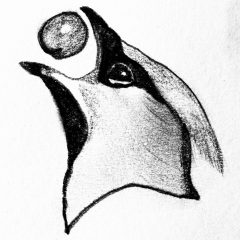
 The Bohemian Waxwing