Guns

Crime scene

In the 1960s, children’s TV featured huge numbers of cowboy shows. Shows like The Lone Ranger, The Cisco Kid, Laramie, Bronco and Gunsmoke. I loved them all. It didn’t occur to me that the clothes, hairstyles (and even skin colour) might be inauthentic and anachronistic. To be a cowboy you had to be white; clean-shaven; wear a modern Stetson rather than a bowler; slick back your hair teddy boy-style and carry a six-gun.

I really wanted one of those black Colt Peacemakers in a leather holster with bullets on the belt. The holster would be tied to my leg of course to allow a quick draw. Instead I had to make do with a silvered cap gun in a black plastic holster ridiculously adorned with red plastic ‘jewels’. Still, it was exciting to go to McKechnie’s Toy Shop on a Saturday morning and buy rolls of percussion caps in their little round white containers. You broke open the gun and placed the roll of caps on the spindle, feeding the end up under the hammer. With the gun closed, each time you pulled the trigger, fresh caps were pushed up ready for detonation. It was so tempting to keep blasting away as the singed paper strip scrolled out of the top of the gun. In no time they were all used up – but what a great smell. Those toy guns were played with until they fell apart.

Real guns were an order of magnitude more exciting but my parents were agin firearms. Bill, our farm mechanic, had a twelve bore shotgun with a magnificent leather cartridge belt, but the first proper gun I remember firing was a .22 rifle owned by my dad’s cousin ‘Uncle’ Robbie. He lived on a farm near Ballantrae which we visited. He had a large collection of guns – and walking sticks. He’d known Harry Lauder and owned one of his famous corkscrew hazel sticks that the entertainer had used onstage. Another stick was a strange-looking thing apparently made out of crystal – and he had an African cudgel of primitive appearance and gory provenance relating to the Mau Mau Uprising.

He took us out in a canvas-topped Land Rover with his German Shorthaired Pointer, Blitzen, running behind. Uncle Robbie pulled up in the middle of a field and surveyed the distant landscape. He solemnly informed me a .22 could kill at over a mile and therefore we had to check for any sheep in the line of fire. He chose a telegraph pole for our target and I remember the sharp crack when I pulled the trigger. There was little perceptible recoil, from which I assumed the gun lacked power. We then drove over to inspect the telegraph pole and found the bullet had torn a four-inch long furrow through the timber on one side. I was impressed and a bit shocked by the extent of the damage. Most other family members had shotguns rather than rifles. My mother’s brother Roy kept a gun in the bedroom and used it to shoot rabbits in the policy field in front of the house. The drawer of the bedside cabinet contained 12 bore cartridges.

An early game of stone, shotgun, catapult…

2

My father had no desire to shoot or fish, stating that the countryside was to be ‘enjoyed not destroyed’. Preoccupied with his business and public life, he took little to do with the day-to-day activities of his three sons. There was never any question of me getting a shotgun or a rifle and my mother consistently refused to allow me the fallback option of an air gun. Aged about 13, I had been doing casual work on the farm and getting little pretend pay packets for my efforts. Once I had generated enough cash I took matters into my own hands.

Wardrop’s Glaisnock Street sports shop was a cornucopia of delights. Guns, rods, fishing tackle and knives filled the interior. I particularly liked the fishing flies in their display cases. I had noticed a .177 air pistol in the window. This was not a proper target pistol but a replica of a modern .45 Colt automatic with a very short, unrifled, barrel that tilted up for loading. It was manufactured by Diana and it looked great. You cocked it by pulling the slide at the back to compress the spring.

One day, before going home for lunch, I gave my savings to my pal Bert. While I was at home enjoying Mum’s usual three-course feast, he went into Wardrop’s shop and asked to buy the pistol. He was clearly under age – and small for his age – but the shopkeeper simply asked a random stranger in the shop to buy it for him. By the time I returned to school in the afternoon some third year boys were using the gun for target practice in the crowded playground. They were very complimentary about the gun, acting like they were big experts. I was relieved to retrieve it from them and smuggle it home in my school bag.

The replacement

I hid the gun in the log shed. My excitement dissipated later when I discovered the pistol lacked any significant power and was wildly inaccurate. After a few days of covert operations – and no avian casualties – my conscience was troubling me; so I confessed to my mother. She was writing letters at her desk in the lounge when I entered with the gun hidden behind my back. Her pleasure at seeing me lasted until I revealed the pistol. Furious, she confiscated it. Later, to punish me further, she let my younger brother use it. I remained contrite in the hope of a reprieve.

Eventually I got it back and after a few weeks of avoiding the subject she relented and said she would let me have a proper air rifle – provided I only shot starlings and sparrows, which were considered pests on the farm. My mother entrusted Bill the mechanic with the job of accompanying me to town to select a rifle, as he seemed to have the necessary expertise. Bill had three daughters who didn’t share his interest in field sports. In the absence of a son of his own he would take me fishing and shooting. He was a very large, robust cockney who boxed when he was in the army and had driven a variety of extremely powerful motor bikes in his youth. I spent many hours in the garage listening to him philosophise about politics and religion from a very different perspective than my Presbyterian parents. Later he would repair my cars when I crashed them.

The main air rifle manufacturers at the time were BSA, Diana and Webley. All the other boys I knew who had air rifles seemed to own a BSA or a Diana. Dianas had rather disappointing pale wooden stocks. The Webleys had beautiful walnut stocks and looked much more like a serious weapon. There were two gun shops in town. In the end we selected a .22 Webley Falcon from the smaller of the two in Townhead Street. Astonishingly, in order to demonstrate its potential, the shop owner let Bill fire the gun over the counter into a wooden door at the back of the shop. The lead pellet buried itself in the wood. We were both impressed. At home, after a brief lecture about safety, I tried it for myself and discovered the gun could propel a pellet clean through an old-fashioned heavy tin can.

Loading that type of air rifle involved breaking the gun by pulling the barrel downwards. The barrel acted as a lever compressing the spring inside the cylinder. For a young boy this required quite an effort, especially when the spring was new and resilient. A lead slug (we never called them pellets) was then placed in the chamber and the gun closed ready to fire. Firing an air rifle isn’t silent but there is no ‘bang’ – just the noise of the spring being released and the air escaping from the muzzle with the projectile. If you looked down the barrel you could see the spiral rifling which imparts spin to the slug making it fly true. Guns have an alluring smell of metal and oil. If you put a few drops of oil in the barrel a puff of ‘smoke’ could be generated when you fired.

The rifle had open sights with a ‘V’ notch for the rear sight and a vertical post at the end of the barrel for the foresight. I felt sure I was aiming it properly but I kept missing despite adjustments to the alignment. Bill confirmed that the sights were out. There seemed to be a manufacturing fault with the rear one. He clamped the gun in a vice in the workshop and set up a cardboard target on the wall. After a few test firings he filed a deeper ‘V’ in the rear sight and after that the gun did shoot accurately.

Releasing the gun from the vice, Bill reloaded it and, with a devilish smirk, turned towards one of his two apprentices. ‘Right, Eddie, dance!’ he said, pointing the rifle at Eddie’s feet. “Aw, come on Bill,’ said the lad, uncertain how much danger he was in. Then Bill fired – and Eddie yelled. I have no idea whether it was intentional or not but the slug went right through Eddie’s heavy work boots just behind the steel toe cap intended to protect him from ‘accidents’. Bill put the gun down and Eddie’s boot was removed. There was a lot of swearing. The slug was still inside the boot and a small chunk of flesh had been knocked off his little toe. I decided to leave the garage staff to sort this out and went off to look for things to kill.

A few days later I saw what I thought was a starling some distance away perched in the top of an old ash tree and took aim. The bird dropped to the ground, but when I retrieved it I saw to my horror it was a male blackbird. Blackbirds were not vermin and definitely contravened the agreement with my mother. Knowing that Bill tied his own fishing flies and that he used blackbird feathers for some of them I hurried round to his workshop to get rid of the evidence. Unfortunately my mother saw me from a rear window, gun in my left hand, dead blackbird dangling from my right. I protested it had been an accident caused by mistaken identity but the rifle was impounded as soon as I returned to the house.

After another lengthy ban the gun was finally returned to me with the reiterated condition that I restrict my shooting activities to vermin – or old milk bottles in the glass dump. A mini slaughter then ensued. I gave my victims to the farm cats – who were grateful. I kept slugs in my blazer pocket so I could go off shooting as soon as I got home from school but eventually I sickened of this work. The death of my victims ceased to be enjoyable to me in any way and I stopped shooting at living targets. Paradoxically, in later life, I would become a keen ornithologist. My murderous urges as a youngster disturb me now. I must have discussed this with Bill because I remember him claiming Sir Peter Scott shot geese on the Solway as a young man. However this seemed to be more of a point about hypocrisy than adolescent morality.

3

My Latin teacher for the first two years of secondary school was the great Ivy McCaig. He had been an athlete in his youth, playing wing three-quarter for Glasgow University and the legend was that he’d once chased an offending boy a mile up the nearby Woodroad Park until the lad was forced to climb a tree to escape. He was now in the twilight of his career and no longer terribly interested in schoolboys. We were made to write the Latin in ink and our translation beneath in pencil. He considered me dilatory and claimed my attitude was, ‘sufficient unto the day is the evil thereof’ [Matthew 6:34]. He would approach the desk where I sat with my friend saying, ‘We’ll just see how much Stevenson and McDonald have done.’ He belted us regularly for a variety of minor offences including lack of industry and always preceded this with a formal intimation to the female members of the class that retribution was imminent. Fortunately in his declining years he couldn’t really ‘draw the belt’* any more.

Our main school building was Victorian but some language classes took place in prefabricated ‘huts’ supported on brick piers. It was near one of these that the third year boys had tested my air pistol. Immediately below the huts was a steep embankment leading to some flat ground where a modern housing estate had been built. One day, during a Latin lesson there was the the noise of something striking one of the windows on the embankment side – hard. Mr McCaig and some of us boys went over to investigate. A small hole was found in the glass with a starburst of cracks around it. Then there was another impact – and another. It dawned on us that we were being shot at from the rear of one of the houses below.

Mr McCaig sprang into action. ‘Get down girls!’ he yelled as he crouched below window sill level. We boys, convinced we were in no particular danger, continued to stare out of the window trying to see where the shots were coming from. Our teacher didn’t seem to care much about our safety. Then a distorted air gun slug was discovered on the floor. Ivy pounced on it. ‘That’s evidence! Give that to me!’ he cried and crept out of the room on all fours. The police were called and two teenage boys from the housing scheme were arrested. The incident made the local paper.

4

Over time air guns start to lose their power. Either the spring becomes fatigued or the seals on the piston start to leak – or both. This reduces the velocity of the projectile. The first sign of this is being able to see the slug as a tiny dot flying away from you when you fired in the air. You could also detect an increasing delay between pulling the trigger and the noise of the slug hitting its target. Fairground guns are always wrecked, their sights are way out and the little coloured darts struggle to reach the target a few feet away. Of course this is exactly what is intended.

With time I used the gun less and less. My first university flatmate was an old school friend. His father was a miner and trade unionist who bred canaries in the traditional manner. Local cats were prowling around his outdoor aviary, disturbing the birds, and he wanted to get rid of them. I agreed to let him borrow the .22 and that was the last I saw of the rifle.

5

Off to St Leonard’s December 2016

In the early 1980s our ‘double upper’ flat in India Street was burgled. The police said the robbers’ technique was to gain access to a stair then ring all the doorbells to ensure everyone was out. They would then target a top flat, pick up a doormat to muffle the blows, and lie on their backs to kick on the bottom of the door. This used the door itself as a lever against the lock and the door jamb would splinter. The thieves took a number of seemingly low-value items from us: shoes, clothes, a replica Bauhaus chess set – and my useless old air pistol. Without an inventory it is very difficult to know when something isn’t there any more and it took several days for me to realise it was gone. For no good reason I replaced it with another similar pistol. In the interim the build quality had deteriorated further and the gun was now even less effective. The manufacturer was no longer Diana but a firm called ‘Sportsmarketing’. After we moved house I did occasionally use it for target shooting in the garden but I hid it away once we had children.

Drive-by

After a child fatality in Glasgow the Scottish Executive decided that all air guns must either be licensed or handed in to the police by the end of December 2016. By then I had forgotten I even had a gun. Being a law-abiding sort I decided to turn it over. Accordingly, with just hours to spare, I took the pistol to St Leonards Police Station. There was a clear (possibly bullet-proof) screen over the counter with a receptacle similar to a bank night safe. The gun was placed in this box which was then tilted back onto the counter side for safe removal of the gun. Before I handed it over the female officer behind the desk asked me, ‘Is the magazine clean?’ I didn’t know what she meant. ‘Is there any ammunition in the gun?’ she said wearily. I said there wasn’t, lowered the gun into the box and it was gone.

Shooting clays with a 12 gauge over-and-under Beretta

* If a teacher could ‘draw the belt’ this meant he or she had the technique to make it really hurt.

Wartime

World War II Flaktürme, Vienna

I was born in 1954, the year World War II rationing ended. I have vague memories of the Cuban Missile Crisis in 1962 and my parents’ distress, but that is all I have experienced in terms of the threat of war. Of course, much later, we had the Falklands War and the various Middle East conflicts, but there was never any question of my British generation being subjected to a general call-up or even having to do National Service. By contrast, as young Americans, my friends Al and Ken had to endure the Russian roulette of the Vietnam War draft. In the end, by good fortune, neither of them were called up. Thanks to Harold Wilson’s refusal to put ‘boots on the ground,’ the worst our British Cold War generation had to contend with was the constant background threat of nuclear war. We read Bomb Culture, but we didn’t have to fight. We did have to endure black and white TV dramas depicting what was in store for us should we survive the initial nuclear exchange. A visit to the decommissioned ‘secret bunker’ in Fife is an unsettling reminder of those far-off times before the Wall came down and Vladimir Putin got very rich.

A regular topic of conversation among us old hippies is how glad we are that we have never had to fight in a war. A friend has a recurring nightmare that he is standing in the front rank of some unspecified army, in the rain, holding a spear. He asks his neighbour what they are doing there and is told that ‘the battle’ is about to start – at which point he wakes up, terrified. While cold steel does seem a genuinely remote possibility, at my now advanced age, 1954 seems terribly close to the largest and most extreme conflict in human history.

Farming was a reserved occupation; one that excused you military service on the basis that your job was essential to the war effort. As a result my family largely escaped doing any actual fighting. Had it been otherwise, I might not be sitting here writing this. Almost all my contemporaries had fathers who served. My mother’s parents were the only grandparents we knew as children. Granny and Grandad were born in the 1890s and married shortly after the end of World War One. Even as non-combatants their experience of that war must have been appalling. Granny frequently told me, ‘You never opened the paper without reading that someone you knew had been killed.’

She herself lost ‘a lad’ she was very fond of. He tried to write to her from a field hospital after he had been wounded. Distressingly, the handwriting trails off mid-sentence and the letter was sent on to my grandmother posthumously. He was an only son and Granny felt very sorry for his parents. She invited them to post war family events – even after she married my grandfather. The elderly couple appear in some of our family photographs – and the letter from their son is still among Mum’s papers.

Even though as a family we were relatively unaffected by the armed conflict in the First World War, ‘Spanish Flu’ (an H1N1 avian virus), arrived with American troops and eventually killed far more people than the war itself. Some estimates are of 500 million infected and 50 million deaths. The virus spread in the trenches and barracks and penetrated every corner of the globe with the returning troops. In fact, there was nothing Spanish about it. The belligerent countries suppressed the dreadful death rate for reasons of national morale, while neutral Spain reported it and became eponymously associated with the disease.

In 1919 flu nearly killed my grandfather who at one point wasn’t expected to survive the night. The fragility of existence in the face of war and disease would have been a basic fact of life for my grandparents in the pre-antibiotic era. Still, the Twenties must have brought some kind of relief. My mother was born in June 1925 and my uncle on ‘Black Tuesday’, the night of the Wall Street Crash of 29th October 1929. The subsequent depression plunged the world into financial extremis and fomented the rise of extreme fascist and communist movements.

I did my surgical house officer job on the orthopaedic wards of the Royal Infirmary. In 1979 I admitted a patient who had broken his hip. It transpired he was from a travelling family and enjoyed being outdoors. He was tanned and sported a neat white goatee beard. He said he had spent the first two years of his life strapped to his mother’s back, sharing all her conversations, and travelling through ‘every town in Britain’. He liked to take a bottle of wine and drink it ‘in God’s good air’. The previous day, whilst walking up the Mound, carrying his bottle, he had fallen and been unable to rise. He asked many passers-by for help but no one would stop, so he had to lie there all night. The next morning a secretary in the Bank of Scotland building sat down at her desk and noticed that the man she had seen lying on the pavement the day before was still there. She called the police and finally he made it to the ward.

I was shocked that no one had been prepared to help him. Presumably they thought he was simply drunk. Having completed the history, I needed to examine him and mark up his broken leg for theatre. I pulled back the bedsheets and was confronted with a heavily scarred and deformed left leg – the opposite side from the broken one. I asked him what on earth had happened. He said, ‘In 1936 doctor a few of us thought democracy was in danger in Spain and so we went over there to fight.’ He had been a member of the International Brigade. I cannot now recall which battle he was wounded in, but he said they wanted to amputate his leg afterwards. He wouldn’t allow it and eventually he recovered and made it home to Scotland.

Having completed the formalities, I told him he would have his broken hip pinned later that day. At that moment a young woman appeared in the open Nightingale ward carrying a baby. She rushed down to the man’s bed, upset, but delighted to see him. At first I thought she must be a relative but it turned out she was the warden of his sheltered housing. She was very fond of him and had reported him missing when he failed to return from his day out.

My mother was 14 when the second war broke out in 1939. The farm was on very flat land near the Firth of Forth at Grangemouth, just north of the Wall of Antoninus Pius. Mum remembered hearing the declaration of war on the radio in the kitchen. Barely a month later, in October, she and Grandad were outside thatching stacks when the Germans attacked warships at anchor in the Firth of Forth. This turned out to be the first German raid of the war – although at the time my mother and grandfather assumed it was an exercise.

Falsely reported in Britain as an attack on the Forth Bridge, the Luftwaffe’s target was actually HMS Hood. A radar failure at Cockburnspath had allowed the bombers to reach the firth undetected. Notably, it was the first occasion Spitfires were used in combat. 602 Squadron (City of Glasgow) based at Drem, and 603 Squadron (City of Edinburgh) based at Turnhouse were scrambled. Said by British sources to be a failure, the Luftwaffe actually hit several ships; 24 men were killed and 44 injured. The Germans lost two bombers, one shot down off the coast at Port Seton and another at Crail in Fife. A further plane crashed in Holland on the way back, killing all the crew. Fortunately the Hood had been moved into dock and was undamaged. Later she would blow up at the Battle of the Denmark Strait when a 15 inch shell fired by the Bismarck hit her magazines. She sank in three minutes and of the 1418 men on board only three survived.

As the war progressed, German bombers would repeatedly attack installations on the Forth or pass overhead on their way to bomb Clydebank. There was an air raid shelter in the garden of the farm and mum said that during attacks they could hear spent anti-aircraft shell fragments hitting the metal hay shed roof. A Polish fighter squadron was based at the neighbouring Grangemouth Airfield and planes would take off low over the farm steading during sorties.

Prisoners of war were held at various places in the Lothians such as Mortonhall Camp and Donaldson’s school. They were put to work on local farms to help the war effort. Some Italian prisoners were sent to my grandparents’ farm. They seemed pleased to be out of the fighting and enjoyed the work. They were nice to the children and even made them toys. At that time the war in North Africa was going badly for the Allies. Granny said the prisoners would tell them in broken English, ‘You see. Rommel do it! Rommel do it!’ which annoyed her greatly. She gave the prisoners their lunchtime sandwiches wrapped in pages from The Scottish Farmer because they contained no war news. As the tide turned under Montgomery she switched to pages from the Scotsman.

Over on the other side of the country, in Ayrshire, my farmer father had yet to meet my mother. During the Second War he was a Special Constable, checking on the blackout in the local town. His cap, uniform and truncheon hung in the hall cupboard and intrigued us as children. We found his gas mask in the attic.

My first flat in Edinburgh was on the second floor of a tenement in Marchmont Road, on the southern margin of the Meadows. I moved there in 1974. The common stair had a rear door leading to the ‘back green’ an area for drying clothes and for some half-hearted gardening. It had the usual unkempt appearance with self-seeded elders, sycamores and long grass. The various properties’ grounds were separated by stone walls. Close to our building there was a large gap in one of the walls associated with an extensive, indistinct, grassy hollow. On the ground floor lived the elderly Mrs Bowie-Deans. She had stayed in her flat throughout the war. One day, on an impulse, I asked her what the odd excavation was in the back green. She told me that it was a bomb crater. German bombers that had lost their way to the target or had to turn back for some other reason would drop their bombs on any urban area they could identify in the blackout. Mrs B-D said the bomb had blown out all the windows at the back of the building.

Later I moved to a flat in a New Town tenement. One of my neighbours was a lecturer in architecture at the at Edinburgh College of Art. He came from a Viennese Jewish family. His father got most of his relatives out of Austria in the 1930s before failing to return from his final trip. Those that remained in the country, including Bob’s father, were lost in the camps. Bob ended up in a displaced children’s refugee camp in the south of England along with future members of the Amadeus Quartet. He remained friends with them for the rest of his life. At the end of the war he was old enough to do national service with the sappers of the Royal Engineers, stationed in the north of Scotland. One day a notice went up asking any German speakers to report to the adjutant’s office. By that time Bob had anglicised his name. ‘How good is your German, Farnborough?’ he was asked. ‘Pretty good sir, I’m Austrian,’ he said.

Bob was sent to Sweden where he discovered his task was to interview the last commandant of Auschwitz, who had been captured trying to escape to South America. It turned out this man had only been in charge of the camp for a couple of weeks and was a pathetic specimen unworthy of Bob’s hatred. The previous commandant had successfully evaded the Allied forces. Later Bob was sent back to Vienna, his home city, as part of the British Army of occupation. He didn’t find any of his family. Vienna is, famously, the city of the film The Third Man. I told Bob his story was amazing. ‘Not really,’ he said. ‘All of us who survived have stories like that. Everyone else is dead.’

My boss when I was a medical house officer at the Northern General Hospital was the neurologist Ernest Jellinek. He was another Austrian refugee of part-Jewish origin. His mother’s family estate included a chapel where Hitler had been christened. In the 1930s it was clear things were getting very serious and his family fled Austria for Britain. On the outbreak of war he was interned on the Isle of Man – which he found tolerable and even interesting because of the brilliant people he was locked up with. Later he was offered the chance of release if he was prepared to join up. At first he did labouring jobs, but graduated to a tank regiment and described his reconnaissance missions in northern France as being a ‘moving target’. He was wounded twice, the second time badly, losing an eye and ending up in a brain injury unit back in England. He said that was what sparked his interest in neurology. You can hear him talk about this and the rest of his fascinating life on the Edinburgh College of Physicians website.

https://www.rcpe.ac.uk/heritage/ernest-jellinek

Many years later I attended a conference in Vienna. A colleague who is a keen student of military history asked if I wanted to see the ‘flak towers’. I had never heard of them. These are massive concrete anti-aircraft towers which also served as bomb shelters for as many as 30,000 civilians. The walls are 3.5 metres thick. They were constructed in Berlin, Hamburg and Vienna from 1940 onwards and were virtually indestructible.

Understandably they are not publicised as a tourist attraction and coming across them in the parks around central Vienna is a stunning experience. During the early part of the war Allied bombers could not reach Vienna but after the invasion of Italy the city was heavily bombed. By that time fuel for the ammunition lifts was running out and the flak batteries on the platforms could no longer be supplied. For a while German defenders held out in the towers which were impervious to the Russian artillery. If you are ever in Vienna I recommend you seek them out.

https://www.hamburg.com/architecture/11748556/st-pauli-bunker/

Working as a doctor has given me access to many veterans’ stories which they often volunteered unasked. A colleague examined a nonagenarian Spitfire pilot who was shot down over northern France. He was picked up by the resistance and smuggled through the south into Spain. After 18 months he made it back to Britain and rejoined the RAF. After the war he found the field in France where he had crashed and picked up a piece of his plane which he kept on the mantelpiece.

Many Polish servicemen stayed on after the war rather than return to a communist régime. A Polish hairdresser I met was warned by a hand-delivered letter from his mother not to return. All it contained was a newspaper cutting describing how Polish ex-servicemen with combat skills were being sent to gulags. He never saw his family again. I also met a German prisoner of war who had been held in a camp at Gosford in East Lothian. He decided to stay on in Scotland after the war ended. He said he liked it there and he had married ‘a beautiful girl from Aberlady’. I suspect his home had also been sealed off behind the Iron Curtain. My own school friends included a smattering of Polish and Eastern European surnames, the sons and daughters of WWII world War servicemen.

Hochbunker, Vienna

My parents’ generation are all but gone now, and with them the chance to hear their first-hand experiences. If they seem lucky to us it is only, as my neighbour said, the fact of their survival that allows us to contemplate their remarkable stories. It is not just the anecdotes that are going, something of the reality of war is fading to be replaced by a thoughtless disregard for what they went through. Worse still, revisionists are waiting to reinterpret history in the light of current prejudices and fashionable tropes.

Horses

Happy and me about 1960

My grandfather Robert ‘Bertie’ Meikle bred Clydesdales, the Scottish draught horses which are similar to, but slightly smaller than the related English Shires. Grandad’s most notable achievement as a breeder was a champion stallion called Dunsyre Footprint.

Dunsire Footprint. I drew this from a photograph when I was 16 and gave it to my grandfather.

My mother worked with Clydesdales as a girl and told us Grandad would sometimes send her out to plough with horses after she came home from school. She was very fond of the animals and admired their power, intelligence and gentleness. After finishing work in the fields, she unhitched them and they would make their own way back to the farm. Her favourite horse mastered escaping from his loose box at night by putting his head over the door and drawing the bolt with his teeth. He could also switch on the lights in the outhouse by turning the knob on the old-fashioned rotary switches. He didn’t bother switching the lights off again.

Mum in a hay field at Bearcrofts, near Grangemouth before the war. Over the hedge you can see the oil containers of the proto-refinery.

There had been working horses on the Ayrshire farm where I was brought up but they were gone by the time I was born in 1954. We still had a stable with horse stalls and racks and pegs on the walls for saddles and tack, but it was only used for the storage of fodder, yellow cans of Snowcem masonry paint, and as a nursery for the collie dogs when they had pups. I was very keen to have a horse and at an early age, about 5, I was given a Fell Pony called Happy. She stood a respectable 14 hands high. My grandfather took me up to the attic of his farm, Hardengreen near Dalkeith, to select bridles and a saddle from tack that had once belonged to my mother and her sister.

Happy was older than me, smarter than me, and a lot bigger than me. She had been the family pony for the children of one of the surgeons at Ballochmyle Hospital for most of her 14 years. They had christened her Happy and she had learned a lot about the riding game. Obsessed with the Lone Ranger, I would have preferred she was called something like Silver. I couldn’t imagine her rearing up, with me aboard, waving my cowboy hat and shouting a hearty, ‘Hi-yo Happy, away!’ Champion the Wonder Horse was more my idea of a proper horse and Ty Hardin, as Bronco Lane, the model for a cowboy.

I remember the day the horse box arrived. The rear door opened and Happy looked back at me over her right shoulder with suspicion. As you can see from the photograph, she was shod when she arrived and the farrier would attend from time to time in his beaten-up Land Rover to see to her feet. As soon as we were fully acquainted, a battle of wills developed. My big cousins had horses that would come to you when you whistled. Happy had to be caught. Being so young, I needed help and Dad would recruit the men to corner Happy in her field and get a halter on her. She was very good at evading capture, sprinting off through any gaps, displaying an energy not at all in evidence when she was being ridden. Eventually I developed my own technique involving hiding the halter behind my back while rattling a pail of oats – which she couldn’t resist.

My cousin Anne undertook my training as a junior horseman. She had an elegant pacer named Vanity, and Happy enjoyed her company. I learned to mount and dismount properly, facing the tail rather than the head – unlike my cowboy heroes. I learned to post during the trot to avoid getting bounced out of the saddle at every stride. We sometimes went to the neighbouring Dumfries House Estate and rode through the ruins of Taringzean Castle by the river Lugar – which evoked a much earlier era of equestrianism.

Happy knew lots of tricks. Apart from avoiding capture, she also knew how to inflate her chest when the girth was being tightened so that the saddle became loose when she breathed out. This meant the saddle slipped down when you put your weight into the stirrup. In the course of trying to record me riding off into the sunset in full cowboy regalia, my father managed to capture a consecutive sequence of these mishaps on cine film. Each time it happened I would turn round and wave at him to stop filming. He didn’t edit this and the family found it very funny. Despite promising he wouldn’t, he showed this footage at the staff children’s Christmas party to hilarious effect. I can now enjoy it all over again having transferred my father’s 5 hours of cine to digital format. I never lived it down – but I did learn to tighten her girth when she breathed out, prompted by a gentle nudge to her chest with my knee.

I was so keen on riding at that age that I would get up long before school to take Happy out. She was a creature of habit. Any indication that we would be going further than the usual trip was greeted with stubborn resistance, ears flattened, and circling on the spot. Sometimes in an open field she would take off at full speed, ears pricked. This was an indication that one should shorten the reins and take a tight grip of her mane. Shortly after take-off her ears would go back and she would stop dead, attempting to throw me over her head. I took a pride in being able to sit tight, and to be fair she always gave up after one attempt. I have to say that any time she pecked accidentally and I did come off, she was very good at avoiding tramping on me on the ground. On my back and winded, I usually still held the reins in one hand.

Happy was an ideal platform for getting up into trees with no accessible low branches. This was particularly useful for chestnut trees. She was immensely strong. I once tied her to one of the heavy cast iron ornamental chains that hung between the brick pillars surrounding the front garden. I brought an upturned pail up to her to use as a mounting block but she started at the noise it made when I dragged it across the ground, and she pulled down two of the pillars.

A more serious incident followed when I rode her into the car garage one morning. The garage had been a vehicle workshop before becoming a simple motor house and there were service pits under both bays covered over with old railway sleepers. Happy was very reluctant to go in and had to be urged forwards. Perhaps she was aware of something amiss underfoot. Unnoticed, the sleepers had rotted over the years and suddenly a couple of them gave way under the pony’s rear legs which dropped down into the gap. I slid off her back and into the service pit. Somehow I managed to grab a sleeper and hang on. An underground spring ran beneath the garage and the pit had filled up with black oily water which came up to my chest. I couldn’t reach the floor of the pit with my feet. My mother was working at the kitchen sink which was in front of a window looking out onto the yard. She looked up to see the pony bolting out of the garage, riderless. She ran to the garage and pulled me out by the wrists, to my great relief.

Mostly Happy was an immensely tolerant and docile companion. She never kicked and only occasionally stood on my welly-booted foot while pretending not to notice. She didn’t know how ridiculous I made her look by clipping her mane and tail like a racehorse. I discovered that Fell Ponies look a lot better left as nature intended.

The thing for taking stones out of horses’ hoofs

As I reached my teens – and she reached her twenties – I became less interested in riding, then stopped altogether. Bicycles, then cars, took up my attention. In any case I had also outgrown her. A British native breed, Fell ponies can be ‘hefted’ and tolerate an outdoor life but I am ashamed that she was neglected and left to fend for herself in her later years. As a typical teenage boy, I was irresponsible and flighty. My parents should have taken an interest even if I didn’t. That is certainly the default position for most family pets, but particularly important for a large, intelligent animal like her. She eventually died in her field at the age of 28. By that time I was away at university.

In Horto Veritas

The kiss of the sun etc…

For the first 20 years of my city existence I lived in flats. The last one was a ‘double upper’ on the 6th and 7th floors of a towering New Town tenement. From its windows the islands in the Firth of Forth were visible. At night, you could see the lighthouses blink if you looked up from your plate at dinner. None of those flats had access to a private outdoor space. I hadn’t really noticed this deficit until, expecting our first child, we moved to a house with a garden. Suddenly there was terroir to manage. A terraced town house is, by its nature, a tall thin thing and the back garden was similarly narrow: the width of the house and about 40 yards long. The previous owners were artists and keen gardeners who had divided the elongated space into ‘rooms’ and crammed it with interesting plants. The trees and shrubs had grown so tall the various rooms afforded almost complete privacy. From the most distant section you couldn’t even see the back of the house. We flitted in October just as everything was dying back but I was thrilled to open the back door, day or night, and enter a private realm. What lay dormant beneath the ground was a mystery yet to unfold.


I was brought up in the Ayrshire countryside and worked on the family farm during school and university holidays. We had a large garden lying a sobering 600 feet above sea-level, but the weather in the west is mild. Mostly. There were two lawns, many mature trees, a pond, formal bedding, fruit bushes, vegetables, cold frames, a potting shed and three greenhouses. One of my father’s enterprises was a hotel in town and the garden looked nice enough to use as a backdrop for wedding photos before the couples attended their reception at the Royal Hotel.

Ayrshire farms were once notable for their ash and willow trees but there have been casualties even before the current horror of ash die-back. We had a huge ash towering over the gates to the drive and another one near the top of the garden close to the stack yard. It became senile and dangerous and so was reduced to a massive trunk about 15 feet high. Our engineer, whose garage was opposite the felled tree, remarked that there was now ‘a hole in the sky’. We topped the amputated bole with an old door which we nailed down to create an observation platform. Camouflaging water-sprouts grew up around it and we improvised a rope ladder with pieces of kindling and baler twine. An overgrown shrubbery around the base of the tree was our cowboy ‘hideout’.

My father loved gardening but most of his time was taken up by his business interests and public work, so he employed a full-time gardener. Dad retained an interest in his tomatoes, dahlias and chrysanthemums which he raised in the greenhouses. An elder of the Kirk, he supplied the church with a flower arrangement every Sunday and corn sheaves at harvest thanksgiving.

Rustication

Apart from annual hay-making in summer, I laboured in the dairy on the bottling and cartoning machines, drove a milk tanker, delivered milk and did a bit of garden maintenance on the side. We had a green ATCO 14-inch cylinder lawnmower. It had a two-stroke petrol engine with an accelerator lever on the right side of the handlebars and a clutch on the left. You revved it up, engaged the clutch, and the mower lurched off, leaving the classic stripes in its wake. The longer grass stalks survived the ATCO and after mowing I crawled about obsessionally, cheek to the ground, cutting them off with shears. Aesthetic and strategic control remained with my father and the gardener. Every year, in early summer, the borders around the lawns were planted out with bright red and yellow begonias and grey echeverias with orange flowers. These tender souls spent the winter sheltering on trays in the potting shed. The larger flowerbeds near the house were planted with antirrhinums (snapdragons).

My father had a vision for the garden as a place of casual but controlled elegance. For a while he employed one of our retired tractor men as gardener. I was very fond of Willie who could be hilariously funny. He loved gardens, but mainly as a means to grow prize vegetables. We held an annual staff horticultural show in the lorry garage which we children were allowed to enter using random stuff from the garden. None of it had a chance of winning against dedicated competitors like Willie. He had a strongly developed sense of order. He would chop off any herbaceous plants that strayed onto the the paths or lop low-hanging cherry branches if he saw that they were clipping the car aerials on the way up the drive. As my father surveyed the latest scene of devastation, Willie would declare, ‘That’s it a’ square’t up again, Mr John.’*

The fruit and vegetable parts of the garden supplied the house in the traditional fashion. All summer we pillaged the strawberries, raspberries, gooseberries and peas. Appropriately the strawberries were bedded on straw and netted against avian depredations. We crawled about under the nets to pick the strawberries – which was delightful as long as you didn’t kneel on a slug. My mother said we should whistle while we worked to stop us eating the berries. We always had fresh salad and new potatoes with our summer meals. Mum made pies from the gooseberries, rhubarb and blackcurrants; the crusts supported by a variety of ceramic flues in the shape of blackbirds or elephants.


It is never a good idea to start digging up a garden before you know what’s there. Each fresh season in our new home brought unexpected delights as things emerged from the ground or drab shrubs unexpectedly burst into bloom. I was never all that keen on herbaceous borders, preferring the simplicity of shrubs and grass. Inevitably some plants will hold less appeal than others. I don’t much like hydrangeas or forsythia. A garden also needs refereeing on a regular basis to stop the bullies taking over. Some decisions were taken for us as elderly or weak trees came down in storms or subjects succumbed to disease. A garden is not like furniture. Everything in it either grows or dies. Only the Japanese seem able to maintain a permanent structure. The loss of a tree or plant should always be regarded as an opportunity to introduce something new – or simply let in more light for the survivors. In the end, I began removing things to avoid presiding over a Scottish version of The Lost Gardens of Heligan.

A garden offers respite from the pressing issues of life, simplifying matters to a choice of plants, physical toil and the changing seasons. I particularly liked strenuous landscaping projects both for the beneficial exercise involved and the eventual satisfaction. These tasks afford the same release as playing sport, freeing you for a while from life’s bewildering options by imposing a simpler set of rules. Like Peter Sellers’ character Chance the gardener in Being There, I imagined myself ruling a mini empire and making Delphic pronouncements to friends about herbaceous perennials or formative pruning. My wife’s mother didn’t share my new enthusiasm. I once complemented her on her own neat garden to which she smiled wearily and said, “I just see a lot of work.”

I suppose it is a lot of work, additional unavoidable chores for the weary homeowner, but a day spent working in the garden is a pleasure to me. Regular injuries are however inevitable. I don’t venture outside thinking, ‘Today I will probably get hurt,’ but I am not put off by the prospect. The tariff of danger varies with the gravity of the task, from tree-felling to a spot of light dead-heading. I have occasionally worked on trees on the boundary of the garden with rusty spiked railings lurking below. I have imagined the casualty admission note, ‘This 65 year old retired radiologist was attempting to…’

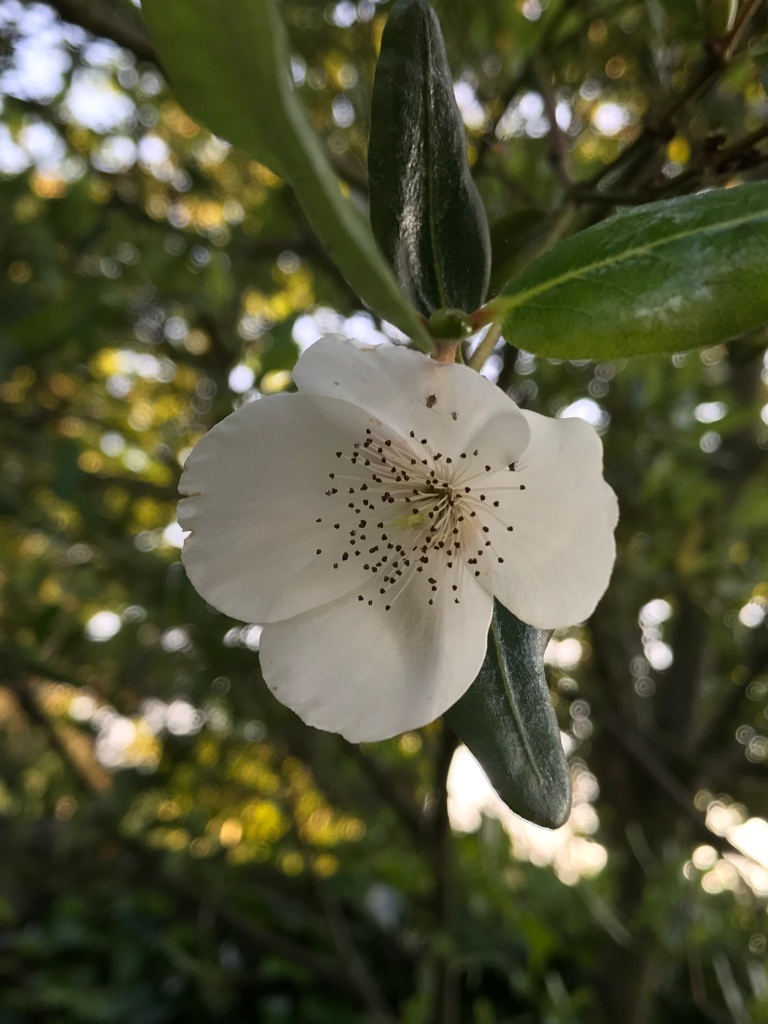
Plants teach you a kind of delayed gratification akin to agricultural sowing and harvesting. Like very slow fireworks, you stick them in the ground and retire for 12 months – or 24 months – or, in the case of my Tasmanian Leatherwood, 10 years. Leatherwoods are famous for the delicate flowers that appear in late summer and high-value honey.

Eucryphia lucida

I bought mine as a small sapling in the shop at Edinburgh’s Royal Botanic Gardens after admiring a splendid columnar specimen in full flower next to Inverleith House. As the years went by, my purchase grew painfully slowly and remained bereft of blooms. After a decade of disappointment, I stood before the the scrawny specimen, my hand hovering over the bow saw, when I noticed a single perfect flower. The next year there were more and now it is covered in blossom and attendant bees every summer.

One of the trees I took out with a very heavy heart was a russet apple. Although russet apples are hard and dry (and do the russet thing of going brown the instant they are cut open) they are sweet and stew well. We had fun weaning both our children on home-grown apple purée. But this russet was right in front of the proposed site of a new summer house. After seeing a lovely American crab apple, Malus dartmouth, in the Botanics, I ordered one online to compensate for the sacrificed tree. It arrived at my work from a nursery in Yorkshire, bare-rooted, 7 feet long and furled in black plastic. I lowered the roof of my car, stuck the long unwieldy parcel between the passenger seat and the transmission tunnel and with the top end protruding backwards, set off for home. A colleague saw me en route and asked me where I was planning to drop anchor. I planted the tree in the lawn and staked it low down for two years. It took well and it is a mass of blossom in the spring. If not picked for cooking, red and orange apples the size of table tennis balls hang on into the winter months like Christmas decorations.

In the end gardens are transient things that depend on an individual or group having the energy and determination to create something out of the incessant flow of nature. Gardens reward the gardener and give pleasure to others but neglect rapidly leads to decline and an overgrown garden is a poignant sight. To some, gardening will always be a dreary chore. Whenever I get overenthusiastic about its charms someone will say, ‘Well if you like it that much, you can come and do my garden.’ To which I always reply, ‘What would be the point of that?’

*My father was initially in partnership with his two brothers and since they shared a surname it was necessary to differentiate between them by calling them Mr John, Mr Willie and Mr James.

Harvest and the Big Mill

Corn stooks
Now westlin winds and slaught'ring guns
Bring Autumn's pleasant weather;
The moorcock springs on whirring wings,
Amang the blooming heather:
Now waving grain, wide o'er the plain,
Delights the weary farmer;
And the moon shines bright, as I rove at night,
To muse upon my charmer.

Song Composed in August
Robert Burns 

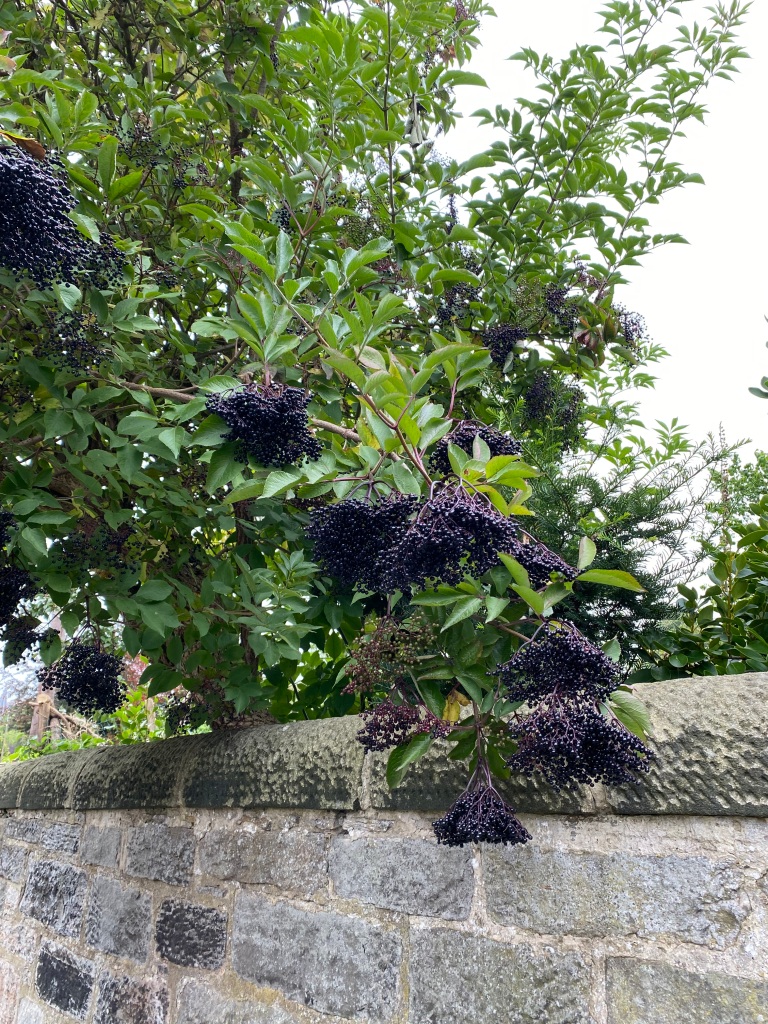
The end of summer is marked by lengthening shadows, the inward creep of sunrise and sunset, and the first hint of a chill in the air. Leaves that once showed a range of pristine greens are dull, holed and tattered. The harbingers of autumn are already rustling in the gutters. Apples, plums and elderberries bend the boughs and vagrant wasps become stupid and aggressive as their colonies decline. The garden display recedes to a limited palette of crocosmia, Japanese windflowers and Michaelmas daisies. An art teacher friend told me he didn’t like asters because they heralded the beginning of autumn term and the close of his seven-week sojourn as a part-time artist and full-time lotus-eater.

Pavement Michaelmas daisies or asters in decline, early September
Elderberries

In the country, the seasons had more practical implications. Once the hay was secured in July, attention turned to the harvest. In wet upland East Ayrshire wheat was never an option and barley varieties that could be relied upon to ripen and stay upright in the rain were a later development. As a boy, the farm depended solely on a third cereal, oats, as a grain crop. Oats are known as ‘corn’ in Scotland. The corn was used for cattle feed over the winter. Before the advent of silos, corn was stored in open bunkers in outhouses – an open invitation to vermin. With some corn in a noisy pail, and a head collar and rope hidden behind my back, I used it as bait to capture my pony.

As Dr Johnson pointed out, oats are fed to horses in England but in Scotland they sustain the people. Oatmeal was our rice. The tall stiff stems of oats resist beating down by the weather, slowly yellowing and displaying their grain in ears, covered by papery chaff. The traditional method of harvesting oats does not involve a combine harvester cutting and threshing the crop in a single process. My only experience of a combine as a boy was on my uncle’s farm south of Dalkeith in Midlothian. I watched as the great machine made its dusty progress across his dry wheat fields, eating up the cereal. The grain was spewed out into an escorting trailer and the straw deposited in long rows onto the field. To a farmer, a cleared stubble field is indeed a delight.

On the west coast farm of my youth, the process of harvesting oats was more complicated and protracted. Once ready, the field was opened manually using scythes, the cut corn was bundled into small sheaves by tying a few stalks around it. Then the reaper-binder, towed by a tractor, moved in. In addition to the tractor driver a second man perched on a seat on the binder itself. The binder featured a wheel similar to one of those paddles on a Mississippi riverboat. It gathered the corn onto the blades where, shorn, it dropped onto canvas belts. These carried the stalks upwards where they where automatically tied into bundles with ‘binder twine’. Tines chucked the completed sheaf out sideways onto the field as the machine progressed. In that state the corn was not yet ready for storage and required further drying in the field. This was done by creating stooks of several sheaves propped against each other. Manual labour was required to stook the sheaves, a process that exposed our vulnerable arms to thistles and insects. My father, an elder, supplied a couple of nice yellow sheaves to the church as decoration for harvest thanksgiving.

Once sufficiently matured by wind and sun, the sheaves were forked off the field onto a trailer and taken to the stack yard, a small field that was part of the farm steading. There they were built into large round Monet-esque stacks. The stacks were set on a base of boulders to keep the straw off the ground. Sheaves were stacked radially with the wider bases to the outside. The stacks could be as high as the roof of a farm building with a thatched conical top. A canvas tarpaulin hap was placed over the stack and weighed down by roped-on bricks to protect it from the weather. Like the loose corn in the outhouses, the crowded stacks supported large numbers of birds and rodents attracted to the free food. It is the origin of the seed-eating chaffinch’s name. Stacks looked great crowded together. I loved their bulk and their sweet smell.

Once the stack yard was filled, there remained the business of threshing; of separating the oats from the chaff and straw stalks. Safely stored in stacks, threshing could await the arrival of the ‘big mill’. The mill men would tour the neighbouring farms with their threshing machine, dealing with everyone’s stacks in turn. My mother was expected to feed the visitors, who arrived at the usual, extremely early, agricultural hour. I recall waking up in bed to the smell of bacon, tobacco, engine oil and sweat emanating from the kitchen downstairs.

The mill was powered by a long belt drive from a stationary tractor. The grain dropped into hessian sacks and the straw was fed into an adjacent baler. As the stack went down, its inhabitants were revealed. Trouser legs were tied with binder twine, the base of the stack was surrounded by unrolled chicken wire, sticks were taken up and the dogs were sent in.

The men would entertain us with stories of rats running up trouser legs. One of them claimed to have trapped a rat against his back by flexing forwards to tighten his shirt on top of it. His colleague then dealt with his passenger using a broken brush handle. He then pulled his shirt out and the dead rat dropped to the ground. After the mill had been, the stack yard reverted to a wildflower meadow and playground with its resident ducks, bantams and chickens. One of our henhouses was in the stack yard.

Later we did manage to grow and harvest barley which was stored in a silo tower. The silo made a good viewing platform but the effect on farm life was striking. The bounty of stored or spilled corn was no longer available and the population of finches, rodents – and the predators who depended on them – crashed.

Numerous stacks are a reflection of a farm’s productivity and prosperity. My grandfather who began life as a tenant farmer was famously stern, business-like and astute. As a young man, just after the First World War, and after he had almost died of Spanish flu, one of his friends asked a favour. He needed to meet his young lady’s parents to ask for their daughter’s hand. The friend was nervous about the outcome of this encounter and asked my grandfather to accompany him. The visit to the parental farm was set for a Sunday after church. The two lads arrived in good time to find the family had not yet returned from worship. No one was at home. Taking his responsibilities seriously, my grandfather grabbed his friend’s arm urgently and said, ‘Quick, let’s go round the back and count the stacks!’

Not vernal show'rs to budding flow'rs, 
Not Autumn to the farmer, 
So dear can be as thou to me, 
My fair, my lovely charmer!

Ashes to Ashes

Ash die-back seems to get little attention in the news media. This disease is going to kill 80% of Britain’s ash trees, cost billions, and threaten native species that are dependent on the tree.

Ashes in an advanced state of decline on the Mortonhall Estate, Edinburgh

It is caused by a fungus Hymenoscyphus fraxineus, which originated in Asia. It has little effect on Chinese ash species but the European ash evolved without exposure to it and the effects have been devastating over the last 30 years. The disease first emerged in the south east of England. While it may have arrived naturally, we were importing thousands of infected ash saplings from Europe up until 2012.

Badly affected young tree in the foreground with a healthy-looking older specimen in the background on the right.

The fungus invades the nutrient channels in the wood and the tree’s response to this results in the channels becoming blocked. The branches distal to the blockage die. Dormant buds proximal to the affected branch sprout, giving the typical appearance of bare branches with new growth close to the trunk. Dark diamond-shaped patches develop on the dead branches. Young trees are affected most severely. Older trees show some early resistance but eventually die. Once you know the signs, it is obvious the disease is everywhere. Newly-established trees planted at great expense for their amenity value are succumbing.

Weeping ashes are not immune.

A small number of our native ashes appear to be resistant but recovery by the spread of these varieties will take at least 50 years. The cost in terms of loss of the beneficial effects of the trees and clearing away the dead ones has been estimated at £15 billion by the Woodland Trust.

https://www.woodlandtrust.org.uk/trees-woods-and-wildlife/tree-pests-and-diseases/key-tree-pests-and-diseases/ash-dieback/

Faceneck

Within my school year group, my 17th birthday in March 1971 was rather late compared to my peers. Many others had passed their driving tests by the time I was eligible. This was an almost unbearable delay to me, desperate as I was to escape from the farm and hit the roads. I had been entertaining other plans involving motorcycles and Heinkel bubble cars – both of which one could drive aged 16. Thankfully my parents resisted – otherwise I probably wouldn’t be around to write about it. In the 1970s road deaths among young people, and young farmers in particular, were common. A farming family that sat opposite us in church consisted of two sons and a daughter. First one son, then the other were killed in car accidents and the father wore a black armband to church from that time onwards. I used to watch him dozing through the sermon beside the two women and wonder how he had borne the loss. My older cousin, also a farmer, liked fast cars and had come within a whisker of disaster on a few occasions.

Obviously such considerations of mortality meant nothing to me as I was convinced, like all young men, of my skill and invulnerability. I was sure I would survive. My father started out teaching me but having driven cars on single track roads and fields since age 11 I was prone to drifting into the middle of the road which unnerved him and an instructor was engaged. He said I was clearly competent but years of unsupervised driving had left me with a lot of bad habits to unlearn before the test. One habit I kept quiet about was secretly driving on public roads long before it was even legal for me to hold a provisional licence.

The day of the test came and I sat it in the family Hillman Hunter Estate. During the test we passed our business offices in Ayr road. My father came out just at that moment and waved to me. I remembered that waving to people during the test was a fault and ignored him. I passed at the first attempt.

At 1500cc the rear wheel drive Hillman was lacking in power but could be put into a very satisfactory and predictable sideways slide on corners if you threw the back end out then steered into the skid. I also double de-clutched in rally style – something I actually had to do on the milk tanker I drove because it lacked a synchromesh gearbox. We started going on very long evening expeditions all over the county instead of doing our homework. We discovered pubs we thought no one would know us in and played darts and drank beer without fear of detection by parents or police. We thought.

My friend Davy had met some girls at the ‘French Summer School’ for music and language students held at West Linton. The summer after passing my test these girls turned up at a similar event in Cumnock and Davy thought we should take them to Ayr and show them the bright lights of Ayrshire. On the way there we were overtaken in humiliatingly easy fashion by a Jaguar saloon and feeling my honour impugned I set off after it as fast as the Hillman’s 1500cc could manage. Even with the accelerator flat to the floor we were struggling to keep the Jaguar in sight – then I noticed an odd noise and smoke began to rise out of the footwell. I had succeeded in blowing the engine. We walked to a phone box and summoned assistance from home. Later dissection revealed I had melted the shell bearings onto the big ends. With a fleet of milk lorries to service and maintain we had a large garage on the farm and three mechanics: the head engineer Bill Bunce, a second in command and an apprentice. Bill had three daughters and I had an absentee (for business reasons) father so we had spent a lot of time chatting in the garage and going on fishing expeditions together. The Hillman had to go to the garage and have Bill rebuild the engine.

Undaunted, we borrowed a milk lorry and used that for the next evening’s excursion. Some locals spotted two youths and two girls crammed into the cab and called the police assuming the lorry had been stolen. Fortunately the police didn’t find us. The upshot of the blown engine was that my father was without his everyday practical farm transport and he decided that I should have my own car to avoid this happening in future. I began looking through the papers for a likely candidate and found a 9 month old Mini 1275GT for sale in a garage in Kilmarnock. Dad was too busy as usual so Bill and I set off to have a look at it.

Bill was a massively built Londoner with a matching large personality who loved everything mechanical. He also loved dogs, guns and fishing. He walked into the showroom and announced to the startled salesman, “Is this where you get the bargains?” We looked at the mini. It was white, had the Clubman grille with red ‘go faster’ stripes and ‘1275GT’ running along the sides. The seats were black and the interior smelt strongly of stale cigarettes. It had belonged to a salesman and had done 15,000 miles in just 9 months. It was priced at £750 and I loved it. Bill had a look inside the engine compartment and did a couple of circuits inspecting the bodywork. He said it was very high mileage and we weren’t interested at that price. To my consternation he turned and walked away. At that the salesman dropped the price to £730 and we did a deal.

Adrian, a friend of Davy’s, had been trying to remember the name of David Coleman as in Sportsnight with Coleman (https://youtu.be/2Im_FnXiCHg) and groping for the right word, came up with ‘Sportsnight with – Faceneck’ for reasons known only to him. I suppose it was his version of thingummy. The ridiculous name stuck in Davy’s mind and we ended up calling the car Faceneck. It amused us at the time.

Faceneck
On her way to Norway with her Cibié spots

By today’s standards the car was not fast, taking about 12 seconds to reach 60 mph and it struggled to get over 90 mph tops. However the sensation of your backside barely clearing the road and a driving position that forced your knees up round your ears was fun. The gearbox was awful, like stirring a box of rubber balls with a stick – and the engine would overheat in summer. You could get round this to an extent by turning the heating up full blast and opening the windows. My father reluctantly accepted this fait accompli and phoned up his insurers to discover that fully comprehensive cover for me was going to cost £250, about a third of the price of the car. His detachment from the whole process was such that it was only when he borrowed the mini to take our cleaning lady home that he discovered its performance. “You be very, very careful in that car,” he warned me afterwards.

Faceneck featured a ‘racing handbrake’. Basically there are no ratchets until the brake was fully on making it a pull-on pull-off brake. A binary bake. This allowed you to do handbrake turns. You threw the wheel right or left and pulled on the handbrake sending the car into a huge spin, doing a 180º to face in the opposite direction. You then pressed the button on the handbrake which instantly fully released it. I garaged the mini in one of the free bays in the hayshed behind the house. The shed is visible in the front view photograph filled with hay bales. One night in the early hours after the usual late night chat with pals I decided to practice handbrake turns on the tarmac surface in front of the shed. It was all going brilliantly until on the fourth or fifth attempt my headlights picked up my pyjama-clad father furiously signalling me to stop. It was apparently difficult to sleep through handbrake turns.

At age 17 such a vehicle was intoxicating. I drove everywhere as fast as possible at the limits of adhesion and timed myself over various regular routes. My father now had his estate car back but very soon the mini was in the garage. I started in a low-key way, skidding on ice and ending up in a ditch on my way home from rehearsals for the school play. My cast-member passenger was very understanding. Things progressed from that point onwards. I went through fences, over fences and finally rolled the car over completely having gone up and embankment on a tight bend. That repair involved Bill ordering an entire new body shell from British Leyland and reglazing the windows. My mother once borrowed the car to go shopping and while parked the Dowager Marchioness of Bute reversed into it with her Rolls Royce. As a result, when I sold Faceneck, the only original parts left were the seats, the engine, the wheels and one of the doors.

Amazingly, I was allowed to bring the car to school and park it with the teachers’ cars. As I had done throughout my school days I always went home for lunch. On returning for the afternoon session I did get into trouble for demonstrating to my fellow pupils how I could generate wheel spin changing from first to second gear as I entered the playground.

Eventually even my father’s patience and detachment ran out and I was told the car had to go. His exact words were, “You’ve had your beard, you’ve had your long hair and you’ve had your sports car. It’s time to settle down.” I was 20. At that time I was sharing a flat in Watson Crescent with Hans Kubon a Norwegian dental student. The cost of living was so high and the exchange rate so extremely weighted in favour of the Krone that Norwegians could buy cars and even flats with their grants. Hans wanted to buy Faceneck. Accordingly, we arranged to travel together on the ferry from Newcastle to Bergen. After a pleasant holiday staying with Hans and his parents in Kråkenes, I left the car behind.

In 1989 I was completing my last Senior Registrar attachment at the Western General before taking up my consultant post. We had to go to the Northern General on a Friday afternoon to do the plain film reporting. As I was leaving one evening I noticed a white Mini Clubman approaching the exit. I checked the number plate: it was SCS 730J. The car was waiting in a queue to join the traffic on Ferry Road. I rushed over and tapped on the passenger window. The woman driver reached over and wound it down. “Sorry to bother you,” I said, “But where did you get this car?” “I bought it off a Norwegian dental student when he went back home,” said the lady, who turned out to be a nurse in the hospital. “This was my first car!” I exclaimed, overcome with excitement, “I sold it to that dental student.” The lady beamed. “I’ve had it ten years. My husband hates it but I love it!” At that point the queue moved forward and she had to say a hasty goodbye. I watched Faceneck disappear down Ferry road.

Making Hay

Haytime at Crofthead in the mid-Sixties. Big cousin and younger brothers on top, me at the wheel.

Every summer we made close to 100 acres of hay. My father disapproved of silage which he thought tainted the milk. In Ayrshire, at around 600 feet above sea level, we made our hay in July. The tractormen did the more skilled tasks of mowing and baling, but working the cut hay and gathering it in was anyone’s job. Bales of hay are heavier than straw, oblong in shape, and secured by ‘binder twine’ which burned your fingers if you let them slide along the cord. Usually it was better to dig your fingers into the bale to lift it. Until your hands toughened up, dried thistles or grass stems under your fingernails were an unpleasant hazard.

The baler would chug along, dropping bales at intervals across the field as it consumed the lines of hay. As children we were too weak to lift bales but we got a few pennies for rolling them together into heaps. This made it easier for the men to fork them onto trailers or the old milk lorries that were drafted in for the season. Later a bale ‘sledge’ was acquired which was towed behind the baler. It consisted of a wooden platform with stout steel prongs mounted behind it that supported the bales until the miniature stack was complete. The task of arranging the bales into a triangular pile resting on these forks at the back of the sledge was brutally physical and was conducted in a choking cloud of dust and flying fragments of dry grass. The ram on the baler rocked the whole rig back and forth making it difficult to keep your balance. Once a pile of 10 bales was constructed, a lever at the side released it onto the field. This had to be done sharply to avoid the pile tipping over. The process then began again.

I started driving tractors at 9 and cars and lorries at 11. Aged 9 I was insufficiently heavy to depress the clutch on a tractor using gravity alone. I had to brace myself against the steering wheel and push down with all my strength. On the way back up, with the spring resisting, controlled engagement of first gear was tricky. The accelerator on a tractor was a lever mounted on the steering column and it stayed wherever you put it, fixing the revs. My favourite tractor was our ancient ‘wee grey Fergie’ (Ferguson TEA 20) which had 4 forward gears and was quite fast. You started it by depressing a brass button with the inner side of your right lower leg and pushing the gear lever into ‘S’. It also had a ‘Ki-Gass’ button which I never understood. I loved the smell of fresh hay and diesel.

At first I simply drove the lorries or tractors between the piles of bales in the fields, stopping at each one so that the two-man team could fork them up to whoever was building the load. The older lorries’ gearboxes lacked synchromesh so I learned early how to double declutch to changing down smoothly. This was useful later when driving cars at rally speeds around country roads. As I got older and stronger I graduated from driving to load-building, learning to lock the bales together like laying bricks.

Bales varied in length and some of the longer ones needed slammed into any gap that was slightly too small. Kneeling down, this took considerable strength and timing, especially when the team with the pitchforks were trying to bury you in more bales. I never made it to pitchforker status. The relentless parade of tractors and lorries shuttling from field to hay sheds meant that the men with the pitchforks were in constant action. In addition to strength and stamina, timing was needed to get the bales onto the top as the load rose higher.

Whoever had built the load would also drive it back to the farm for unloading and storage in the hay sheds. There was an element of taking responsibility for your construction skills. On the lorries we simply relied on gravity to hold the bales in place but the biggest tractor-drawn trailer loads overhung the sides and were so tall they often had to be roped to cope with the big sways caused by negotiating ruts at the field gates. This made riding on top of such loads quite exciting. Even if the load held – and sometimes it didn’t – the branches of nearby trees would threaten to brush you off your perch.

On really hot days little whirlwinds would pick up loose hay and deposit wisps of it onto the tops of nearby trees. Rain usually meant work was suspended. As a small child I remember sitting on top of the last load of the day along with the men in the pitchfork team as it left the field. As it started to rain, one of the men lifted a bale out to create a space for me. I jumped in and they placed the bale across the hole for shelter. It was very pleasant to ‘coorie-in‘* as my refuge swayed back and forth.

Before baling, the hay needed to be sufficiently dry to stop the shed turning into a massive compost heap. The weather was critical to this. While it takes only three consecutive dry days to cut silage (which is preserved by fermentation) at least two weeks of dry weather are needed to get any significant acreage of hay. This rarely happened. In the worst years prolonged rain could turn hay that was almost ready into a blackened mess fit only for burning. My father sometimes called Prestwick Airport to get an indication of what was coming towards us over the Atlantic. If it was rain, you might bale hay that wasn’t quite ready rather than lose it altogether. The longer the mature hay lay in the field, the less its nutritional value.

The tractor men ‘opened’ the fields of long grass by cutting the ‘end-rigs‘ next to the hedge first, then cutting the rest of the field into long rows. After the top layer of grass had begun to dry the rows needed turned over. The older turning machines used the movement of their wheels over the ground as a source of power. Later I used a more modern ‘Acrobat’ rake with 4 large yellow wheels of sprung tines which rotated by being dragged over the ground. Set separately these would pick up two rows of drying grass and flip them over individually. By rearranging the 4 wheels into a single line the Acrobat could be converted into a rake for clearing any residual hay left after all the bales had been removed. Whether turning or raking, it took a long time to do a whole field. A cleared field was described as ‘redd‘. Clearing up at the end of a day was getting ‘redd-up‘ as in; ‘We’ll need tae get redd-up, it’s lowsing time‘. Lowsing or loosing probably refers to the unyoking of horses or oxen at the end of a day’s work.

One summer while turning a field, I noticed a hint of putrefaction as I reached the end rigs next to the hedge. Returning to the same place on the following set of rows the smell got stronger. The next time it was detectable far from the hedge and became quite overpowering. I stopped to investigate. Over the hedge, trapped in a ditch by thorns, was a black-faced ewe, still alive, but with her hindquarters seething with maggots. It’s a distressing image I cannot seem to erase from my mind. A couple of seasons later I had a parallel experience – but this time the smell was sweet. As I approached the source it was obvious that it emanated from a huge mound of wild honeysuckle, its yellow flowers covering the hedge.

Once turned and dried on the reverse side, the maturing hay needed ‘tedding’ – using a tedder of course. These machines were power-driven from the PTO (Power Take-Off) on the tractor and their job was to throw two rows of drying hay into one large row, fluffing it up in the process. This allowed the sun and wind to further dry the hay ready for baling. The machine I favoured had two horizontal rotating wheels with large tines attached. We called this process ‘wuffling’ as one make of tedder was actually called a ‘Wuffler’. Once, when enthusiastically experimenting with how fast I could turn round on the end rigs, I miscalculated and wuffled the hedge. Bits of hawthorn flew in all directions and I bent some of the armatures. Our engineer had to straighten them with a welding torch and a hammer.

Later on as a teenager I would spend the summer mornings working in the dairy, loading milk bottles into crates as they came off the bottling plant, or get up at 4am to deliver milk for one of the roundsmen. After this very early start the dairy was finished by the afternoon and it was time to go to the hay fields once any morning damp had dispersed. My mother would bring refreshments out to us. It was lovely to take a break and sit on a bale under the shade of a tree eating sandwiches and taking tea from a flask. The men got a beer. It was good for morale. If it remained dry with no early dew, work would continue far into the evening, making escape to the pub before closing time increasingly difficult.

During the day, priorities might change and my father, who was supervising it all, would sometimes stop me working in one field in order to go to another or help out elsewhere. The constant drone of the tractor engine and the noisy machinery were like white noise. You stopped noticing it after a while. Paradoxically the racket and monotony of traversing a field over and over again allowed your mind to wander.

My father had a powerful whistle which he could deliver without using his fingers – something I never mastered. This was how he got my attention if I was working on a noisy tractor. Hearing his whistle, I would look up and see him in tweed cap, waistcoat and rolled-up sleeves, waving at me from the gate. He died when I was in my third year of medical school and while I was in a bit of academic trouble. The year after that, I was working a field when I thought I heard a whistle. Automatically, I looked down the rows to the end of the field, which was – of course – deserted. It was like a waking version of those dreams where you discover someone you loved and lost is still alive. My dreams about my late father finally stopped a few years ago and I no longer wake up just as I am demanding to know why he has kept his survival a secret from us for so long.

Building the hay into the corrugated iron sheds was tough. Each shed was divided up, by the girders supporting the roof, into several sections or ‘dasses‘ (another Scots word). These sections were stacked to the roof in turn. Open wooden trunking was placed on the floor of the dass to allow it to be ‘blown’ later. As the dass rose, the space under the curved metal roof got smaller – and hotter. Reversing into the shed was tricky and the men would amuse themselves by shouting false instructions at us:

‘Up the hill!’

‘Naw, doon the hill!’

‘Back, back, back, come on! Oh Christ you’ve hit it!’

The last dass in a shed was completed using an elevator to take the bales up through a small opening high in the gable end. In summer the roof was hot to the touch and the atmosphere inside suffocating. It was easy to overwhelm the unseen team in the shed by loading the bales too quickly onto the elevator. More shouting was required.

Inevitably, no matter how dry the hay was, it tended to heat in the shed; the same process that takes place in a compost heap. In an attempt to stop this happening a huge power-driven, heated, fan was mounted on a tractor to blow air into the trunking at the bottom of the dass. Steam would emerge from the openings in the gables in a satisfying way. The noise of the tractor engine droning on into the evening is associated in my mind with late summer, as too the glorious peace that ensued when the engine was cut, leaving just the sound of swallows twittering on the telephone wires.

Throughout the rest of the year the hay sheds were our playgrounds. We would build houses out of the bales or jump off the top of one dass onto loose straw on the lower one next to it. There is no recreational value to be had from a silage pit.

*snuggle in.

My mother Edith with a hay cart at Bearcrofts, near Grangemouth, before the War.

Not-So-Common Swifts

Common swift casualty, Tourettes-sur-Loup, Provence July 2014. The pale edging on the wings indicates a juvenile.

If any bird typifies Edinburgh in summer it is – or at least was – the swift. There are no house martins or swallows in the centre of the city; swifts are the only insect hunters we see overhead. The beginning of summer is marked by their arrival in May. We enjoy them for just three short months before they head off, juveniles first, in mid August. This spring, of 2021, was exceptionally cold and their appearance was delayed beyond the 15th of May, the date when I expect to look up and see one overhead. Their wings are long and stiff with a short ‘arm’ and long ‘hand’. They generate propulsion on the downstroke and the upstroke. Head-on, the wing action has a striking ‘whirling’ appearance as if the wings were rotating. Famously, they eat, sleep and mate in the air.

Swifts have very short legs and tiny feet. Indeed, they were once thought to have no feet at all – hence their scientific name Apus (a-pus, no feet). Apus apus, the common swift, is one of those select species that was so good, they named it twice. Convergent evolution has resulted in superficial similarities between swifts, swallows and martins but swifts are more closely related to hummingbirds. They also look a bit like smaller versions of the nightjars that precede them on the taxonomic list. The huge alpine swift with its white belly and wingspan of close to 2 feet is something else. I have seen and filmed one in Scotland, an experience I will never forget.

Swifts live up to their name. They are the fastest of birds in level flight, reaching 70mph. Peregrines can achieve greater speeds but only in a power dive. Swifts winter in Africa and are masters at using the winds associated with weather fronts to aid their movement. They won’t hunt in rain while they are in Europe and will fly hundreds of miles around bad weather to find food. They pack the insects into pellets in their throats to transport back to the nest. Swifts nesting in the west of Scotland have been tracked flying to Loch Neagh in Northern Ireland to feed. If the weather is bad and no food is available, the young birds in the nest will go into a state of torpor for up to 48 hours. Hummingbirds can perform the same trick.

When I moved to an upper flat in the New Town in 1979 I became much more aware of these birds. The top floor rooms had coom* ceilings with large single-pane skylights set into the pitched roof. I could watch swifts traversing that patch of sky from my bed – or my bath. Later in the season, ‘screaming parties’ of speeding swifts would hurtle through the airspace above the gardens at the rear of the tenement. I watched them from the common stair windows.

Gangs of screamers would pass low overhead at a beer garden we favoured in Morningside. I found the strange noise atmospheric and never unpleasant. Even then, 40 years ago, the numbers were no match for the fathoms of swifts and hirundines you see over urban areas in France and Italy but now they are even less common. This year I have only witnessed one small party over a friend’s garden, but they were a welcome sight. The most reliable place to see them locally seems to be over the tenements of Marchmont where presumably there are suitable sites for nests. Once airborne, juvenile swifts can stay aloft continuously for 10 months or more without ever touching down.

Historically, swifts nested on cliffs, in caves and in holes in trees. A small colony in the Cairngorms still does this. Deforestation meant a move to the towns where they used spaces under slates and eaves to nest. Swifts mate for life and re-use the same nest site. The nest is made from feathers and other detritus collected on the wing. Sometimes the nest material is eaten by clothes and carpet moths during the 40 weeks it is abandonned by the birds. Even more unpleasant are the huge blood-sucking ticks that have evolved to parasitise the birds. The equivalent size in a human being would be a shore crab crawling about in our underwear.

The reason the numbers in Edinburgh are so seriously diminished is uncertain. The lack of insects is a possibility, as witnessed by the current dearth of fly squat on the front of our cars. Increased affluence has perhaps resulted in Edinburgh repairing the more crumbly bits of its ancient built environment, reducing possible nest sites.

My office at the Western General Hospital and the coffee room next door looked onto a large enclosed area surrounded by the original 1865 Victorian sandstone hospital building, including a clock tower. The clock was correct twice a day. As usual in the NHS, the enclosure had been crammed with later, cheap, flat-roofed buildings including the dining room and kitchens. A pair of swifts nested in a hole in the wall below the clock tower opposite our offices. Probably the site of some old pipework, the hole was small and situated about 10 feet above the flat roofs. The birds would fly straight into this tiny aperture at top speed and I enjoyed watching them come and go.

Swifts prefer to launch themselves by dropping from a perch using gravity to increase airspeed. The lore is that swifts, with their tiny legs, cannot take off from a flat surface. Once, while eating lunch, I saw a swift exit the hole then plunge downwards crashing onto the flat roof. I was already preparing a rescue mission in my mind. ‘Watch!’ I said confidently to my colleagues, ‘It won’t be able to take off’. As I said this, the fallen bird whirred its wings and rose into the air with little apparent effort. Most texts now specifically say that they can take off from the ground. One winter morning I came to work and glanced out of the window to see that the hole had been cemented up. Not all maintenance is an improvement.

Now, in early August, the michaelmas daisies, buddleia and Japanese anemones are in flower. Soon the swifts will slip away and the children will return to school. The days are already noticeably shorter and today it felt a bit chilly out of the sun.

*a sloping ceiling under a pitched roof.

The Ghastly Astley

Pigsty 1
Pigsty 2
Pigsty 3

To us medical students in Edinburgh in the late 1970s the Astley Ainslie Hospital (AAH) was known as the ‘Ghastly Astley.’ This was mostly for the satisfaction of the rhyme rather than any particular horrors it held. It was a rehabilitation hospital, one of the first of its kind, set in the majestic wooded grounds of a number of grand villas and a nine hole ‘ladies’ golf course. The oldest villa, Canaan House, dates from 1805 and I attended medical management meetings in it. There are mementoes of the Ainslie family there; paintings and agricultural trophies. Like many other properties ‘owned’ by NHS Lothian it was donated to the people of Edinburgh by a public-spirited benefactor long before the inception of the NHS. It is now being sold off and the money chucked into the black hole of NHS financing – where it will disappear without trace. Many other Edinburgh medical institutions funded by public subscription, such as Leith Hospital, have already been disposed of despite protests.

The history of the place is interesting. Lost in the mists of the sixteenth century is the chapel of St Roque. It was dedicated to a French saint who survived the plague and was fed by a hunting dog who brought him bread. He is usually depicted lifting his robe to display the bubo of the disease on his left thigh. A dog bearing a loaf is often alongside him. He is the patron saint of the sick and of dogs. His tomb and a church dedicated to him are in Venice.

King James IV of Scotland was very keen on St Roque (or Roch or Rock or even San Rocco) and his supposed powers of intercession with the plague. After assembling his doomed Flower of Scotland army on the Burgh Muir in 1513, King James prayed in St Roque’s Chapel which stood in what is now the Astley Ainslie grounds. The chapel is long gone. As it was being demolished in the late eighteenth century on the orders of its then owner, scaffolding collapsed killing several workmen. Work was delayed for fear of further punishment from God or the saint. Nothing now remains of the chapel and no one knows exactly where it was. There is a modest modern educational building near the spot. I briefly worked with Brian Pentland at the Northern General Hospital in 1980.

Brian Pentland Education Unit

The area around St Roque’s Chapel was a refuge for many of Edinburgh’s plague victims and there are burial sites in the hospital grounds. Nobody is exactly sure where these are either. Also scattered around the campus are bits of ecclesiastical masonry including bosses from the roof of a church or chapel. One of them depicts Christ’s wounds with nails piercing disembodied hands and feet. Over the years these interesting architectural fragments have been pillaged – presumably for garden ornaments – and few remain. There is a theory that says the stones are from the dismantled Trinity Church which stood on the site of Waverley Station. However they could well be from St Roque’s itself. There are also a number of medieval wells in the grounds.

Hands, feet, skull and nails
Bits and pieces

The fine nineteenth century villas that still make up parts of the hospital occupy one of the best locations in the city. Their huge south-facing gardens contained many rare plants and trees because several of the occupants had an interest in botany. The villa of Millbank was the home of Professor James Syme the famous surgeon. Born on Princes Street, his father was a lawyer and landowner. As a student Syme discovered a process for waterproofing textiles using rubber but didn’t bother developing it further leaving Mr Macintosh to make his fortune from it and achieve eponymous fame. If he had bothered, people would be donning their ‘Syme’ to go walking in the rain.

Syme rose to occupy chairs of surgery in London and Edinburgh. His home of Millbank was demolished and replaced by one of the AAH ‘butterfly pavilions’ but some photographs of it exist. Millbank had a huge garden with extensive glass houses growing exotic fruits; bananas, figs, grapes and pineapples. The professor enjoyed serving these to his dinner guests. In the morning Syme would inspect his ‘glass’ with his gardener before heading off to the Royal Infirmary to operate. The Infirmary was in Infirmary Street at this time.

There is an eponymous Syme foot amputation, preserving the heel, which he developed. He was a quarrelsome man, thought to be ‘correct in the matter but not in the manner of his disputes’. One of the people he quarrelled with was his former friend James Young Simpson, professor of obstetrics and the inventor of anaesthesia. Syme did not believe in anaesthesia feeling that it weakened the patient. The quarrel was only made up after Syme operated on Simpson for an abscess in his armpit that Simpson developed after he cut his hand during an operation. They were the two colossi of Edinburgh medicine, at a time when Edinburgh Medical School was a world leader. One of the arguments Syme did win, albeit posthumously, was over the siting of the last-but-one Royal Infirmary on the northern edge of the Meadows, inaugurated in 1879. The ‘Battle of the Two Sites’ centred around whether to build a new infirmary on the existing site or on the 11 acre grounds of George Watson’s Hospital off Lauriston Place. Syme died following a stroke in 1870.

Millbank

Friends’ Seat by Catherine Stevenson

Syme’s eldest daughter Agnes shared her father’s interest in botany. She married her father’s assistant Joseph Lister, the future Lord Lister, who developed antisepsis and saved countless lives. Experiments into suitable sterilising substances took place at Millbank and Agnes assisted with these. The couple were married in the living room of the house, apparently in deference to Lister’s Quaker religious views, and a modest plaque on the side of the boarded-up Millbank Pavilion commemorates the event. Lister operated on my great grandmother.

Millbank Pavilion before…
…and after

John Astley Ainslie inherited a vast fortune on the death of his brother. An orphan, he and was taken under the wing of his uncle David Ainslie who had a house called Costerton near Fala south east of Edinburgh. It is now a roofless ruin. The two men were very close. John had already donated money to the construction of the new Royal Infirmary at the time of his death. The year after he graduated from Oxford he died in Algiers of unknown causes aged 26.

The family fortune passed to his uncle David who wished to do something to commemorate the life of his nephew. When David died in 1900 he left £800,000 for the founding of the ‘Astley Ainslie Institution’. This sum would be around £30 million in today’s values, apparently the largest bequest in Scottish history. He stipulated that the money should be invested for 15 years after his death so that its value might increase. World War One intervened and in the end the hospital was constructed in the 1920s to a very high architectural standard. The trust bought up adjacent properties to incorporate them into the Institute.

The parkland around Millbank included a nine hole ladies’ golf course and fine specimen trees. The hospital gardens were laid out by experts from the Royal Botanic Gardens in Edinburgh. ‘Butterfly pavilions’ were constructed so that invalids could take the air out of doors on their beds. The site eventually covered nearly 50 acres.

George Bald memorial bench: 45 years a gardener at AAH.

This brings us to the current sorry state of affairs. NHS Lothian is moving off most of the site to new premises in the grounds of the Royal Edinburgh Hospital in Morningside. Several of the splendid AAH pavilions have already been boarded up and local vandals have moved onto the site. The buildings have been aerosol sprayed and re-sprayed in a delinquent palimpsest of graffiti ‘art’ and windows have been broken to gain entry to the abandoned premises. Discarded bottles and cans and burnt-out fires litter the grounds. A former pigsty in the pine woods (an abandoned Christmas tree scheme apparently) has been interestingly redecorated several times but the pavilions just look grim. Tennis courts to the west of the woods have long since been taken over by self-seeded sycamores. My wife Catherine and I are very familiar with the site. We live nearby and have walked our dog there for 5 years. Catherine has painted several views of AAH.

Anyone for tennis?

We are told that a large part of the site has been sold for residential development which is likely to mean there will no longer be any access to the lovely grounds for responsible locals. The physician superintendent’s house has already been demolished and replaced by a row of high specification terraced town houses by Malcolm Fraser. Goodness knows what the fate of the architectural remains and the listed 1920s buildings will be. There is an Astley Ainslie community trust and a campaign to keep some sort of communal access. Ian Rankin whose son stays in the adjacent Royal Blind accommodation has become involved.

If an area with this degree of historical significance and beauty ends up as just another anonymous overpriced, over-crammed, group of apartment blocks similar to others nearby it will be a great loss to the city and to the people David Ainslie imagined his bequest would benefit.

St Roque House
The Lantern of St Roque by Catherine Stevenson