New Year’s Day, Ne’erday, pronounced ‘Newerday’ in our part of East Ayrshire, was a significant day on the farm where I grew up. On a dairy farm caring for the animals has to continue every day of the year and the farm workers, whether on or off duty, would be invited to come into the kitchen at intervals during the day to have a drink and a piece of homemade cake or shortbread, known as their ‘Ne’erday’.
A sort of Lord of Misrule situation applied on these occasions and older members of the farm staff would enjoy recounting stories of Changue as they remembered it from long ago. Although my father was 47 when I was born, Mary McKrindle the dairy maid remembered him, his two brothers and his sister as children. She also remembered my grandmother, suffering from acute appendicitis, being taken away to Glasgow, never to return. That was in 1920 and my father, the eldest of the children, was 14 when she died.
My father and his mother in 1908
In due course a stepmother arrived who was thereafter referred to as ‘Mrs S’ within the family. When my grandfather, her husband, died in 1932 my father was left to lead the family and the business at the age of only 25. Mrs S, apparently lacking any confidence in Dad’s youthful judgement, left Changue and went off to Glasgow. When I was born 22 years later in 1954 there was no longer any reason for my parents to mention her at all. One day my mother took us aside in the morning room and said, ‘I think you boys should know that Mrs S has died’. Although the name was vaguely familiar to us we had no idea who she was referring to.
In addition to my father and his siblings James, Willie and Nan, there had been a wee brother David who was scalded to death in an accident on the farm aged 2. That story filled us with dread and was perhaps meant to engender caution on our part when playing all day unsupervised among so many agricultural dangers.
Changue in the 1950s
On the other side of the family my mother’s parents were not that much older than my father. My grandad was born in 1892 and my father in 1907. It seemed perfectly natural to us to have just the one set of grandparents.
My mother was very close to her parents who having retired from farming nearby, lived in Eskbank. We visited each other many times a year, becoming very familiar with the A70. We knew the coal mining count-down of Howgate, Rosewell, Bonnyrigg and Lasswade before we reached Eskbank and Fala House. The sulphurous smell of smouldering pit bings told us we were getting close to our destination.
Granny and Grandad always came to Changue for Christmas and New Year. We played cards and stayed up for the bells, watching TV. Being awake at midnight was a strange and unfamiliar experience. Granny and Grandad toasted the new year with soft drinks like Schweppes Bitter Lemon. All the adults held strong christian beliefs and my father was an elder of the Kirk. Drinking any alcohol other than perhaps a sweet sherry was frowned upon even at the great midwinter celebration.
Nevertheless it was exciting to be allowed to stay up late and we accepted the naff offerings on TV without question. The White Heather Club dancers, Andy Stewart, Duncan McRae and Ricky Fulton tripped their monochrome way across the Ferranti set with its wooden doors and bakelite knobs.
Below the screen were two large round knobs; one to switch the set off and on and the other for volume. Between these, in a little fold-down compartment, were additional controls: brightness, contrast, vertical hold and horizontal hold. When we finally got STV, a small maroon box with cream switches appeared on top of the cabinet. This meant we could rush our lunch and watch Larry ‘sit back and relax’ Marshall and the One O’Clock Gang before going back to school in the afternoon. It supplied a vocabulary of really bad jokes by which to judge better ones later.
There was a certain thrill to the change in the year, a much more significant event if your age is still in single digits. I can recall the Blue Peter programme pointing out that 1961 read the same upside down as it did the right way up and later years seemed to have an almost science fiction air of modernity as the numbers ticked up. The Sixties were all about relentless modernity.
At primary school early one January I overheard some boys telling each other a hilarious joke which included some words I was not familiar with. I carefully remembered it so I could entertain my father when he collected me at lunchtime.
“Dad, do you know what year it is?”
“Eh, what year is it then?”
“It’s f*****g nineteen b********g sixty one!”
Dad’s thoughts, as usual, were miles from the subject but he suddenly became very focussed.
“You must never, ever, use words like that again! That’s a very bad thing to say!”
I was totally crestfallen. Like many jokes I would attempt later it hadn’t gone down as well as I hoped.
Unburdened by the concerns of grown-ups, extreme weather is thrilling when you are young. I was eight when the Big Freeze of 1963 started; and I loved it. The south west of England had the worst snow before New Year. Scotland’s big storm arrived in January after school had restarted. Today we are used to accurate weather forecasts. This was not the case in the sixties. During crucial hay and harvest times my father would phone Prestwick Airport to get a better idea of what was coming our way and adjust his decisions accordingly. Very bad weather often arrived with little or no warning.
On snowy days a message would come round the classrooms instructing any children from farms and other outlying areas to go home early. Our classroom looked south across the main Ayr road towards Shankston Wood; in reality an old pit bing covered in dark leafless trees. As the children from the more remote rural areas trooped off to their buses, we looked out at snow blowing past the black woods like billows of white smoke. Eventually all pupils were released and we set off across the playground in high spirits. Snow was drifting across the ground like sand over a beach. Some daft boys lay down and let it pile up against their backs, giggling.
Our father or mother always collected us from the school gates. We lived about a mile from the town on a farm 600 feet above sea level. In winter the weather up there was significantly colder than it was in town. On this snowy afternoon my father came for us early and we set off uphill in the Triumph Herald. Our own farm road was about 300 yards long, flanked by hawthorn hedges, with a steep bit in the middle caused by mining subsidence. As my father turned off the main road into our ‘roadend’ we could see that drifting had already started. Visibility was very poor. We felt the car rising and falling over the developing ridges of snow.
My Uncle Willie, Dad’s younger brother, had been to visit him during the day. Willie’s own farm lay a few miles up the river Stinchar from Ballantrae, about 50 miles away. He had already set off for home that afternoon but been forced to turn back. It looked like he might have to stay with us – an exciting and unique event. Uncle Willie was always good fun and sometimes brought us gifts – like chinchilla rabbits.
In a last pointless attempt to effect his brother’s escape Dad asked the apprentice mechanic to help dig out Uncle Willie’s car. I remember standing at the upstairs landing window, gazing down into the yard, watching the indistinct dark figures struggling in the white-out. They soon gave it up. A phone call was made to Ballantrae to say that Willie would not be home that night. My aunt, alarmed, said it looked like snow was starting to cover the house as she couldn’t see out of the ground floor windows.
At home we all sat down for tea in the kitchen in front of the Aga, wondering what the morning might bring. Excitement mounted with the continuing frenzy outside. We always had baths at night followed by a snack then off to bed with our hot water bottles. The wind was coming out of the west, the direction our bedroom windows faced. We pulled back the curtains to be confronted by a blank whiteness. Snow was sticking to the glass. All night the wind howled round the house.
In the morning the snow covering the windows kept our bedroom dark and ice had formed on the inside of the glass. We rushed to the front windows to look out. There was a large yard in front of the house – where our Uncle’s car was now buried. Beyond it, on a rise, lay the garden. Trees surrounded a lawn and beyond that there were vegetable and fruit beds enclosed by a tall beech hedge. Snow drifts the size of sand dunes arched across the yard, into the garden and over the hedges. There was a beautiful curved drift in front of the garage where the wind had swept round it. Everything sparkled in the slanting sunlight under a blue sky. We dug ourselves out of the back door.
As the farm road had completely filled up to the top of the hedges, we were snowed in – as far as normal transport was concerned. The main road had been ploughed clearing a path wide enough for a single vehicle but we had to wait another week before the National Coal Board sent a JCB to excavate our own road. Meanwhile all goods and people had to be moved in and out of the farm by tractor, across the fields. The fields had been blown almost clear by the ferocity of the storm. It was a great way to go to school. We returned home on foot which made our mother nervous as the snow drifts on either side of the main road were taller than us and the traffic, although sparse, was unpredictable. When cars appeared we clambered into the drifts at the side to let them pass. To complete the last few hundred yards to the house we had to take to the fields again.
The hinterland of the estate: another farm, a large eighteenth century house and some cottages, were connected by unsurfaced back roads. The one leading south from the farm steading had a wood on one side and a hedge on the other and had also filled up with deep drifts. Between the road and the wood lay a small burn running in a ditch. The burn had frozen solid and the ditch had disappeared. The snow was deep enough to dig tunnels and chambers into it that lasted for weeks. Once, having walked half a mile over the snow in dazzling sunlight, I wasn’t able to see properly for a few minutes after coming indoors. A sort of mild snow blindness.
When the farm road was finally cleared we resumed milk deliveries with our fleet of diesel lorries. Diesel starts to thicken into a gel as the temperature drops and the lorries would often get a few miles from home before conking out due to blocked fuel lines. The fuel system could even become air-locked and require bleeding before the engine would start again. The mechanics would occasionally use blow torches on the fuel tanks to prevent this happening. On the return journey lorries coming uphill got stuck on the steep bit and cinders and hessian sacks were thrown under the wheels to improve traction.
It froze continuously for the next six weeks, the thaw only coming on the fourth of March, my ninth birthday. Uncle Willie, his farm completely cut off, ended up staying with us for several days. When he got home he found the drifts had indeed covered the ground floor windows of the farm and the nearby steep-sided valleys had filled to the point where they were no longer visible.
Looking back, there was little evidence of any surviving wildlife during the weeks of intense cold. It was only as an adult I learned that an estimated 70% of small birds had perished. There certainly seemed to be nothing for them to eat.
Other big winters happened in 1978 and 1979. In one of them two friends were stuck for three days in a queue of cars at the Ord of Caithness where three people died. They both suffered frostbite.
In January 1982 I was the medical registrar on call in Dunfermline on the night the lowest temperature in UK history occurred at Braemar (-27.2 C). I had no idea how cold it was (-25 C in Dunfermline I believe) when I was woken by the hospital telephonist in the early hours of the morning to attend a cardiac arrest. I threw my white coat over my cotton pyjamas and sprinted across the car park to deal with it. About an hour later I was making a slower return journey and was struck by the brilliance of the full moon and the glittering ice crust on the lying snow. I stopped to contemplate this beautiful scene but very quickly got the sensation of icy fingers reaching through my clothes into my chest. I hurried back to the ‘on-call cottage’ and although I’d only been outside for a few minutes I experienced pain in my fingers, ears and the tip of my nose as the circulation returned.
In terms of sheer depth of snow I have never experienced anything like 2010. Heavy falls kept coming with no wind and no thaw until there was about three feet of lying snow on undisturbed surfaces. My two-seater in front of the house was an unrecognisable blob and many of the garden shrubs bowed down then broke under the weight.
December 2010
Let’s hope the recent wintriness is not a harbinger of a big winter but I still cannot throw off my childish excitement about extreme weather. The exception is wind. I cannot see any good in it and I may scribble something about the 1968 Hurricane – another experience I will never forget.
Our childhood Christmases took place on a farm in Ayrshire, a mile from the nearest town and 600 feet above sea level. Even so, white Christmases were infrequent. Many mild winters were spent waiting in vain for a decent snowfall to take the rust off the sledge runners; but we did get a lot of hard frosts. The old curling pond half a mile from the house sometimes froze solid allowing the creation of huge slides. Wellingtons were no protection against the ice and our feet had to be thawed out in basins of warm water in the kitchen afterwards. It made your toes ache.
March 4 2009
On the lead-up to the holidays a couple of rocks stuck up out of the rapids. The first problem was the annual SDF Social Club children’s party. With 120 staff there were a lot of children. Dad held the party in our hotel. I had to perform an excruciatingly childish grace (Thank thee Lord for the food we eat, Thank thee Lord for the world so sweet, Thank thee Lord for the birds that sing, Thank thee Lord for everything… Amen) to the assembled company. This humiliation was followed by party games like The Farmer’s in His Den and Bee Baw Babbity. The latter was a kissing game. I once tried running away but was hunted down by Martha the Hotel manageress.
Shudder…
My father then gave a film show using his own Bolex projector. I recently discovered the catalogue for the cartoon films he hired in Glasgow. He supplemented these pieces with some family cine. Despite having promised never to do it, he showed a film of me, dressed in full cowboy regalia of fringed hat, waistcoat, gun-belt, wellies and ‘Lone Star’ spurs, trying and failing to get onto my pony. She was adept at taking a deep breath when you tried to tighten her girth, then breathing out when you put your weight on the stirrup. The saddle then slid down under her belly. Hilarious – and tremendous ammunition for those who would use it.
After this affront was over, the lights suddenly went out and Santa arrived on his sled loaded with presents. The sled was made of plywood and was kept in a store room behind the cafe for the rest of the year – we discovered. Santa had his hood up and with his big beard and moustache only some deep-set twinkly eyes were visible. We were called up in turn to shake his leather-gloved hand and receive our present. Those of us in the know recognised the voice of the dairy manager and his signature miasma of cigarette smoke.
Later in life there were the primary school parties, which I also dreaded. That awful cavalry charge from one side of the gymnasium to the other when the boys were told to take a partner. Did you converge on the most desirable option and find yourself in an unseemly maul while the object of boyish desire made her selection, or pick a mid-range model and beat the rush? After this pairing game ran its course the teacher would cue the appropriate Jimmy Shand record and a clumsy Gay Gordons, Dashing White Sergeant, Strip the Willow or Canadian Barn Dance would follow.
It wasn’t all bad. I quite liked doing the March of the Mods – and I once won a dance competition with Janice Harrison. We did the Shake and I got an Airfix model for a prize. I can’t recall what Janice won.
Back home, the Christmas tree, always a Norway Spruce, stood in the hall in a disguised galvanised bucket. It was braced with kindling sticks and weighed down with gravel for ballast. Needles started falling off immediately. We decorated it with those fragile glass balls that had glittery bits and silver sunburst inserts. We added some glass toadstools, tinsel and tree lights. The shades covering the light bulbs had scenes from nursery rhymes: dishes and spoons, cows and moons. If one bulb went, all the rest went too. Re-ignition was a laborious process involving changing the bulbs one by one until the deceased party was identified. The tree was always topped out with a star because my mother felt there was a hint of idolatry about angels and fairies.
Our Christmas cards hung on strings between the wall lights above the fireplaces in the hall and in ‘the lounge’. There were a lot of pheasants in the snow and olde stagecoaches. We put up a modest number of paper swags that mysteriously un-concertina’d themselves when pulled apart. We also had paper bells and fat snowmen that expanded from their folded-up state with a faint crackle.
Given the strength of my mother’s Christian belief and my father’s role as an elder of the Kirk there was surprisingly little religious symbolism. I am sure this reflected the traditional Presbyterian suspicion of Christmas, which was not even a public holiday in Scotland until relatively recent times. It seemed to include the word ‘mass’ after all. An exception to this secularism was the large cubical red candle my mother placed on a window ledge at the top of the stairs. It had four paper decals of stained-glass Christmas scenes, one on each side. Over time it slowly burned down in the middle to illuminate the windows. The lighting of it filled us with tingly anticipation. The scene on the window side shone out into the black nothingness of a Scottish winter night.
When you live on a farm there is no Christmas break as others might understand it. The animals need fed and attended to just like any other day. In fact, you may be even busier due to the absence of the usual staff. Because we had a milk retail business on Christmas Day my father and I often had to deliver extra supplies of cream and milk to grumpy chefs in hotels and restaurants. He felt it was important for customer relations that we were constantly available. The black bakelite phone in the morning room was ‘switched through’ from the office in town at the end of the working day and a tear-off notepad with carbon paper to make copies was placed beside it. Some customers – like the posh Miss M from Park Circus in Ayr – liked to micromanage their orders. We suspected they deliberately phoned out of hours so they could speak to my mother in person. Miss M always seemed slightly irritated if it was me who picked up. Last thing at night we took the ‘lines’ out to the dairy manager’s office next to the ‘platform’ where the lorries would load up in the morning.
Granny and Grandad came to stay for the duration of festivities. They were my mother’s parents, my Dad’s mother and father having died long before we were born. Grandad was a meticulous planner and a very competent driver. He always put a hundredweight bag of fertiliser in the boot of the car over the rear drive wheels for added traction on snow or ice.
When they arrived the burden of keeping us entertained passed to our grandparents releasing my mother to her endless kitchen drudgery. My father was always occupied elsewhere anyway. The card table was set up in front of the fire with upright kitchen chairs so as to be more businesslike. Granny and Grandad started us off on rummy, whist and ‘Slippery Anne’ before we finally graduated to their favourite game – bridge. I never had the concentration to play really well and quite liked being ‘dummy’ so I could wander off to the kitchen for a snack. Grandad thought I should have stayed and learned how to play out a contract.
Warmth was always an issue at home. We had central heating of sorts powered by a solid fuel boiler at the rear of the house. There was no access to it from the house. Dad had to go outside in whatever weather prevailed to stoke it from a pile of coal. There was something delicious about doing it when it was actually snowing. The radiators were warm, but not hot and functioned merely to take the chill off the room air and melt any ice feathers that had formed on the inside of the windows overnight.
After nightly baths we were tucked tightly into bed with our hot water bottles, pinned down by cold sheets covered by wool cellular blankets, feather quilts and a counterpane. In a masochistic way I enjoyed seeing how long I could tolerate holding a bare toe against the hot water bottle. Getting up in the morning in the lowest temperatures was daunting. Mum would turn on a rattly fan-driven electric heater and hold our clothes up in front of it to tempt us out of our cocoons.
Rooms you actually wanted to sit in needed an open fire for real comfort. Stores of coal, logs and coke were piled up in a shed behind the car garage and fetching new supplies of these also involved an open air expedition. Heat wasn’t a problem in the kitchen where the solid fuel Aga stayed lit for the entire winter. It was a welcome source of comfort for frozen fingers and toes. Dad would come in, lift the lid over the hot plate, rub his hands, and complain of being “starving of the cold” an expression my mother, from the East, found perplexing and annoying. However it is in the dictionary as a Scottish and North English term for feeling extremely cold. Perhaps it comes from the German sterben meaning ‘to die’.
The quotidian ritual of riddling the ash out from the bottom of the Aga and filling it up with coke through the hole in the top went on throughout the season. We were never allowed to riddle it ourselves in case we dislocated the thing that held up the burning coke. That would have meant shutting the stove down to re-site the part. The brief intrusion of fumes into the kitchen during filling left an acrid taste in the mouth. In the other rooms the open fireplaces needed cleaned out every morning and a fresh fire built to be lit later.
A pleasant refuge from the elements on a cold night was the byre. Dozens of large animals produce plenty of heat and the smell of the cows combined with sawdust, turnips and sharn* was not unpleasant. On proper snowy nights flakes drifted down through the ventilation gap that ran along the ridge of the roof like a bovine Pantheon d’Agrippa, while the satiated cows lay chained in their stalls, grunting sleepily.
My mother’s strong faith undermined her commitment to the fantasy of Santa Claus. She felt we would not believe her about God and Jesus were she to be caught lying about Santa. It took minimal pre-school questioning from me to extract a confession from her. As a result it was very difficult to get us to go to sleep as we knew the presents had to arrive before Mum and Dad went to bed. Eventually Mum allowed us to open one present and a box of Edinburgh Rock before we fell asleep. I can remember waking up in the early hours once with a stump of half-eaten rock stuck in my hair.
And then it was Christmas morning.
*Noun: (chiefly Scotland): The dung or manure of cattle or sheep. From Middle English: scharn
As a country child of the Sixties it was necessary to ‘make your own entertainment’ when not at school or in church. This consisted of outdoor pursuits involving dogs, a variety of other small animals, cows, horses and the slaughter of wildlife. We supplemented this with reading on inclement days. Books had a prominence then undimmed by electronic distractions.
To me the best books were those precursors of the scientific tomes of adulthood produced by Ladybird Books. They produced guides to many things but I particularly liked the ‘What To Look For’ series illustrated by the peerless C F Tunnicliffe.
A cornucopia of Ladybirds
The Ladybird book of BRITISH BIRDS and their nests was bought for me in Gatehouse of Fleet when I was four. We were staying at Cally Palace. It is the first family holiday I can vaguely remember and we have cine footage of it. The staff kept stale bread behind reception so that we could feed the ducks on Cally Lake. My father knew Mrs Murray-Usher and we received one of her famous Christmas cards annually.
The Observer books were exciting because they looked more like proper textbooks or field guides that a grownup might use. Birds interested me and I had both The Observer’s Guide toBirds and The Observer’s Guide toBirds’ Eggs. Later, at Christmas 1964, my father’s cousin Robert Osborne, a birdwatcher, gave us TheOxford Book of Birds, illustrated by his friend Donald Watson. The dust jacket is now tattered and fragmented – from use, not lack of respect.
For years Spotted Flycatchers nested in the Virginia creeper above the front door at the farm. My father was very fond of them and bought a watercolour by Donald Watson of an adult perched on honeysuckle holding a Small Tortoiseshell butterfly. Two juveniles are in the background waiting to be fed.
Inevitably I started a birds’ egg collection. That’s what boys did in the Sixties. It was exciting looking for the nests and I once witnessed a wren’s egg hatching through the side entrance of the globe-shaped nest. I only took one egg from any clutch – which the parent would soon replace with a new one. I have heard that the collection of fresh gull eggs for eating involved taking one egg and marking the rest so that you could return the next day and identify which one was new-laid and therefore didn’t contain a gull embryo.
My father had our local joiner make me a glass-topped display case to show off my collection. The eggs were bedded on cotton wool within plywood partitions. The eggs first had to be ‘blown’ by putting a small hole in each end and forcing out the contents using wind power. When my Uncle heard I had started a collection he asked if I had a hen’s egg in it. I asked him why I would need such a thing and he said firmly that no collection was complete without a hen’s egg. The next day he handed me one and said, “There you are. Blow that one.” The family watched as I tried my utmost to expel the contents without success. The egg had been hard-boiled. Afterwards I noticed tiny petechial haemorrhages in the whites of my eyes as evidence of the effort I’d made. I often wonder if the surface of my brain looked the same.
My childhood coincided with the peak use of primitive pesticides in the UK and I am sure this contributed to the striking lack of raptors around our farm. DDT was a notorious cause of fragile eggs in raptors as the chemicals become concentrated in their bodies from eating contaminated prey. It was not unusual to discover dying wood pigeons around the place, presumably having ingested treated grain.
In the byre, and even in our kitchen on the farm, we had electric fly killer devices mounted on the walls. These heated up and vaporised solid insecticide which fumed off into the air in places where we produced milk, prepared our food – and breathed. Perhaps my mother was concerned about it because as I recall the ones in the house were usually switched off.
Later, as a teenager, my interaction with birds became much more destructive. I may post something later on guns, but suffice it to say that I had sufficient expertise with a .22 Webley Falcon air rifle to cause the demise of many, many sparrows and starlings. I kept my old school blazer until it became a victim of moths. In the pocket was a handful of lead pellets, which we referred to as ‘slugs’.
For my 21st birthday Robert Osborne – my dad’s cousin whom I mentioned above – gave me a pair of Zeiss East* 7×30 binoculars with a leather strap and case and a copy of Collins Pocket Guide to British Birds, the precursor to the legendary Petersen, Mountford and Hollom. This was my first proper field guide but both these gifts were stored away without being used. Urban pursuits were much more interesting.
Birds didn’t feature in my life after that for over a decade until I began my radiology training at the Royal Infirmary.There I met my friend Rob Jones who was in the training year above me. Rob had a very wide range of interests: athletics, chess, military history, castles, food, wine, art – and birds. Having ascertained that I once possessed a collection of eggs he asked me if I wanted to go out birdwatching with him. By this stage I had progressed so far down the lounge lizard route that I no longer had any outdoor clothing – only impractical smart car-to-bar stuff. However I still had my as-new, unused, pair of East German binoculars and a field guide. I said I would be interested in going out to look for birds and when I asked where we would be going he said, unexpectedly, “Musselburgh”. This did not sound promising but I bought some walking shoes and waterproofs and one Saturday morning we set off.
What was once a big sandy beach north of Musselburgh racecourse was enclosed by a massive concrete rampart so that it could be back-filled with water-borne ash from the coal-fired power station at Cockenzie. The amount of unburnt coal these ash deposits represent is incomprehensible. The ‘settlement lagoons’ within the wall incidentally created a sea-viewing platform hundreds of yards long extending from the mouth of the Esk to beyond ‘the scrapes’ and their concrete, roofless hides. Scrapes are shallow pools intended to attract wading birds. The hides have to be such spartan affairs because the locals have predilection for setting wooden hides on fire. Adding topsoil to the ash pans created a vast weedy, grassy plain frequented by breeding skylarks, stonechats and winter migrants. It became one of the best sites for rarities in the UK.
I noticed that Rob’s binoculars did not look as if they had been made in East Germany. I also noted he had a telescope.
At first I didn’t grasp the necessity of constant vigilance and treated the day like a nice walk and a chat. After I missed what would have been my first ever peregrine falcon flying low overhead I decided I really ought to concentrate. At the end of the day I’d seen birds like mergansers, goldeneyes and divers from the pages of my childhood books that I thought contained only fantasy creatures never to be seen. I also discovered that making an identification was not at all easy. The birds might be too far away. The light might be bad. They might be bobbing up and down on a choppy sea or they might be in atypical plumage. Also, I had no idea what noises they might make. Most troublesome of all, I had no concept of what birds were common or where they might be expected to turn up. I needed an experienced teacher. I was hooked.
So what does one call this bird hobby then? In the UK it is generally known as ‘birdwatching’ – a passive-sounding title. In North America it is called ‘birding’, yet another of the US noun-to-verb evolutions. I bird, you bird, he or she birds, we bird, you bird, they bird.
Birding does sound a bit more active than birdwatching. Whatever it is, it is certainly not ‘bird-spotting’. I cannot pinpoint why this is such annoying term. Maybe it’s the similarity to train-spotting with all the humiliating geeky baggage that implies. What is clear is that it is still very much a male pastime. The inside of the Collins guides had the following:
Many years into my birding life my attention returned to my egg collection. There were my prized possessions; the eggs of wrens, lapwings, song thrushes, blackbirds, starlings, curlews, chaffinches, yellowhammers… and by now I was acutely aware that it was illegal to have them. Lots of bad publicity surrounded egg-collectors, people I had come to regard as deranged or evil – or both. I wondered if my eggs might be of interest to an official collection. I phoned up my trade union, the RSPB, for advice. The gentleman at the other end did not hesitate. “Destroy them.” he said. “You cannot hold a collection of wild bird eggs.”
So I did. I smashed them up and put them in the bin. Even though no one would ever have known I had them. I felt I had to cleanse myself of them but I can’t avoid some pangs of regret.
The handsome bespoke display case survived. We filled it up with other little treasures and nicknacks: silver napkin rings, art nouveau spoons, silver egg cups, glass animals – and a painted goose egg. Mike Gill, head of the Art Department at Watson’s, kept poultry. He painted the blown goose egg with images of “Hark the Herald Angels Sing” and gave it to us one Christmas.
*At the end of World War II the division of Germany also split the factories of the German optical firm of Carl Zeiss. Its headquarters were in Jena, which ended up in the DDR. The West German part of the company continued to innovate and improve their product making the highest quality binoculars. Meanwhile, in communist East Germany the Soviet Union dismantled the factory and removed it to the USSR as part of war reparations. There they continued to manufacture optics to the pre-war designs. The binoculars were still of good quality and much cheaper than the West German version, however they fell further and further behind in technical refinement. Buying Zeiss East was a more affordable way to get decent optics – but with the unification of Germany in 1990 manufacturing ceased in the former Eastern Bloc and the factories closed.
It’s midwinter. The full moon at midnight is dazzlingly bright and almost directly over our heads. The Moon looms large in our collective conscience. Lunacy is everywhere in our words, phrases and popular songs: harvest moons, honeymoons, moonshine, moonlighting, over the Moon, once in a blue moon, many moons, moonlight flits. In November we get a ‘woodcock moon’. Migrating woodcock use it to find their way across the North Sea to the east coast of Britain. In the morning they are often found in unexpected places; behind walls, in gardens or even on window ledges, as they recover from their exertions. Despite its influence on us the Moon doesn’t feature much in our superstitions – although my mother thought it was unlucky to see a new moon ‘through glass’.
The Moon is 385,000 km away from us, 30 times the diameter of the Earth, and it takes light from the moon 1.3 seconds to reach us. The movements of the Moon and the Earth are not particularly complicated. Almost everything goes in the same direction. Looking down on the Earth from above the North Pole, the Earth rotates in an anticlockwise direction. The Moon orbits the earth every 27.3 days, in an anticlockwise direction, and the Moon and Earth together orbit the sun – in an anticlockwise direction. The direction of rotation of the Earth means that every ‘object’ in the sky: the Sun, the Moon, the planets, stars and galaxies, rises in the east and sets in the west.
To observers on Earth the Moon looks bigger at the horizon than it does overhead. The reason for this illusion is under debate. The truth is, the Moon measures slightly less at moonrise and moonset because it is 4,000 miles farther away from us at those times than it is at midnight. The width of the Moon is roughly equivalent to that of Australia and its total surface area is about the same as North and South America combined. Contrary to appearances, the lunar surface is not very reflective. It is comparable to ‘worn asphalt’ but appears bright to us in an otherwise black sky.
As it orbits us every 27 days or so the Moon seems to progress slowly across the night sky from right to left, from west to east, through the various constellations of the Zodiac. At the time of a new moon the Moon lies directly between us and the Sun and is briefly invisible. As it passes beyond the Sun it forms a thin crescent lit from the right which follows the Sun to the western horizon at sunset. A week after a new moon it reaches the first quarter when it is half-lit and starts to lag a bit farther behind the Sun. In the second week the waxing ‘gibbous’ Moon grows until it is a fully illuminated disc, a full moon. This happens when the Moon, Sun and Earth are once again lined up – but this time the moon is on the opposite side of the Earth with the Sun shining directly on the whole of the Moon’s disc. At full moon the Moon rises as the Sun sets and at midnight it is directly overhead. In the northern hemisphere we are used to seeing the crescent moon lit from the side but in the Tropics the Moon is lit from below and the crescent Moon lies on her back.
The crucial secret to understanding time and the apparent movements of the Sun and the Moon is that we on Earth are moving at terrific speed around the Sun. Although the Moon completes an orbit in about 27 days in sidereal (star) time, the Earth has moved during that time, placing the Sun, from our viewpoint, in a different part of the sky. Because of this the Moon has to travel for another 2 days to line up with the Sun and become another new moon. This means that on Earth the interval between one new moon to the next is 29 days and not the 27 sidereal days taken for one complete Earth orbit by the Moon.
Observer ‘X’ sees a new moon 2 days after the Moon completes a circuit of the Earth
There is another time anomaly also related to the Earth’s movement. This has to do with the length of our day. In sidereal time the Earth rotates once every 23 hours and 56 minutes, not every 24 hours. The Earth is always moving around the Sun and from a fixed position on the Earth’s surface – your house for example – the Sun rises 4 minutes later every day than the time taken for one complete Earth rotation. Clearly we can’t have a system of time that is dissociated from sunrise and sunset so our days are not determined by one rotation of the Earth but instead by the time from from one sunrise to the next – 24 hours.
This linkage of time to the Sun means that the stars don’t stick to Earth time either and the constellations above us move slowly westwards throughout the year by the same missing 4 minutes every day. Eventually, 12 months later, they return (roughly) to their starting positions (4 minutes x 365 = 24.3 hours).
Confused?
Despite the outwardly majestic progress of these event and the rock solid feel of terra firma beneath our feet, the speeds involved are jaw-dropping. The Moon orbits the Earth at a brisk 1 km/sec but the Earth and Moon together are hurtling round the Sun at 30 km/sec. That’s 67,000 mph in old money.
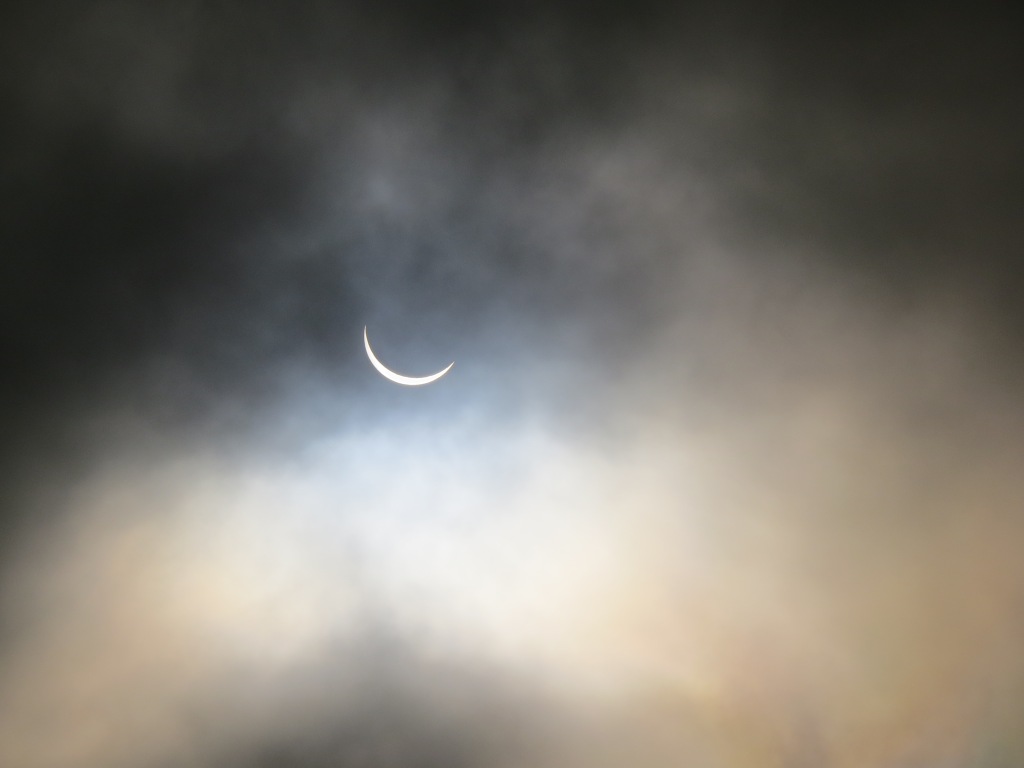
While we are vaguely aware of the Moon’s phases, something additional has to happen before we really pay attention. Lunar eclipses are relatively common because the Earth casts big shadow that the Moon can stray into. While these events often make the news it is usually well down the agenda. Solar eclipses on the other hand are much rarer and hit the headlines.
The solar ecliptic is the plane of Earth’s orbit around the Sun. All the planets of the Solar System lie on the solar ecliptic. Although close to the ecliptic, the Moon’s orbit round the Earth is very slightly angled at 5°. If the Moon orbited us in the plane of the solar ecliptic we would have solar eclipses all the time – which would be fun. Instead we have to wait for the rare occasions when the paths of the Moon and Sun intersect. The most recent eclipse visible from the UK was a partial one in March 2015. The last total eclipse was in Cornwall in August 1999.
At these moments we are compelled to contemplate the intimidating scale of celestial events. How odd that the Moon, 385,000 km away, happens to be just the right size to cover the sun completely. But the Moon is slowly moving away from the Earth at the rate our fingernails grow. Eventually it will be too small to totally cover the sun and all eclipses will be annular. We just happen to be alive while it can still cause a total eclipse.
Famously, we on Earth only ever see one half of the Moon; the near side. The invisible far side is not actually a ‘dark side’. It gets as much sunlight as the rest of the Moon but we never see that side from Earth. This is because the Moon’s slow rotation is in synchrony with its orbit so that the same hemisphere is always facing towards us. Our moon is the largest moon relative to the size of the planet it orbits and almost all the other moons in the Solar System are smaller than it.
In fact our moon is so big that the Earth and Moon together can be seen as a binary planet system. The centre of rotation of the Earth and Moon does not lie at the centre of the Earth. Like an adult swinging a large child in a circle, the Moon is heavy enough to make the Earth lean backwards slightly to compensate.
The Moon’s fixed plane of orbit has one other effect. Like the sun, the Moon’s elevation in the sky changes with the seasons. Pleasingly, this is the reverse of the Sun’s positions. The full moon at its zenith in midwinter (as it is now) is high in the heavens while in midsummer it stays low down towards the horizon.
It is fortunate that the word moon has so many rhymes. Where would the popular song be if we called it Selene, Luna – or Cynthia?
Drawing the bedroom curtains at 7am this morning Venus was un-missable, gleaming in the south east sky like the headlight of some UFO. Lying above and to the right of the un-risen Sun she is presently the ‘Morning Star’ but her dazzling beauty in the dark blue, pre-dawn sky is soon engulfed by the light from the rising Sun. She is still up there of course, moving westwards to set invisibly before the sun chases her down below the western horizon. Venus is the second brightest object in the night sky after the Moon. She can cast shadows and can, rarely, be visible in broad daylight.
Mercury and Venus are inferior planets, closer to the sun than we are, lying within the Earth’s orbit, and therefore they never appear in the middle of the night when our bit of the Earth, with us on it, faces away from the Sun and the two inner, inferior, planets. Observed from Earth Venus is never more than 47° (maximum elongation) away from the Sun and therefore appears to follow our star around. Galileo first observed that Venus showed ‘phases’ like those of the Moon; cycling in appearance from a crescent to a half-disc, to full disc and back again. This proved to him that Venus orbited the Sun, not the Earth, and got him into a lot of trouble with the Vatican. Venus is at her brightest at maximum elongation from the sun when she is a half-disc.
As Venus continues her (Venusian) year’s journey around the Sun from where she is at present she will eventually appear to the left, the east side, of the Sun and become instead the ‘Evening Star’. Venus moves more rapidly around the Sun than we do and she will then overtake us to become the Morning Star once again.
The Greeks did not realise that these two phenomena reflected the same heavenly body so they called the Morning Star Phosphorus and the Evening Star Hesperus (see under Henry W Longfellow’s Wreck of the Hesperus and Groucho Marx’s Lydia the Tattooed Lady). The Romans did realise this ‘star’ was one object but retained the temporal differentiation as Lucifer (the light-bringer) in the morning, and Vesper in the evening.
Venus is almost exactly the same size as Earth and is one of the four rocky ‘terrestrial” planets. She rotates very slowly in the opposite direction from Earth, so slowly in fact that a Venusian day is longer than a Venusian year. Her dense atmosphere is 96% CO2 and with a mean temperature of 464°C she is the hottest planet in the Solar System. She presents a featureless, dazzling surface to the Earth. Even with a good telescope the surface is disappointingly devoid of detail. Also, she has no moons – while Jupiter has several and Saturn has jaw-dropping rings that were created when one of its moons disintegrated. These latter two monster ‘superior planets’ are farther away from the Sun than we are, outside Earth’s orbit, which means they can be visible in the darkest part of the night. At the moment the two gas giants are close together in the early night sky.
To the naked eye the most obvious heavenly bodies are the Sun and Moon and the planets Mercury, Venus, Mars, Jupiter and Saturn. The total, seven, was a significant number to the Romans, to whom the planets also represented the gods. Originally the days of the week were named after the god-planets: dies Solis (Sunday) dies Lunae (Monday), dies Martis (Tuesday), dies Mercurii (Wednesday) dies Iovis (Thursday), dies Veneris (Friday) and dies Saturni (Saturday).
Living in the pagan north, some of our days were renamed in honour of the Norse gods, giving us Tiw’s day, Woden’s day, Thor’s day and Freya’s day. The French stuck with Imperial Rome and used mardi, mercredi, jeudi and vendredi for Tuesday to Friday. The romance languages use some version of sabbath (shabbat) for Saturday and ‘The Lord’s Day’ for Sunday, giving us sabato and domenica in Italian and sabado and domingo in Spanish. The now slightly disgraced tenor Placido Domingo’s name means ‘peaceful Sunday’.
Although all the planets lie broadly on the ecliptic (the plane of Earth’s orbit around the Sun) Venus’ orbit is slightly inclined compared to the Earth which means she does not always pass exactly between us and the Sun. When she does, this is called a transit of Venus and allows astronomical measurements to be calibrated, so that things like the size of the Solar System can be calculated. Captain Cook sailed to Tahiti in 1768 to observe a transit of Venus, then went on to explore the east coast of Australia. Exoplanets outside our solar system can be sought by measuring the slight decrease in luminosity of distant stars as a transit occurs.
The astrological sign for Venus is a circle surmounting a cross. It is also the symbol for female – a concept that has become controversial recently. As well as being the most striking planet, Venus is of course the Roman goddess of beauty, love and desire, the equivalent of the Greeks’ Aphrodite – and the diseases of love are named after her.
The Bohemian Waxwing Bombycilla garrulus is a beautiful bird. They breed in the northern conifer zones of the ‘Western Palearctic’ where they are insectivorous. In winter they migrate from the arctic cold and change their diet to berries, mainly rowan and hawthorn. In November they arrive in central and western Europe to overwinter. A shortage of berries can result in huge irruptions of birds further south and west although the precise balance between population and food source is not fully understood. In these irruptive years they arrive in eastern Britain in large numbers and disperse westward as they consume the available berries. Much of the fruit has fermented and, despite having a famously large and efficient liver, the birds can become intoxicated. They have little red waxy beads at the tips of their secondary flight feathers which gives rise to their English name – but why ‘Bohemian’?
The Birds of the Western Paleartic Volume V
Bohemia is the Westernmost part of the Czech lands, now the Czech Republic. It was part of communist Czechoslovakia and its capital city is Prague. The French word bohémiens was used to refer to the French Roma people in the mistaken belief that they had come from Bohemia. In fact the Roma originate in northern India. The French also used the term gitans for them, a word more familiar from the blue-packaged Gitanes cigarettes, which feature the silhouette of a gipsy dancer.
In time bohémien evolved to mean a lifestyle of artistic and moral freedom. Bohemians adopted a kind of voluntary poverty in pursuit of creative fulfilment. They had a flexible approach to marriage, law and hygiene. If you were an aristocratic type you might simulate this lifestyle by joining the better-off haute bohème. The romantic image of impecunious creativity and uncontrollable gipsy passion features in several operas. Carmen is referred to as a bohémienne. Puccini’s opera La bohème is about impoverished Parisian poets and artists, starving in their frozen garrets. One of them falls for a doomed consumptive seamstress. It would seem the waxwing is neither a gypsy nor a starving poet.
The German term Böhme doesn’t necessarily mean ‘from Bohemia’ either. They use it as ‘French’ is used in English to indicate exotic foreign species – as in the French Partridge (the Red-legged Partridge) or French Yellowhammer (the Cirl Bunting). It implies a migrant, in the case of the waxwing, a winter one. The waxwing is therefore a Bohemian because it wandered to Germany from foreign parts. In Germany in the past these birds were eaten.
Zwei tote böhmische Seidenschwänze by Lucas Cranach The Elder 1530
It has taken a long time settle both the common and scientific names of the bird. Conrad Gessner in 1555 named the bird Garrulus bohemicus which is literally ‘Bohemian Jay’, although they are not jays. John Ray in 1678 adopted this term but mistranslated it as the Bohemian Chatterer. In fact the waxwing is a rather silent bird. Thomas Pennant changed the name again to the Waxen Chatterer because of the peculiar flight feathers, but in time waxwings were removed from the chattering classes altogether and put into a genus of their own called Bombycilla. The waxwing’s plumage is soft and silky. The common name for waxwings in Germany is Seidenschwanz which literally means ‘silk-tail’. Translating this into the clumsy Latin used by scientists we get Bombycilla; but the bird has never been able to shake off the chattering thing altogether. The species name retains garrulus.
In my childhood copy of the Observer’s Book of Birds the waxwing and the Golden Oriole face each other on opposite pages. Two fabulous exotics firmly in the never-to-be-encountered category; but in November 1988, about 3 years after my interest in birds was rekindled by a colleague, there was an irruption of waxwings in the UK after a long gap of about 15 years. No smartphones with birding apps were available so we used a telephone service called Birdline Scotland to get our information about rarities. You called in and received a message along the lines of:
“Welcome to Birdline Scotland. Thursday: Late evening update. In Lothian, 25 waxwings at Longniddry Railway Walk; still present this afternoon. Park near the station and walk east. The birds are feeding on hawthorn hedges.”
Inevitably the chance to add such a prize to your life list made you a bit twitchy until you had the opportunity to go for them. If the birds were still there it wasn’t difficult to find them because inevitably there would be a group of birders gazing at them. If they were still there.
Waxwings are gregarious and have a superficial similarity to starlings in flight. Their flight is fast and direct with long pointed wings. They are not particularly shy, presumably because they spend most of their time in vast uninhabited pine forests. The red waxy tips are not easy to see but the paler colour and the unique crest is obvious compared to Sturnus vulgaris. The wing markings that are visible are the white and yellow edgings to the primaries and the bird has a square, yellow-tipped tail with a ‘chestnut vent’. They are strictly arboreal and often turn up in supermarket car parks and public parks where berry-bearing trees and bushes have been planted. In winter it is always worth checking any flocks of good-sized birds in trees because they may not be starlings.
After I added waxwing to my life list at Longniddry there were further substantial arrivals in later years. A cotoneaster hedge in a friend’s front garden once drew a flock and we were able to watch them moving back and forth from the hedge to nearby trees and drinking water from the roof gutters. Their diet of berries makes them messy visitors. I have them on my ‘garden list’ as well.
The most unexpected sighting I’ve had was while doing a ‘portable’ ultrasound scan in one of the oncology wards at the Western General Hospital. I was accompanied by a junior trainee. As we approached the ward along an upper corridor I noticed a flock of birds in the large sycamore that stood outside. This old tree had somehow survived the various building programmes since the Western began life as Craigleith Hospital and Poorhouse in 1868. It dawned on me that these birds were a pale colour and had crests. They were close enough to convince my junior that we were indeed witnessing some unusual ornithology.
So why call this blog The Bohemian Waxwing? Apart from the fact that I like waxwings and that the concept of Bohemianism appeals to me, the scientific name can be abbreviated to B. garrulus – something that, unlike the waxwing, I am prone to do.
We used to frequent a restaurant in Kingussie. It was in the High Street and in the olden days you could park in front of the council offices across the road. We often went there in autumn and emerging from the car, having just pulled off the A9, the cold Highland air and smell of birch wood smoke sharpened the appetite.
All the seasons have a distinct smell. At the moment we have the damp fungal odours of fallen leaves decaying to mush while the last scents of summer have blown away. I find myself looking forward to the first frosts clearing the air completely, leaving it smelling of nothing but the occasional garden bonfire and, here in Edinburgh, the breweries. That yeasty smell still reminds me of returning for autumn term and meeting old friends in warm pubs.
These olfactory signs of the earth’s journey around the sun are inseparable from the pineal ones of changing day length. After all, it is the change in day length and declination of the sun that underlies everything else. A graph plotting day length throughout the year has the form of a sine wave with a peak in summer and a trough in winter. The implication of this type of curve is its effect on our perception of the rate of change. There is little change at the peaks and troughs but rapid change during the upwards and downwards slopes. The word solstice means ‘the sun stops’ and from late May to the end of July, around the peak of the sine wave, there is little perceptible change in the times of sunrise and sunset. The day lengthens slightly for a month then shortens slightly for a month, but it is always daylight when we wake up and always light at bedtime. It is this effect that makes it seem like the sun has paused at its zenith for a couple of months.
In the tropics, between Cancer and Capricorn, where day and night are roughly equal all year round, the sun sinks suddenly and vertically below the horizon and night rapidly follows day with little twilight. Living in the ‘far north’ as we do, the situation is more complicated than the simple time that elapses between sunrise and sunset. In Edinburgh, a graph of light levels rather than simply the time between sunrise and sunset shows that around midnight in summer, when the sun dips briefly below the horizon, there is still enough light bending round the earth to create a continuous ‘gloaming’ between sunset and sunrise. At the summer solstice the peak of the daylight graph goes off the chart as it is never truly dark. In Shetland it is even more pronounced and is called the ‘simmer dim’. In St Petersburg they have the ‘White Nights’.
At the other end of the year, in the depth of winter, from late November to late January the days are cruelly brief and the nights are truly dark because the sun spends most of its celestial journey sunk far below our horizon. It rises late, appearing briefly in the southern sky and shines at us almost horizontally at midday. This makes window blinds paradoxically more useful in winter than summer in northern latitudes. The shallow angle of the sun’s rays also makes the effect of clouds more pronounced in winter. If cloud cover is complete, the sun’s rays have to pass through much more of the stuff to reach the ground than in summer. Cloudy winter days are extra dark and we find ourselves putting the lights on at noon.
In winter, when still working in a windowless radiology department, I left home before 8am and returned after 6pm. This meant that for a couple of months it seemed to me to be dark all the time. Early February was a landmark, because that was the first time I found myself leaving the department in daylight since the previous November. Now that I have retired I notice the slight improvement as January wears on. We are more aware of sunrise and sunset in winter because we are awake to witness it.
The steepest slopes of the day length graph are seen between the solstices, in spring and autumn. Unlike at the solstices, these times are associated with pronounced changes in day length. These periods of rapid change encompass the equinoxes when day and night are equal in duration over the entire planet and the sun sits directly over the equator. The further north you are, the faster the change in day length. In Scotland the day lengthens or shortens by nearly 5 minutes a day around the equinoxes. Some parts of Greenland experience a 15 minute change in day length at those times. Unlike winter and summer, every day seems to bring a change in the light.
By chance our street runs almost exactly east to west. The back of our house faces south and the front, north. At the equinox the sun shines directly along the street at sunrise and sunset. As summer comes in, the points of sunrise and sunset migrate north, narrowing the angle between the two until their maxima at the solstice. The summer sun floods through the the windows on the north side of the house early in the morning and once again in the late evening. The reverse happens in autumn as the points of sunrise and sunset migrate south and the nights ‘draw in’ leaving the north side of the house sunless for six months.
A right parhelion or sundog due south of the house on the morning of 3rd January 2009. The real sun is over to the left and not in shot. There was another sun dog to the left of the sun but too widely spaced to capture in one frame. Sun dogs are caused by refraction of the sun’s rays by ice crystals in the upper atmosphere.
These changes in daylight are astronomical and precise but the organic sensations down here on earth are out of sync with our star. My grandfather used to say, “As the day lengthens, the cold strengthens.” The seas around Britain take time to warm up and time to cool down. The ground has less thermal inertia than the water but it also takes time to adjust to the energy coming from above. This means that spring is colder than the equivalent time in autumn and the chill can extend well into June. After the summer solstice things finally start to warm up. Similarly, mild days in autumn can extend well into November as they have done this year. We are only about 6 weeks away from the winter solstice now but maximum temperatures are still in double figures. However it is also wet and windy, what Robert Louis Stevenson called ‘this dog’s weather’, from which there was no relief until after Christmas when proper cold set in. In RLS’s day this meant Duddingston Loch freezing over sufficiently thickly to allow skating. He described watching the skaters from the hill as they lit their torches at dusk. It must have been beautiful – but the loch rarely freezes now:
In Scotland we pay for our lovely long summer days with with the seemingly endless darkness of December and January. If only we could bank the excess daylight of summer, wasted on us while we sleep, and use it instead to dissipate the winter gloom.
My Presbyterian family – father was an Elder of the Kirk and mother had strong beliefs – had a deep suspicion of anything that smacked of Catholicism or idolatry. Celebrations of Easter and Hallowe’en came under those categories. The other Christian feasts and fasts were a total mystery. We didn’t fast or feast – although we did stretch a point at Christmas despite it seeming to be a mass. As a family we leaned towards the old Scottish approach to Christmas in regarding it as just a normal working day. There wasn’t much choice on a farm anyway. My mother was acutely uncomfortable telling us about Santa Claus. She thought that if she lied about Father Christmas we wouldn’t believe her when she told us about Jesus. As soon as we questioned whether an old man actually came down the chimney with presents for us she told us he didn’t exist. We were able to debunk Christmas for our peers after that. New Year, free of any problems of faith, could be celebrated with impunity. We had a drink at midnight in front of the TV then straight to bed. New Year was always the bigger celebration in Scotland anyway.
Easter in its Christian manifestations featured too many crucifixes, thorns and blood for Presbyterian tastes. We observed it purely as a festival of chocolate confectionary with its own obscure pre-christian themes of rabbits and eggs. Hallowe’en and Bonfire Night were of more uncertain origin. What was Hallowe’en anyway? I don’t think I was aware then that it was a compression of ‘All Hallows Evening’ far less what ‘All Hallows’ was. From recent reading it seems that the following day, November 1, is All Saints or All Hallows Day. Whatever that means.
As children we were keen to take part in what looked like fun events but I suspect my lifelong aversion to group ‘fun’ originates in awful Hallowe’en and Christmas children’s parties. My mother was not going to tolerate the mess of genuine ducking for apples but we were allowed to kneel on a chair, leaning genteelly over the back and drop forks from our mouths in an attempt to spear apples floating in a bucket on the floor. We also had ‘false face’ masks for added ‘fun’. Occasionally we would attempt to go ‘guising’ but living as we did on a farm a mile from the nearest town there was little scope for visiting neighbours or having them visit us. We would sometimes get dressed up and visit our friends who lived in the nearest farm half a mile away. There we could perform our party pieces and receive nuts or small chocolates in return. I can vividly remember the acrid taste of the moustaches my mother drew on our upper lips using the ersatz Camp Coffee. For the uninitiated, Camp Coffee is a sticky syrup made from chicory essence and flavoured with a tiny amount of coffee. It was made in Glasgow and featured on the label a Highland officer being served coffee by an Indian servant. The officer was seated outside a tent.
Of much more significance at Hallowe’en was the business of creating a turnip lantern. The farm turnip crop was harvested into a huge muddy pile outside the main byre ready to feed the cattle spending the winter there. We clambered over this mound to select a good one. I vividly recall my chagrin on carving my first pumpkin lantern for our kids to discover that pumpkin flesh was soft and easy to core out. Not so the small unyielding Scottish turnip. A huge effort was required even to cut the ‘lid’ off and flatten the base. With aching fingers the wooden flesh was scraped out using an old spoon and a depression created in the bottom to hold the base of the candle. The most important thing was to make sure that the hole in the lid was directly above the candle flame – otherwise the flame would burn the turnip lid creating a really unpleasant smell. The leering face carved into the front was better left imperforate otherwise the October breeze would blow your candle out. A string handle was attached to the body and threaded through the lid for security. It had to be long enough so the candle flame didn’t burn your fingers. The point of the lanterns was lost on us – not that we ever considered that. It was a ritual that required observance. Maybe that was what Presbyterianism lacked. Ritual. After a few days the wrinkled dehydrated turnip with its sooty, half-cooked lid was a sorry smelly sight.
Hallowe’en did seem vaguely Christian with its emphasis on saints, despite the whiff of devils and witches which still hung about it. Bonfire Night by contrast seemed to be purely political. What I didn’t appreciate as a kid was that ‘gunpowder treason and plot’ was also linked to religion – as all politics was then, and often still is.
On the death of Elizabeth I without issue in 1603, James VI of Scotland became James I of the United Kingdom. At the state opening of parliament on November 5th 1605 a group of disaffected provincial Catholics, who had hoped for greater religious tolerance under the new protestant king, placed 35 barrels of gunpowder in the undercroft of the House of Lords. It would have been enough to reduce it to rubble, killing the king, members of his family, the Lords, the most senior judges and the bishops of the Church of England. The plotters intended to kidnap the King’s daughter Elizabeth who was not present at the ceremony and place her on a new, Catholic, throne. A letter gave the plotters away. Guy Fawkes was discovered in the undercroft guarding the explosives and was arrested. The other plotters fled but were captured and subsequently hanged, drawn and quartered. In an act passed in 1606 and only repealed in 1857 it was compulsory to commemorate the failed regicide (remember, remember). The tradition of lighting bonfires, burning Fawkes in effigy and letting off fireworks started soon after.
How disappointing those fireworks were in reality compared to the dazzling packaging by Aurora, Rainbow or the more prosaic ‘Standard’. The biggest rocket usually sported a red plastic cap to differentiate it from the smaller blunt-ended variety but invariably it turned out to be little different from the others. The display of begonias and echeveria having been lifted from the beds outside the hall windows we half-buried a milk bottle in the bare earth and launched the rockets from there. It seems unusual now but I remember the ground often being frosty – however we were living at 600 feet above sea level.
It is known that early christians converted pre-existing roman or pagan celebrations to their own purposes and there’s a great deal of wisdom in making sure the new religion did not deny the faithful the chance for a time-honoured party. Vestiges of the old ways persisted in the British Isles well into the twentieth century. Young men would blacken their faces and adopt disguises then go round their neighbours demanding food and playing tricks. It was bad luck to deny the guisers their ransom.
Our bonfires celebrate the death of a traitor 400 years ago, but it seems bonfires at this time of year are not new – or even Christian. November 1, Samhain, was seen as the beginning of winter in the Celtic religions and even further back there is evidence that some neolithic monuments are aligned with sunrise on November 1. It is a liminal festival reflecting a time of transition and supernatural events. In practical terms it marked when the cattle were brought down from high pastures for the winter. There would be insufficient food to maintain livestock for the whole winter and animals would be selected for slaughter and consumption.
It was also thought by the ancient ones that the spirits of the dead might roam free on Hallowe’en and visit the homes they once inhabited. The evergreens, like the holly, the ivy and the weird parasitic mistletoe, had significance for pagans and there is a theory that the burning of dead deciduous leaves released the spirits from their summer home so they could return, via the medium of smoke, to the holly and the ivy for the winter. It’s interesting that we still hang mistletoe at parties and sing Christmas carols that contain references to these old beliefs…
We have a big sycamore Acer pseudoplatanus at the bottom of the garden. It stands about 35 metres from the rear of the house and screens us from the back gardens in the next street. Our house is one of four linked terraced dwellings now standing on the site of a large orchard formerly the grounds of an older semidetached house to the south of us. Our terrace was built around 1905 and I calculate that the sycamore must be about 100 years old now. The main trunk is divided, and it has the general air of a weedy self-seeded arriviste. When we moved in it had a large elliptical scar on the west side of the trunk where it had lost a substantial branch.The bare surface of the wound was peppered with opportunist woodworm holes. Over the 28 years since we arrived the rolled edges of healthy bark have slowly grown in and have now almost closed the gap.
I have allowed an ivy to elbow its way in and it now has a trunk as thick as my arm running up the eastern aspect of the sycamore trunk. The strangling stems have surged upwards and out onto the main branches while the upper growth has undergone that change in leaf shape and branch pattern that occurs in ivies with maturity. It flowers profusely in the autumn, feeding the last of the nectar-eaters, followed by dark berries. Although the overall effect looks a bit like neglect, I am persuaded that the ivy is good for the garden biome.
A nest box, half-smothered in ivy leaves, is used annually by blue tits. There is a venerable bowling club next door and I acquired the box at their summer fair sale of work. It was made by one of the club members. In the winter I bring it down to clean it out and remove any potential birdy parasites. I worry about finding little starved nestling corpses inside but so far have always found only an empty cup of moss and feathers supported by grass with a few strands of interwoven plastic objets trouvés. When the nest is removed it forms a perfect cubical cast of the bottom of the box. As instructed by the RSPB I scrub it out with hot soapy water and put fresh wood shavings in, but the tits always chuck them onto the ground in spring.
The sycamore was introduced to Britain around 1500 and has self-seeded itself everywhere. The wood is white and fine-grained and is used in the construction of musical instruments and kitchen work surfaces. As with lime trees, aphids infest it in the summer. The leaf sap contains far more sugar than the other nutrients the aphids need and so they excrete the unwanted sticky waste onto any surfaces below. In our case this is shade-tolerant laurels and camellias. The sugar deposit then grows an unsightly black mould. I hope the aphids help feed our dwindling Edinburgh population of swifts. Along with sticky aphid waste the tree produces a profusion of whirligig seeds which spin down in late summer. In turn legions of seedlings emerge on the lawn and in the borders the following year. I regularly miss a few and uprooting the older saplings can be strenuous.
The Acer family is renowned for spectacular autumn colour – but not the common sycamore. One of the first hints of autumn is sycamore leaves developing black fungal spots. These have a yellow halo and are not unattractive. However, the leaves then turn a dull grey-brown and are shed in colossal numbers, forming drab rustling drifts everywhere. All-in-all the sycamore is quite a humdrum run-of-the-mill sort of tree. Which brings me to the subject of etymology.
Scientific names are an inconsistent mixture of Latin and Greek and that doesn’t really matter as long as the name is officially agreed. Acer is the genus and pseudoplatanus is the specific or species name for the sycamore. Even here the tree gets let down a bit from hinting that it is just a ‘pseudo’ plane tree, a species that it superficially resembles.
The common name of sycamore is more interesting and also relates to a resemblance. In the Bible creation myth Adam and Eve are introduced to sin by disobeying God and eating fruit forbidden to them from the tree of the knowledge of good and evil. In Western culture this is usually portrayed as an apple which Eve offers to Adam after eating some herself. In fact the seductive fruit was originally one unknown in northern Europe, called the sycomore fig. Early Christian teachers felt the impact of the story would be lessened by using a tree unknown to the faithful and substituted the more familiar apple – which was also considered highly desirable.
The fig leaf, useful in censoring offensive artistic subjects, has a three-lobed structure which the acer leaf was thought to resemble. The name was therefore transferred to the humble pseudo-plane acer.
Distant SycamoreThe Black SpotAutumn Brown Turkey Fig




 The Bohemian Waxwing