
Now westlin winds and slaught'ring guns
Bring Autumn's pleasant weather;
The moorcock springs on whirring wings,
Amang the blooming heather:
Now waving grain, wide o'er the plain,
Delights the weary farmer;
And the moon shines bright, as I rove at night,
To muse upon my charmer.

Song Composed in August
Robert Burns
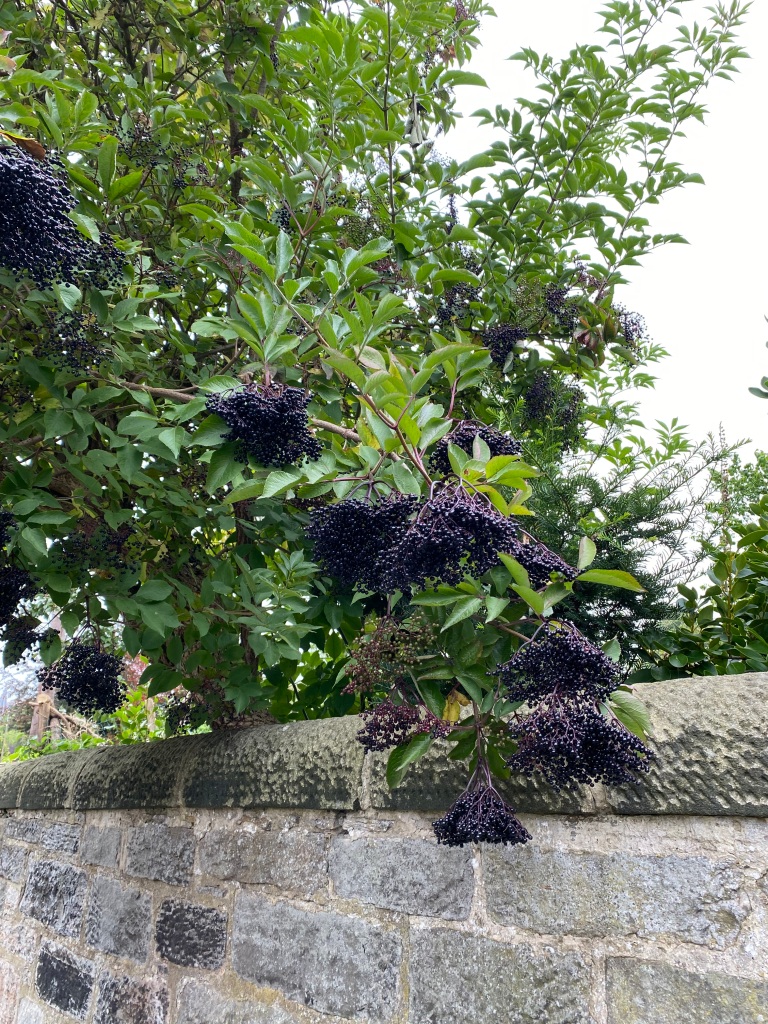
The end of summer is marked by lengthening shadows, the inward creep of sunrise and sunset, and the first hint of a chill in the air. Leaves that once showed a range of pristine greens are dull, holed and tattered. The harbingers of autumn are already rustling in the gutters. Apples, plums and elderberries bend the boughs and vagrant wasps become stupid and aggressive as their colonies decline. The garden display recedes to a limited palette of crocosmia, Japanese windflowers and Michaelmas daisies. An art teacher friend told me he didn’t like asters because they heralded the beginning of autumn term and the close of his seven-week sojourn as a part-time artist and full-time lotus-eater.

In the country, the seasons had more practical implications. Once the hay was secured in July, attention turned to the harvest. In wet upland East Ayrshire wheat was never an option and barley varieties that could be relied upon to ripen and stay upright in the rain were a later development. As a boy, the farm depended solely on a third cereal, oats, as a grain crop. Oats are known as ‘corn’ in Scotland. The corn was used for cattle feed over the winter. Before the advent of silos, corn was stored in open bunkers in outhouses – an open invitation to vermin. With some corn in a noisy pail, and a head collar and rope hidden behind my back, I used it as bait to capture my pony.
As Dr Johnson pointed out, oats are fed to horses in England but in Scotland they sustain the people. Oatmeal was our rice. The tall stiff stems of oats resist beating down by the weather, slowly yellowing and displaying their grain in ears, covered by papery chaff. The traditional method of harvesting oats does not involve a combine harvester cutting and threshing the crop in a single process. My only experience of a combine as a boy was on my uncle’s farm south of Dalkeith in Midlothian. I watched as the great machine made its dusty progress across his dry wheat fields, eating up the cereal. The grain was spewed out into an escorting trailer and the straw deposited in long rows onto the field. To a farmer, a cleared stubble field is indeed a delight.
On the west coast farm of my youth, the process of harvesting oats was more complicated and protracted. Once ready, the field was opened manually using scythes, the cut corn was bundled into small sheaves by tying a few stalks around it. Then the reaper-binder, towed by a tractor, moved in. In addition to the tractor driver a second man perched on a seat on the binder itself. The binder featured a wheel similar to one of those paddles on a Mississippi riverboat. It gathered the corn onto the blades where, shorn, it dropped onto canvas belts. These carried the stalks upwards where they where automatically tied into bundles with ‘binder twine’. Tines chucked the completed sheaf out sideways onto the field as the machine progressed. In that state the corn was not yet ready for storage and required further drying in the field. This was done by creating stooks of several sheaves propped against each other. Manual labour was required to stook the sheaves, a process that exposed our vulnerable arms to thistles and insects. My father, an elder, supplied a couple of nice yellow sheaves to the church as decoration for harvest thanksgiving.
Once sufficiently matured by wind and sun, the sheaves were forked off the field onto a trailer and taken to the stack yard, a small field that was part of the farm steading. There they were built into large round Monet-esque stacks. The stacks were set on a base of boulders to keep the straw off the ground. Sheaves were stacked radially with the wider bases to the outside. The stacks could be as high as the roof of a farm building with a thatched conical top. A canvas tarpaulin hap was placed over the stack and weighed down by roped-on bricks to protect it from the weather. Like the loose corn in the outhouses, the crowded stacks supported large numbers of birds and rodents attracted to the free food. It is the origin of the seed-eating chaffinch’s name. Stacks looked great crowded together. I loved their bulk and their sweet smell.
Once the stack yard was filled, there remained the business of threshing; of separating the oats from the chaff and straw stalks. Safely stored in stacks, threshing could await the arrival of the ‘big mill’. The mill men would tour the neighbouring farms with their threshing machine, dealing with everyone’s stacks in turn. My mother was expected to feed the visitors, who arrived at the usual, extremely early, agricultural hour. I recall waking up in bed to the smell of bacon, tobacco, engine oil and sweat emanating from the kitchen downstairs.
The mill was powered by a long belt drive from a stationary tractor. The grain dropped into hessian sacks and the straw was fed into an adjacent baler. As the stack went down, its inhabitants were revealed. Trouser legs were tied with binder twine, the base of the stack was surrounded by unrolled chicken wire, sticks were taken up and the dogs were sent in.
The men would entertain us with stories of rats running up trouser legs. One of them claimed to have trapped a rat against his back by flexing forwards to tighten his shirt on top of it. His colleague then dealt with his passenger using a broken brush handle. He then pulled his shirt out and the dead rat dropped to the ground. After the mill had been, the stack yard reverted to a wildflower meadow and playground with its resident ducks, bantams and chickens. One of our henhouses was in the stack yard.
Later we did manage to grow and harvest barley which was stored in a silo tower. The silo made a good viewing platform but the effect on farm life was striking. The bounty of stored or spilled corn was no longer available and the population of finches, rodents – and the predators who depended on them – crashed.
Numerous stacks are a reflection of a farm’s productivity and prosperity. My grandfather who began life as a tenant farmer was famously stern, business-like and astute. As a young man, just after the First World War, and after he had almost died of Spanish flu, one of his friends asked a favour. He needed to meet his young lady’s parents to ask for their daughter’s hand. The friend was nervous about the outcome of this encounter and asked my grandfather to accompany him. The visit to the parental farm was set for a Sunday after church. The two lads arrived in good time to find the family had not yet returned from worship. No one was at home. Taking his responsibilities seriously, my grandfather grabbed his friend’s arm urgently and said, ‘Quick, let’s go round the back and count the stacks!’
Not vernal show'rs to budding flow'rs,
Not Autumn to the farmer,
So dear can be as thou to me,
My fair, my lovely charmer!

 The Bohemian Waxwing