Birdsong

Blue tit and fat balls.

The successful identification of birds is not confined to knowing their physical appearance. Knowledge of birdsong is often the clincher when confronted by a mystery creature. Knowing the songs – and the more difficult calls – is a huge help in working out what you are looking at. Modern smartphone birding apps often include recordings of the songs, but you mustn’t use these to lure a bird into the open! Birds exist within a tight energy economy, especially when breeding, and making them waste energy pursuing a phantom rival is not fair.

In the prior paper-only era, field guides often included ridiculous English renditions of songs, which were meant to help you with ID. ‘The song may be rendered thus: “Prithee-come-thither-thou-varlet!” ‘ That sort of thing. The onomatopoeic impressions of songs with their umlauts and strings of consonants which replaced such nonsense in the field guides are little better – and less funny. Some bird names, notably the cuckoo and chiffchaff are onomatopoeic in themselves. The scientific name of the corncrake (Crex crex) is another example. Whatever aids you employ, there is no substitute for going out and learning the songs for yourself.

It is late spring now, and birdsong is at its peak. I’ve never been sure that birdsong fulfilled a purely pragmatic territorial or pair-bonding function. For me it always had that element of joie de vivre. I thought I might go over some of the easier songs should you wish to explore the genre in the safety of your own garden. Knowing the songs of the common birds allows you to move confidently on to the rarer ones. Remember that any puzzling sound is likely to be an unusual noise from a common bird rather than the usual sound of a rare one.


Unusually, both male and female robins sing throughout the winter as they defend their territories ferociously. In fact, they start singing in September, a sound my grandmother identified as a harbinger of winter. Their song is like the squeaky wheels of a supermarket trolley, and quite easy to learn. They also make a high-pitched ticking call.

After the winter robins we come to the early spring starters. In respect of their songs, great tits and cole tits are confusion species with chiffchaffs coming along later to further muddy the water. The great tit mainly gives us its greatest hit, the classic ‘teacher, teacher.’ The smaller cole tit has a very similar but higher-pitched song, ‘see-too, see-too.’ Later, when the chiffchaffs arrive they make the sound their name suggests, another two-beat declaration, but their little aria is wheezier and irregular. Every now and then they stick in an extra ‘chiff‘ or ‘chaff‘ which the two tits never do. To finish the commonest tits, Blue tit song consists of two high-pitched notes then a longer trill of lower notes: ‘si si… tr’r’r’r’r’r’r’rt.’ Sometimes they do, ‘si si churrr – si si churrr.

The blackcap also kicks off early. Some of them now over-winter in Britain, perhaps because garden feeders are so widely available to them in this country. Once you learn the song, you realise these birds are ubiquitous. Blackcaps deliver a short, rapid, sweetly musical burble of notes with long pauses in between. Like a little blackbird in a hurry. The verse is often preceded by a short ‘irresolute’ scratchy twitter. With patience you will spot the singer among the fresh spring leaves, unmistakeable in his black headgear. The garden warbler ‘s song is almost identical to its close relative the blackcap, but ironically, you are most unlikely to have one in your garden. They are very difficult to see in the dense cover they favour. Leave them to the experts.

The blackbird has the most wonderful repertoire, completely underrated in my opinion. Usually delivered from the top of a shrub or tree, it consists of well spaced-out measured phrases of endless variety, frequently punctuated by quieter trills or twitters. We have one in the garden at the moment who has been performing brilliantly for weeks. Blackbirds also have a predilection for singing at night – as the Beatles noted.

Everyone thinks they know the blackbird’s song – but can you tell him from his close relative the song thrush? Also a wonderful performer, the thrush helps us by repeating his phrases two or three times. The mistle thrush is a bigger, paler, and rarer bird. Also known as the ‘storm cock’ because his singing supposedly precedes bad weather, he sings from treetops in brief verses; a simpler, colder version of the blackbird. He also emits a very distinctive, loud, ‘football rattle’ alarm call.

The chiffchaff’s close relation in the leaf warbler family is the willow warbler, which is now singing as the weather warms up. The willow warbler looks almost identical to the chiffchaff but sounds totally different – which is useful. He gives us a string of sweet descending notes which trail off into nothing as if he’s been distracted by something. This contrasts with the superficially similar chaffinch (not even a warbler) whose final upwards flourish is supposed to sound like a bowler running up to the crease and delivering the ball. He also goes, ‘pink, pink, pink.’ Chaffinches have been shown to have regional accents.

The lead-grey headed Dunnock (aka hedge sparrow) is very common in urban gardens, sticking mainly to ground level, hopping about, picking up stuff. The song is delivered from shrub-top level and has a monotonous, cantering rhythm. Like a lot of duller birds that skulk in bushes, the song is loud. They lay beautiful blue eggs leading to the local name in East Ayrshire of ‘blue dykey’.

Speaking of loud skulkers, the Wren is the classic. It’s mouse-like habits mask their huge numbers; they are the commonest birds in Britain. Wrens intersperse their song with a diagnostic drawn-out, ‘zerrrrr,’ which is also the alarm call. A loud ‘zeck’ is also produced.

Goldfinches have a lovely soft song and were kept for this purpose. They were trapped in enormous numbers for the cage bird trade along with bullfinches. Their song is a merry tinkling jangle of quiet notes interspersed with a version of their call, which sounds like ‘quit-it‘ to me. They often feature in early paintings because of their supposed association with the crucifixion – they have Christ’s blood on their faces. Everyone knows Carel Fabritius’ wonderful portrait of one chained to its perch. Robert Fergusson’s rumination on the fate of a caged goldfinch is very moving. He mentions the sticky birdlime used to trap the poor things; still a common practice in Europe.

Ode to the Gowdspink

Another very easy bird to identify, once you know the song, is the Bullfinch. For such a boldly marked and colourful animal the song is very disappointing. Hesitant and quiet, it consists of a few tired, fluty notes, descending at the end ‘phü – phü – phü.’ It surprised me to learn that they can be taught to talk and were kept for this purpose. They were once killed in huge numbers to prevent them eating the buds of fruit trees. In my garden at least, they are now increasing. Quite shy, they are always seen in pairs. Look out for the bright white rump as they fly off.

Greenfinch numbers have crashed thanks to Trichomonosis, but I’ve been seeing a few more recently. They have a distinctive loud ‘zweee’ call that also features in their song. Yellowhammers are also rarer now and are more birds of open farmland but I include them because they famously go, ‘a-little-bit-of-bread-and-no-cheese‘.

Pied wagtails are easy because they call, ‘Chiswick, Chiswick‘ as they fly over, and House sparrows give us the classic ‘chirrup’.

Finally, there is another bird that is definitely on the increase, but despite that, almost impossible to see. The great spotted woodpecker is everywhere these days, including in our garden trees and on the peanut feeders. However, the bird is also a fantastic example of dazzle camouflage. Its bold black and white markings break up its outline, especially in dappled light. It perches on trunks or along the branches of trees, blending in with the outline or disappearing behind them. Fortunately there are three things about GSWs that reveal their presence. The first is their distinctive call, a loud ‘tchick!’ Once you are familiar with it, you will be alerted to their presence everywhere. They often call in flight. The flight pattern is the second feature. It is deeply undulating or ‘bounding’ because they intermittently close their wings to their bodies. The third feature is the famous ‘drumming’ which echoes through leafless woods in early spring. It is said you can attract GSWs by doing your own ‘drumming’ with a pair of sticks. I’ve never seen this succeed!

I recommend getting to know your local birds’ songs. Think how much more you would get from sitting in the garden or walking in the spring sunshine if you knew who was singing to you.

In Horto Veritas

The kiss of the sun etc…

For the first 20 years of my city existence I lived in flats. The last one was a ‘double upper’ on the 6th and 7th floors of a towering New Town tenement. From its windows the islands in the Firth of Forth were visible. At night, you could see the lighthouses blink if you looked up from your plate at dinner. None of those flats had access to a private outdoor space. I hadn’t really noticed this deficit until, expecting our first child, we moved to a house with a garden. Suddenly there was terroir to manage. A terraced town house is, by its nature, a tall thin thing and the back garden was similarly narrow: the width of the house and about 40 yards long. The previous owners were artists and keen gardeners who had divided the elongated space into ‘rooms’ and crammed it with interesting plants. The trees and shrubs had grown so tall the various rooms afforded almost complete privacy. From the most distant section you couldn’t even see the back of the house. We flitted in October just as everything was dying back but I was thrilled to open the back door, day or night, and enter a private realm. What lay dormant beneath the ground was a mystery yet to unfold.


I was brought up in the Ayrshire countryside and worked on the family farm during school and university holidays. We had a large garden lying a sobering 600 feet above sea-level, but the weather in the west is mild. Mostly. There were two lawns, many mature trees, a pond, formal bedding, fruit bushes, vegetables, cold frames, a potting shed and three greenhouses. One of my father’s enterprises was a hotel in town and the garden looked nice enough to use as a backdrop for wedding photos before the couples attended their reception at the Royal Hotel.

Ayrshire farms were once notable for their ash and willow trees but there have been casualties even before the current horror of ash die-back. We had a huge ash towering over the gates to the drive and another one near the top of the garden close to the stack yard. It became senile and dangerous and so was reduced to a massive trunk about 15 feet high. Our engineer, whose garage was opposite the felled tree, remarked that there was now ‘a hole in the sky’. We topped the amputated bole with an old door which we nailed down to create an observation platform. Camouflaging water-sprouts grew up around it and we improvised a rope ladder with pieces of kindling and baler twine. An overgrown shrubbery around the base of the tree was our cowboy ‘hideout’.

My father loved gardening but most of his time was taken up by his business interests and public work, so he employed a full-time gardener. Dad retained an interest in his tomatoes, dahlias and chrysanthemums which he raised in the greenhouses. An elder of the Kirk, he supplied the church with a flower arrangement every Sunday and corn sheaves at harvest thanksgiving.

Rustication

Apart from annual hay-making in summer, I laboured in the dairy on the bottling and cartoning machines, drove a milk tanker, delivered milk and did a bit of garden maintenance on the side. We had a green ATCO 14-inch cylinder lawnmower. It had a two-stroke petrol engine with an accelerator lever on the right side of the handlebars and a clutch on the left. You revved it up, engaged the clutch, and the mower lurched off, leaving the classic stripes in its wake. The longer grass stalks survived the ATCO and after mowing I crawled about obsessionally, cheek to the ground, cutting them off with shears. Aesthetic and strategic control remained with my father and the gardener. Every year, in early summer, the borders around the lawns were planted out with bright red and yellow begonias and grey echeverias with orange flowers. These tender souls spent the winter sheltering on trays in the potting shed. The larger flowerbeds near the house were planted with antirrhinums (snapdragons).

My father had a vision for the garden as a place of casual but controlled elegance. For a while he employed one of our retired tractor men as gardener. I was very fond of Willie who could be hilariously funny. He loved gardens, but mainly as a means to grow prize vegetables. We held an annual staff horticultural show in the lorry garage which we children were allowed to enter using random stuff from the garden. None of it had a chance of winning against dedicated competitors like Willie. He had a strongly developed sense of order. He would chop off any herbaceous plants that strayed onto the the paths or lop low-hanging cherry branches if he saw that they were clipping the car aerials on the way up the drive. As my father surveyed the latest scene of devastation, Willie would declare, ‘That’s it a’ square’t up again, Mr John.’*

The fruit and vegetable parts of the garden supplied the house in the traditional fashion. All summer we pillaged the strawberries, raspberries, gooseberries and peas. Appropriately the strawberries were bedded on straw and netted against avian depredations. We crawled about under the nets to pick the strawberries – which was delightful as long as you didn’t kneel on a slug. My mother said we should whistle while we worked to stop us eating the berries. We always had fresh salad and new potatoes with our summer meals. Mum made pies from the gooseberries, rhubarb and blackcurrants; the crusts supported by a variety of ceramic flues in the shape of blackbirds or elephants.


It is never a good idea to start digging up a garden before you know what’s there. Each fresh season in our new home brought unexpected delights as things emerged from the ground or drab shrubs unexpectedly burst into bloom. I was never all that keen on herbaceous borders, preferring the simplicity of shrubs and grass. Inevitably some plants will hold less appeal than others. I don’t much like hydrangeas or forsythia. A garden also needs refereeing on a regular basis to stop the bullies taking over. Some decisions were taken for us as elderly or weak trees came down in storms or subjects succumbed to disease. A garden is not like furniture. Everything in it either grows or dies. Only the Japanese seem able to maintain a permanent structure. The loss of a tree or plant should always be regarded as an opportunity to introduce something new – or simply let in more light for the survivors. In the end, I began removing things to avoid presiding over a Scottish version of The Lost Gardens of Heligan.

A garden offers respite from the pressing issues of life, simplifying matters to a choice of plants, physical toil and the changing seasons. I particularly liked strenuous landscaping projects both for the beneficial exercise involved and the eventual satisfaction. These tasks afford the same release as playing sport, freeing you for a while from life’s bewildering options by imposing a simpler set of rules. Like Peter Sellers’ character Chance the gardener in Being There, I imagined myself ruling a mini empire and making Delphic pronouncements to friends about herbaceous perennials or formative pruning. My wife’s mother didn’t share my new enthusiasm. I once complemented her on her own neat garden to which she smiled wearily and said, “I just see a lot of work.”

I suppose it is a lot of work, additional unavoidable chores for the weary homeowner, but a day spent working in the garden is a pleasure to me. Regular injuries are however inevitable. I don’t venture outside thinking, ‘Today I will probably get hurt,’ but I am not put off by the prospect. The tariff of danger varies with the gravity of the task, from tree-felling to a spot of light dead-heading. I have occasionally worked on trees on the boundary of the garden with rusty spiked railings lurking below. I have imagined the casualty admission note, ‘This 65 year old retired radiologist was attempting to…’

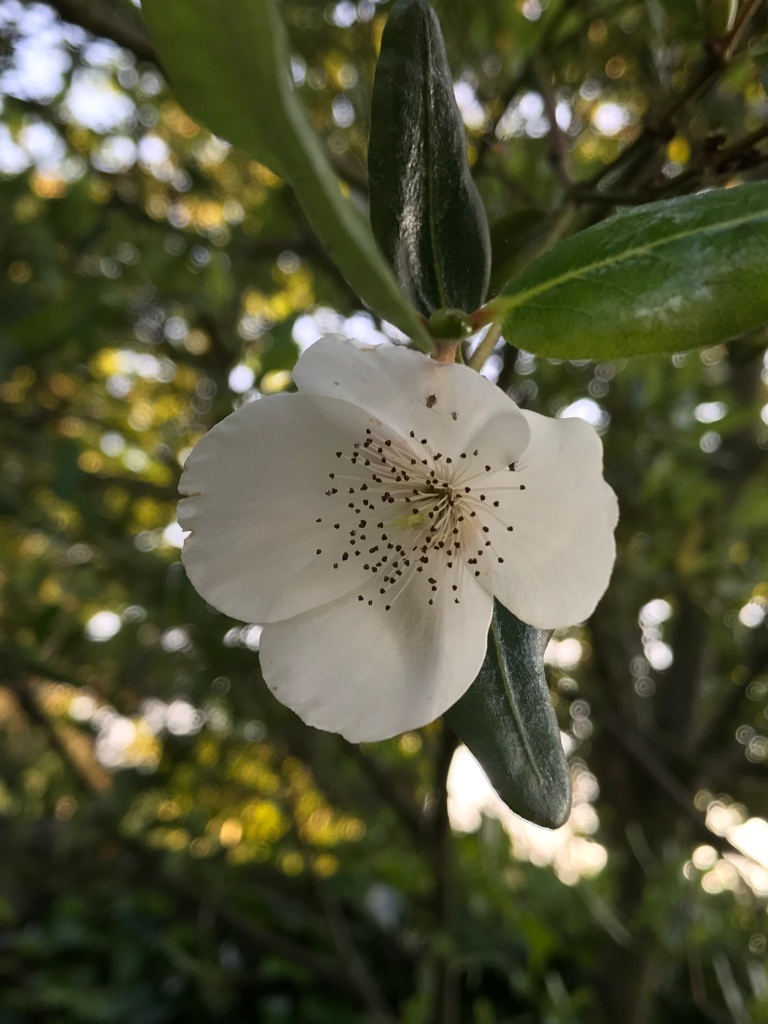
Plants teach you a kind of delayed gratification akin to agricultural sowing and harvesting. Like very slow fireworks, you stick them in the ground and retire for 12 months – or 24 months – or, in the case of my Tasmanian Leatherwood, 10 years. Leatherwoods are famous for the delicate flowers that appear in late summer and high-value honey.

Eucryphia lucida

I bought mine as a small sapling in the shop at Edinburgh’s Royal Botanic Gardens after admiring a splendid columnar specimen in full flower next to Inverleith House. As the years went by, my purchase grew painfully slowly and remained bereft of blooms. After a decade of disappointment, I stood before the the scrawny specimen, my hand hovering over the bow saw, when I noticed a single perfect flower. The next year there were more and now it is covered in blossom and attendant bees every summer.

One of the trees I took out with a very heavy heart was a russet apple. Although russet apples are hard and dry (and do the russet thing of going brown the instant they are cut open) they are sweet and stew well. We had fun weaning both our children on home-grown apple purée. But this russet was right in front of the proposed site of a new summer house. After seeing a lovely American crab apple, Malus dartmouth, in the Botanics, I ordered one online to compensate for the sacrificed tree. It arrived at my work from a nursery in Yorkshire, bare-rooted, 7 feet long and furled in black plastic. I lowered the roof of my car, stuck the long unwieldy parcel between the passenger seat and the transmission tunnel and with the top end protruding backwards, set off for home. A colleague saw me en route and asked me where I was planning to drop anchor. I planted the tree in the lawn and staked it low down for two years. It took well and it is a mass of blossom in the spring. If not picked for cooking, red and orange apples the size of table tennis balls hang on into the winter months like Christmas decorations.

In the end gardens are transient things that depend on an individual or group having the energy and determination to create something out of the incessant flow of nature. Gardens reward the gardener and give pleasure to others but neglect rapidly leads to decline and an overgrown garden is a poignant sight. To some, gardening will always be a dreary chore. Whenever I get overenthusiastic about its charms someone will say, ‘Well if you like it that much, you can come and do my garden.’ To which I always reply, ‘What would be the point of that?’

*My father was initially in partnership with his two brothers and since they shared a surname it was necessary to differentiate between them by calling them Mr John, Mr Willie and Mr James.