
I was brought up on the family farm in East Ayrshire but my mother came from the Edinburgh area – which makes me the product of a mixed marriage. My father ran a large business and was a prominent farmer. This meant he was away from home most of the time. We lived 600 feet up a hill and a mile or so from the nearest town. I essentially spent the first five years of my life with my mother. I had no friends of my own age and the adults I met were either relatives or worked for my father.
I can recall the feeling of dread as schooldays approached. I couldn’t bear the idea of spending part of every weekday away from home in an alien environment. I made an ineffectual attempt at school refusal, easily overcome by my mother who pointed out that Jennifer, a girl of my acquaintance, was happily attending her second year of primary school.
My next problem was linguistic. The local town of Cumnock had just 10,000 inhabitants and was surrounded by farmland. This was the late 1950s and at least a third of my new school friends didn’t have a TV at home. They weren’t listening to the Home Service either. They communicated in broad rural Scots. To avoid being ostracised I had to become fluent in the vernacular as quickly as possible. Later I would complete the assimilation process by adopting the required left-wing politics. These views came in handy later in the debating society and, in East Ayrshire at least, they made you more attractive to girls. My mother’s early training did come in useful during English exams. When asked to fill in the blanks in sentences I would put down what I thought my mother would say and that was usually the right answer.
I am a tolerably good mimic and learning to speak like my new classmates was helped by my complete immersion in the patois. There being no national standard for Scots (there still isn’t) this was the East Ayrshire version. Scots speakers from Hawick, Glasgow, Edinburgh, Aberdeen or Kirkwall all sound different and may even have trouble understanding each other. Scots in its various forms is an archaic form of English with some adopted French and other northern European words, the result of foreign-educated monarchs, commerce and settlement. The Scots word ashet for a large serving plate derives from assiette and fash for angry or vexed from fâché.
Charles I was born in Dunfermline Palace. Once he was executed the Stuart dynasty’s connection with Scots was severed. When Scots ceased to be the language of court, it fragmented into its regional dialects. The language of power became the English of London and the south eastern élite. The shift of power from Edinburgh to the south freed the great academic and legal brains of Scotland from a royal court but left them under the yoke of a powerful and atavistic church. Somehow, in spite of this, there was a Scottish Enlightenment that outshone the rest. For a while Scots was spoken at all levels of society north of the Tweed but by the late eighteenth century only a few elderly aristocrats still used it. Aspirational Scots would even employ tutors to try and eradicate their embarrassing verbal inheritances. Broad Scots receded to the rural peripheries and diversified into regional variants like Doric. The major conurbations, notably Glasgow, all had their own unique styles.
To return to my autodidactic efforts; I first had to learn all the altered vowel sounds. Nothing signals a fake accent more quickly than getting those wrong. Then there was the alien syntax and the huge vocabulary of Scots words. Eventually I was fluent and sounded no different from the other boys but at home and in the classroom standard English, albeit with an accent, prevailed.
Like many generations of Scots before her, my mother was concerned as far as possible to exclude the provincial from her speech, but it was interesting to hear my father use full-on Scots with the farm staff. He had left the local village school with its handful of pupils at age 14. My mother’s family seemed to differentiate between the Scots they had spoken as children and what they regarded as the debased urbanisms I was learning at school. They particularly disliked ‘yous‘ and referred to the locals as speaking ‘fur-tae-be, gawn-tae-be‘ Scots. In retrospect I think they were nostalgic for the lost east coast rural dialect of their youth. In private situations my mother and her parents would use old Scots with us as the language of emotional intimacy and comfort. Outside the home it remained ‘common’ – the language of the ‘common five-eighth’. I rejected all this casual snobbery and revelled in my new expertise and communications skills. To do anything else would have invited ridicule – or worse.
My youngest brother was born six years after me. In that short interval every household had acquired a TV. There was now widespread exposure to BBC English and to multiple regional English dialects through soap operas and comedies. I was aware of the shrinkage of Scots among my wee brother’s contemporaries who could mimic many UK regional accents but would fail to recognise some common Scots words.
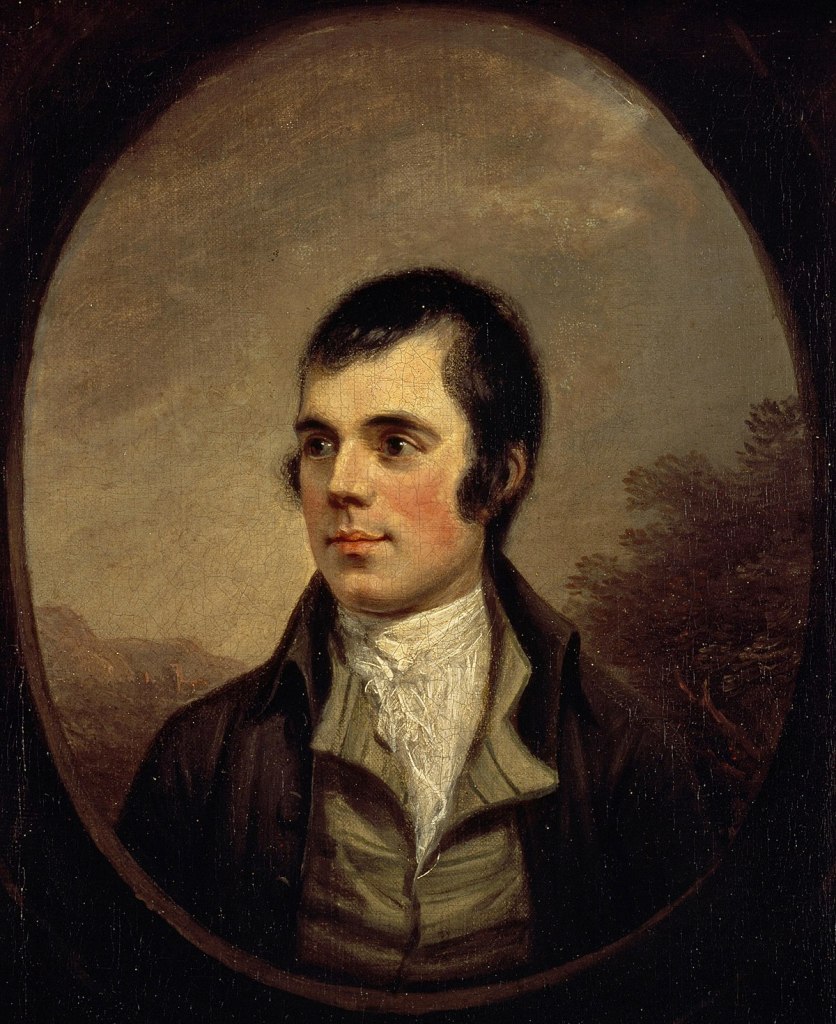
It being Ayrshire, Robert Burns’ poems and songs featured prominently in our education. For deliberate effect Burns wrote in an archaic form of Scots, even for the eighteenth century. He would also alternate stanzas of Scots with formal English in poems such as To a Mouse. Perhaps there was some truth in the urban debasement of the language because even we true country kids needed our vocabulary expanded to understand his poems. I suppose that is simply an illustration of the dynamic nature of language. It has always changed and diversified – but now mass media is homogenising English worldwide.
One day a student from Strathclyde University turned up at the farm bearing a thick research questionnaire about Scots words used in the area. He wanted me to fill in the local words next to the standard English ones. I glanced down the long list of animals, plants and objects with a blank column alongside for the local equivalent. I told him I knew a few of the words but doubted there would be much more to add. I showed it to one of our tractor drivers who was nearing retirement age. To my amazement he went through the list filling in words I had never heard before – or read in the works of Robert Burns.
Aged twelve I sat the common entrance exam for an independent boarding school in Edinburgh. Once again I was uneasy at the thought of leaving home – this time to live among strangers of uncertain character. It was an extremely hot day. I was shown to the examination room while my father went off to have tea with the headmaster. A teacher came in and handed out the papers. ‘The bright boys over there are sitting the bursary,’ he said. ‘You thickies are sitting the common entrance. When you open the paper you will find some questions on New Maths. That’s the last time you will see any of that rubbish. We don’t believe in New Maths here.’
Not having been to a prep school I found the exam puzzling and I did not feel motivated to do well. A succession of cricketing prefects in whites came in to invigilate us between their spells at the crease. Their accents sounded posh English to me. I felt lost and ill at ease. There was a break in proceedings and we candidates wandered out to watch the cricket in progress on the vast playing fields. Another farmer’s son, equally culturally adrift, asked me how many pupils there were at my school. I answered, accurately, ‘1500’. He assured me that couldn’t be correct, so I backed down in embarrassment and said I thought it might be 500. I was very relieved when my father picked me up at the end of the day and drove us home to Ayrshire, windows down, tyres singing over the sticky tarmac.
My father, an elder of the Kirk, had detected whisky on the headmaster’s breath at 10am that morning. This gentleman had emphasised that sporting excellence was what got a boy ahead in life and they would do their best to see that I spent as much time as possible playing games. I passed the entrance, but without distinction. My father asked me if I wanted to go. I said no and that was accepted. When this decision became known, some of my mother’s friends were appalled. ‘But Edith, he’ll get a dreadful local accent!’ Years later, when I was a junior doctor, one of my colleagues (The Dragon School, Rugby, Harlequin FC) asked me why I hadn’t been sent away to school. I recounted the story above to which he replied, ‘But your accent’s not that bad…’
All Scots have unconscious scotticisms in their speech; words and constructions they imagine are standard English but which stand out to an English speaker from the South. Among these are words like ‘outwith’ and the ubiquitous use of the possessive pronoun – my work, my dinner, my bed etc. The English go to work not to ‘their’ work. They have dinner and then go to bed. They are never ‘away to their beds’. And they don’t clap dogs or eat sweeties. Scots speakers also differentiate phonetically between the words witch and which, and the country Wales from the animals called whales. These word pairs sound the same in received pronunciation (RP) which makes some jokes impossible in Scots:
Question: ‘How do you get to Wales in a car?
Answer: ‘One in the front and one in the back.’
Similarly, Scots are rhotic speakers and always pronounce the ‘r’ at the end of words like war and door. RP speakers are ‘non-rhotic’ and drop the ‘r’ unless it is followed by a vowel as in ‘better apples’. Because of this, southern speakers will often add an intrusive ‘r’ where none exists – as in draw-ring and lawr-and order. Crosswords can be a problem when a setter references non-rhotic homophones like woe and war or doh and door. A Scot hears these words as distinctly different. When I left school and went to Edinburgh to study medicine I encountered independent school pupils from Edinburgh who sounded English to me. Then I met real English students and detected a difference.
At university I made no conscious effort to moderate my dialect or accent but if I had used full Ayrshire, almost everyone I was trying to communicate with would have struggled to understand me. For a few years, to my mother’s dismay, my social circle remained anchored at home and I could slip effortlessly between Edinburgh and Ayrshire speech. Later I began to have problems. Half way through a sentence I would muck up some word or vowel and create a ghastly linguistic chimera. My Cumnock friends laughed, and mocked me for an Edinburgh snob – but they suspected I was going over to what they regarded as the dark side.
As a young man I had a passion for everything Scottish. I saw us as a slighted, under-appreciated genius nation who should throw off the English yoke as soon as possible. On a few occasions I even voted for a party that wanted to separate us from the rest of Britain. I joined the Scots Language Society (SLS) and tried writing short stories in Scots. The effusions of the SLS soon began to drop through the letterbox. As I read these, I became uneasy. There was no ‘real’ Scots – it was anything you wanted it to be, spelled any way you liked. The tricky vowel sounds were not those between Scots and English but between Scots and other forms of Scots. It was an invented nonsense. Instead of being inspired, I found the high priests of the lingo like Hugh MacDiarmid morally repugnant – and TV’s peddler of the Mither Tongue, Galston’s Billy Kay, risible. I thought it was important to read, understand and study Scots literature but, a bit like urban Gaelic, the modern version was a sickly mutant. I underwent a complete cultural vault-face and quickly abandoned the movement.
At university I knew the folk singer Rod Paterson quite well. Later he would become a noted interpreter of Burns songs. I met him at a gig in Edinburgh once and remarked jocularly, ‘Where the hell did Billy Kay get that accent from? I’m from Ayrshire and nobody speaks like that in Ayrshire!’ Rod’s eyes narrowed, ‘Billy’s done a lot for our country Allan,’ he said. Like many things in our country these days the whole thing has gone beyond a joke.
 The Bohemian Waxwing