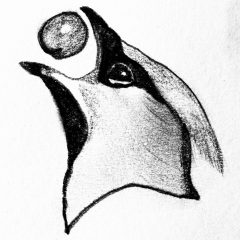
The Bohemian Waxwing Bombycilla garrulus is a beautiful bird. They breed in the northern conifer zones of the ‘Western Palearctic’ where they are insectivorous. In winter they migrate from the arctic cold and change their diet to berries, mainly rowan and hawthorn. In November they arrive in central and western Europe to overwinter. A shortage of berries can result in huge irruptions of birds further south and west although the precise balance between population and food source is not fully understood. In these irruptive years they arrive in eastern Britain in large numbers and disperse westward as they consume the available berries. Much of the fruit has fermented and, despite having a famously large and efficient liver, the birds can become intoxicated. They have little red waxy beads at the tips of their secondary flight feathers which gives rise to their English name – but why ‘Bohemian’?

Bohemia is the Westernmost part of the Czech lands, now the Czech Republic. It was part of communist Czechoslovakia and its capital city is Prague. The French word bohémiens was used to refer to the French Roma people in the mistaken belief that they had come from Bohemia. In fact the Roma originate in northern India. The French also used the term gitans for them, a word more familiar from the blue-packaged Gitanes cigarettes, which feature the silhouette of a gipsy dancer.
In time bohémien evolved to mean a lifestyle of artistic and moral freedom. Bohemians adopted a kind of voluntary poverty in pursuit of creative fulfilment. They had a flexible approach to marriage, law and hygiene. If you were an aristocratic type you might simulate this lifestyle by joining the better-off haute bohème. The romantic image of impecunious creativity and uncontrollable gipsy passion features in several operas. Carmen is referred to as a bohémienne. Puccini’s opera La bohème is about impoverished Parisian poets and artists, starving in their frozen garrets. One of them falls for a doomed consumptive seamstress. It would seem the waxwing is neither a gypsy nor a starving poet.
The German term Böhme doesn’t necessarily mean ‘from Bohemia’ either. They use it as ‘French’ is used in English to indicate exotic foreign species – as in the French Partridge (the Red-legged Partridge) or French Yellowhammer (the Cirl Bunting). It implies a migrant, in the case of the waxwing, a winter one. The waxwing is therefore a Bohemian because it wandered to Germany from foreign parts. In Germany in the past these birds were eaten.

It has taken a long time settle both the common and scientific names of the bird. Conrad Gessner in 1555 named the bird Garrulus bohemicus which is literally ‘Bohemian Jay’, although they are not jays. John Ray in 1678 adopted this term but mistranslated it as the Bohemian Chatterer. In fact the waxwing is a rather silent bird. Thomas Pennant changed the name again to the Waxen Chatterer because of the peculiar flight feathers, but in time waxwings were removed from the chattering classes altogether and put into a genus of their own called Bombycilla. The waxwing’s plumage is soft and silky. The common name for waxwings in Germany is Seidenschwanz which literally means ‘silk-tail’. Translating this into the clumsy Latin used by scientists we get Bombycilla; but the bird has never been able to shake off the chattering thing altogether. The species name retains garrulus.


In my childhood copy of the Observer’s Book of Birds the waxwing and the Golden Oriole face each other on opposite pages. Two fabulous exotics firmly in the never-to-be-encountered category; but in November 1988, about 3 years after my interest in birds was rekindled by a colleague, there was an irruption of waxwings in the UK after a long gap of about 15 years. No smartphones with birding apps were available so we used a telephone service called Birdline Scotland to get our information about rarities. You called in and received a message along the lines of:
“Welcome to Birdline Scotland. Thursday: Late evening update. In Lothian, 25 waxwings at Longniddry Railway Walk; still present this afternoon. Park near the station and walk east. The birds are feeding on hawthorn hedges.”
Inevitably the chance to add such a prize to your life list made you a bit twitchy until you had the opportunity to go for them. If the birds were still there it wasn’t difficult to find them because inevitably there would be a group of birders gazing at them. If they were still there.
Waxwings are gregarious and have a superficial similarity to starlings in flight. Their flight is fast and direct with long pointed wings. They are not particularly shy, presumably because they spend most of their time in vast uninhabited pine forests. The red waxy tips are not easy to see but the paler colour and the unique crest is obvious compared to Sturnus vulgaris. The wing markings that are visible are the white and yellow edgings to the primaries and the bird has a square, yellow-tipped tail with a ‘chestnut vent’. They are strictly arboreal and often turn up in supermarket car parks and public parks where berry-bearing trees and bushes have been planted. In winter it is always worth checking any flocks of good-sized birds in trees because they may not be starlings.
After I added waxwing to my life list at Longniddry there were further substantial arrivals in later years. A cotoneaster hedge in a friend’s front garden once drew a flock and we were able to watch them moving back and forth from the hedge to nearby trees and drinking water from the roof gutters. Their diet of berries makes them messy visitors. I have them on my ‘garden list’ as well.
The most unexpected sighting I’ve had was while doing a ‘portable’ ultrasound scan in one of the oncology wards at the Western General Hospital. I was accompanied by a junior trainee. As we approached the ward along an upper corridor I noticed a flock of birds in the large sycamore that stood outside. This old tree had somehow survived the various building programmes since the Western began life as Craigleith Hospital and Poorhouse in 1868. It dawned on me that these birds were a pale colour and had crests. They were close enough to convince my junior that we were indeed witnessing some unusual ornithology.
So why call this blog The Bohemian Waxwing? Apart from the fact that I like waxwings and that the concept of Bohemianism appeals to me, the scientific name can be abbreviated to B. garrulus – something that, unlike the waxwing, I am prone to do.

 The Bohemian Waxwing