In the Midlands and north of England wasps are commonly known as jaspers. No one seems to know exactly why. Is it a phonetic corruption of ‘vespa’ or a just the similarity in colouring to the mineral jasper? Maybe it’s a reflection of the wasp’s perceived character – like a moustachioed Victorian bully called Jasper. This presumed nastiness is reflected in our usage of ‘waspish’ as an adjective for unpleasant things – like a sarcastic sense of humour or a prickly personality. In America wasps are known as yellowjackets. Wasps exhibit aposematism, a warning coloration. Having noticeable jazzy colours helps other animals avoid being stung and the wasps avoid being eaten.
The Italian for wasp is vespa. Anatomically they are sharply divided into head, thorax and abdomen with only the slimmest ‘wasp waist’ connecting the latter two segments. Close examination of their black and yellow exoskeleton makes you feel that they are actually more evolved than we are. They are perfect, tiny, armoured flying machines carrying sophisticated weaponry. When aircraft manufacturer Enrico Piaggio saw the first post-war prototype of the scooter his company would take to world-renown, he exclaimed ‘Sembra una vespa!’ – ‘It looks like a wasp!’ – naming his product instantly.
Now is the time the vespal queens over-wintering inside our houses start to emerge from their torpor spent in the folds of our curtains and pelmets. We have had fewer dormant queens in the house than usual this year; just the one in fact, found clinging to the curtains in the drawing room a couple of days ago. I trapped her using a glass tumbler and a postcard and released her from the bedroom window. She cleaned her antennae briefly before zooming off over the garden.
Having emerged, the queens seek a site to build their grey papier mâché nests. The legend is that the Chinese invented paper after observing wasps chewing wood to make their nests. The rasp of their jaws on dead wood is audible to us. Typically they use old fence posts and decaying garden sheds as substrate. Wasps nests are called bykes in the North of Britain. They build them in hollow trees or in animal burrows and sometimes in the roof spaces of our houses. As a boy I can remember my father getting one of the men on the farm to destroy a wasps’ nest by pouring petrol down the burrow and igniting it – a tricky operation.
During the winter, as logs are brought into the house, sleeping queens come with them. Roused by the heat of the room they appear without warning, cruising around the Christmas cards and tinsel. They are magnificent insects and I never have the heart to kill them. I return them to the biting cold of the log store with no great expectation of their survival after this premature end to their suspended animation. I suspect they burn up too much of their stored fat in the false hope of refuelling from spring flowers.
Wasps are social insects related to ants and are said to exhibit reasoning (New Scientist 8 May 2019). In Britain there are about 9,000 species of wasp but we are only really familiar with the common wasp (Vespula vulgaris) and the German wasp (V germanica). They are very difficult to tell apart. The german workers have three black spots on the face. Wasps are pollinators and also useful predators of insect pests such as caterpillars and aphids and they should be left in peace.
The vigorous cherry laurel (Prunus laurocerasus) familiar from shrubberies contains toxic amounts of prussic acid – hydrogen cyanide – which is the reason the cut leaves and stems smell faintly of almonds. Crushed leaves in a jar can be used to kill insects. It is said to be too slow a method to use on butterflies and moths who damage themselves as they struggle in their death throes. An artist friend of mine, Jim Dalziel, has an interest in entomology and once spent a summer afternoon capturing wasps and putting them in a jar with shredded laurel leaves. Once they keeled over he was able to use a magnifying glass to work out which were the german ones and which the commoner vulgaris variety. When we came round later that evening for supper he was keen to show off his new skills and invited me into his studio. Retrieving a folded-up piece of drawing paper from the bin, he opened it, promising to show me the key identifying features. It was immediately apparent to both of us that the numerous wasps had only been anaesthetised and were now quite annoyed to find themselves trapped in a paper prison. We rushed to return them to the garden before they attacked the unsuspecting company.
Unlike bees, wasps can sting as often as they please using their un-barbed tail-mounted weapon. The sting contains an alkaline form of venom, unlike bee stings which are acidic. This is the supposed logic behind our mothers putting bicarbonate of soda on bee stings and vinegar on wasp stings. In my mind, the hot-poker pain of a wasp sting is forever associated with the pungent smell of the vinegar my mother used. It was never effective as far as I could tell.
Once, on holiday at a villa in Umbria, I was stung by a hornet, the splendidly-named Vespa crabro, a much larger relative of the wasp. I was relaxing on my back on a Li-Lo in the swimming pool, contemplating the evening sky after a hot day driving around southern Tuscany. Paddling myself about I managed to trap a floating hornet between my upper arm and the side of the Li-Lo. The hornet, already distressed by its imminent death by drowning, stung me immediately. The pain was intense and persistent and a large indurated area developed around it which lasted for days.
Apivorus means ‘bee-eater’ but the European honey buzzard(Pernis apivorus) eats far more wasps than bees and is actually called the Wespenbussard in German. It’s not even a true buzzard as in the familiar Buteo group. Honey buzzards are secretive summer migrants and mainly breed in central and southern Britain. There are several breeding pairs in Scotland too but you are very unlikely to see them. Birds perch in mid-canopy to scout for prey. The claws are blunt for a raptor – rather like a vulture’s – and it uses its powerful feet to excavate wasps nests from burrows to get at the grubs. It has dense scaly feathers over its face to protect it from attack and the feathers are thought to contain a wasp repellant. The European bee-eater (Merops apiaster) also eats a lot of wasps. It is adept at knocking out the stings of bees and wasps on its perch before consumption.
Adult worker wasps are female and only live for an average of 2 weeks. Once the queen has begun the nest and produced the first few workers she becomes flightless and confines her activities to egg-laying. The workers are actually capable of laying haploid eggs that produce male wasps. The workers feed the larva on masticated caterpillars and aphids. In return, the larvae secrete a sugar-rich fluid which is the main food of the workers who cannot digest solid food. The colony expands to a maximum of about 10,000 individuals.
At the end of summer, sexual larvae, queens and drones, are produced which will mate before the queens seek out their winter quarters. When these sexual forms pupate the supply of sugary secretions runs out and the workers start looking for alternative sources of energy from any unharvested fruit such as plums and figs – or from picnics. The old queen dies and the social structure of the nest disintegrates. The workers start to succumb to starvation and cold and this is the time of year when we must beware the groggy, moribund Jaspers who still pack a punch.
We moved to our present terraced townhouse in autumn 1992. The front of the building was smothered by a huge clematis montana that extended onto our second floor balcony and also onto our neighbours’ balcony to the east. Squirrels lived in it and made dreys there.
In June of the following year it erupted into bloom. It flowers later than the commoner montana sp. It was immediately apparent that the flowers had a very unusual scent – of chocolate. In fact it was almost overwhelming when approaching the front door. This became a much anticipated annual event quite apart from the floral spectacle itself.
Over a decade later, in late June, we were about to drive to Fife to catch the car ferry from Rosyth to Zeebrugge. A classic (for Edinburgh) torrential summer downpour started. I had a quick final look around the house before leaving and was appalled to find water coming through the drawing room ceiling above the bay window. The neglected clematis had finally blocked the gutter running around the balcony. There was nothing to be done but to put a bucket under the leak and hope there was a dry spell for the next two weeks.
Cutting it back and clearing the gutters that autumn was a big job and I ignored the sage advice when dealing with a very mature plant – which is to take half away one season and leave the rest to the next. To avoid the extra work I simply cut it all back to first floor level and carted away an enormous amount of pruned branches and leaves. I refer to this sort of activity as ‘hackenbush’ in homage to Groucho and the waste as ‘prunage’ on the basis I like putting ‘age’ after verbs to make a noun.
The following spring I waited nervously for signs of life. I was relieved when shoots appeared from the stumps and grew rapidly for a few weeks. Unfortunately, and quite suddenly, they wilted heralding the demise of what was once a magnificent specimen. There was nothing to do but remove the rest of it and learn the lesson. June was never the same after that.
At the time I had no idea what variety the montana might be. I’d never heard of a chocolate-scented clematis. Thanks to the internet I eventually identified it as the variant wilsonii using the brilliant expedient of googling ‘chocolate scented clematis’. Duh..
I found a supplier in the West and ordered two plants as insurance. I trained them over a metal arch on the east wall of the back garden and used it to frame a bench.
C. montana wisonii on the arch, scented deciduous azalea to the right and rosa ‘Fantin Latour’ to the left. All have a very nice smell. ‘Starry’ flowers
Although the new plants’ flowers do smell faintly of chocolate they do not seem to have the power of the original – which is very disappointing as it is otherwise just a late flowering C. montana. In a fit of horticultural enthusiasm I have twice taken multiple inter-nodal cuttings in successive years, all but one of which have died of fungal affliction – and the sole survivor is not looking too great this year. Reading around the subject I have perhaps left taking the cuttings too late. I feel defeated by it now and regret promising friends a rare scented clematis, an offer I find I cannot fulfil. I would have settled for even one survivor to plant in the front garden and mitigate my crime. Perhaps in time it would have grown to be a nuisance to someone else.
As I write, in keeping with the aphorism, March is showing leonine tendencies having been peacefully ovine at the outset. My birthday is located at the beginning of the month on March 4th, which is “the most commanding day of the year,” according to our old dairyman. A pun that was never quite funny enough.
Spring is the time for meteorological aphorisms and coming from a farming background these sayings had some practical significance. Now that I have substituted gardening for farming there is still some utility in knowing what to expect. My grandfather would say, “February fills the dyke, be it black or be it white,” alluding to the tendency for huge amounts of precipitation of either type in that month. There is a codicil to that saying of which I was unaware as a child; “But if it be white, It’s the better to like.”
This year we had both. Dreadful Somme-like mud and flooding followed by hard frost and heavy snow – which was certainly preferable. When walking an energetic Vizsla conditions underfoot are crucially important and it made me think of another longed-for sign – March dust. The lengthening day, the waxing of the Sun’s power as its angle to the Earth steepens added to a bit of wind-induced evaporation produces that welcome indication that the land can be worked again. The blackened sods pale and the mud on tarmac and paths slackens its grip. Dust blows about in the dazzling light. At least that is the theory. Climate change may modify these old adages.
Miniature daffodils, possibly a variety of Narcissus asturiensis
Not having to ‘work the land’ these days, such considerations are less relevant to an urban existence. Perhaps they are less important to farmers too as so many cereals are now sown in the autumn to germinate before winter and so get off to a flying start in spring. To a gardener the progress of the early year is marked instead by flowers.
It’s important to have something to cheer you in the depth of winter, but to me there’s something slightly depressing about winter jasmine and its screaming yellow successor, forsythia. I much prefer witch hazel with its little streamer-like petals and fantastic orangey smell – and it looks so nice with a bit of snow on top.
Witch hazel in snow
Another mood-enhancer in the shortest days is winter (or sweet) box, Sarcococca confusa. Oddly, its scientific name means ‘flesh berry.’ The sweetness refers to the exotic scent of the inconspicuous flowers which are borne in mid-winter. I planted it at the front door to greet winter visitors and in the back garden as evergreen punctuation. Its habit is looser than Buxus but vigorous even in quite deep shade. Sarcococca originates in South East Asia and our Chinese neighbour says the scent makes her nostalgic.
The spring sequence of herbaceous plants that exploit the light passing through bare deciduous trees begins with winter aconites and snowdrops. Our snowdrops are spreading rapidly through the lawn but I haven’t the heart to mow them down before they die back naturally. This makes for great untidiness in late spring and early summer.
Iris reticulata emerging
Iris reticulata is found from the Caucasus to northern Iran and is presumably an alpine species. The flowers are evanescent and the leaves very fragile. Like the muscari grape hyacinths it is a welcome relief from all that yellow. Apart from the omnipresent snowdrops, I have more hellebores than any other winter flowering perennial. Most of these are the early-flowering ‘Christmas Rose’ types whose drooping heads have to be tilted up to see their full splendour. The later-flowering Lenten Roses don’t seem to do so well with me. I like to cut off last year’s leaves to get the full benefit of the flowers.
‘Home of the Happy Helebore’
Daffodils are underrated in my opinion, probably because they are ubiquitous. I like the green ‘non-scent scent’ of the big ones. Many dwarfs and poetica species are properly scented. One miniature daffodil has been following our family around for a very long time. Originating in my grandfather’s farm – which is now lost under the satanic mills of Grangemouth oil refinery – they were introduced to several of our family’s gardens. They are very short, with swept-forward tepals and coronae. The leaves are greyish green. I think they are a variety of Narcissus asturiensis but this is an amateur ID. They did not appreciate the woodland nature of our garden and I am now on a salvage mission, growing them on in pots with fresh compost every year in the hope that they will grow forth and multiply.
Returning to shrubs, the witch hazel is now past – although we have excellent autumn colour to look forward to. The hybrid Camelia x williamsii is just getting into its stride. Old photographs show it as a shin-height shrub when we moved in 28 years ago. It is now towering over us. I suspect it is the variety ‘Anticipation’ and it was always a favourite of our daughter. The huge peony-like flowers drop off without wilting in a strange unnatural way, carpeting the ground in puffy pink blooms. I once floated a few of the shed flowers in a bowl as a table decoration for a dinner party. It intrigues me that another member of the family, Camelia sinensis, is the source of tea. The shrub flowers and is hardy even in Scotland. Scottish-grown tea is available.
Magnolia x soulangeana
The gaudy star of the show, waiting in the wings, is our magnolia. Magnolias are ancient plants from the dinosaur era and they evolved before bees. The theory is that they were pollinated by beetles. They have a strong association with France. Magnolias as a group were named in honour of the French botanist Pierre Magnol (1638 – 1715). Our variety is a Magnolia x soulangeana. This is not quite so ancient having been bred by Étienne Soulange-Bodin, a doctor and cavalry officer in Napoleon’s army. He was superintendent of the Empress Josephine’s gardens at Malmaison.
I desperately wanted a magnolia of my own having suffered from magnolia-envy for many seasons. I bought the potted sapling at Hopetoun Garden Centre. The label said it had pale lemon, almost pure white, scented flowers. It did not prosper in its first location, so I moved it. Although it did flower and the blooms were spectacular I noticed that some branches had died. Despite this, vigorous shoots remained and I persevered. The tree gained in strength and began flowering profusely. Being red/green colourblind it took me a while to notice that the flowers had changed in character and now had a red flush at the base of the petals and no scent. It eventually dawned on me that the tree had been taken over by the rootstock it had been grafted onto.
One of the original huge Magnolia x soulangeana flowers
We are past the vernal equinox now and the clocks have been put forward for arcane reasons I can never understand. Something to do with the milking and Scottish schools… At least in this lockdown year there was no boozy dinner party to compound the effects of ‘losing an hour’ as my mother used to call it. April is imminent. So often a ‘cruel’ disappointing month relapsing into cold weather and damage to the tender shoots of recovery. April ‘showers’ are such a euphemism. Perhaps, like last year, we will be lucky and have one of those warm springs that comes on all summery and incongruous before the leaves are fully out.
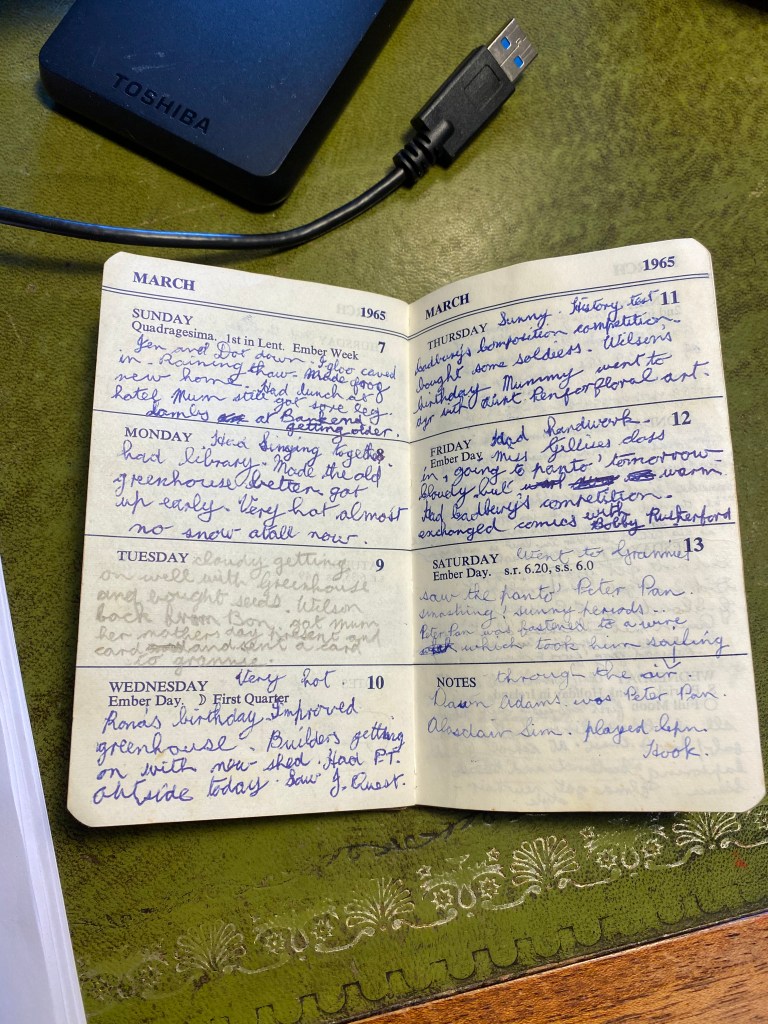
When a colleague learned I kept a diary he asked, ‘What do you write in it? Cornflakes again today?’ ‘No’, I said, ‘It’s all about you actually!’ That wasn’t too far from the truth at the time – but why keep a journal at all unless you are Pepys, Boswell or Chips Channon? I kept one intermittently as a child, as do most people. Recently I transcribed my 11-year-old experiences from 1965. For their entertainment I sent it to a friend who had shared many of those events.
A Complimentary Diary, 1965Made frog new home. Wilson back from Bonn. ‘Smashing’ panto – Alastair Sim played Captain Hook
My diary-keeping stuttered on into the Seventies. I kept a record of a secondary school trip to Norway for the amusement of my fellow travellers. I also have a complete diary for 1973 and a chunk of 1974 straddling years one and two of medical school. The rest of university was a shameful chaos and mercifully went unrecorded.
I did try to keep journals of holidays on the basis that these would be more interesting than the quotidian routine, but they are mostly incomplete. As soon as matters became enjoyably complicated the logging of events tended to lapse. Frustratingly, my account of a 1977 student elective in New York stops after three weeks with six more action-packed weeks to go. In any case, the quotidian is not necessarily less interesting than foreign jaunts.
One’s distant, undocumented, memories get hauled out randomly at dinner parties, over drinks in the pub or just for the contemplation of that inner eye that is the bliss of solitude. They are then put away again, on each occasion having mutated slightly towards your preferred version of the past. Eventually they can become complete fabrications. I have heard junior colleagues quote me using words I know I would never have used. Their pleasure in this false recollection makes it difficult to contradict them.
Even further back, my brothers and I have incompatible recollections of many shared childhood events. Some of this is simply differences in what an individual chooses to retain, but often there is a conflicting version of the raw facts of the matter. History is written by the victors of course and I feel a diarist need only be true to himself. The experiences of others around you can only be inferred. Diaries are inevitably more valuable as insights into the author’s personality than as sources of hard historical truth – but at least a contemporary written account has the chance of reflecting the truth better than a disembodied anecdote regurgitated decades later.
My earliest attempts at making a record have proved quite disturbing to read. Apart from the inevitable cringe factor, scenes are depicted of which I have absolutely no recollection. Names appear, confidently written, of people I cannot now recall. Even worse, I have discretely used initials to represent some of them making identification even less likely. I had assumed that all my memories would revive if prompted by the written word – but they don’t. Some things are stubbornly locked in the past and no amount of CPR can resuscitate them.
In my early thirties life became more settled. At the time I was thinking about writing fiction and wanted to base that on experience. The problem is I never shook off my conviction that history and biography are more interesting than made-up stuff. I could see that writing fiction releases you from the yoke of facts, perhaps allowing a greater truth to be portrayed. I decided to make a record of life, work and people as fodder for some future creative process as yet unspecified. Very soon it became an obsessional end in itself. 34 years and millions of words later I’m still gathering information.
1986 to 2020
A scriptwriter friend of mine expressed scepticism that I could have sustained this effort for that length of time and demanded proof. I fetched 2008 from the shelf as that was the year we travelled to Australia to visit him. I opened it at the page describing our arrival in Sydney. ‘You won’t be able to read it anyway, my handwriting is appalling,’ I said handing it over. ‘On the contrary,’ he said, ‘I can read it perfectly well.’ He asked how many words I thought the diaries represented. As a proper writer who earns his living by words, logo-metrics are of interest to him. After a quick count to derive the average number of words-per-page we calculated the total stood at approximately 5 million. ‘That’s a hundred film scripts!’ he said.
Mindlessly, I have recorded everything without prejudice. Cornflakes, jokes, anecdotes, births, deaths, rites of passage, children’s first words, sickness, all the striking or mundane events of life and work. I take my diary everywhere with me. After all, one should always have something sensational to read on the train.
My diaries as they stand are more a set of lecture notes than deathless prose. I assumed the narrative could be filled out later to make it readable. Having done that a couple of times for smaller projects I discovered that this process more than doubles the volume of verbiage. Even with incomplete and unreliable recall the dried-out facts expand dramatically when hydrated by grammar and a few adjectives.
But no matter how recently the pen has crossed the paper there remains the question of veracity. Even recording current events more or less as they occur, the moment you write something down you impart a self-flattering spin to it. A diary is always subjective, never objective. One of my favourite diarists, Jeremy Clarke who writes ‘Low Life’ for the Spectator, says of his partner:
I would like to say much more about her only she forensically analyses every mention I might make of her in these columns and measures it against something she calls ‘truth’.
What then should be done with this unreliable archive and the thousands of hours of pointless effort it represents? My wife’s grandfather’s World War I experiences were consigned to the fire by his widow. Perhaps a bonfire of the vanity project is what is called for.
For contrasting journal-keeping techniques I would recommend:
Hugh Johnson on Gardening The best of Tradescant’s Diary
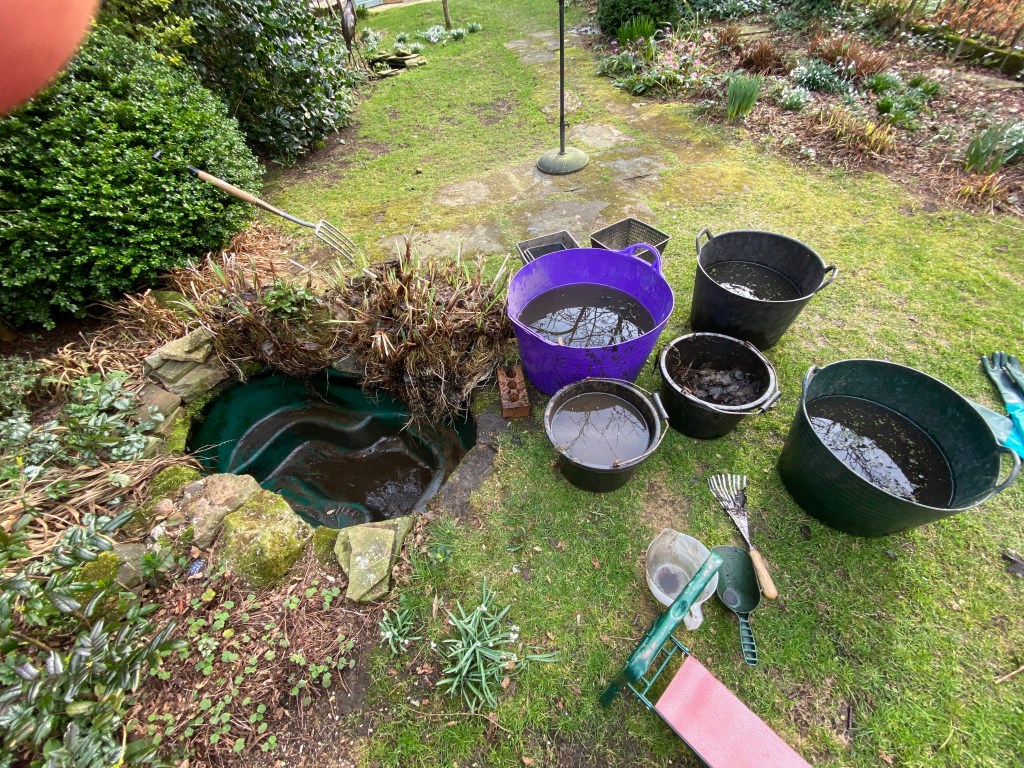
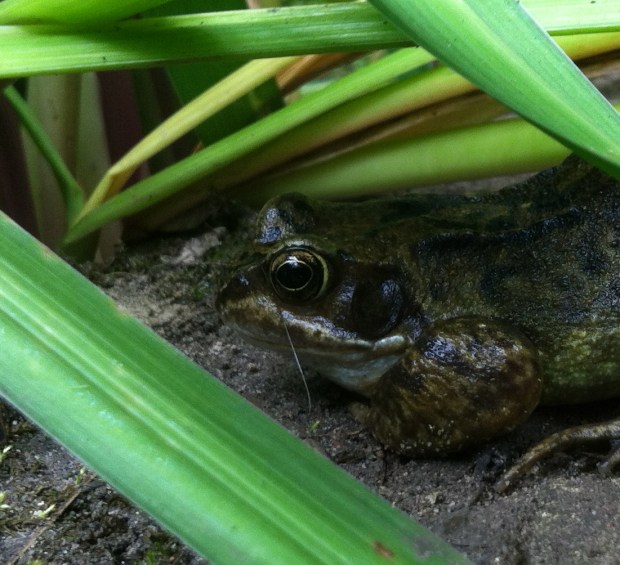
This week I have been cleaning out our two garden ponds. It’s the first time I have done this with the current pond iteration. The more established of the two had become completely choked with the matted roots of Iris sibirica and Caltha paulstris, the marsh marigold. When I hauled the root balls out, the water level dropped about 15cm. Spring is supposedly the best time for this unpleasant chore and I had noted at least one frog moving about near the surface indicating that spawning was imminent.
At the bottom, as I reached the deepest layer of slime, sludge and decaying leaves I discovered 7 hibernating frogs. Adult frogs overwinter in ponds in a state of torpor, absorbing enough oxygen through their skin for their meagre requirements. Smaller juveniles apparently prefer to hibernate al fresco under stones and logs. I removed all the solid waste, refilled with clean water and inoculated the mix with a couple of trugs of the old water I had reserved. I also returned the drowsy frogs to their watery beds. I found no evidence of my pond snails – just the rather repulsive freshwater crustaceans that feed on decaying detritus.
Pond #1
Our garden frogs were already in residence when we moved into our house in 1992. The sellers informed us the frogs had arrived as a couple of bucket-loads of spawn from another garden pond in nearby Dick Place. We inherited two square ponds about 100cm x 50cm in area which were situated under an old laburnum. I decided to keep the ponds – and the tree. I covered the ponds with a stout wooden frame enclosing heavy-duty square-mesh sheep fencing and pegged it to the ground. The children later used these unyielding structures as a handy platform from which to catch frogs. They never ate any laburnum seeds.
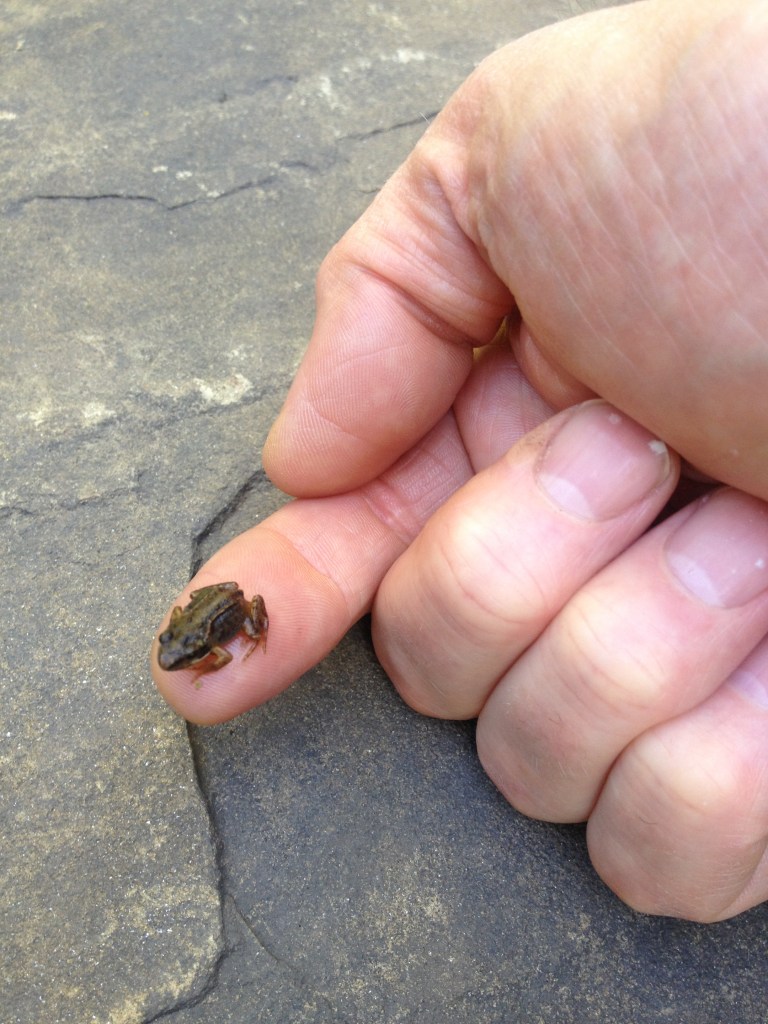
We had huge numbers of the amphibians in those days. They came in all sizes from tiny tail-less quadrupeds, recently emerged from the water, up to large greenish females. Mowing the lawn in late summer was nerve-racking as I tried to avoid chopping up tiny froglets. The bigger frogs were liable to give you a start by leaping out of the border while you were weeding – or splashing into the ponds for refuge.
Older offspring James was very keen on dinosaurs, as most boys are, and insisted on bedtime readings of his vast library of dinosaur data. We all learned a lot about dinosaurs. Included in that material was information about amphibians, and the etymology of the name. At nursery, his class was asked if they knew what amphibian meant. James piped up that it came from the Greek ‘amphi bios’ meaning ‘double life’.
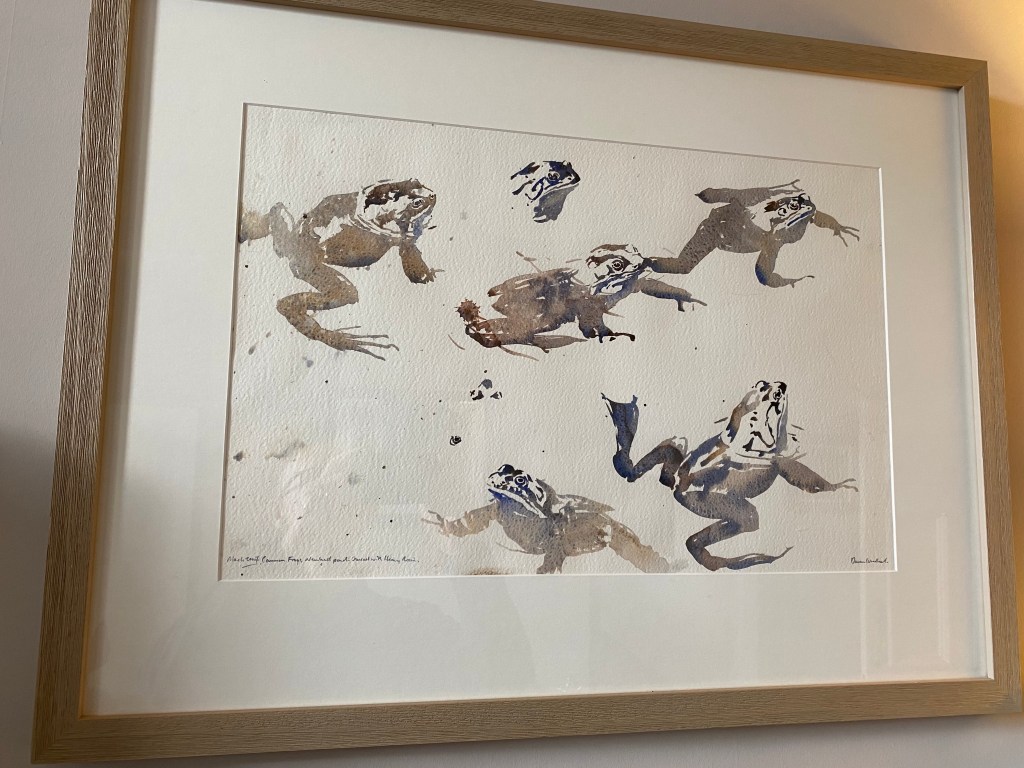
Frogs are ‘good gardeners’ and keep down the army of invertebrates intent on munching your plants. However there is something unsettlingly human about them – they are homunculi with long legs and bandy arms. All they lack is a cranium. Instead, their heads are all eyes and mouth like some genetic experiment gone wrong. And then there’s that pulsing throat…
Mr Jeremy Fisher
After a while I gave up on those old ponds. I had a much bigger D-shaped pool constructed against a boundary wall, filled in the original ponds and grassed them over. The new pond was huge with a flat-topped wall surrounding it. My idea was that you would sit on the wall to observe the aquatic flora and fauna. Perhaps, if you were a princess, you might kiss a frog in thanks should it retrieve your crystal ball from the depths.
At the planning stage I had not considered that frogs might be disinclined to use a raised pond. They needed to climb up the ivy alongside the pond to get into the water which never worked well. Unlike toads they are not good climbers. Worse, I didn’t bother with an electricity supply, pump and filter so the seasonal accumulation of leaves eventually produced a nasty toxic, anoxic, brew. Everything except the plants died – including some sticklebacks I’d introduced. I created a further small ground-level pond to try to maintain a little frog-friendly habitat.
A couple of years ago I admitted defeat and abandoned the 20-year old raised pond. It was impossible to clean or maintain. Despite repointing, the external masonry had deteriorated. Below that layer of stone was a well-constructed breeze block and cement infrastructure, so strong that a huge effort was required over some days to demolish it using club and sledge hammers. Before the destruction, to maintain frog facilities, I reverted to two small ground-level ponds.
Pond Folly
Our next door neighbours used to have their own large pond which would seethe with mating, croaking, frogs at this time of year. It must have offered many frogs a winter refuge. However, when they became grandparents, they filled in their pond for fear of accidentally drowning their descendants. For several seasons after that in a pathetic demonstration of amphibian nostalgia, the frogs continued to lay spawn on the grass where the pond had been.
Numbers of frogs in our garden have dwindled drastically from their peak at the end of the last century but I was cheered to find those sleeping princelings in their slimy beds this week. More microcephalic heads have appeared in the other pond which I haven’t yet tackled.
In an echo of our own plight a nasty virus, Ranavirus, is killing frogs but I have a feeling habitat loss is the main problem in our own little domestic crisis. At the moment I am trying to rebuild our population of Rana temporaria. There was plenty of spawn last year although some of it proved infertile. I am concerned that I don’t see many juveniles about. For a few years, hoping to increase the survival rate in the tadpole derby, I gave them flaked aquarium fish food to eat. Some say raw mince works better. I have witnessed them feasting on a drowned blue tit fledgling.
Frogs take three years to mature and I hope the younger ones, which hibernate under logs, stones etc rather than at the bottom of ponds are still about somewhere and will reappear along with the invertebrates as the weather warms up. There is some debate over the lifespan of frogs but they seem surprisingly long-lived with a quoted range of 4-15 years. If that is the case our current residents may simply represent a relict population at the senile end of the bell curve. I hope not.
Herons have an enormous appetite for ‘puddocks’.* Their chest feathers disintegrate into a powder that defends them against the sliminess of eels and the like. If they have been fishing in your waters they leave a scum of this powder on the surface like talc. Our local herons must know all the ponds in Edinburgh and turn up in gardens to help themselves to the copulating hordes; an amplexus nexus.
One spring, when daughter Milly was quite small and our frogs were legion, my friend Willie and I were standing at the parlour window observing a heron polishing off its oblivious victims. Like me, Willie is a birder and we were content to watch the giant grey egret at work. Milly on the other hand was appalled. We explained to her gently that this was simply nature taking its course and carried on observing the proceedings, not paying much attention to her. Suddenly the back door flew open and a furious Milly charged out into the garden brandishing a broomstick over her head shouting, “Get away from our frogs!” The huge bird leapt into the air and flapped off before she could reach it. I now use a makeshift cage of plant trellis to protect our remaining assets during the mating season.
The Great Auk Pinguinis impennis surrounded by his relatives – Thorburn
In the early days of ornithology, before high quality optical equipment was available, it bore more than a passing resemblance to hunting. The only sure way to identify a bird was to shoot it. It was said, ‘What’s hit is history, what’s missed is a mystery’. If successful you could have your quarry stuffed for your personal taxidermy collection, or you might donate it to an academic collection. The corpses would be skinned and the pelts preserved with arsenic then stuffed with cotton or something similarly inert. The little mummified bodies were placed in drawers for future reference. Museums and some bird observatories hold huge collections of bird skins and eggs. I remember being cautioned to wash my hands after touching some of the skins in the collection on Fair Isle. Presumably those specimens went up in smoke with the rest of the archive during the fire of 2019. The Natural History Museum has 750,000 skins and over 200,000 clutches of eggs. Art departments also had collections of stuffed specimens. The immortals were set in fanciful natural settings in large glass cases, their plumage faded and their poses decidedly un-natural. I remember my great aunt Chrissie’s house, Carskeoch, had stuffed exotic birds under a glass dome in the drawing room.
Before they recolonised Scotland, the last official breeding record of osprey was in 1916. Prior to this collectors of these fish raptors would make boasts about their shooting prowess; ‘I obtained both birds with a single shot’. At Loch an Eilean in May 1851 the notorious egger Lewis Dunbar stripped off and swam out to the ruined castle on the eponymous island – in a blizzard. The nest atop the castle ruin had been used for many years. In an atypical error Dunbar forgot to take anything to carry the eggs in. He tried putting one of the eggs in his mouth but found he could not breathe. In the end he swam back to shore on his back with an egg in each hand. He blew them immediately, washed them out with whisky and sold them to an English egg collector.
The Portuguese word for the great auk is penguin. (This might be derived from the Welsh pen gwyn meaning ‘white head’ but no one knows for sure.) When Portuguese sailors first travelled to the Southern Hemisphere and saw those other large, flightless, seabirds they named them penguins as well. In fact the two genera are not closely related. The great auk bred on islands in the North Atlantic and was very easy to capture. The other smaller auks including razorbills, puffins and guillemots are still around, but the last great auks in the world were shot to extinction in the mid nineteenth century to supply museums. Those institutions were desperate to have specimens of the fast-disappearing oddity for their collections. As numbers of these huge birds dwindled towards zero, prices kept rising and their fate was sealed. They did not deserve to be harvested so easily and so completely to feed brutish, thoughtless sailors. Still less to be permanently obliterated from history to supply Victorian museums with specimens.
If some master genetic engineer ever asked me what bird I would most like to see resurrected from extinction from its dessicated DNA I would probably go for the great auk. Imagine the giant razorbill restored to the North Atlantic! And speaking of giants, why not resuscitate the South Island giant moa? The moa’s distant ancestors flew to New Zealand 40 million years ago. Having settled in and found no predators, they gave up flying, grew to a height of 12 feet and swelled to a weight of 250 kilograms. When the Polynesians arrived in the fifteenth century the bird’s great height and weight were no deterrent to hungry Maoris. As the moas disappeared, the astonishing 15 kilogram Haast’s eagle, which preyed on them, was robbed of its food source and it went too. New Zealand still has species of shrub with long outward-facing spines and small leaves (matagouri) thought to have evolved to protect the plants against grazing moas.
There is no doubt in my mind that we and our fellow homo sapiens in our teeming hordes are the entirety of the Earth’s problems. When it comes to getting depressed about it I take some comfort from the late great George Carlin. His eco-heresy is that we are going away – and the planet will be fine…
I have an old friend, Jim who, like me, loves birds. On our many quests to see new ones and revisit our old favourites we have enjoyed years of harmless, happy companionship. Often accompanied by the man who started it all, Rob Jones, we have found ourselves in landscapes we might otherwise never have known: Norfolk reed beds at dawn; grey sea lochs on Islay; dusk on Speyside under Scots pines. We have also shared the pleasures of the collector. Our collections are not made up of objects you can hold or contemplate but things that are much more ephemeral; a list of moments when you made a brief connection with a wild bird – especially those moments when that bird was a fabled rarity.
Jim is an artist and he can capture those moments using his special gift, but for the rest of us they must simply ‘flash upon that inward eye which is the bliss of solitude’. Birdwatchers’ notebooks can be works of art in themselves but these days few would rely on their field notes or sketches alone to confirm a rare sighting to the British Birds Rarities Committee. This is partly why birdwatching has been overrun by photographers for whom the experience of seeing a bird is not enough; they have to trap it digitally. Perfect photographs are now expected. It’s progress I suppose.
The tribe of birders has its own arcane jargon and traditions. ‘Twitching’ is a British term, meaning the pursuit of previously located rare birds in order to add them to your list. It arose in the 1950s and supposedly described the nervous behaviour of one Howard Medhurst, a British birdwatcher, who used to get very cold on the back of his pal’s motorcycle. If another birder regales you with a detailed description of a rarity you have missed, you are being ‘gripped off’. This is very bad manners. A ‘lifer’ is a bird seen for the first time ever. Giss (pronounced jizz) refers to ‘general impression of size and shape’ and apparently derives from a WWII term relating to the identification of aircraft. An ‘LBJ’ is a ‘little brown job’ – which abound in Britain. ‘Crippling’ views are when you see a bird in the best possible conditions at very close quarters and a ‘plastic’ bird is an escapee from an avian collection which cannot be added to your list. There are other terms of such cringing geekiness I prefer not to use or even mention them.
The generality of normal people have a vague notion that twitchers are mad, bad – and sad. When the subject crops up in conversation birders are often challenged with, “You’re not one of those awful twitchers are you?” Rather than attempting any form of self-defence, Jim would reply, “Yes I am,” to put his accuser at a disadvantage. Next up are the other classic questions – how do you prove you’ve seen a bird? Do you have to take a photograph of it? Can’t you just say you’ve seen it anyway? The latter question misses the point that there is no pleasure in pretending to see a bird. It’s an honour system that polices itself. But Jim and I are not true twitchers. The real ones are driven obsessives teetering on the edge of sanity [cough]. In fact, we are ‘dudes’ (birders with all the gear who enjoy easy birding in pleasant weather and whose fieldcraft could be better).
The transition from having an interest in birds to having birds take over your whole life is often one of damascene suddenness. Intrinsic to this conversion is a fondness for making lists and being male. There is no getting away from the fact that birding is mostly a male preoccupation. If gardening is surrogate agriculture then perhaps birding is surrogate hunting. The urge to find animals to eat must be deeply embedded in our nature and the skills that allow hunters to do this are very similar to those needed to find, observe and identify wild birds. In the early days of ornithology, before high quality optical equipment was widely available, it bore more than a resemblance to hunting. The only sure way to identify a bird was to shoot it, skin it and preserve it. Museums still hold large collections of bird skins and eggs.
So why birds? Well, most of them fly about emitting noises which makes finding them a lot easier than finding other animals such as mammals. The protean nature of their plumage makes them a wonder to behold and crucially there is a manageable number of bird species on the ‘British List’. Currently that list stands at 622 but many of those have been seen only once or just a handful of times since records began. It is therefore possible for a reasonably enthusiastic student to get to know all the likely species; their size, plumage, regional distribution, movements and voice. Learning a British insect list would be a much bigger challenge. And they are awfully small.
If birds are not to be shot to confirm their identity then how are they to be identified? Should you have the appropriate licence you can trap or net them – but that is only for proper scientists who need to measure and ring birds. For the rest of us we have to classify our prey by observation. A decent pair of binoculars and a field guide is the essential kit. Most serious birders would add a telescope and tripod to that. If you really must photograph birds there are attachments to connect your camera or smart phone to the end of your scope or, like the ‘toggers’, you could carry around a colossal telephoto lens instead (and wear a camouflage jacket).
Surprisingly, photographs don’t always show the crucial field marks. This means that skilled bird illustrators are still essential to proceedings. Field guides are constantly being re-illustrated, rewritten and revised. The ‘must-have’ edition keeps changing and, unavoidably, aesthetics come into it. I started with an old Collins Pocket Guide but was persuaded by Rob to get the Shell Guide, which was much better, but I never much liked it because of the odd, pallid illustrations. As new editions of the better guides came out I ended up with a collection of them. I now use the Collins Bird Guide app on my smartphone instead of a physical book which means I have one less item to carry. That app even includes recordings of the songs and calls but it is very bad form to use them to attract birds. Knowing birdsong is a deeply rewarding skill. It’s lovely when the summer migrants return and you can refresh your memory of all those lovely warblers. Despite the wonderful new technology I still miss thumbing through a nicely distressed guide, especially in the pub at the end of the day.
Field Guides Section of my Library
Once armed with good optics, the right clothing, and your preferred field guide, your problems really begin. Birds don’t look like they do in the field guides. They don’t perch side-on, in good light, in full breeding plumage, next to similar species for ease of comparison. On top of that they might fly off silhouetted against the sky, plunge into the shrubbery, or bob up and down among waves far out to sea. A gale may be shaking your scope and jolting your elbow and your fingers and toes might be freezing off. There may be no other birder nearby to help you sort it all out. If there are other birders, they might see a bird while you don’t. If the bird doesn’t reappear, you’ve had it. This is called ‘dipping’, an especially galling experience if you have travelled a good distance in hopeful expectation of seeing ‘the beast’. Because of these frustrating experiences Jim and I referred to ourselves as the ‘Edinburgh Dippers’ in an hilarious bird-based pun.
Supposing you do see the bird well but there is no one else around to ask what it is – what do you do? Traditionally you make sketches, take notes and pore over the big books when you get home. When you do, you find that you have failed to record that one crucial feature which separates your bird from the other very similar bird you didn’t know about. The field skills of experienced birders are very impressive and even obsessive beginners may never attain top skill levels. The best field ornithologists seem almost psychic in their ability to find and identify birds – and they hold all the field guides in their heads.
It is inevitable that you will feel the need to record what you have seen – if only to have something to refer to in future when memory dims. Initially I ticked off each sighting on a list at the back of my favourite field guide. A new bird seen for the first time is referred to as a ‘tick’. It might be a garden tick, a local patch tick, a year tick, a Scottish tick, or a UK life tick (lifer). The latter, of course, the best kind of tick. I graduated from paper to an Amstrad 9512 and floppy disks, then to Excel spreadsheets and finally online lists which allow you to enter the date and place of sighting, store the list remotely, and share it with other enthusiasts.
My current lists with their totals are below. The top list is my British life total, currently 315. Rob has over 400 which is pretty serious. Below that, birds I have seen in Scotland, then a couple of year totals, the Australian birds I’ve seen and at the bottom, the 56 species I have seen in or from my garden.
Once you have a serious list the gaps in it begin to rankle; those embarrassingly common things you haven’t seen yet. I put them in a section called the ‘Hit List’. These were the target birds I had to get for the sake of respectability. At first you go out for a day’s foraging and come back with half a dozen new birds. Easy. But soon the yield per trip begins to tail off and new species become harder to find. Still, as you labour to add to your list of commoner birds, rarities turn up at random. This results in anomalies like having a buff-breasted sandpiper but no Mediterranean gull. To control the addictive qualities of twitching some birders will limit their area of interest to one of the constituent countries of the UK or even just a county. Americans have a much bigger problem with the area thing. Their field guides are usually divided into birds found east or west of the Rockies.
In the beginning, your enthusiasm gets the better of you and in your ignorance you gaily identify rare species right and left. Later, it turns out your great find is unknown at that time of year or never seen in that habitat. Mis-identification can be toe-curling if you are found out by a more experienced birder but still quite embarrassing to confess to a non-birding companion who has become weary of many false dawns. No one wants to be a dude.
A friend of mine who is a radiologist in Liverpool, and a keen birder, was once at Leighton Moss reserve and had just seen a spectacular marsh harrier hunting over the reed beds. As he walked back along the path from the hide he saw two women coming towards him. They had top quality outdoor clothing and were hung about with the best binoculars and telescopes. Most birders will share information with others unasked because it should be about sharing. My friend hailed them and after exchanging pleasantries he said, “Have you seen the marsh harrier?” The ladies glanced at each other, puzzled, then one of them said brightly, “Yes, I think he’s in his office back at the visitor centre.”
Any bird on your list that you are not 100% sure of is referred to as ‘stringy’. A birder who has a lot of these on his list is looked down upon as a ‘stringer’ and his life list total as totally dubious. For a while I had my own stringy sightings in a separate part of my list under the heading ‘String Section’. It is a relief to finally get a proper look at any of those dodgy ones, and over the years I have removed the offending items one by one. However satisfying this is, it is always tinged with the regret that you have not added to your total with your new sighting, merely soothed an old wound. It is always better to wait until you are sure of what you’ve seen. I only have one bird left in the String Section now. To confess: it is: Leach’s Petrel, Pentland Firth, 7th August 1988. Now, it may indeed have been one of those exotic pelagic wanderers, but I know my ID skills at that stage were not really up to it. I stringed a Leach’s Petrel and it still makes me wince when I come to it on my life list. Chances of another are slim.
In the end the essential skill required for bird identification turns out to be an intimate knowledge of common birds from which the rarity will then naturally separate itself. Jim and I once came across a very pale, almost white, greenshank at Aberlady Bay. Getting excited, we approached the warden (pleasingly called Warden Gordon) who was nearby and invited him to inspect our find. “It’s a greenshank,” he said flatly. “But it’s so pale!” we protested. “Nevertheless, that is what it is.” he said wearily.
Division into multiple areas of interest increases tick frequency but inevitably this dilutes the pleasure. Foreign trips are often recommended by non-birders on the basis that you would just love to see all those beautiful birds they saw while lounging around the pool at their villa. They can’t quite remember what they were called or exactly what they looked like – but the thing is: those birds don’t really matter. They are not on the British List. Of course it is lovely to see a Hoopoe in Corsica, but seeing one in Dunbar…
The most recent addition to my list took me 33 years of serious birding to get. As a small boy, one hot summer night my father drew my attention to a strange rasping call coming from the fields in front of the farmhouse. “Hear that?” he said. “That’s a corncrake. You won’t be hearing many of them in future, they’re dying out.” They were indeed, due mainly to changes in farming methods. Although I heard them many times since then in suitable habitats in the Western Isles I could never quite clap eyes on one. The grass was always a bit too long by the time we went on holiday. The nearest I got to one was a freshly dead specimen on Fair Isle. My anaesthetist pal Donald wondered if resuscitation might be a possibility…
Finally, on June 1st, 2019 at RSPB Balranald on North Uist, we pulled into the car park to see a small knot of people looking over a fence into a weedy paddock. Unmistakable calls were coming from it. There were a few tense moments as the others (non-birders mostly) described a head sticking up from the foliage only for it to duck down before I could get a bead on it. It was unbearable. Finally I succeeded. I was able to watch it calling and skulking around in the vegetation. Crippling views in fact.
Rare birds can turn up at any time but the main twitching season is autumn, principally October. It is then that the current year’s crop of inexperienced young birds are on the move and prone to be diverted by adverse winds. The ideal meteorology is a high pressure over Scandinavia which results in onshore easterlies pushing Europe’s southbound birds onto our east coast.
Because many birds die during their first winter the sheer numbers are much greater in autumn. Spring migration is spread out over a longer period and involves fewer birds. The upside of Spring is that they are all in breeding plumage and the males may even sing making identification easier. In autumn drab immatures and adults moulting into muted non-breeding plumage makes identification tricky. Flight calls are hard to learn and distressingly similar. On the east coast any rarities usually originate in eastern Europe, or even Siberia. On the other side of the country westerly gales, especially fading hurricanes, can carry ‘yanks’ to our shores. I often think about how many birds must drop exhausted into the ocean for every one that turns up here to be twitched. Some birds are thought to arrive on boats, so-called ‘assisted passage’. North Sea oil rigs have enthusiastic bird groups who experience many ‘falls’ of migrants onto the superstructure of the platforms.
It might be useful to define terms: a migrant is a bird taking its normal annual route while a vagrant or accidental is a bird that is way off-course. These lost souls are what the twitchers are after. Such birds are not ornithologically significant, they are simply oddities of nature that interest the collector more than the scientist.
Before rapid electronic communications one of the best ways to get really rare birds was to visit a hotspot like Fair Isle or the Isles of Scilly and simply wait for what turns up. A remote island in the middle of a vast sea draws in exhausted birds. The general lack of tree cover means they have little choice when it comes to places of concealment and they can be found more easily. On Fair Isle, Heligoland traps allow the wardens to measure and ring birds in the hand. Doing a round of the traps in the morning brings the excitement of discovering who the mystery captives are.
My wife and I spent part of our honeymoon helping to ring storm petrels on Fair Isle. Their musty smell, redolent of old books, is unforgettable. The Warden gave us the ‘honeymoon suite*’ in the Observatory, probably out of pity for my wife. These days, with much better information available about the location of rarities, FOMO has taken over and many twitchers opt to stay on mainland Britain so they can chase the latest sightings. East Anglia offers a compromise. It picks up many vagrants but you can also drive all over it – and it is not surrounded by raging seas.
If a serious rarity turns up on your ‘patch’ huge numbers of birders will materialise to see it. At a twitch the car park will contain a variety of dilapidated hatchbacks with half-eaten takeaways on the dashboard and missing wheel covers. Sometimes there will be a comatose birder snoring in the back seat. Swivel-eyed fanatics will tell you they’ve driven overnight from Kent to get here. Whether they dip or not they will usually divert to any other nearby sites holding rarities and then to any others on the way home.
Sometimes these events get in the papers. Usually there is a photograph of the poor lost vagrant and another of the horde of nutters, bristling with scopes on tripods. A twitch can cause trouble if the bird doesn’t have the decency to locate itself in some remote spot but instead takes up residence in the bushes of a Tesco car park or someone’s back garden. For these reasons some birds are ‘suppressed’ only to appear in the annual bird reports years later, much to the distress of twitchers.
Finally, a last word on terminology. ‘Birding’ is preferred to ‘birdwatching’ with its implications of passivity. Birding used to refer to wild-fowling as in Shakespeare’s Merry Wives of Windsor: “She laments sir… her husband goes this morning a-birding.”
Whatever you call it, it is never ‘bird-spotting’.
As a farmer’s son from Ayrshire I have some knowledge of the culture and landscape associated with Burns’ work. Alloway Kirk is a familiar landmark and my brother had a farm on the banks of the Doon. We have a tenuous connection to the man himself. He is said to have had negotiations regarding working in Jamaica at the home of Patrick Douglas whose family owned a plantation there. They lived at Garrallan House, Cumnock, part of the estate our family owned until recently. Patrick Douglas of Garrallan was present at the first ever Burns Supper on 21st July 1801 held in Burns’ Cottage. Of the 9 guests present only Hamilton Paul, who organised it, had not met Burns.
In Ayrshire, Burns Suppers are approached with no little gravity and reverence. When I moved to Edinburgh to attend university I was surprised at the levity associated with Burns Suppers on the East Coast. 10 years ago I was asked to prepare something for a Supper at a friend’s house. Knowing he would have some fairly able guests contributing to it I took my usual approach to public speaking and wrote some doggerel. At the time, Jeremy Paxman was getting flak for saying he didn’t like Burns, and looking at the annual parade of mediocrity on the Scottish media around January 25th one could hardly blame him for feeling negative about it. However, such tastelessness is not the fault of Burns’ work.
A few facts about Burns’ life might be helpful to the uninitiated. He was of course a farmer, well educated through his father’s efforts, and embarked on ‘poesy’ and womanising at a precocious age. Initially he was not successful and had to continue with the day job whether he liked it or not. The plan to escape Ayrshire and his romantic entanglements by going to work on the plantation in Jamaica was abandoned when his first book of poems the Kilmarnock Edition, made him an overnight success. He also abandoned ‘Highland Mary’, left waiting on the quayside, who he had intended to take with him. She then succumbed to a fever. After a three-day ride to Edinburgh he was feted by high society and embarked on an ultimately unsuccessful romantic correspondence with Agnes McLehose using fancy noms de plume. Meanwhile he made Mrs McLehose’s poor maidservant pregnant.
He returned to farming but remained financially embarrassed. His poor health, probably due to rheumatic heart disease, was an increasing handicap to hard physical labour and he took a job as an exciseman (or gauger) to support his family. The prescription of seawater bathing did not help matters. As an exciseman he was compelled to join the Royal Dumfries Volunteers. Aware that his life was coming to an end, he requested that the Volunteers should not honour him at his funeral saying, ‘Don’t let the awkward squad fire over me’. They did so nevertheless.
His wife Jean Armour gave birth to his last child in an upper room of his house in Dumfries as his coffin, filled with wild flowers, was carried past below. He was 37 years old.
The Immortal Robert Burns
His place is on Parnassus Mount But English men contest it The Ayrshire farmer’s verses count Though Paxman does detest it
(Sam Johnson’s more to Jerry’s taste They share Albanic grudges Sam’s self-description points their place- They’re both just “harmless drudges”)
Though born to toil in sodden field His passions overwhelmed him Amang the stooks the lassies yield The cutty stool will learn him
The churchmen sought to dowse his fire And lecture him on morals Our Robin ducked the elders’ ire And sought poetic laurels
Upon the muse his die was cast Scholastic style or rural The words came flowing free and fast Though life was hard and frugal
But nothing could he wrought that sold To free him from his labour The sullen land lay black and cold With penury its neighbour
He brushed the Carrick soil away And looked towards Jamaica Sweet Mary waited on the quay The ship would never take her.
The trusting Highland Lassie pines While the Poet woos the nation From Scotia’s Seat he reads the lines; “Edina’s new sensation”
Three days upon the eastward road Half-dead on his arrival The City hailed her ploughman God He had no match nor rival
The salons put him to the test He won each verbal combat The Masons clasped him to their breast His brithers true – for a’that
Part erudite sophisticate Part drunken rustic lover He’d scant regard for etiquette As Nancy did discover
She rued the floral path she chose Clarinda spurned Sylvander It’s back to Agnes McLehose And Robert Burns the farmer
The drink and Toffs went to his head He raped the Sabine women He claimed he had been badly led By passion he was driven
Despite the blaze of worldly fame His poetry attained him There was no living in the game The writing ne’er sustained him
So to Dumfriesshire’s green terrain Where rain and clay reclaimed him The labour wracked his sickly frame And in the end it tamed him
While words came freely to his quill Hard toil would never free him And so to save his family ill An excise man he’d be then
But Death soon claimed the Gauger man Whose heart, by now, was failing The quack prescribed Seawater baths His mortal span curtailing
That day Jean bore a child, his last The Awkward Squad fired o’er him Below her room the coffin passed Her heart held none before him
It’s surely worth the work and will To do a little learning We need no other voice to fill A Nation’s deepest yearning
Of mice and lice, and dugs and birds Society’s divisions Of trysting’s sweet and secret words And Tam o’ Shanter’s visions
The TV offers up its rot A thousand tasteless turns We should disown the bloody lot The Star is Robbie Burns
Although fixed in shape, fancifully, as ploughs, bears, archers and the like, the constellations visible to us change with the seasons. Obviously we cannot see any stars during daylight hours when we are facing the sun. The stars we can see now, in mid-winter, are only those visible from the dark side of the Earth when we are turned away from the Sun. As the Earth moves to its mid-summer position on the opposite side of the Sun a completely different set of stars become visible to us and the winter stars we see now will be obscured by sunlight during the day. That is why Orion is a winter constellation while Scorpius is seen in summer. As we slowly transition from winter to summer the stars visible at night migrate westwards in the sky. The winter constellations gradually sink below the western horizon to be replaced by summer ones rising in the east.
These perceived changes in the appearance of the heavens depend on two things the Earth is doing. It spins on its axis, giving us night and day and it orbits the Sun (at 30km a second) giving us the seasons. Because of this rapid movement of Earth around the Sun, the position of the Sun in the sky as seen from Earth changes slightly every day. For this reason sunrise actually occurs 4 minutes after the Earth has completed one single 360º rotation. For obvious practical reasons we set our clocks to sunrise and sunset – not star (sidereal) time. We divide the day into 24 hours but a complete rotation of the Earth only takes 23 hours and 56 minutes. This means that the stars appear to move westwards by 4 minutes every night. In a year this adds up to 24 hours and the stars return to the same position in the sky every 12 months as the Earth returns to its original position.
In cosmic terms the Sun is quite close to us. An astronomical unit (AU) is the distance between the Earth and the Sun. It amounts to 150 million km and it takes sunlight 8 minutes to reach us. Because the stars are so much further away from us than the Sun their positions within any given constellation appear to be fixed in the night sky despite our own journey around the Sun. By contrast the planets of our solar system wander about through the constellations in an apparently random way that intrigued ancient observers.
Obviously those fanciful pictures the stars make in the sky are not delineated by points of light stuck onto the inner surface of a dark hemisphere but to stars which vary enormously in distance from us. Although our earthly position in the solar system changes by only 2 AU every six months this does affect the relative position of stars due to the phenomenon of parallax. Parallax is the change in position of close objects relative to distant objects as the point of observation changes. Try holding one finger up against a distant background with one eye open. Now close that eye and open the other one. The change in the position of your finger is due to parallax.
In the night sky the differences are so tiny that the existence of parallax shift was debated by astronomers for many years. Indeed, the apparent lack of any observable parallax was used to argue against Copernicus’ heliocentric model of the solar system; the problem was that early astronomers like Tycho Brahe could not conceive of distances so great that the measured shift would be infinitesimal.
Using very precise measurements a closer star will be seen to move relative to more distant ones as the Earth moves by 2AU around the Sun. By measuring this minuscule shift in position and by knowing Earth’s distance from the Sun it is possible to use trigonometry to calculate the distance to the nearer star. The first scientist to do this was Friedrich Bessel in 1838. The unit of length derived from this calculation is the “parallax second” or parsec (pc) which is defined as the distance at which 1AU subtends an angle of one arcsecond. An arcsecond is a mere 1/3600th of a degree. Expressed in other more familiar terms a parsec (pc) is 3.26 light-years or 206,000 AU. The nearest star, Proxima Centauri, is 1.3 pc away.
Parsecs are used to quantify distances to closer objects within our galaxy while kiloparsecs (kpc) are used for more distant intra-galactic things. Beyond our Milky Way we use megaparsecs (Mpc) for distances to the closer galaxies and gigaparsecs (Gpc) for quasars and more distant galaxies. The colossal size of these units is not easy to comprehend.
There is a famous mistake in George Lucas’ Star Wars (1977) when Han Solo refers to the Millennium Falcon having done the ‘Kessel Run’ in less than 12 parsecs. As discussed above, the parsec is a measure of distance not time despite ‘sec’ appearing in the unit’s name – and for 40 years Lucas has had trouble explaining it away.
I love pianos, the least portable instruments in the world, but wander away from the well-maintained specimen at home and you will be a hostage to fortune if you get invited to play one. Tuning to concert pitch is nice but usually a random piano will be out of tune with notes that stick or don’t work at all. The felt on the hammers of old heavily used pianos in institutions becomes compacted producing a distinctive plonking sound.
There is a story about Art Tatum and a speakeasy. Tatum was blind but his other senses were remarkably sharp. He had perfect pitch. He could tell you the date of a nickel by the noise it made when it fell on the floor or the amount of beer left in his bottle by tapping it to detect the change in pitch. This speakeasy happened to be hidden in the rear of a funeral parlour. Tatum noted the strange embalming smells as he was conducted to the hidden room at the back. There, a pianist was entertaining the customers on a terrible piano. Tatum sat down and after listening for a while remarked that the A above middle C was sticking. Presently he said, ‘Take me up there.’
‘But Art, that piano is awful,’ his companion protested.
‘Never mind, take me up there,’ he insisted.
He sat down, pushed up the stuck A key and started playing. As the dazzling runs flew over the keyboard he used his left hand to flick up the stuck-down key each time he hit it with his right. He didn’t miss a note and to the listeners there seemed to be nothing wrong with the piano.
The first piano I can recall belonged to my grandparents. It was an upright Bechstein and stood in the parlour of the house they bought in Eskbank after my grandfather retired. My mother and her older sister Hilda had played it when they were growing up. Hilda was the better and more enthusiastic musician. She died young in the 1930s of ‘acidosis’, a mysterious diagnosis that was never clarified. I suspect they kept the piano for sentimental reasons because no one was playing it by the time I appeared on the scene.
Black is the eye of the Raven, Black is the eye of the Rook, But blacker still will be the eye of the person that steals this book
We had no piano at home in Ayrshire but we visited my grandparents regularly and I became fascinated by the amazing machine, experimenting with the noises it made. One day we arrived to stay as usual – and the piano was gone. It had been sold. I was inconsolable. My grandmother said she would not have disposed of it had she known I was so keen.
After that my only regular access to a piano was in the hotel where we ate Sunday lunch after church. I would hurry through the meal and skip dessert to rush off to the ballroom for a few minutes of experimentation. I tried to pick out hymn tunes and TV themes. Eventually my parents decided they ought to encourage me and an upright – a Cramer – was purchased.
Of course it was not their intention that I play any old thing I fancied so lessons were arranged with Mr Walker, a music teacher at the local secondary school. He had a small grand piano and a very cold house. While you negotiated your badly prepared pieces with frozen fingers he would warm his hands down the back of the radiator. Although I did want to learn to read music I did not enjoy the lessons nor the annual concerts his pupils were made to play. I didn’t go as far as my younger brother who, in his desperation to avoid a piano lesson, had a bath, put on his pyjamas and went to bed. After doing the Grade I Theory exams I gave up attending Mr Walker, ostensibly to concentrate on my O-Levels, but I never went back.
Those were the days of obsessional playing and rapid progress in my ‘by-ear’ technique. I just wouldn’t stop playing and my mother sometimes locked the piano to force me to do some homework. By late secondary school I could knock out some half decent blues and boogie woogie numbers. Once, having finished an appearance as Mr Bumble the beadle in the school production of Oliver! I was ‘entertaining’ the rest of the off-stage cast with some Champion Jack Dupree in the music room behind the stage when a breathless ASM came rushing in to say I could be heard ‘front of house’ and Mr Hunter (our scary director) said I was to stop immediately.
Music was a dichotomy for me then: the cryptic specks and spots on the stave which caused me so much grief, and the melodies and chord changes I had begun to work out for myself by experimentation. It would be decades before I began to see how the two related to each other. To this day I am much happier working with chord changes and a top line than I am with formal written music – I still cannot read with any fluency.
Ironically, the point at which your friends start to think you can play is often the moment you realise you can’t. Musicians’ self-knowledge is acute. Only other musicians truly appreciate how good the best are. Technical competence is an unattainable goal for many of us but a starting point for the really gifted. Perhaps a deep knowledge of what the great players achieve is the true benefit of being a serious amateur.
Leaving for Edinburgh University meant not having access to a piano again. I could play the pianos in the bars of the Teviot Row Union but that was always a ‘performance’ in a public place. I had nowhere to practise. Then I discovered a grand piano in an unlocked side room on the top floor of the Union, above the debating hall. There was competition for this instrument from other keen students, often very good players.
A short wander from the Medical School and the Union was a music shop cheesily entitled ‘Varsity Music‘. It sold a variety of instruments including a wide range of reconditioned pianos. Despite a rather gruff affect, the owner was prepared to let me play the pianos in the shop because he thought it created a good atmosphere. In the process I learned a little about the mechanics of pianos. He recommended German makes which were steel framed and overstrung. A steel frame was proof against warping and over-stringing meant longer base strings and a better tone. Above all you did not want to buy a piece of old British furniture with a wooden frame.
Eventually, when I got a flat of my own in third year, I bought a suitable reconditioned upright piano from Varsity Music. I was then able to resume my obsession – and the musical torture of the neighbours. I also acquired a Wurlitzer 200A Electronic Piano. This instrument had been used in recordings by Ray Charles (What’d I Say?) and the band Supertramp (Dreamer). I had hopes to perform with it but at 25kg with awkward screw-in legs it wasn’t really portable.
I played a bit in pubs and clubs around the city after that, then in August 1977 I arranged my fourth year medical student elective at Bellevue Hospital in Manhattan, a teaching hospital that was part of New York University Medical School. I would be in the States for 9 weeks. At that time it was still possible to hear the best jazz musicians in the world playing at intimate venues in Midtown and Greenwich Village. The Village Gate on Bleecker Street was recommended. It had a ground floor bar that was open to the street and a performance venue upstairs. The piano in the bar had been stripped down to show the action and a mic was suspended over it for amplification.
My problem was the $15 cover charge which represented three days-worth of my allowance. I starved myself until I had enough cash. A kindly barman took pity on me and offered me free drinks if I could play the piano. In desperation I accepted. Once I got going, and drinks started arriving, he introduced me to the owner Art D’Lugoff who said I could play in the bar for drinks and get free admission to the gigs upstairs. I accepted.
Musicians hung around the bar and one night I played with Steve Knight formerly of Mountain. The big room upstairs was L-shaped with a stage at the angle. Over the weeks of my ‘residency’ I saw Memphis Slim, Earl Hines, Charlie Mingus and Dizzy Gillespie; each of them twice. At one point Memphis Slim was drinking in the downstairs bar while I was playing, tapping his fingers in time on the table. I got to speak to him and shake his hand.
A New York DJ I met asked if I wanted to stay with him while I tried to get gigs, but the few short weeks I was there were enough to convince me I had neither the talent nor the desire to emulate the outwardly rather grim lives of the brilliant musicians I had met. I returned to university in Edinburgh and to playing in pubs.
A few years later once I was embroiled in the junior doctor years my grandmother died and left me a little money. I hadn’t given this windfall much thought when my girlfriend suggested I replace my old upright with something decent. I went to a proper piano shop, the kind that had a flock of grands in the showroom with their lids up, asking to be played. It was immediately obvious that a new German grand was well out of my reach but I noticed they had a Yamaha G2 ‘boudoir grand’ that was within budget. As far as I was aware Yamaha made motorcycles. It had never occurred to me that their logo was three crossed tuning forks.
Yamaha has been making musical instruments, including pianos, since the nineteenth century, long before they made motor bikes. In the Far East their pianos populate the hotels, schools and concert halls. The Yamaha in the shop sounded bright and clean to me and had a nice action. I thought it suited jazz and blues. The girl in the shop said it was her favourite instrument too – so I bought it.
My flat at the time was on the top two floors of an Edinburgh New Town tenement. I was wondering how the shop might deliver such a massive object to such an inaccessible place. The van turned up with the piano crated up in the back. The rear lift lowered the crate onto the pavement where a team of men lifted it onto a small aluminium dolly with solid rubber wheels. They only lifted the piano when they came to steps. The rest of the time they moved it effortlessly on the dolly. In no time the piano was in my study and being de-crated. They fixed the legs on, turned it over and were gone. My friend Jim Dalziel painted it for me to celebrate the occasion. In due course it migrated to our current home where it sits in the bay window of the dining room. I’ve played it almost every day for over 35 years.
I abandoned the lonely business of playing piano in pubs as proper work took over my life but after a very long break with no performances I started playing with rock bands. Properly amplified music with a PA and fold-backs was terra incognita to me. This meant adding a proper stage piano, a Yamaha P-80 with the full 88 weighted keys. It had several very convincing sampled piano sounds and a decent range of organs. As the Capitols sang in Cool Jerk, “Now, give me a little bit of bass, with those 88’s”.
Later still, as a radiologist, I attended a series of medical conferences in Chicago. We settled on the Palmer House Hilton as our favourite shake-down. It’s impossibly grand with a painted ceiling in the vast atrium. It also has the Empire Room where Liberace made his debut. In it is a suitably grand piano. I have no idea if it is the grand piano – but I played it and one of my juniors recorded it.
A final note: the farm I grew up on is called Changue, a descriptive Gaelic place name pronounced ‘chang’. Farmers are often known by the name of their farms rather than their actual surnames – as in Knockterra, Auchengilsie, Cooperhill, Changue etc. Their sons are referred to as ‘Young’ followed by the farm name. I was therefore ‘Young Changue’ to many local farmers. Imagine my surprise when I discovered that in South Korea there is a company called Young Chang – and they make pianos.










 The Bohemian Waxwing