Wine

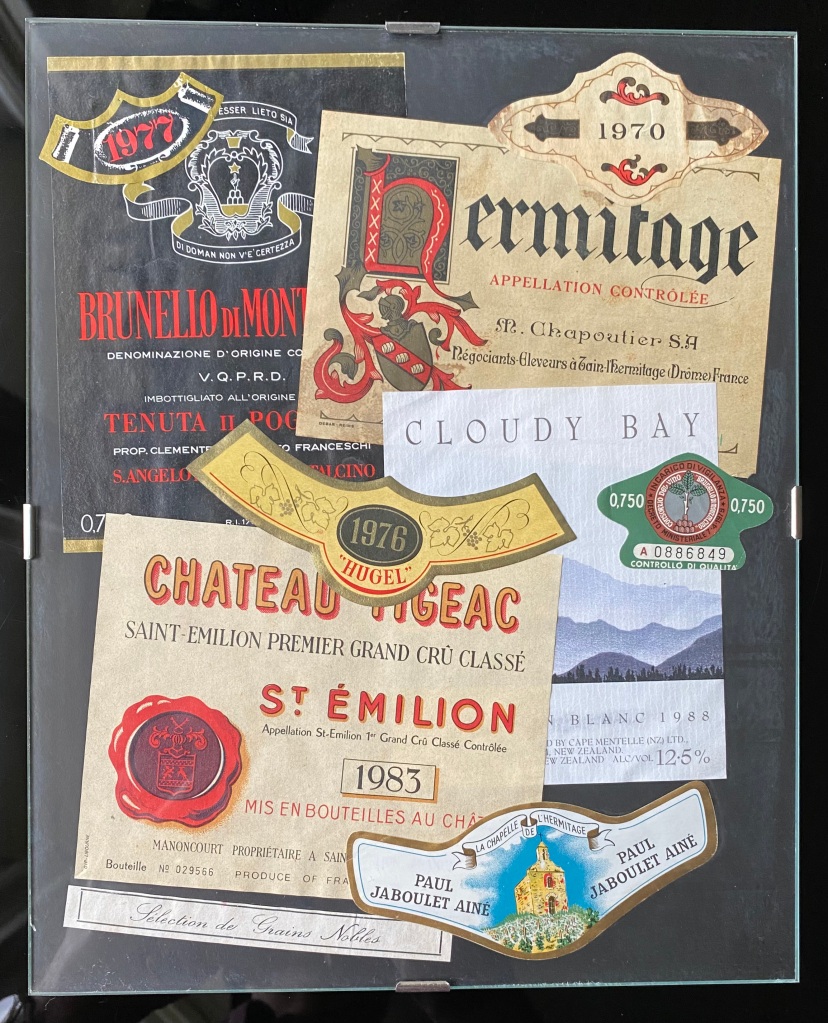
Random labels: the Figeac ’83 was not my granny’s legacy bottle, but a subsequent purchase.

My friend Rob and I wanted to try the famous wines, the ones that always seem unjustifiably expensive. Could they really be that much better than our regular, affordable, choices? When our consultant posts separated us by a few hundred miles we decided to each put £5 a month into a wine fund. It was a light financial burden that would allow us to have special wines, with a meal, every year or two. Once the pot had built up, Rob went to his wine merchant in Colchester and asked them if they had anything interesting. In that way we were able to indulge in some spectacular bottles.

My early experience of wine was nil. My whole family were very presbyterian. My father was even an elder of the Kirk. He hardly drank alcohol at all, but he had a very sweet tooth. When he did have a drink he liked Harvey’s Bristol Cream Sherry, Asti Spumante or a Sauterne called La Flora Blanche. I had tried the sweet Italian fizz, but never the Sauterne. Out for a meal with my then girlfriend and her parents, her father asked me if I had any thoughts on the wine list. The only thought I had was that I recognised the name La Flora Blanche there. I said my father liked it, so a bottle was ordered. Of course it was unbearably sweet and totally unsuitable for drinking with the main course. I was embarrassed.

When my grandmother died, her flat in Ayr was cleared. Like my parents, my grandparents almost never took a drink; my granny’s brother and father having been rather too fond of the stuff. She was always exhorting my mother not to let us have strong drink in case we, ‘got a taste for it.’ Like my parents, they would perhaps risk a sherry at Christmas.

In Granny’s posthumous sideboard were some bottles of wine she’d been given as presents but never consumed. I inherited a bottle of champagne and a bottle of a red wine called Chateau Figeac. Both bottles had been left upright and ignored for years. The vintage of the red was sometime in the sixties; 1962 I think. Some years after acquiring this legacy I chilled the champagne and opened it, only to find the cork had shrunk and the wine was flat. By that time I did know a little bit about wines and the major grape varieties. I knew that fresh air was bad for reds. I reckoned that the Figeac, having been stored in the same way, would be a treacherous bottle to serve to guests and left it in the cupboard under the stairs for a few more years.

My brother came to stay with us while he was between properties. One night, the three of us got carry-out pizzas for supper and I discovered we had run out of our usual red. My eye lit on the Figeac. Here was a chance to try it without fear of letting any dinner guests down – so I opened it. The cork was tight and smelled lovely. I tasted the wine, and it too was lovely. The three of us drank it, reverentially, around the coffee table, over our pizzas. At the time, it was the best red wine I had ever drunk. It was a lesson learned. I checked online while I was writing this piece and the current price quoted for a bottle of 1962 Figeac is £273.

Rob set about doing wine and restaurants with the same enthusiasm and dedication he had brought to fell running, top level chess, military history, castles, birdwatching, abstract expressionism – and medicine. He discovered a restaurant-with-rooms in Kingussie called The Cross, run by Tony and Ruth Hadley.

The restaurant was housed in a charming Victorian shop on the High Street. In the front was seating for pre-dinner drinks around an open fire. The tables were in the rear. Ruth, impossibly, cooked in a tiny galley-type kitchen buried in the depths of the building. The food and accommodation were ridiculously good and ridiculously cheap, although prices rose as the rave reviews and awards followed. At the outset, Rob could save up for a visit by putting his loose change in a jar every day. It was the most fun you could have over a weekend. We went as often as we could, frequently with friends. The scent of birch logs in the air on an autumn afternoon, as we parked the car across the street and checked in, acted as a Pavlovian appetiser. Ruth cooked brilliantly while Tony did front-of-house and the wine. After a marvellous meal, all you had to do was find your bedroom.

I still have the menus, but the food is a topic for another time. The way the Hadleys ran The Cross was very onerous. In addition to the main event of the evening, they did breakfasts every morning. Every year they took a month off to visit their beloved France, recharge their enthusiasm and find new ideas. That is, they did until France restarted nuclear testing in the Pacific. That did it for Tony. To the amazement of national restaurant critics, he stopped buying French wines completely. ‘They aren’t testing their weapons in Entre-Deux-Mers or the Loire,’ he declared.

Rob would pass me his Hugh Johnson Pocket Wine Book annually when he bought a new one, but it was at the Cross that we did our serious wine research. Tony was happy to help out. He once gave us a vertical tasting of three vintages of the New Zealand super star, Cloudy Bay. At the time, some considered it the best Sauvignon blanc in the world. The wines were all gorgeous, and subtly different in character. In 2003 Cloudy Bay was acquired by the champagne house Veuve Clicquot, who increased production and, in my opinion, decreased the quality. I think it is now over-priced for what it is and trading on its illustrious name. We also learned that kicking off an evening with a bottle of methode champenoise between four of us before the meal was perhaps a mistake. On one notable occasion the fizz was a Jansz from Tasmania. By the time we negotiated a ‘flat white’ with the early courses and arrived at the red wine, our powers of discrimination were markedly impaired.

The trouble with wines is that they are consumer goods. You can keep them in a collection like stamps or coins but basically you ought to drink them. Like burning a Picasso, once it’s gone it’s gone, and all you have left is a fading memory. And like twitching, it’s an evanescent pleasure; intense but transient. You can of course keep the labels – like taking photos of a rare bird – but these are just mementos. For a while, we soaked these stylish bits of paper off our favourite bottles, and after a debate about who should have them, stuck them in albums or, in my case, a collage. Chateau Mouton Rothschild would commission famous artists to do their labels which changed with the vintage. Curiously, the labels from the better vintages are less collectible than the poorer years. This is because the less desirable years get drunk quickly and so those labels become rarer. Rob kept the Marc Chagall label from our bottle of Mouton Rothschild 1970.

There is a modest, but excellent, Turkish restaurant near us in Edinburgh which has two framed collections of labels from some of the world’s most famous wines. Wines like Mouton Rothschild, Petrus, Chateau Latour and d’Yquem. I asked the owner and chef, Gursil, where he got them and, rather indignantly, he said, ‘I’ve drunk them all!’ Astonished, I cautiously asked how he could possibly have afforded them. He said he had been a chef in top restaurants in London for many years. High net worth diners would order the most expensive wines on the list as a demonstration of their spending power but frequently left them unfinished!

Other memorable wines from the days of the old rugged Cross included a Tollot Beaut from Chorey-Les-Beaune, a great vintage, of which we eventually finished all the examples in Tony’s cellar. Later we bought other vintages of the same wine but they were never as good. Tony said new, stricter, regulations had been introduced under the appellation d’origines contrôlée (AOC) system which outlawed blending in any grapes from outwith Burgundy. Apparently in the past you could augment your wine with imported grapes from other areas of France, like Bordeaux. The net result of these new restrictions was a thinner, rather disappointing wine.

There was also a stunning Macon Villages Cuvée Botrytis dessert wine. Burgundy is not noted for its sweet wines but in certain years, when the conditions are right, grey botrytis (pourriture noble, or the ‘noble rot’) attacks the Chardonnay grapes. It extracts the water and pushes up the sugar content. In Italian vin santo, the sugar content is increased simply by drying the grapes, while the French sweet wine grapes are actually mouldy. Fermentation proceeds to its maximum, the point where the alcohol content stops the yeast growing, leaving much of the sugar unconsumed. The result is the exquisite sweetness with autumnal ‘fungal’ overtones that make these wines so interesting. Tony told us a tale about the owner of the vineyard concerned. Having found that his grapes had become infected during wet autumn weather, he phoned a pal of his in Sauternes to ask for advice. The pal came to his rescue and they made a unique sweet wine. Researching this phenomenon online, it seems a Cuvée Botrytis is actually a rare, but nevertheless regular, occurrence in the Maconnais.

There is mystery about wine and its country of origin. Wines drunk in situ, where they are produced, always taste better. Chianti Classico, Barbera d’Asti, Barberesco, Altesino and Brunello di Montalcino all taste fabulous in Italy – but when you get home, and buy the same wine in the UK, it never reaches those heights. Is it the weather, or the atmosphere, or do they simply keep the best grapes for themselves? The same is true of the more humble French Rosés. When on holiday in blazing hot Provence they are unbeatable and indispensable. Drunk cold on a chilly June afternoon in Edinburgh they often just make you shudder.

In Edinburgh, our favourite restaurant was Daniel Wencker’s L’Auberge in St Mary’s Street. It is now David Bann’s vegetarian establishment. Before we had children we often went for lunch on a Saturday followed by a pleasantly enhanced shopping trip. As regulars we were known to the staff and I was once asked to minister to one of the trainee chefs who had collapsed in the kitchen.

One day, our waiter came to our table and said, ‘Dr Stevenson, would you know the playwright Arthur Miller if you saw him?’ It was then that I realised that the distinguished-looking, and strangely familiar, man at the next table was Miller. At that time, a season of his plays was running at the Lyceum and Kenny Ireland had taken him and his partner out for lunch. Years later I discovered he had been put up in my cousin’s flat in Northumberland Street which she rented out through the Scottish Arts Council.

At L’Auberge we usually started with a half-bottle of a particular Chablis to accompany the starters. One day, when I asked if we could have it, the waiter said, ‘No you can’t.’ Puzzled, I asked, ‘Why not?’ ‘Because you’ve drunk them all,’ he replied.

The special Rob and Allan Wine Fund trundled along in a satisfactory way but more widely-spaced visits resulted in even greater sums accumulating in the account. We splashed out on increasingly expensive and illustrious stuff. Great white Burgundy, classic Bordeaux reds, stunning Australian reds (like Penfold’s Grange; the bouquet could be detected all the way across the room), and fabulous pudding wines. We had Chateau Gilette (aged in concrete vats), a Chateau Rieussec, and a half bottle of d’Yquem which cost us £61 in the Nineties.

Eventually, children and work commitments made further oenological experiments impractical and reluctantly we wound up the account. Our final round of bottles was the best we could remember and the realisation that we just wanted to repeat those choices next time told us we had reached the end of a very pleasant road. Our final red was from California, a Ridge Monte Bello ’78. This was actually the best red I have ever drunk, better than the Figeac.

It was a great regret that on our trip to Califiornia we weren’t able to fit in a trip to Ridge Vineyards, perched on the Monte Bello Ridge south of San Francisco. In any case, I would have had to drive down there, rendering the visit pointless. Rob’s sister lived in San Francisco for a while and joined the Ridge tasting programme. The vineyard organised vertical tastings of their wines, including the Monte Bello, for their members. These were accompanied by live jazz and a paella cooked en plein air. Rob has been to one of those.

One of the drawbacks of taking a pretentious interest in wine is that kind people inevitably give you special bottles. I usually write the name of the donor on the label, then carefully put it in a rack on the bottom shelf of the dining room cupboard for later consumption, meanwhile carrying on with the usual Cavas, New Zealand Sauvignon Blancs, Riojas and good Italians. Every now and then I might push the boat out and have a Royal Tokaj with dessert.

The wines in this ‘too good to drink cupboard’ have been neglected for fear of another Figeac incident. I have now decided this has to stop. Along with my sense of smell, my palate is definitely deteriorating and those two abilities are inextricably linked. Like me, some of the wines have started fading with age and the fear is that a few may have gone over completely. Therefore, they must be drunk – and we must be drunk – before it’s too late.
Wichita Lineman

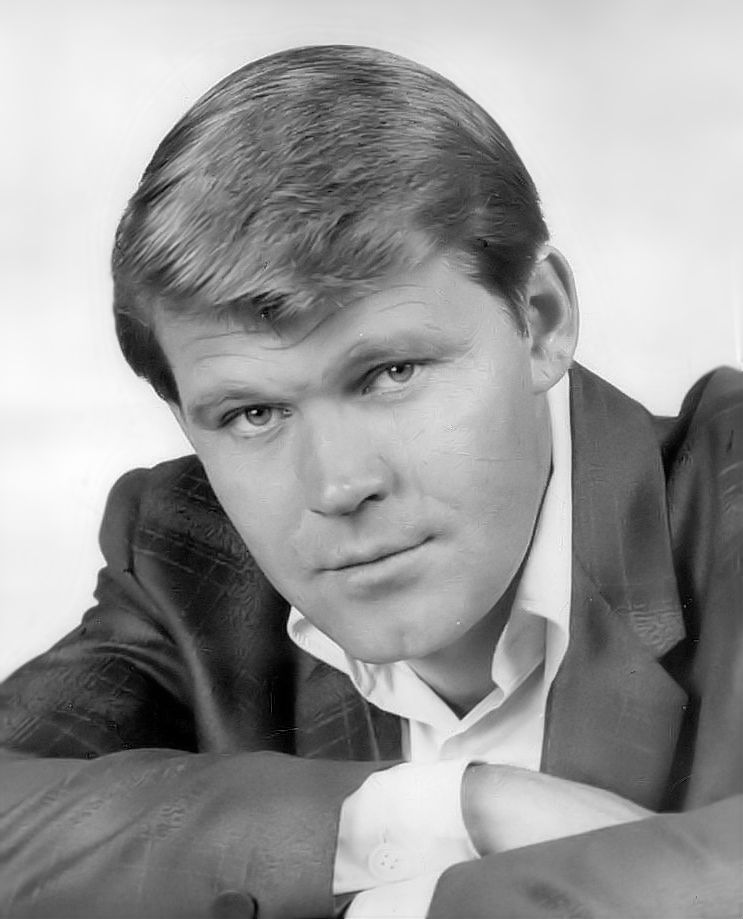
Glen Campbell publicity still.

Last Friday I went to a concert at the Queen’s Hall in Edinburgh. The legend that is Jimmy Webb was telling anecdotes from his remarkable song-writing career and singing some of his hits. The support was Ashley Campbell, Glen Campbell’s daughter. At the age of 75, the targets he set for his voice were ambitious, and the once dazzling keyboard technique faltered at times, but he was still great. The complexity of his playing is more like a classical musician. He studied music in California, to the distress of his Baptist minister father. He wrote a musical in his sophomore year, then dropped out to become a huge success, winning a Grammy in 1968 aged 22 for By The Time I Get To Phoenix. He is nevertheless a genuine Oklahoma country boy who hoed and picked cotton, and loaded hay bales.

Webb told a great creation myth about Wichita Lineman (1968). Glen Campbell was agitating for a new song from him to follow up the success of By The Time I Get To Phoenix. Webb spent a few hours on an idea then sent it off, incomplete. It had no third verse. He heard nothing for a couple of weeks, then ran into Campbell at a recording studio. Webb eventually asked what he’d thought of the song and Campbell replied, ‘Oh, we cut that.’ ‘But it wasn’t finished!’ said Webb. ‘It is now,’ said Campbell.

I play Lineman on the piano – after a fashion – and sing along as best I can. No one can match Campbell’s fabulous tone and effortless five-octave range but it’s Webb’s chord changes and harmonies that are fascinating. It’s impossible to work out what key you are in – and in that sense it is similar to a classical work.

First we have to mention the bass intro. Carol Kaye was one of the Wrecking Crew group of session musicians as was Glen Campbell. Kaye’s background was in jazz. She and Campbell had played together on countless hits by other artists (California Dreamin’, These Boots Are Made for Walkin’, Be My Baby, The Beat Goes On, Good Vibrations). Glen Campbell even toured with the Beach Boys, replacing Brian Wilson when he was ‘indisposed.’ The Wrecking Crew all had jazz or classical music backgrounds and could (apart from Campbell) sight-read fluently. Kaye used a Fender but also had a distinctive six-string Danelectro bass guitar which Glen Campbell borrowed to play the guitar solo in Lineman. Kaye felt the number needed a strong opening and came up with the classic six-note figure that leads into the opening chords.

Those opening chords cycle between Fmaj7 and (the way I do it) Bb/C. Ah, one thinks, this song is going to be in F because we are switching between the I and V chords, which are the tonic and dominant chords of the key of F. Then the song begins: ‘I am a lineman for the county…‘ and suddenly we are in Bbmaj7. That’s OK, Bb is the IV chord of F, and we will surely soon be home. But then we move through Am to Gm, then Dm, Am, G and D and by the time we go ‘searching in the sun for another overload,’ it all becomes a bit uncertain. Are we in D now? The sheet music key signature is certainly the two sharps of D major.

The chorus follows the verse with more nice inversions. Inversions are chords that don’t have the root note on the bottom and are written with a ‘/’ before the alternative bottom note.

I hear you singing in the wire (Cmaj7), I can hear you through the whine (Gmaj7/B, Gm/Bb) and the Wichita Lineman (D/A, G/A) is still on the line…(Bb, C9).’ This is where Webb puts in the little morse code reference with a repeated high D when the lineman is, ‘still on the line.’ A normal song would now return to the key of D that we assume we are in – but instead we have Bb/C and we head off in the direction of F once more. The Campbell guitar solo over the verse leads us to another sung chorus (there is no third verse – it’s an unfinished song). The finale is a fade out on the Bb/C9 cycle with big strings and horns on top.

The miracle is how the melody flows naturally through these unusual chord changes without any tension. Lineman remarkable not only for the voicings and changes but for the depth of emotion expressed in the lyrics. Webb gives us a telegraph engineer with the soul of a poet.

The Colour-Blind Blues

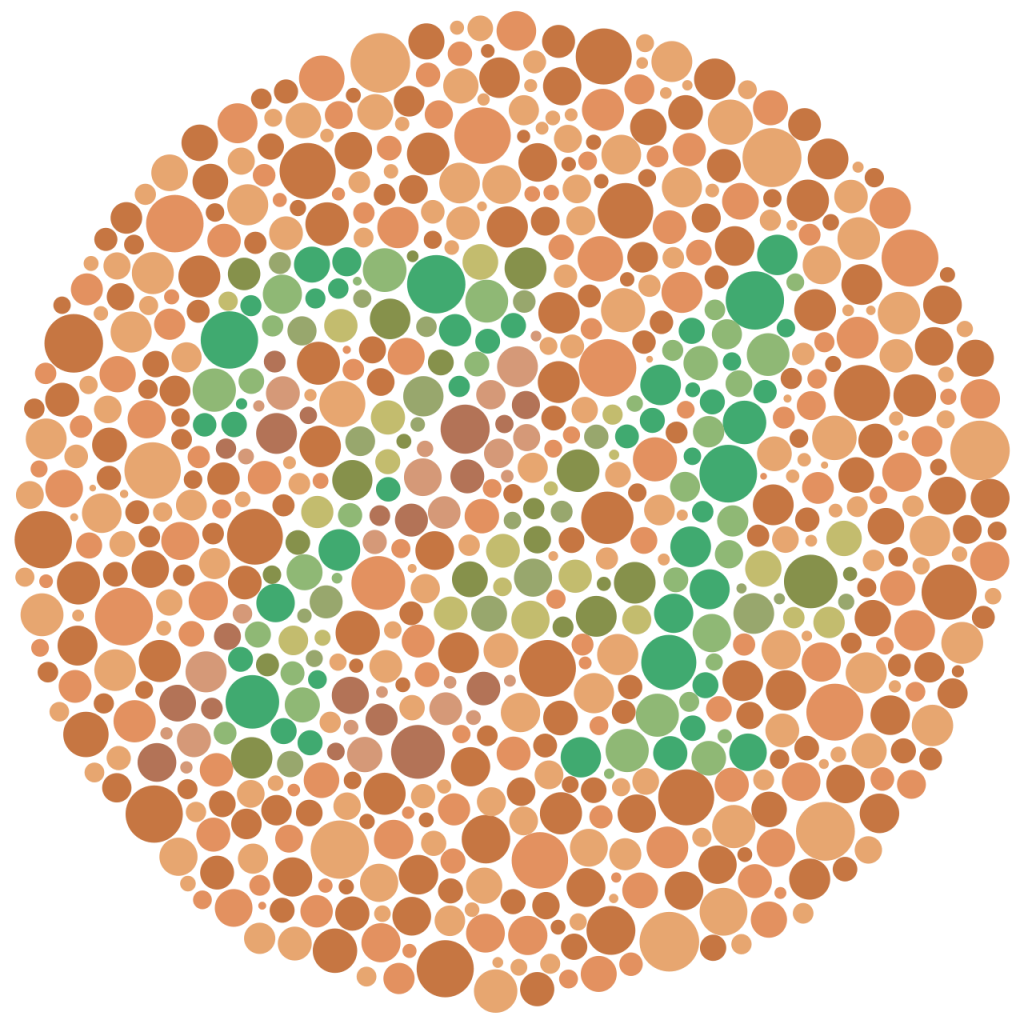
Ishihara: It’s 74 – or is it 21 or nothing?

I am red-green colour-blind. I am a ‘deutan’ meaning I have deuteranomaly, the commonest form of the disorder, which affects about 8% of men of Northern European ancestry. Apparently this is because my green-sensitive retinal cones don’t work properly. It is all my mother’s fault – or even my grandmother’s fault. Like haemophilia, scourge of the Romanovs, colourblindness is an X-linked genetic disorder; meaning women are usually asymptomatic carriers, protected by their paired normal Xs, while men, with only a pathetic Y to pair up with their single X, have no such protection. There is some evidence that carrier women, expressing both the normal and abnormal Xs, have enhanced colour vision, known as tetrachromacy. Apparently they can see two different kinds of red. Trichromacy is normal colour vision.

If a woman carrying the gene has a child with a normal man, there is a 50% chance her sons will be colour-blind and a 50% chance any daughters will be carriers. My grandmother passed the abnormal X (X’) to my mother and also her son, my uncle, who was colour-blind. My mother passed her X’ on to two of her three sons; a run of bad luck in the family – but not as bad as haemophilia.

In the reverse situation, where the father is a sufferer (X’Y) and has children with a normal (XX) woman, all his daughters will be carriers, but his sons, to whom he gives his benign Y, will be normal. However, if a colour-blind man (X’Y) has a child with a carrier woman (X’X) there is a 50% chance their daughters will have two abnormal X chromosomes. This is the main reason 0.5% of women have the disorder, and it is usually in a profound form.

My parents (I say parents but I was raised by my mother, my father was always too busy to bother with us) twigged that something was amiss fairly early on. I seemed to be incapable of learning my colours properly. The school was onto it too and I was sent off to Ayr to be tested. I did the Ishihara tests like the one above – and I was all over the shop. I saw numbers that weren’t there and I couldn’t see the numbers that were there. By contrast, they told me I had done surprisingly well on the tests that required you to arrange little discs of colour in order as they went from one shade to another. They couldn’t explain this. They then gave me a list of occupations I was now debarred from; things like a commercial or military pilot, a pathologist or an officer above sergeant in the signals corps. I immediately developed a yearning to be any or all of those people. Doors had been closed to me at a very early age.

I am able to see some frequencies of red, so I do not live in an entirely drab world. Other shades of red just look dark green to me and spectacular rhododendrons with dark red flowers can look all-green. I sometimes have to look for the flowers as separate structures from the leaves. Problems also arise with colours that are mixtures of other colours, so that some purples look blue to me and browns look the same as green. The reds had dropped out of the mix.

In art classes at school I was careful to ask my nearest classmate to tell me which was the brown crayon and which the green. I carefully placed them on opposite sides of the desk so that my trees would look correct. We were once asked to do a design for wallpaper. I decided to go for a Chinese theme. The teacher came round the class looking at our efforts. When she came to me she said, ‘That’s very nice Allan, bit why have you plumped for such conventional colours? Why not have blue trees with yellow leaves?’

At secondary school my favourite teacher, Mr Harrison who taught biology, had monochrome vision. His abnormal X’ must have carried an extreme form of the condition. I remember him asking us why certain colours didn’t go together. He was unable to understand the concept.

Whenever the subject of my colourblindness cropped up, people always started pointing to various nearby objects and asking me what colour they looked to me. This became very tedious. I couldn’t think of a witty response that would get me out of answering them. From birth, I have had patches of white hair among the brown on the left side at the back of my head. This too became a subject for enquiry, so I started saying that my mother had been frightened by an Ayrshire cow when she was pregnant. Similarly, when challenged for smoking cigarettes as a medic I would look shocked and say, ‘They’re not bad for you, are they?’

There did not seem to be any advantages to my condition. Since I had some concept of normal vision, when shown shades of green or pink, I knew what they should look like and could switch my perception of them back and forth from green to pink depending on what people told me I was looking at. It’s not much of a trick – and one that is entirely in the eye of the beholder. These problems did not stop me painting but the results tended to look a bit odd to normal-sighted types.

I played cricket at school, a red ball on a green pitch, but I seemed to manage OK. Years later I read a paper about this. They looked at whether red-green colour blindness was a handicap to cricketers and found that there was a slight but definite preponderance of red-green colour-blindness among first class batsmen compared to the general population. Ian Botham, for example, is red-green colour-blind. It seems a fast-moving object is perceived in monochrome because the colour-sensitive cones in your retina don’t react quickly enough. It’s those monochrome rapid rods that see the ball coming. So why would a colour-blind person see the ball a bit better than a normal? Is it because they generally rely less on colour? There is also evidence that colour-blindness helps you identify camouflaged objects, perhaps because you depend more on pattern recognition than colour.

Even if I couldn’t fly a plane, I was allowed to drive. In some countries I wouldn’t be. Here there was a potential problem. Traffic lights and brake lights are quite important. It’s easy to learn that the red light is always at the top of traffic lights – and anyway it looks completely different to me from the whitish green light at the bottom. However, I don’t see much difference between red and amber. Similarly, with brake lights, they look the same shade as side lights and indicators to me. I have to specifically look for red stop lights and brake lights as they don’t really stand out to me among all the other street lights – especially on dark rainy nights.

I can hardly claim to be handicapped. Indeed, if colour-blindness was a significant detriment to sufferers we would eventually die out. Instead, it persists. Sickle cell trait confers protection against malaria, so perhaps colour-blind hunters were better at identifying hidden quarry. I do inhabit a drabber world than the rest of you, but I cannot do anything about that.

The special glasses that claim to restore your colour vision are negatively reviewed online and I haven’t bothered trying them. Wikipedia has a list of my illustrious fellow-sufferers:

https://en.wikipedia.org/wiki/List_of_people_with_color_blindness

Birdsong

Blue tit and fat balls.

The successful identification of birds is not confined to knowing their physical appearance. Knowledge of birdsong is often the clincher when confronted by a mystery creature. Knowing the songs – and the more difficult calls – is a huge help in working out what you are looking at. Modern smartphone birding apps often include recordings of the songs, but you mustn’t use these to lure a bird into the open! Birds exist within a tight energy economy, especially when breeding, and making them waste energy pursuing a phantom rival is not fair.

In the prior paper-only era, field guides often included ridiculous English renditions of songs, which were meant to help you with ID. ‘The song may be rendered thus: “Prithee-come-thither-thou-varlet!” ‘ That sort of thing. The onomatopoeic impressions of songs with their umlauts and strings of consonants which replaced such nonsense in the field guides are little better – and less funny. Some bird names, notably the cuckoo and chiffchaff are onomatopoeic in themselves. The scientific name of the corncrake (Crex crex) is another example. Whatever aids you employ, there is no substitute for going out and learning the songs for yourself.

It is late spring now, and birdsong is at its peak. I’ve never been sure that birdsong fulfilled a purely pragmatic territorial or pair-bonding function. For me it always had that element of joie de vivre. I thought I might go over some of the easier songs should you wish to explore the genre in the safety of your own garden. Knowing the songs of the common birds allows you to move confidently on to the rarer ones. Remember that any puzzling sound is likely to be an unusual noise from a common bird rather than the usual sound of a rare one.


Unusually, both male and female robins sing throughout the winter as they defend their territories ferociously. In fact, they start singing in September, a sound my grandmother identified as a harbinger of winter. Their song is like the squeaky wheels of a supermarket trolley, and quite easy to learn. They also make a high-pitched ticking call.

After the winter robins we come to the early spring starters. In respect of their songs, great tits and cole tits are confusion species with chiffchaffs coming along later to further muddy the water. The great tit mainly gives us its greatest hit, the classic ‘teacher, teacher.’ The smaller cole tit has a very similar but higher-pitched song, ‘see-too, see-too.’ Later, when the chiffchaffs arrive they make the sound their name suggests, another two-beat declaration, but their little aria is wheezier and irregular. Every now and then they stick in an extra ‘chiff‘ or ‘chaff‘ which the two tits never do. To finish the commonest tits, Blue tit song consists of two high-pitched notes then a longer trill of lower notes: ‘si si… tr’r’r’r’r’r’r’rt.’ Sometimes they do, ‘si si churrr – si si churrr.

The blackcap also kicks off early. Some of them now over-winter in Britain, perhaps because garden feeders are so widely available to them in this country. Once you learn the song, you realise these birds are ubiquitous. Blackcaps deliver a short, rapid, sweetly musical burble of notes with long pauses in between. Like a little blackbird in a hurry. The verse is often preceded by a short ‘irresolute’ scratchy twitter. With patience you will spot the singer among the fresh spring leaves, unmistakeable in his black headgear. The garden warbler ‘s song is almost identical to its close relative the blackcap, but ironically, you are most unlikely to have one in your garden. They are very difficult to see in the dense cover they favour. Leave them to the experts.

The blackbird has the most wonderful repertoire, completely underrated in my opinion. Usually delivered from the top of a shrub or tree, it consists of well spaced-out measured phrases of endless variety, frequently punctuated by quieter trills or twitters. We have one in the garden at the moment who has been performing brilliantly for weeks. Blackbirds also have a predilection for singing at night – as the Beatles noted.

Everyone thinks they know the blackbird’s song – but can you tell him from his close relative the song thrush? Also a wonderful performer, the thrush helps us by repeating his phrases two or three times. The mistle thrush is a bigger, paler, and rarer bird. Also known as the ‘storm cock’ because his singing supposedly precedes bad weather, he sings from treetops in brief verses; a simpler, colder version of the blackbird. He also emits a very distinctive, loud, ‘football rattle’ alarm call.

The chiffchaff’s close relation in the leaf warbler family is the willow warbler, which is now singing as the weather warms up. The willow warbler looks almost identical to the chiffchaff but sounds totally different – which is useful. He gives us a string of sweet descending notes which trail off into nothing as if he’s been distracted by something. This contrasts with the superficially similar chaffinch (not even a warbler) whose final upwards flourish is supposed to sound like a bowler running up to the crease and delivering the ball. He also goes, ‘pink, pink, pink.’ Chaffinches have been shown to have regional accents.

The lead-grey headed Dunnock (aka hedge sparrow) is very common in urban gardens, sticking mainly to ground level, hopping about, picking up stuff. The song is delivered from shrub-top level and has a monotonous, cantering rhythm. Like a lot of duller birds that skulk in bushes, the song is loud. They lay beautiful blue eggs leading to the local name in East Ayrshire of ‘blue dykey’.

Speaking of loud skulkers, the Wren is the classic. It’s mouse-like habits mask their huge numbers; they are the commonest birds in Britain. Wrens intersperse their song with a diagnostic drawn-out, ‘zerrrrr,’ which is also the alarm call. A loud ‘zeck’ is also produced.

Goldfinches have a lovely soft song and were kept for this purpose. They were trapped in enormous numbers for the cage bird trade along with bullfinches. Their song is a merry tinkling jangle of quiet notes interspersed with a version of their call, which sounds like ‘quit-it‘ to me. They often feature in early paintings because of their supposed association with the crucifixion – they have Christ’s blood on their faces. Everyone knows Carel Fabritius’ wonderful portrait of one chained to its perch. Robert Fergusson’s rumination on the fate of a caged goldfinch is very moving. He mentions the sticky birdlime used to trap the poor things; still a common practice in Europe.

Ode to the Gowdspink

Another very easy bird to identify, once you know the song, is the Bullfinch. For such a boldly marked and colourful animal the song is very disappointing. Hesitant and quiet, it consists of a few tired, fluty notes, descending at the end ‘phü – phü – phü.’ It surprised me to learn that they can be taught to talk and were kept for this purpose. They were once killed in huge numbers to prevent them eating the buds of fruit trees. In my garden at least, they are now increasing. Quite shy, they are always seen in pairs. Look out for the bright white rump as they fly off.

Greenfinch numbers have crashed thanks to Trichomonosis, but I’ve been seeing a few more recently. They have a distinctive loud ‘zweee’ call that also features in their song. Yellowhammers are also rarer now and are more birds of open farmland but I include them because they famously go, ‘a-little-bit-of-bread-and-no-cheese‘.

Pied wagtails are easy because they call, ‘Chiswick, Chiswick‘ as they fly over, and House sparrows give us the classic ‘chirrup’.

Finally, there is another bird that is definitely on the increase, but despite that, almost impossible to see. The great spotted woodpecker is everywhere these days, including in our garden trees and on the peanut feeders. However, the bird is also a fantastic example of dazzle camouflage. Its bold black and white markings break up its outline, especially in dappled light. It perches on trunks or along the branches of trees, blending in with the outline or disappearing behind them. Fortunately there are three things about GSWs that reveal their presence. The first is their distinctive call, a loud ‘tchick!’ Once you are familiar with it, you will be alerted to their presence everywhere. They often call in flight. The flight pattern is the second feature. It is deeply undulating or ‘bounding’ because they intermittently close their wings to their bodies. The third feature is the famous ‘drumming’ which echoes through leafless woods in early spring. It is said you can attract GSWs by doing your own ‘drumming’ with a pair of sticks. I’ve never seen this succeed!

I recommend getting to know your local birds’ songs. Think how much more you would get from sitting in the garden or walking in the spring sunshine if you knew who was singing to you.

Boxing

I followed boxing from an early age, listening to Harry Carpenter’s commentaries on the ‘radiogram’. The earliest fighters I recall were all in the heavyweight division; Rocky Marciano, Ingemar Johansson and Floyd Patterson. The British fighters, apart from Henry Cooper, seemed tame by comparison but there were some good men in the lighter divisions. Cooper would have been far too light for a heavyweight these days. He was naturally left-handed but fought with a conventional stance rather than as a southpaw. His manager Jim Wicks joked that southpaws ‘should be drowned at birth’.

Cooper achieved immortality after his fight with the then Cassius Clay at Wembley Arena in 1963. Clay had had a less impressive start to his professional campaign than you might think. The Cooper-Clay fight featured the future Muhammad Ali being knocked to the canvas for the second time in his professional career. With about four seconds left in the fourth round Cooper’s fabled left hook did the damage. Clay was up at a count of three but clearly shaken. The recording confirms that one of his gloves was already torn during the fourth round. He may also have been given smelling salts illegally (it looks like that on the tape). The break between rounds four and five was indeed longer than the regulation 60 seconds – but only by five seconds; and Clay fought on without changing gloves. Angelo Dundee later admitted exacerbating the pre-existing tear in the glove to delay matters – and perhaps increase the potential damage to Cooper’s face. The fifth round was a horrific three minutes of eye surgery during which Cooper’s gum shield was knocked out and his corner threw in the towel.

The following year the unbeaten Clay fought Sonny Liston for the world title. I was only ten but I was aware of the champion Sonny Liston’s frightening power. He’d learned to box while in jail for armed robbery. He had also been jailed for assaulting a police officer and seemed to be deeply involved with organised crime. Cooper’s manager Wicks said they would be prepared to meet Clay after the fight – but not Liston. They didn’t even want to meet Liston ‘walking down the same street.’

It seemed inevitable to me that Liston would put the shockingly arrogant Cassius Clay in his place. Clay won gold in the light heavyweight division at the 1960 Rome Olympics and seemed bent on winding everyone up with his relentless braggadocio. I couldn’t see how this conceited lightweight egomaniac would beat the fearsome Liston. I recommend Nick Tosches’ excellent The Devil and Sonny Liston if you want to explore this topic further.

Liston had knocked out Floyd Patterson in the first round of both their fights before he faced Clay. The brief nature of these fights meant Liston had very little recent ring time and there were rumours that his age was more than 32; perhaps even 40. He was also carrying chronic shoulder injuries which were being treated secretly. Confident of victory, he was not training vigorously.

The boxing authorities were nervous of Liston’s mob connections and the politicians were concerned about the potential damage he might cause to the civil rights movement. Boxing journalists disliked both fighters. Before the fight Clay called Liston a ‘bear’ and boasted he would ‘whip him like he was his daddy’ apparently unaware that Liston bore scars from savage beatings his father had inflicted on him using the buckle end of his belt. Uniquely, Clay also wrote a poem about his impending victory, which ended:

Yes, the crowd did not dream, when they laid down their money,

That they would see a total eclipse of the Sonny.

Liston was incensed. All this grim background detail was unknown to the ten-year-old me.

The fight started at 10pm local time, 25th February 1964. The commentary was broadcast in the UK in the early hours of the 26th. I pleaded with my mother to be allowed to stay up and listen to Harry Carpenter but she refused. Reluctantly I retired to bed. I had no radio in my room. The following morning Mum came upstairs to wake me for school. I sat up bleary-eyed. “Well, your man lost,” she said, smiling. “No, Mum. I was supporting Liston,” I corrected her. “That’s right. Liston lost. Your breakfast is ready.” I was utterly astonished.

Clay admitted to being genuinely scared of Liston but out-boxed and out-hit him for four rounds. In the fifth, the ‘blind round,’ Clay’s eyesight went. Angelo Dundee touched Clay’s face, then his own eye, and found that he suffered the same blinding, stinging sensation. The allegation was that Liston’s gloves had been ‘juiced’ by his corner at the end of the fourth round. Alternatively the substance could have been put on Liston’s shoulders where it would be transferred to his opponents face. All these theories founder on the likelihood that the same irritant would be transferred to the perpetrators eyes. In any event, Clay survived by back-pedalling furiously until his sight recovered. He then dominated the sixth. At the end of it Liston told his corner ‘That’s it,’ and refused to come out for the seventh round. Only one previous heavyweight had given up the world title on his stool. Clay announced, ‘I must be the greatest! I shook up the world! I shook up the world!’

Clay swept everything before him, joined The Nation of Islam and changed his name to Muhammad Ali. In 1965 he would beat Liston again in an even more controversial fight which featured the ‘phantom punch.’ My uncles, who followed boxing a bit, liked Ali even less than before and expected his downfall with every fight. I liked him more and more and was disappointed when his refusal to serve in Vietnam on the grounds he had no beef with the Vietcong interrupted his brilliant career. He lost his best years – as Angelo Dundee said.

For a digestible analysis of Ali’s global impact I recommend Ken Burns’ excellent eight-part documentary currently available on BBC iPlayer.

Meanwhile, at school, I had the usual playground fisticuffs with rivals but steered clear of any seriously competent fighters; discretion being the better part of playground fights. Children love a fight and any skirmish was immediately engulfed by an excited crowd. A teacher would then wade through the diminutive melee to separate the adversaries. We were belted for fighting at school; the teachers presumably being of the opinion that violence could be eradicated by violence.

Ever keen to have a go at boxing, I persuaded my mother to buy me two pairs of gloves for Christmas. My friend John Hunter and I cleared a space in the hall, put the gloves on, and squared up. Very soon John hit me plumb on the nose and there was blood everywhere. The gloves were confiscated for a while and remained forever stained with my gore. In secondary school we tried to persuade the PE teachers to start a boxing club. They considered it for a while but eventually decided against it. Just as well.

I remained a big fan of boxing, and Ali in particular, but he was never quite the same after he returned to the ring. He lost to Joe Frazier in their first fight and then had his jaw broken by the underrated Ken Norton in the second defeat of his career. Norton and Frasier were both beaten up by George Foreman before Ali faced Foreman in the Rumble in the Jungle in 1974. Foreman could beat deep dents into a sand-filled heavy bag and was alleged to have broken sparring partners forearms when they covered up to defend themselves.

Rather like the first Liston fight, no one expected Ali to win. In fact, they rather expected he would get seriously hurt. Normal Mailer’s The Fight, which is about that encounter, is worth reading. The fight was meant to be preceded by a music festival, Zaire 74, featuring the greatest black artists of the day, but the contest was delayed due to a training injury to Foreman’s face. Because of the artists’ prior commitments the musical event went ahead on schedule. The movie Soul Power is about those performances. The Oscar-winning documentary When We Were Kings is tremendous and includes some footage of Zaire 74.

Ali spent the first round throwing right crosses in an attempt to surprise Foreman with this ‘amateur’ tactic. He connected but it had no effect. At the first break Ali stood in his corner and stared out into the African night, contemplating his fate. His high-risk decision was, famously, to let his opponent hit him until he was exhausted. Ali knocked Foreman out in the eighth round, ushering his falling victim to the deck like a matador intent on preserving the beauty of the moment. The fight was Harry Carpenter’s finest hour – ‘Oh my God, he’s won the title back at 32!

Three years later in 1977 I was doing a student elective at Bellevue Hospital in New York. At the end of September Ali was to fight Ernie Shavers at Madison Square Garden. By that time I had been in the States for two months and had run out of money. Emergency funds from home were on the way, but held up in the banking system. As a result I lost my only chance to see Ali fight – and he actually won that one. The later fights against Leon Spinks and Larry Holmes were a mistake. Holmes was an Ali fan and actually asked the referee to stop the fight to save his hero any more punishment. Ali was already experiencing serious neurological symptoms. He should have listened to Dr Ferdie Pacheco.

My American friend Al has lived in Philadelphia for many years but was raised in Newark NJ in the same neighbourhood as the great middleweight champion Marvin Hagler. Late one night in 1976, on his way home from work as a waiter, Al came across a large Cadillac parked in a Society Hill lot. The interior light was on and Al could see piles of money on the dashboard. Curious to see who would risk doing this, Al peered in. A man was seated at the wheel, counting the money with a gun beside him on the passenger seat. It was Joe Frazier who had just been defeated by George Foreman for second time. Undaunted, Al tapped on the window and offered his hand in commiseration. Initially startled, but confronted by a harmless-looking white kid, Frazier lowered the window and graciously shook his hand. ‘Yeah man,’ was all he said.

While I still retained some interest in the sport, the best fights were in the middleweight division where Marvin Hagler operated. Hagler’s fights against Tommy Hearns, John Mugabi and Sugar Ray Leonard were classics of the genre. The last fight I recall taking a serious interest in was Frank Bruno versus Tim Witherspoon in 1986. I was in Philadelphia at the time and Al had some trouble finding a bar that was showing the fight. The contest was being held in Wembley Stadium during the early evening in the States. Frank had already lost to James ‘Bonecrusher’ Smith and ‘Terrible’ Tim Witherspoon looked like another tough prospect. Al opined that British fighters lacked the tough upbringing of the Americans, which made all the difference. Frank lost in the 10th and we went off to a Japanese restaurant to get drunk on saki.

A week later Marvis Frazier, son of Joe, took on the 20 year old Mike Tyson. I had barely heard of Tyson and expected any son of Joe to have some decent chops. Al and I went to the City Bites bar-restaurant to watch it. Al’s friend Dean Rohrer’s band played there. We got some beers and went to a table. The fight started and Al said, ‘Watch. This won’t last long.’ It lasted 30 seconds. Tyson went on a rampage through the heavyweight division becoming the youngest ever champion later that year. A synonym for brute force and power his name adorns countless tough-looking dogs and another present-day world heavyweight champion in Tyson Fury.

We had our own top middleweights in the UK but the encounter between Michael Watson and Chris Eubank in 1991 ended my enjoyment of boxing. The two were very evenly matched but Eubank was losing, and in the penultimate round Watson put him down for the first time in his career. Eubank got up, feeling everything was on the line, and felled Watson with an uppercut. Watson was already showing signs of serious intracranial mischief by this stage but his lead on points persuaded his corner and the referee to let the fight continue. Eubank, realising he might now salvage the fight, went at the defenceless Watson with ferocity. Watson collapsed and became deeply unconscious. There were no medics and no oxygen at the ringside. There was a prolonged delay in getting him any treatment. Although he survived to sue the promoters, he ended up in a wheelchair for six years and permanently disabled. Eubank profoundly regretted the outcome of the fight.

You might say to me that a doctor who (up to that point) could not see anything wrong with a sport whose principal objective was inflicting sufficient brain damage to cause unconsciousness, was suffering from a large moral scotoma – and you might be right. I have ignored the Lewis/Klitschko/Joshua/Fury years and don’t feel I’ve missed much. Like a lot of things in life, the events of long ago seem more vibrant and satisfying.

Stadio Olimpico, Rome.

In March 2012 I travelled to Rome to watch Scotland play Italy in the RBS Six Nations rugby tournament. Scotland lost every match of that campaign. You can see the RBS logo on the tent in the background of the photograph above. Our party wore Scotland strips and kilts, topped off with Peroni horned ‘viking’ beer hats. We lost count of the number of times we were asked for a photograph. The weather was lovely, the catering, by Peroni, superb. Food and cold beer were served to the crowd on a sunken running track next to the Stadio Olympico itself. The site was surrounded by modern romanesque statuary left over from the 1960 Olympics. The Italians were delighted with the whole day and we put a brave face on it. In an idle moment, I googled the 1960 games and discovered I was standing in front of the hall where Cassius Clay had won his light heavyweight gold medal.

Scots Thoughts

Skirving after Naysmith

I was brought up on the family farm in East Ayrshire but my mother came from the Edinburgh area – which makes me the product of a mixed marriage. My father ran a large business and was a prominent farmer. This meant he was away from home most of the time. We lived 600 feet up a hill and a mile or so from the nearest town. I essentially spent the first five years of my life with my mother. I had no friends of my own age and the adults I met were either relatives or worked for my father.

I can recall the feeling of dread as schooldays approached. I couldn’t bear the idea of spending part of every weekday away from home in an alien environment. I made an ineffectual attempt at school refusal, easily overcome by my mother who pointed out that Jennifer, a girl of my acquaintance, was happily attending her second year of primary school.

My next problem was linguistic. The local town of Cumnock had just 10,000 inhabitants and was surrounded by farmland. This was the late 1950s and at least a third of my new school friends didn’t have a TV at home. They weren’t listening to the Home Service either. They communicated in broad rural Scots. To avoid being ostracised I had to become fluent in the vernacular as quickly as possible. Later I would complete the assimilation process by adopting the required left-wing politics. These views came in handy later in the debating society and, in East Ayrshire at least, they made you more attractive to girls. My mother’s early training did come in useful during English exams. When asked to fill in the blanks in sentences I would put down what I thought my mother would say and that was usually the right answer.

I am a tolerably good mimic and learning to speak like my new classmates was helped by my complete immersion in the patois. There being no national standard for Scots (there still isn’t) this was the East Ayrshire version. Scots speakers from Hawick, Glasgow, Edinburgh, Aberdeen or Kirkwall all sound different and may even have trouble understanding each other. Scots in its various forms is an archaic form of English with some adopted French and other northern European words, the result of foreign-educated monarchs, commerce and settlement. The Scots word ashet for a large serving plate derives from assiette and fash for angry or vexed from fâché.

Charles I was born in Dunfermline Palace. Once he was executed the Stuart dynasty’s connection with Scots was severed. When Scots ceased to be the language of court, it fragmented into its regional dialects. The language of power became the English of London and the south eastern élite. The shift of power from Edinburgh to the south freed the great academic and legal brains of Scotland from a royal court but left them under the yoke of a powerful and atavistic church. Somehow, in spite of this, there was a Scottish Enlightenment that outshone the rest. For a while Scots was spoken at all levels of society north of the Tweed but by the late eighteenth century only a few elderly aristocrats still used it. Aspirational Scots would even employ tutors to try and eradicate their embarrassing verbal inheritances. Broad Scots receded to the rural peripheries and diversified into regional variants like Doric. The major conurbations, notably Glasgow, all had their own unique styles.

To return to my autodidactic efforts; I first had to learn all the altered vowel sounds. Nothing signals a fake accent more quickly than getting those wrong. Then there was the alien syntax and the huge vocabulary of Scots words. Eventually I was fluent and sounded no different from the other boys but at home and in the classroom standard English, albeit with an accent, prevailed.

Like many generations of Scots before her, my mother was concerned as far as possible to exclude the provincial from her speech, but it was interesting to hear my father use full-on Scots with the farm staff. He had left the local village school with its handful of pupils at age 14. My mother’s family seemed to differentiate between the Scots they had spoken as children and what they regarded as the debased urbanisms I was learning at school. They particularly disliked ‘yous‘ and referred to the locals as speaking ‘fur-tae-be, gawn-tae-be‘ Scots. In retrospect I think they were nostalgic for the lost east coast rural dialect of their youth. In private situations my mother and her parents would use old Scots with us as the language of emotional intimacy and comfort. Outside the home it remained ‘common’ – the language of the ‘common five-eighth’. I rejected all this casual snobbery and revelled in my new expertise and communications skills. To do anything else would have invited ridicule – or worse.

My youngest brother was born six years after me. In that short interval every household had acquired a TV. There was now widespread exposure to BBC English and to multiple regional English dialects through soap operas and comedies. I was aware of the shrinkage of Scots among my wee brother’s contemporaries who could mimic many UK regional accents but would fail to recognise some common Scots words.

It being Ayrshire, Robert Burns’ poems and songs featured prominently in our education. For deliberate effect Burns wrote in an archaic form of Scots, even for the eighteenth century. He would also alternate stanzas of Scots with formal English in poems such as To a Mouse. Perhaps there was some truth in the urban debasement of the language because even we true country kids needed our vocabulary expanded to understand his poems. I suppose that is simply an illustration of the dynamic nature of language. It has always changed and diversified – but now mass media is homogenising English worldwide.

One day a student from Strathclyde University turned up at the farm bearing a thick research questionnaire about Scots words used in the area. He wanted me to fill in the local words next to the standard English ones. I glanced down the long list of animals, plants and objects with a blank column alongside for the local equivalent. I told him I knew a few of the words but doubted there would be much more to add. I showed it to one of our tractor drivers who was nearing retirement age. To my amazement he went through the list filling in words I had never heard before – or read in the works of Robert Burns.

Aged twelve I sat the common entrance exam for an independent boarding school in Edinburgh. Once again I was uneasy at the thought of leaving home – this time to live among strangers of uncertain character. It was an extremely hot day. I was shown to the examination room while my father went off to have tea with the headmaster. A teacher came in and handed out the papers. ‘The bright boys over there are sitting the bursary,’ he said. ‘You thickies are sitting the common entrance. When you open the paper you will find some questions on New Maths. That’s the last time you will see any of that rubbish. We don’t believe in New Maths here.’

Not having been to a prep school I found the exam puzzling and I did not feel motivated to do well. A succession of cricketing prefects in whites came in to invigilate us between their spells at the crease. Their accents sounded posh English to me. I felt lost and ill at ease. There was a break in proceedings and we candidates wandered out to watch the cricket in progress on the vast playing fields. Another farmer’s son, equally culturally adrift, asked me how many pupils there were at my school. I answered, accurately, ‘1500’. He assured me that couldn’t be correct, so I backed down in embarrassment and said I thought it might be 500. I was very relieved when my father picked me up at the end of the day and drove us home to Ayrshire, windows down, tyres singing over the sticky tarmac.

My father, an elder of the Kirk, had detected whisky on the headmaster’s breath at 10am that morning. This gentleman had emphasised that sporting excellence was what got a boy ahead in life and they would do their best to see that I spent as much time as possible playing games. I passed the entrance, but without distinction. My father asked me if I wanted to go. I said no and that was accepted. When this decision became known, some of my mother’s friends were appalled. ‘But Edith, he’ll get a dreadful local accent!’ Years later, when I was a junior doctor, one of my colleagues (The Dragon School, Rugby, Harlequin FC) asked me why I hadn’t been sent away to school. I recounted the story above to which he replied, ‘But your accent’s not that bad…’

All Scots have unconscious scotticisms in their speech; words and constructions they imagine are standard English but which stand out to an English speaker from the South. Among these are words like ‘outwith’ and the ubiquitous use of the possessive pronoun – my work, my dinner, my bed etc. The English go to work not to ‘their’ work. They have dinner and then go to bed. They are never ‘away to their beds’. And they don’t clap dogs or eat sweeties. Scots speakers also differentiate phonetically between the words witch and which, and the country Wales from the animals called whales. These word pairs sound the same in received pronunciation (RP) which makes some jokes impossible in Scots:

Question: ‘How do you get to Wales in a car?

Answer: ‘One in the front and one in the back.’

Similarly, Scots are rhotic speakers and always pronounce the ‘r’ at the end of words like war and door. RP speakers are ‘non-rhotic’ and drop the ‘r’ unless it is followed by a vowel as in ‘better apples’. Because of this, southern speakers will often add an intrusive ‘r’ where none exists – as in draw-ring and lawr-and order. Crosswords can be a problem when a setter references non-rhotic homophones like woe and war or doh and door. A Scot hears these words as distinctly different. When I left school and went to Edinburgh to study medicine I encountered independent school pupils from Edinburgh who sounded English to me. Then I met real English students and detected a difference.

At university I made no conscious effort to moderate my dialect or accent but if I had used full Ayrshire, almost everyone I was trying to communicate with would have struggled to understand me. For a few years, to my mother’s dismay, my social circle remained anchored at home and I could slip effortlessly between Edinburgh and Ayrshire speech. Later I began to have problems. Half way through a sentence I would muck up some word or vowel and create a ghastly linguistic chimera. My Cumnock friends laughed, and mocked me for an Edinburgh snob – but they suspected I was going over to what they regarded as the dark side.

As a young man I had a passion for everything Scottish. I saw us as a slighted, under-appreciated genius nation who should throw off the English yoke as soon as possible. On a few occasions I even voted for a party that wanted to separate us from the rest of Britain. I joined the Scots Language Society (SLS) and tried writing short stories in Scots. The effusions of the SLS soon began to drop through the letterbox. As I read these, I became uneasy. There was no ‘real’ Scots – it was anything you wanted it to be, spelled any way you liked. The tricky vowel sounds were not those between Scots and English but between Scots and other forms of Scots. It was an invented nonsense. Instead of being inspired, I found the high priests of the lingo like Hugh MacDiarmid morally repugnant – and TV’s peddler of the Mither Tongue, Galston’s Billy Kay, risible. I thought it was important to read, understand and study Scots literature but, a bit like urban Gaelic, the modern version was a sickly mutant. I underwent a complete cultural vault-face and quickly abandoned the movement.

At university I knew the folk singer Rod Paterson quite well. Later he would become a noted interpreter of Burns songs. I met him at a gig in Edinburgh once and remarked jocularly, ‘Where the hell did Billy Kay get that accent from? I’m from Ayrshire and nobody speaks like that in Ayrshire!’ Rod’s eyes narrowed, ‘Billy’s done a lot for our country Allan,’ he said. Like many things in our country these days the whole thing has gone beyond a joke.

Rugby

Saw him play several times

My earliest memory of international rugby was a typically Scottish one of seeing a black and white Andy Hancock run the length of the Twickenham pitch to level the scores when I thought we had definitely won the Calcutta Cup. Uncle Roy, my mother’s brother, had played for Edinburgh Accies FPs and the Co-Optimists in the 1950s. He was a giant of a man for those days and my mother had kept all his newspaper cuttings. I couldn’t wait to get to secondary school and play rugby.

At the start of autumn 1966 we eleven-year-olds reported for duty as potential players in the first year side. The PE teachers put all the tall boys in the scrum and the short ones in the three-quarters. Presumably they thought they could sort out our true aptitudes later. Incongruously, I was put in the front row of the scrum as a prop. I quickly developed low back pain that would just about resolve between episodes of play. Eventually I could tolerate it no longer and asked to be moved out to the threes. I was upset when I was initially dropped because of this. At the start of the season it was exciting to get the little blue folded card fixture list with our all home and away opponents for the season laid out: Ayr, Ardrossan, Irvine, Beith, Marr, Bellahouston, Kilmarnock etc… Alongside these matches were the spaces for filling in the scores for and against.

Cumnock Academy didn’t have a sports pavilion in those days. We changed in the technical department classrooms and washed up afterwards with cold water in the sinks in the cloakrooms. The sports ground at Broomfield was on the outskirts of the town off the Auchinleck road near the river. We had to run through the town in our kit to get there. This was bracing on a frosty night but we enjoyed the clatter of our studs on the pavement. It felt like we meant business. Cleaning mud off your legs with cold water after playing in sub-zero conditions is an experience that stays with you.

Cumnock was not known for its rugby. It was more of a football and basketball school. Being so large (1500 pupils) there were a number of schoolboy football internationals. Cumnock would usually get to the final stages of the schools cup and produced a number of professional players, notably George Burley. Out of curiosity he once came for a net with the cricket team. After asking how to hold the bat thingy he proceeded to whack my fastest deliveries in all directions. Another time, after mocking the rugby players, the football team turned out for one of our practices saying that it didn’t look that hard. They then proceeded to run rings round us in a most annoying fashion.

Away games introduced us to what were often long bus journeys to places like Stranraer and somehow we learned the words of the mandatory obscene songs. Three-Card Brag in the back row of seats was the other way to kill time. I never fully understood ‘prials’ and the like. The boys stuck strictly to the rules as money was at stake and traditionally added the played cards to the bottom of the deck without shuffling them. Legends arose of the infallible memories of some players and their ability to predict how the hands would be dealt as the game went on.

The other great excitement was travelling to Edinburgh for internationals. At Cumnock we didn’t get into the famous schoolboy enclosure next to the pitch. This seemed to be the preserve of the independent schools. We were mixed in with hoi polloi on the terracing, taking our chances with beer-swilling adults. Aged 13 in December 1967, I was present at the All Blacks game when Colin Meads was sent off for kicking the legs from Chisholm. we were all chanting ‘Off! Off!’ but were astonished when he was actually dismissed. We all took part in the obligatory pitch invasions at the end, hardly able to believe we were running on the match surface. One of our party once got an autograph from Mervyn Davis (Merv the Swerve). He claimed Merv signed it holding the pen in his closed fist like a dagger.

Sometimes Uncle Roy had spare tickets for internationals. Once we were driving up to Eskbank to meet him at my grandparents’ house when the bonnet blew clean off my father’s Jaguar near Douglas. The mechanic in the local garage was able to weld the hinges temporarily but we were very late. Uncle Roy was also a rally driver and we set off for the ground at top speed in his Sunbeam Rapier. I recall hurtling through the junction of Frogston Road and Biggar Road at Fairmilehead. A school chum of Roy’s had a laundry business right next to Murrayfield Stadium where he parked and we made our way under the railway bridge to the turnstiles from there.

Until a school trip to Bergen, Murrayfield was the one place where I felt a bit short. This was particularly so in the area behind the West Stand where Roy had his seats. Another difference between me and the crowd in that part of the ground was their refined accents. On the way back to Ayrshire my mother asked me if I’d enjoyed myself. I said I had but I was a bit embarrassed that everyone around me was so posh. My mother said, ‘Well, you should have shown them that you can speak nicely too.’ At this my father exploded and said, ‘You speak any way you like! Don’t be ashamed of the way you speak!’ An atmosphere persisted in the car after that. It was difficult being the product of a mixed marriage.

After second year at Cumnock there were only two rugby teams: the first and second fifteens. To play for one of those in third year required some physical precocity. In second year I got kneed in the face and had only been saved from losing my front teeth by having had an orthodontic brace fitted the week before. I decided to give up rugby for a bit.

I carried on playing cricket in the summer. I was cricket captain in first and second year but frankly this wasn’t much of an accolade as we frequently had trouble finding eleven boys to turn out. When I was made Head Boy at the end of fifth year it was made clear to me that I would be expected to play a winter sport, so I returned to rugby. I played inside centre for the final season – although I was never really fast enough. I am on the far right of the back row in the picture below. I appear to be taller than the rest but that is a trick of perspective. The boys in the middle of the row were lock forwards, taller than me, well over six feet.

On my right is Tom Frame, who was precocious in many ways and was Ayrshire Schools sprint champion at age group level. We shared a flat in Edinburgh in 1975-6. As you can see, a strict dress code was not enforced and the number of times a strip had been through the wash resulted in us looking like a motley crew. We might have been disheveled but the team contained four future doctors, several scientists and a couple of lawyers. We won the vast majority of our games.

‘I don’t know what effect these men will have upon the enemy, but, by God, they frighten me’

Sixth year brought the chance of a trip to an away international. The year before, Scotland had lost to Wales 19-18 at Murrayfield, the game that featured ‘the greatest conversion since St Paul’. This was the kick by John Taylor that won the match. We had high hopes of winning the next game in Cardiff. A number of outwardly respectable teachers played for the lower strata of Ayr Rugby Club and four of us pupils (Gordon and Peter Paterson, Ian Kiltie and myself) accompanied them and some of their teammates to Cardiff for the match. Having picked us up in Cumnock the bus first made its way to Ayr High Street where the entire row of back seats were stacked to the roof with cans of Tennants Lager and McEwans Export. The teachers blew up balloons and wrote ‘McEwans Marauders’ on them. We were asked how many beers we wanted. We thought half a dozen cans would suffice. It turned out they meant cases.

The bus then headed south to the sound of beer cans opening and filthy songs. As we headed south the ‘grown-ups’ called for increasingly frequent piss-stops until the bus driver, infuriated, refused. The party then discovered a hatch in the floor of the bus used for cleaning it out. You could see the prop shaft to the back wheels below and the tarmac rushing past. At first the effluent was passed into beer mugs then emptied down the hatch but soon this process was streamlined to pissing directly onto the motorway. Inaccuracies resulted in pools of liquid slopping around the floor.

Formal stops were made at motorway service stations which were invaded by the Marauders. Members of the public clasped their loved ones to their sides for their protection and the bus began to fill up with ‘souvenirs’. I remember a huge yellow Duckham’s Oil thermometer. Finally we arrived in Cardiff and were driven off to hospitality at one of the Welsh rugby clubs. I have only the vaguest recollection of the rest of that evening but I do recall doing my party piece – the bass recitatif from the last movement of Beethoven’s Ninth Symphony followed by the first verse. We were dropped off at our digs where I was sick all night into the hand basin in our room.

The next morning I felt appropriately terrible and both my wrists were swollen up like balloons. At that point I remembered I had fallen down the stairs of the digs as we left for the rugby club the previous evening. Our tickets were for some strange terracing under the main stand at Cardiff Arms Park. As play went to the ends of the ground the view was obscured by the supports for the seating above and the crowd would surge forward, lifting us off our feet in an alarming way.

The game was epic. JPR Williams – who has admitted to using pharmacological assistance in those days – stamped on PC Brown in a dead ball situation. Later JPR went off having mysteriously developed a broken jaw. In the second half Scotland were leading 12-10 with the last quarter still to go when Gareth Edwards gathered the ball on his own 25 yard line, kicked ahead and ran the length of the pitch to score. One of the greatest tries of the era, it was used in the opening sequence of Grandstand for many years. After that everyone in the Welsh team seemed to score including, once again, John Taylor. At 35-12 it was a record defeat for us.

On the second night, in the hope of meeting the players, Gordon Paterson had booked us into the grand Parc Hotel now Jurys Inn. I was in no fit state to enjoy it and certainly wasn’t up for any drinking. The team of course were at the post-match dinner – of which more later. The next morning, Sunday, the disheveled remnants of McEwans Marauders climbed on board the bus to head back up the M6. They stank of stale beer, vomit and ketones. We were appalled to see them opening the last of their cans. As we were dropped off in Cumnock we heard them discuss meeting up ‘for a pint’ somewhere in Ayr that evening.

Later that year, myself as Head Boy and John Hunter as rugby captain, were invited to attend a Cumnock Rotary Club lunch. The guest speaker was Gordon ‘Broon fae Troon’ Brown who, like JPR Williams, was a British Lion and had played in the game we were at in Cardiff. The teachers rightly thought we would appreciate the opportunity to hear him. Brown was a great speaker and regaled us with stories of the Lions on tour. He said the New Zealanders were not good losers, kept to themselves after matches, and muttered, ‘They shouldn’t have sent Pine Tree off in ’67’. He took questions and I asked about that year’s game in Cardiff and the incident with his brother Peter Brown. He said the team were furious about JPR but said the coach Clive Rowlands had the Welsh team so wound up before a match that they ‘would eat their grandmothers’. JPR seemed to have lost it when he stamped on Peter Brown early in the match, ‘But,’ Gordon said, ‘We melted him at the next high ball’. I remembered the shredded state of his shorts. Later in the match JPR sustained a broken jaw and he missed the post match dinner. A message came to the Brown brothers at the dinner that JPR wanted to see them outside. Imagining more trouble was brewing, both brothers went outside to meet him only to find him upset and wishing to apologise for what had happened.

Many years later Gordon Brown attended our department at the Royal Infirmary. He was being seen in out-patients and needed a chest X-Ray. I was looking forward to maybe having a chat with him after I reported the film but Miss Brown our senior radiographer – and a Borders girl – intercepted me so that she could escort the great man back to out-patients. When she returned I asked her what they had chatted about. ‘I told him there was something I’d always wanted to know,’ she said. ‘Why did your brother always turn his back on the ball before taking a place kick?’ ‘What did he say?’ I asked. ‘He told me it was to give it a surprise!’ she said.

The other Welsh game that stuck in my mind was the infamous over-sold match at Murrayfield in 1975 which had a world record official attendance of 104,000. Thousands of welshmen holding tickets couldn’t get into the ground and the rumour was that the crowd was a lot bigger than the official figure. I believe that was the match when my friend Willie Kerr had his front teeth knocked out by an unprovoked head butt from a welsh fan outside the Caledonian Alehouse in Haymarket. The pub was later demolished for the tram scheme in 2008.

When we got to the ground the terracing was packed and people were falling down the grass embankment behind it. Stewards were cramming people in from the aisles. We were packed so tightly my arms were trapped by my sides. In order to smoke I had to raise my hands above my head and place the fag packet and matches on the shoulders of the man in front of me to light up. People were fainting and being passed over the heads of the crowd by hand. We thought it was a bit of a laugh. When the Welsh ran out there seemed to be enormous numbers of their support but the arrival of the Scots exceeded that in noise and flags. Somehow we won 12-10.

In 1983 I saw Scotland draw with New Zealand 25-25. Peter Dodds missed a touchline conversion to win it. But the biggest thrill I had at Murrayfield was the Grand Slam game of 1984 when we beat France. My brother and I unexpectedly got tickets but it looked like I would have to do on call for acute psychiatry at the Royal Edinburgh Hospital where I was a first year trainee. Everyone else was busy but a trainee from Singapore had recently joined the scheme and was living on site. In desperation I asked if he was doing anything that weekend. He said no and that he would be happy to cover me. It’s the only match I’ve ever been to where people threw their hats in the air.

Six years later in 1990 my luck ran out. Scotland were playing England in a Grand Slam decider. Neither my brother David nor I could get tickets so we planned to watch the big match on TV together. At the very last moment a pal of David’s came up with debenture seats that his father wasn’t able to use. David went to the match, the biggest in Scottish rugby history, and I didn’t. After that I bought debentures so I would never miss out again but further successes for Scotland have been conspicuously absent ever since.

That summer Scotland toured New Zealand as northern hemisphere champions. I was a year or so into my consultant radiologist post by then and an enthusiastic colleague thought we should be offering Saturday morning barium lists as part of our service. Scotland had done well on the tour but had lost the first of the two tests. The second test was in Aukland on 23 June. It went out live in the early hours of Saturday morning our time – so I recorded it rather than stay up late on a work night.

The next morning I made a coffee and watched the first half as live without knowing the result. Scotland scored two tries and were deservedly ahead 18-12 at half time. I thought this was it; the first ever victory against the All Blacks. The second half started – and the weather changed. Scotland were playing into a sleet-filled gale that made kicking impossible – even for Gavin Hastings. I glanced at my watch; barium time was approaching. I had to fast-forward the VHS to reach the denouement and avoid being late for my list. The score ticked over, Grant Fox popped up with the wind behind him. I saw the score change to 18-15, then 18-18. Fox kicked six from six that day, the winning penalty coming with ten minutes to go.

The players in any All Blacks side facing Scotland don’t want to be the ones who finally lose to us. Their fans are particularly unforgiving in defeat. It must be odd to support New Zealand, a team that wins all the time. A mono diet of victory has to become a bit stale eventually and the rare defeats unusually bitter. Their fans are also denied the intense pleasure that comes with overcoming the odds once in a while.

Dogs

Rose and Louis. Good dogs.

The malleability of dog DNA is extraordinary. Cats of all breeds look more or less alike but a chihuahua and a Great Dane don’t look anything like the same species. Canis lupus familiaris has been living with us and serving us for perhaps 23,000 years. Unconsciously employing the same mechanisms that underlie evolution, humans have selected the canine characteristics they desired to accelerate change. Dog personality was pushed towards a more puppy-like mentality from the cold detachment of an adult wolf, making them more suitable as domestic companions – and less dangerous. Russian research has shown that this personality adjustment can be achieved quite quickly in wolves. Even diet has been manipulated and the domestic dog can digest starch entirely unsuitable for other canids.

In spite of the domestic felid’s familiar habit of torturing their captives, in the wild, most cats kill their prey quickly after an ambush or brief pursuit. Lions are the exception to these solitary feline hunting methods. Wolves on the other hand are certainly pack animals and their hunting technique is a relentless pursuit of the herd to identify weak, old or sick individuals. They have an exquisite sense of smell. Death when it occurs is not quick or pleasant. The pack catches and pulls down the much bigger ungulate by targeting the soft parts. Wolf pack hunt success rates are in fact low. Perhaps one in twelve hunts for moose end in a kill and wolves are adapted to a famine-or-feast existence. They are also at risk of injury during a hunt. Pressure from these predators keeps the ungulate population fit, healthy and numerically sustainable. The recent reintroduction of the grey wolf to Yellowstone had an astonishing and very rapid positive effect, a so-called trophic cascade, forcing changes in the behaviour of elk that has benefited the whole environment with marked diversification of both plant and animal species.

The physical features of dogs were initially selected for utility in hunting or defence situations. The ancient Roman bodyguard the Cane Corso, the Dobermann and the Rottweiler were all developed for the protection of their owners or their property. Great Danes were bred big enough to tackle wild boar. (These dogs are actually German mastiffs. Their name was changed, like that of the Alsation, because of anti-German feeling.) Sighthounds became fast enough to run down prey too swift even for wolves to catch. Wolfhounds and deerhounds grew huge and lanky with long rough coats. Short-legged terriers could follow their quarry into the earth – as their name implies. I feel the Cane Corso with its traditional cropped ears would have been a better choice for the Devil’s hellhounds in The Omen than the rather pleasant-looking Rottweilers they actually used.

A magnificent Cane Corso. Google them for more striking images.

The appalling ‘sports’ of dog fighting, bull- and bear-baiting produced ferocious animals with immense bite pressures and extreme tenacity once they locked onto their victim. Animals with a back story like this do not look like good prospects for pets – unless you actually want to weaponise your dog. Recently some breeds’ more aggressive characteristics have been ameliorated by selective breeding but horrific attacks still hit the headlines.

Dog breeding eventually went beyond the practicalities of hunting, guarding, fighting and baiting. The desire to produce an appearance conforming to a seemingly arbitrary breed standard has resulted in characteristics that make some dogs unfit for a normal active life. It’s the kind of unhealthy obsession that led to abominations like the tumbler pigeon. Flat-faced (brachycephalic) dogs have trouble breathing, eating and panting – but look cute. They also suffer eye and skin problems. The short-legged Dachshund, bred to hunt badgers, ended up looking like an achondroplastic Doberman – but looks cute. Dachshunds have spinal problems and the inexplicable desire to have a German Shepherd’s back slope downwards towards its rear legs has left them with spinal trouble too.


The first dogs I knew were working collies on the farm rather than pets. My grandparents had two grey and white long-haired collies called Mac and Spot. At bedtime we thrilled to tales of their bravery in tackling vicious hedgehogs or herding foolishly reluctant ducks into their house for the night. Great sagacity was attributed to them.

My uncle had a classic short-haired black and white Border Collie called Nell of whom I was very fond. A railway line ran past the end of our farm road. The main road crossed over it by a nearby bridge. Nell met her end by vaulting the parapet of this bridge, mistaking it for a fence, and plunging onto the tracks below.

Not all the farm dogs were as friendly as the late Nell. One of them had David Bowie-style odd-coloured eyes and would rush to the limit of its chain to snarl and bark at us if we came near, nose up-turned and lips curled back from its teeth. I resented this no-go area around the shed where it was tied up. In frustration I fired a light, dried, herbaceous plant stem at it using my home-made rowan bow and was horrified to see it snag in its thick coat (with no skin penetration). Scared I would be caught abusing the dog, I screwed my courage to the sticking place and advanced on my opponent. To my surprise he let me disentangle the stick without so much as a whimper and we got along fine from then on. Not that I recommend shooting arrows at dogs as a training method… Even allowing for the fact that domestic dogs can digest starch the collies’ diet of bruised maize and milk did not seem adequate. I never saw them given any meat – but they did get butcher’s knap bones from time to time.

When I was a child we still had hill farms on the estate and watching the shepherds work the dogs was fascinating. Our shepherd put a small metal plate with a hole in it into his mouth in order to whistle but my father could make a piercing whistle without any artificial aids, not even his fingers. I have always needed to use my fingers for a proper whistle. Most enjoyably there were often collie pups to play with. The shepherd would note which ones naturally set about herding the hens in the yard as an indication of whether they would make good working sheepdogs. My mother was averse to dirt and smells and would never allow dogs or cats of any age into the house.

Most farms would have a smaller dog as a house pet and ratter in addition to working collies. My grandfather told me he set up a slate with a pull-cord in the byre to cut off the escape route of rats eating the cows feed at night. He then put his terrier in for a gleeful slaughter of the thieves. People forget the practical purpose these dogs were bred for and seem surprised if an occasional dopey grey squirrel fails to escape their pet. In addition to his collie my uncle had a Corgi called Wendy who was adept at finding hedgehogs in the woods. We would roll them up in hankies to take home. The spines would stick through like Mrs Tiggywinkle’s cap. We noted the hedgehogs were well-colonised by fleas.

Our farm mechanic, Bill, liked to shoot and owned a Golden Labrador called Biddy. He brought her to work with him so that his three daughters wouldn’t ‘spoil’ her. He kept a Cairn Terrier at home to occupy them. Biddy was amazing. She was devoted to Bill and a brilliant retriever. He would tease her by ordering her to ‘fetch the screwdriver!’ She understood ‘fetch’ but obviously had no idea what object Bill desired. Frantically she would bring him a variety of things lying around the garage workshop until by chance she picked up the screwdriver. Bill would make a big fuss over her success and Biddy would be ecstatic.

To train her, Bill would send her to the back of the garage where she couldn’t see what he was doing then throw a rag doll, a familiar toy of hers, far into the adjacent stack yard with its long grass and weeds. After making her wait for the command he would release her to quarter the stack yard, nose down, until she found the doll. She was infallible on a shoot, retrieving everything Bill shot and some birds other dogs had missed.

Finally, under constant pressure, my mother relented and allowed us a dog. It was to be my younger brother’s pet primarily. He wanted a Beagle. They are lovely looking dogs but I would not recommend a pack hound as a pet. They don’t even bark properly! The Beagle he chose was the dominant pup in the litter, reflected in his name: Winston. With hindsight this was also a mistake.

Winston with his humans

Bill the mechanic demonstrated that Winston was prepared to defend his food if challenged and told us we would have trouble if he did not learn to accept removal of his bowl while he was still eating. Winston remained obstinate and at times aggressive about meals and once bit Granny on the ankle when he thought she was interfering with his breakfast. I suppose the adults present should have been more forceful.

Typical of Beagles, Winston was not content with the entirely adequate diet we supplied and would sneak off to eat the cows’ ‘cake’ (processed feed) from the troughs in the byre. He would continue eating until he was so stuffed he could barely walk. He once disappeared for a few hours to return bearing a whole salmon wrapped in greaseproof paper. The farm was a mile from the nearest town and the mystery was never solved. No one from any of the farm cottages reported a theft. His attempts to dominate those around him finally ended after a confrontation with an off-the-lead Alsation while on a walk up the back road. He was never the same.


Our daughter was very keen to have a dog but while we were both working I felt this would be unfair to the animal which would have to be left alone during the day. We would also, by necessity, have to exercise it before and after a tiring day at work. Eventually my wife retired and I was working part time, so we relented. Our daughter accused us of deliberately waiting until she had gone to university but it was a practical decision. We needed the exercise.

The question then arose of what sort of dog to get. Obviously the right thing to do would have been to adopt a rescue animal but I was worried about the psychopathology of some of these dogs, many of whom had been badly treated or allowed to develop bad habits. There was also enough of the farmer in me to admire the look of pedigree stock and be put off by the chimeric disorder of mongrels. We also decided we wanted a ‘proper’ dog, not some deformed lap animal. An artist friend of ours who only paints outdoors kept a Hungarian (or Magyar) Vizsla for a companion while he was out and about. She died at an advanced age having become attractively ‘sugar-faced’ as Vizslas do.

Sugar face.

He replaced her with a wire-haired variety, as the original with her thin coat was vulnerable to cold weather. Smooth-coated Vizslas only have one layer of hair and cannot be kennelled outdoors in a cold climate. We did not intend to keep our dog outside. Our artist friend was fulsome in his praise of the breed and strongly recommended we get one.

Vizslas featured in a bronze statue, Budapest.

Using the Kennel Club website we located a breeder near Loch Lomond who had a litter for sale. While expecting all the pups to be spoken for we made enquiries. The breeder said she might have one dog and would call us back the next day. This sounded odd – but it turned out one of the pups was due to go to what the breeder considered was an unsuitable home and, furthermore, the buyer had delayed picking it up for frivolous reasons. We were told we could have this pup instead. Accordingly we went on a visit to Loch Lomond to see the litter. We thought we were inspecting the breeder but it turned out she wanted to have a good look at us!

Louis and his sibship. One of whom now travels in private jets.

We picked him up at eight weeks old. He was the last to leave his mother who leapt into our car before we departed as if she wanted to check us out. We set off for Edinburgh with him on my wife’s lap. Shortly after this the pup was sick but he would turn out to be a very good traveller eventually.

Louis as a pup

The first hurdle was what to call him. I wanted to go for something Hungarian and favoured Béla – as in Bartók, but our daughter said she didn’t want to have to explain why the dog had a ‘girl’s’ name – or have to shout ‘Béla!’ on Blackford Hill. In the end we compromised and settled on Louis for some reason. It seems to suit him. He has been subjected to many variations since then: Ludwig, Luigi, Luigi-Mo and even Lulu. He proved very easy to house train, taking less than a week, and has remained fastidious in his habits ever since.

The subject of neutering your dog is a fraught one. The primary benefit has to be the avoidance of unwanted litters, but it also removes the possibility of testicular tumours and benign prostatic hypertrophy in older dogs. It may reduce ‘humping’ activity and roaming but this is not certain. From a theoretical point of view, and being familiar with the appearance of geldings and bullocks (and castrati), I thought doing it too early might result in an overgrown animal with skeletal problems. In the end we waited until well after growth had ceased and had him done at 18 months. I cannot rid myself of feelings of guilt about this assault. It was distressing to sit with him in the vet’s waiting room after he was sedated and watch his bewilderment as he struggled to remain upright on jelly legs.

Louis netsuke.
Portraiture

‘Entire dogs’ still seem to me to have a more taught, muscular, disposition. A lovely dog, a Weimaraner cross, whom we sometimes meet, has also been ‘done’. We asked his name once and were told he was called Fidel. ‘He’s been neutered, so now we call him Fidel Castrato,’ said the owner cheerfully. What a splendid joke I thought. Maybe the chap’s a writer. A few months later the James Bond film Die Another Day was on TV while I was pottering about. There was a scene in an outdoor café where the villain points the gun at a waiter called Fidel’s groin and says, ‘Now round up some more girls and take them to Room 42. Unless you want to be known as Fidel Castrato’. Fidel the dog’s owner was a plagiarist!

I would have to say that a Vizsla is not a suitable beginner’s dog. Vizslas are a very ancient breed kept by Magyar aristocrats for hundreds of years and exchanged between them as gifts. They have boundless energy and were bred to follow a mounted huntsman all day. After the two world wars and the associated devastation of Hungarian society Vizslas were down to a few hundred specimens and were in danger of extinction as a breed. In view of this shallow gene pool great care has been taken with blood lines in rebuilding their numbers to their present huge popularity. However, some English and American specimens seem a bit too skinny and nervy to me. Louis comes from solid Hungarian stock and is now calmness personified.

Rather like choosing your child’s name, what you think will be an original and fashionable selection often turns out to be common as muck – and Vizslas are now ubiquitous. Everybody knows about the ‘velcro dog’ nickname. I have to say Louis is not prone to their typical habit of climbing on top of you at every opportunity, but he does like to be with you all the time. Vizslas are in the ‘hunt, point, retrieve’ group of utility gun dogs – and all that that entails. They are scent hounds, obsessionally exploring the aromas of town and country. They point. They have a very strong prey drive and will pursue anything; suitable (squirrels and rabbits) or unsuitable (cats). In five years of trying, Louis has only caught one squirrel. At first nonplussed to find it in his mouth he did despatch it fairly quickly then shot off. He wouldn’t give it up but returned empty-mouthed quite quickly. Too quickly to have eaten it surely. Retrieving, at least in Louis’ case, is not such a strong trait. At most he will fetch a ball three times before becoming bored and setting off on some new, more engaging olfactory exploration.

The first 2 years of ownership were testing. Inevitably it started with the chewing thing and the the razor sharp puppy teeth took a toll on our hands and chair legs. It was a blessed relief when the adult teeth with their blunt points came in. Then there was the boundless energy. In the early days of puppy walking we met a chap in the street using a theodolite. As Louis hauled us forward, nose to the ground the man made it clear he wanted to engage with him. He had an eastern European accent. “My sister has Vizslas,’ said the chap, laughing. ‘Vizslas are like pup till five!’ This was a depressing but accurate analysis.

Having a dog means frequenting unusual places in all weathers. Louis has an comic aversion to rain. He doesn’t like casual water either and avoids puddles. In the end Louis calmed down a lot and, if a reward is pending, he is flawlessly biddable. He has a sweet nature but is a bit forward and tends to greet visitors with a good sniff around their perineal areas. At 32 kilos he can have you off your feet in an unguarded moment should a squirrel or cat hove into view. His tail is heavy and thrashes about in company – at coffee table level. Our first experience of entertaining with him around resulted in the near clearance of the fizzy flutes on the drawing room table. We are wiser now.

Louis by Kelly Stewart

In a coffee shop near our house there were a number of charming dog portraits by a local (Australian-origin) artist called Kelly Stewart. We asked her to do Louis and were delighted with the result. He now stares calmly at the front door from the wall above the kneehole cabinet, greeting everyone as they come in.

Coronary Cares

After residential redevelopment the old Royal now looks more like Central Park West

When I started writing this piece at the end of last year I was awaiting some cardiac investigations. After a lifetime in medicine I was finding out what it’s like to be ‘on the wrong side of the desk’ as an oncology colleague once put it. An episode of chest pain had ended with an attendance at A&E. After negative tests on the day, I was recruited to a study (TARGET-CTCA) looking at whether a CT scan of the coronary arteries (CTCA) might be helpful in the setting of acute chest pain which did not appear to be a heart attack. There are two arms to the study – scan or no scan. I was ‘randomised’ to the scan arm of the study. The examination was to be performed at a later date. In the meantime my cardiologist ordered an MRI myocardial perfusion scan – which was normal – then I had the study CTCA – which wasn’t.

The following piece contains medical details, technical stuff and a great deal about death – so be warned. Medical jargon uses acronyms because the full titles of things are too cumbersome to use in rapid communication. For example, coronary care units, where they take you when you have a heart attack, are referred to as CCUs. Referencing this sort of thing, one of the sketches in our cabaret at the Final Year Club Ball consisted of nothing but such acronyms. The punchline involved an SEN from OPD and an SHO with an MGB GT V8. We opened the show with the line: ‘From the people who brought you I Tedious and The Sound of Mucus…’ which set the intellectual tone for the evening. We knew our audience.

In those days the medical school was still in the purpose-built Italianate building next to the McEwan Hall and the Teviot Row Union. As clinical experience increased, students made the short journey across Middle Meadow Walk to the Royal Infirmary more and more frequently. The proximity of these sites has now been lost – and with it some of the magic of an Edinburgh medical training.

Clinical medical training only began in earnest after graduation with pre-registration house officer (PRHO) jobs. They lasted a year, split evenly between surgical and medical experience. House officers are also called residents because they were once expected to be resident in the hospital throughout that year. The Royal Infirmary of Edinburgh where I did my surgical house job (an unfashionable orthopaedic post) had a residency, also known as the Mess, where we ate and, if possible, slept when on call. Originally residents had to pay for the honour of training under the surgical and medical gods. In the Mess we ate around a huge dining table covered with a white tablecloth. We were attended by Robbie the Butler who would take orders for breakfast while our bleeps went off, summoning us to the nearest telephone. The food was the same modest canteen fare from the kitchens that everyone else in the hospital ate and there was little sense of privilege.

The mess silver, donated by previous residents and accumulated over many years, had been stolen, but the billiard room was hung with interesting old mess tabletops carved with the initials and dates of previous residents going back to the nineteenth century. The signatures of illustrious visitors such as George V, Queen Mary and Prince Philip had been professionally carved into the surface for permanence. Philip visited in 1961. He enjoyed the event so much that proceedings overran and the London train had to be held at Waverley for him. The mess table tops hang in the new Royal now, ignored by the passing throngs. You can read more about the history of the Mess here:

https://www.rcpe.ac.uk/journal/residency-mess-royal-infirmary-edinburgh-history-and-traditions

By my time we were only resident in the hospital when on-call for the wards, but the frequency of this could be onerous; some posts demanded every second night and every second weekend in the hospital on top of the standard five-day week. Non-medical friends would ask how much time we got off at Christmas and I would have to point out that ‘we never closed’. Having completed this first year satisfactorily, you were eligible for full registration with the GMC.

Being a house officer turned out to be even worse than the appalling accounts I had heard from my seniors. It was like the stress you might expect during a war, and like a war, it bound us together in relentless adversity. Life-and-death crises, interpersonal aggro and steep learning curves all took place in a setting of extreme sleep deprivation. Any hint of flakiness under fire would affect your reference, so we all suffered mutely behind a mask of cheery efficiency. I suppose it did generate a degree of camaraderie among us. Certainly anyone who hadn’t experienced it couldn’t truly understand what we were going through. We propped our brains up with fags and black coffee. At 4am when you’d worked 20 hours straight, the pleasure of tea, toast and marmalade prepared for you by a kindly yellow-uniformed domestic lady was intense. I developed the ability to go to sleep in an instant and wake up fully functional just as quickly. I had no sleep pattern. This proved very useful when off duty as you could seamlessly enter party mode without the need for any rest. Time off was never sweeter.

My second house job, from February to July 1980, was at the Northern General Hospital on Ferry road. I was the sole house officer for the neurology wards and throughout that post I experienced the nagging anxiety that every fleeting symptom I experienced was the harbinger of some horrific ‘nervous’ disease. I was, after all, surrounded by genuinely awful cases. Uncertainty about what I wanted to do with the rest of my career added to my general unease.

The opportunity to apply for senior house officer (SHO) posts arose early in the year and I realised my indecision had led me to miss the deadline. Checking the closing date in the British Medical Journal, I was seized with panic. I decided I did want to give the big game a go instead of drifting off into a subspecialty – or general practice. I went to see one of my consultants, the notoriously brusque Clifford Mawdsley, to explain the situation. I told him I wanted to apply for the Edinburgh SHO jobs. I thought I might have a chance of the CCU post at the Royal Infirmary. This job involved nine months working in the unit with three months of general medicine tacked on at the end – and was the least popular of the various SHO options. It all depended on whether it was still possible for me to be considered. Mawdsley called me a silly bugger – then phoned John Matthews who was the senior physician in Wards 28/31 with the attached CCU. Putting the phone down, he said, ‘Right, get yourself up there now and he’ll see you’.

In his office the patrician former international cricketer and I had a chat about my future. I did my best to seem decisive and keen. To my relief he said a late application would be accepted. I submitted my CV, was interviewed and subsequently appointed to the cinderella CCU post. I later learned that my success had caused consternation among my contemporaries. They had spent six or seven years slaving to be ‘top’ while I’d had to repeat the third year of medical school. This was due to a combination of my own indolence and my father’s illness and death in the weeks leading up to my resits. I had no academic profile whatsoever and worse; I was considered an eccentric.

As advertised, the CCU job was heavily weighted towards the unit but it transpired that one of my medical school contemporaries, fellow SHO and budding cardiologist, Mike McLeod, wanted some additional CCU experience. I gladly swapped a three month block with him and ended up with a full six months of general medical experience. Shortly after completing our SHO year, Mike contracted a severe viral infection that had been circulating in the city. He returned to work, perhaps not fully fit, and collapsed and died while on call at the Eastern General Hospital. Ten years later when I was appointed consultant radiologist at the Eastern we held clinical meetings in the seminar room where a memorial photograph of Mike hung on the wall.

House officer duties in neurology with a bit of on-call respiratory medicine weren’t really adequate preparation for running the CCU of a large teaching hospital. Apart from other appropriate skills, I had never intubated anyone. Just before taking up my new post I went to Philadelphia to stay with friends. I read Samuel Shem’s novel House of God, about junior doctors in Bellevue Hospital. It reminded me of my NYU student elective there in 1977. I also spent some time lying on a scorching beach at Ocean City, New Jersey, reading Leo Schamroth’s An Introduction to Electrocardiography (a textbook on ECG interpretation). In early August 1980 I returned to the Royal and reported for duty, a rank above the poor residents in the mess.


One of the commonest complications of a myocardial infarction (MI), known colloquially as a heart attack, is ventricular fibrillation (VF). In this condition, the heart muscles simply tremble and circulation of the blood ceases. The patient has no pulse and is clinically in cardiac arrest. The ECG is easy to interpret in VF because it shows only chaotic electrical activity. During my six months in CCU I did little else but ‘defibrillate’ people who had gone into VF. This was achieved by passing a powerful DC electric current through their chest known colloquially as ‘shocking’ them. The hope was that this would induce an electrical ‘silence’ in the heart allowing a normal heart rhythm to become re-established.

The patients in CCU were treated in separate rooms with ECG monitors above the doors. The monitors indicated instantly when a patient had gone into VF. You then grabbed the resuscitation trolley with the defibrillator and made for the relevant room. Sometimes a degree of residual cardiac function meant that patients entered a twilight state of diminishing awareness before becoming fully unconscious. Humanity demanded that you wait until the victim was completely unaware before putting 200 joules of electricity through their chest. On one occasion a patient took an unusually long time to pass out. I paused over the bed with the paddles raised ‘unaware’ that some of the conducting gel I had applied had oozed down onto my fingers. Once the patient appeared to be completely out, I told the nursing staff present to stand away from the bed.  I applied the paddles to the patient’s chest and pressed the buttons to deliver electric salvation. The charge threw me backwards against the wall where I slid to the floor, stunned. Fortunately, the patient and I were both in ‘normal sinus rhythm’.  

Another procedure frequently performed in CCU was the insertion of a temporary pacemaker if the patient’s heart rate had become too slow (bradycardia). ‘Temporary’ indicated that it was only required during the acute phase of an MI. If the condition persisted then the patient might require a permanent, implanted, pacemaker. The pacing room was separate from the CCU, lying across a corridor which led to the adjacent general medical ward. A pacemaker drives the heart by delivering a regular electrical pulse to the inner surface of the right ventricle. Pacemakers were positioned under X-Ray guidance, a process known as ‘screening’ and the image was displayed on a TV monitor. A foot pedal turned on the screening which showed a real time image of the patient’s thorax on the monitor. A lead apron was required to protect your body from the almost daily exposure to scattered radiation. Over this onerous garment you were gowned and gloved-up as required for a sterile procedure. Later, I would do this many times as a radiologist. It was hot under all those layers.

The right side of the heart receives venous blood returning from the body. The right ventricle pumps it through the pulmonary arteries into the lungs where carbon dioxide is expelled and replaced with oxygen. Venous blood is noticeably dark in colour while oxygenated arterial blood is bright red. To place the pacing catheter inside the heart, a Seldinger Technique was used. This is a means of increasing the calibre of the access to a vein until it will accept the thickness of the pacing wire.

The patient was tilted slightly head down on the table to avoid the potentially fatal ingress of room air into the central venous circulation. This head-down positioning also caused the central veins to become more distended creating a bigger target for the initial venous puncture. After infiltrating local anaesthetic, a small syringe attached to a long needle within a plastic sheath or cannula around it was used to work your way backwards from under the right clavicle until you hit venous blood. You slid the plastic cannula forwards and pulled out the syringe and needle leaving just the plastic cannula (hopefully) in the right subclavian vein. A stiff metal guide wire was passed through the cannula then the cannula itself was removed. A nick was made in the skin with a scalpel at the point where the wire entered the body, then a larger bore catheter was fed over the guide wire through the incision. Finally the guide wire itself was removed leaving just the largest catheter. You had to put your thumb over the end of the catheter to stop blood pouring out. The pacing wire could then be fed down the catheter into the superior vena cava leading directly to the right side of the heart.

The X-ray image intensifier allowed you to see the progress of the wire from the subclavian vein, through the superior vena cava, into the right atrium, through the tricuspid valve and on into the right ventricle. One hoped to place the tip of the wire against the inner ventricular wall where it could drive the heart at a normal rate. Only the air in the lungs, the soft tissues, the bones of the thorax and the pacing wire can be seen on X-Ray screening. The chambers of the heart are invisible and the progress of the wire through the various structures had to be inferred from the shapes it made. It was possible to get lost down the coronary sinus that drains into the right ventricle. The leads at the proximal end of the wire was then attached to the pacing ‘box’ strapped to the head of the bed. The box delivered a regular electric pulse, the rate and voltage of which could be set. It also told you what voltage was required to ‘capture’ the heart rhythm This was known as the pacing threshold. A low threshold meant you were in a good position, a high threshold a poor one, possibly up against dead infarcted heart muscle. Once everything seemed satisfactory you stitched the wire securely to the skin to maintain its position and covered it with a dressing. This was my first experience of using X-ray equipment to guide a procedure.

An elderly lady with a profound bradycardia (very slow pulse) needed a pacemaker. Her heart rate was so slow she was barely conscious – and very confused. I had successfully placed the wire but the problem was that as soon as I put her heart rate up to normal, she came round, tried to pull the pacing wire out of her neck and get off the table.  The nurse assisting me with this tricky procedure suddenly announced to me that she didn’t feel very well. While gently restraining the patient to maintain the placement of the wire, I suggested the nurse go and get someone to relieve her and help me stitch in. She set off across the room but half way to the door she began to sway and then fainted, striking her head loudly off one of the big cast-iron radiators. She ended up motionless on the floor, apparently unconscious. ‘Scrubbed’ and unable to operate the intercom while pinning the patient down, I had to yell for help – which seemed to take forever to arrive. The fainting nurse recovered without any major sequelae.

When the blood supply to the heart is blocked by a coronary artery thrombosis the heart muscle supplied by that artery dies and stops working. It may also generate abnormal electrical activity of its own (see under VF above). One of the patients I paced during the early part of the post developed pleuritic chest pain. This is a sharp pain when you breathe in and usually indicates irritation of the sensitive lining of the lung called the pleura. My registrar did a round of the unit and when he came to the patient with the pain he pronounced that the pacing wire must have gone through the patient’s dead heart tissue and was now irritating the pericardium causing symptoms identical to pleuritic pain. He clinched this opinion by pointing out that the pacing threshold had risen. He told me I must reposition the tip of the pacing wire to relieve the pain and place it on a healthy bit of heart muscle so that we could continue pacing him. Just as I made the arrangements to return him to the pacing room for this, his wife turned up. I explained that we had to make a minor adjustment to the pacemaker and she would soon be able to see him.

I got the patient positioned head down, cut the anchoring stitch on the wire and pulled it back a little. He immediately went into ventricular tachycardia (VT). This isn’t quite as bad as VF but it is a serous arrhythmia nevertheless. I asked him to cough, as this sometimes terminates the rhythm without any formal intervention. That worked and I made to move the wire again. He immediately went back into VT. After this had happened three times, each time terminated by coughing, he went into proper VF and I had to shock (defibrillate) him. I had to shock him twice more and although the final position of the wire was not ideal the threshold was OK and I accepted it with gratitude. As we pushed him back across the corridor to CCU his wife was sitting in the corridor waiting, handbag on her knees. ‘That’s all fine’ I said cheerily. ‘You can see him now.’

Some cardiac arrests are true arrests, i.e. the heart is not fibrillating but has ceased to beat at all. This is known as an ‘asystolic’ arrest, systole being the contraction of the heart’s ventricles. In this setting I learned how to insert pacing wires ‘blind’ at the bedside without the help of X-ray screening. It was usually a last ditch effort involving inserting and re-inserting the pacing ‘wire’ through the large bore cannula. You hoped to place the tip in the right ventricle by trial and error. Pushed far enough, the tip would either be in the right ventricle or have gone past the heart altogether into the hepatic portion of the inferior vena cava in the upper abdomen. It might even have passed through the right ventricle and into the pulmonary arteries. If, when you turned on the pacing box, you could capture the heart rhythm, you knew you were in the right place. You could then force it to beat at a normal rate. If there was still no pulse you knew the heart was too badly damaged to recover, a phenomenon known as electro-mechanical dissociation.

Ultrasound imaging of the heart was in its early stages then but I witnessed the first use of a portable cardiac ultrasound scanner in CCU. The cardiology registrars were keen to try out their new equipment and a suitable case appeared. A young woman had been admitted, suffering from multiple pulmonary emboli (solid material passing through the right ventricle and blocking the pulmonary arteries). There was no obvious origin for these emboli.  Usually the source would be blood clots travelling up to the heart from veins in the legs or pelvis known as a deep vein thrombosis – or DVT. She had none of the usual signs or risk factors for a DVT. We watched in silence as the scan showed a large mass oscillating in the right ventricle. It was clear now that clots or pieces of this tumour were breaking off and going into her lungs. We hoped this would turn out to be something benign called a myxoma. I was able to go to theatre to watch the attempt at curative surgery. Sadly, the external surface of the heart had a ‘peau d’orange’ appearance due to malignant infiltration. The tumour was a sarcoma and there was nothing to be done. I was intrigued by seeing the physical proof of what I had seen on the grainy greyscale image. Much later in life, ultrasound would become the mainstay of my clinical practice as a radiologist.

By December of 1980 I was feeling a great deal more confident, almost blasé, about my duties in CCU. I was never a ‘good riser’ and always left my departure for work to the last minute. It didn’t take long to drive from my flat in India Street to the Royal Infirmary where I had a coveted parking permit. On the morning of 9th December 1980 the radio alarm went off as usual. I heard the presenter say, ‘…and we will return this morning’s tragic news after the weather forecast.’ I wondered who had died. Someone important it seemed. The forecast completed, the ‘pips’ went for 8 o’clock and the presenter, Brian Readhead, said. ‘It’s 8 o’clock on Tuesday the 9th of December. Former Beatle John Lennon has been shot dead by an unknown gunman who opened fire outside the musician’s New York apartment where he lived with his wife, Yoko Ono, and his son.’

In CCU life and death went on as usual. A couple of weeks after Lennon was shot, on Christmas Day, we had five deaths before lunchtime. I’d seen five sets of grieving relatives by the time the sister and house officer from Ward 28 bounced into the unit bedecked in tinsel, intending to hand out presents. We suggested they didn’t bother. 

A few years ago, I visited the Science Museum in London.  On the top floor are the Wellcome Galleries, a museum covering 500 years of medical history.  There are many interesting exhibits: pieces of ancient equipment, scale models, dioramas of historic breakthroughs and life-sized figures. There is a model of a British Man-of-War with a naval surgeon carrying out an amputation below decks and a Victorian chemist shop complete with the chemist in his stovepipe hat. Having circumnavigated these tableaux, I came to the final one labelled ‘A Coronary Care Unit of the 1970s’. There in front of me was the very set-up we had in the Royal.  I’d lived long enough for the working environment of my junior doctor years to end up in a museum.  

Oh, and my CTCA showed ‘moderate coronary occlusive disease in my left anterior descending (LAD) coronary artery and a possible narrowing at the ostia (origin) of the LAD from the aortic root’. Most of us wander about unaware of any cardiac sword of Damocles hanging over us, but thanks to the trial I am now aware. Better the devil you know?

The Kingdom of Fife

Early in 1981, while working in the Coronary Care Unit of the Royal Infirmary in Edinburgh, I was interviewed for the two-year medical registrar post at Milesmark Hospital in Dunfermline.  The interview was held at Lynebank Hospital, an institution for patients with ‘mental handicap’, as it was then called.  It was also the site of various administrative offices for the West Fife region. I was keen to get a job that would allow me to stay in Edinburgh while I studied for the MRCP*. In the candidates’ holding pen I came across the medallist from my year who had graduated MB ChB with honours.  We were not close friends. From this discovery I assumed that my chances of being appointed were now poor to nil. He emerged from his session with the interview committee looking his usual confident self.  

The committee were seated at a long table, their backs to three windows that looked out onto the grounds of the hospital.  The candidate sat facing them. Hoping to impress my interlocutors, I had listed, at the end of my CV, the number of lumbar punctures I had performed as a house officer in neurology and the equally numerous temporary pacemakers I had inserted in my current post. When his turn came to question me, Dr Desmond Noel Scott Malone (formerly of the Royal Canadian Air Force) flicked through the pages of my application and alighted upon all this information. “What are the memoirs of Malcolm Muggeridge all about then?” he asked, in a stinging tone. Muggeridge had recently published a lengthy, over-detailed and self-regarding autobiography. 

At this delicate point of potential humiliation, one of the resident patients chose to wander past outside and look into the interview room.  He paused at each window in turn to pull a face and stick out his tongue at the occupants. I was the only one in the room who could see him. “Well?” asked Dr Malone, growing impatient. Distracted, I made some stumbling excuse about trying to quantify my experience for the panel and assumed the interview was now definitely a goner. At this point I did not know that Doctors Lawson, Malone and Fraser put a bit more weight on what one might call social skills than pure academic brilliance.  To my astonishment and delight, they called me back in after their deliberations to offer me the job.  Apart from any other benefits, it meant I had secured gainful employment for the next two years.

The advantage of the commute between Edinburgh and Dunfermline was that you were travelling against the heavier traffic. In the morning, most of it was moving south across the Forth Bridge from Fife into Edinburgh while you made your way north on the quieter carriageway.  The reverse applied on the way home.  On mornings when a haar** affected Edinburgh, one often emerged from the advection fog into beautiful sunshine halfway across the bridge. 

Two additional middle-graders, a senior house officer and another registrar, rotated through Milesmark from Edinburgh posts, creating a one-in-three resident on-call rota.  It soon dawned on me that with annual and study leave to be taken by each one of us, huge blocks of one-in-two on-call lay ahead. During these times, every second night and every second weekend had to be spent in the hospital.  At one point, I did three continuous months of one-in-two, only getting home to Edinburgh for a weekend off once a fortnight.  Not being a natural swot, I found this level of commitment combined with studying quite testing.  

Inevitably, life shrank down to the hospital and its immediate environs. Socialising was largely restricted to our fellow inmates, much to the detriment of relationships with friends and family at home. It did, however, breed an intense camaraderie. Should a staff night out occur, we would simply stay over in the hospital residence.  I remember the entire junior staff establishment turning out for a cardiac arrest in the early hours after the off-duty cohort had returned from a night of curling at the Green Hotel in Kinross. It was a successful resuscitation despite that. 

The medical experience on offer was excellent and represented the best possible preparation for the clinical parts of the ‘Membership’ exam. We saw a full range of general admissions, including coronary care and poisonings, and we triaged patients who would go on to regional specialist units in Edinburgh.  The outpatient clinics were immensely varied.

Having already cracked temporary pacemakers, I was soon a dab hand at gastric washouts. Unfortunately, the local surgical service was not on-site. The surgeons were based at the old Dunfermline and West Fife Hospital in the town. We medical registrars were expected to go there on request to offer physicianly advice. Conversely, when I performed my first-ever suprapubic catheter insertion, I had to follow instructions over the phone from a consultant surgeon who was scrubbed-up in theatre at the time. After I passed the MRCP, I ran into him when I was at the West Fife on a consultation.  “I understand that congratulations are in order, Allan,” he offered, lugubriously.  Pleased that he’d noticed, I thanked him. “Well, now you’ll find out everybody’s got one,” he said.  

We ventilated major poisoning cases without the luxury of an attending anaesthetist. Our equipment was a cape ventilator with huge knobs on it that looked like something Dan Dare might use. The patient got whatever minute-volume you set on it whether they liked it or not. A nurse who had taken a massive barbiturate overdose required longer term respiratory support and a change of endotracheal tube was called for. My consultant confirmed with me that I was happy to go ahead with this, then went home.  When I extubated her she went into laryngeal spasm and I couldn’t re-intubate her.  Having ascertained that we had some suxamethonium, I administered it for the only time in my career – and to my colossal relief the vocal cords parted like magic. It was less ‘see one, do one, teach one’ than ‘do one’. 

The last job of a weekend on-call was to record the week’s poisonings. In those pre-computer times, this involved yellow punch cards with holes running around the periphery. Each case was recorded on one of these cards. The holes corresponded to various data such as age and sex, the substance taken and any treatment given. Using a hand punch, you cut a V-shaped notch into the relevant hole. Later, to sort the data for publication, you made a neat bundle of all the cards, then pushed a knitting needle through the hole relating to the parameter you wanted to select. If you shook the cards, any positives with the notched-out holes would then fall off the needle onto the desk. We had many poisoning admissions every week, but I always put the hated card-punching chore off until the very last moment on Sunday night. 

The registrars’ on-call accommodation was a ‘cottage’ next to the car park. The previous incumbent had been an Indian doctor. His family were feeling the Scottish cold terribly and he had stuffed the gaps around the windows with cotton wool to try to keep the heat in – a sight that somehow added to the gloom of the place. Overnight, a telephonist was on duty at reception.  One of them, an attractive lady with a cockney accent, had a side-line in making charming alarm calls to various other local workers – policemen and the like. She was always cheerfully apologetic when she called you in the middle of the night. “I’m sorry love, cardiac arrest, Ward 2,” she would coo gently. You then had to leap out of bed and run across the car park hoping the house officer had started resuscitation. 

In-house entertainment was confined to table tennis and a TV, but while on-call there was rarely much time for sitting about.  The news events I remember during my incumbency at Milesmark were Ian Botham’s Ashes series, the Falklands War and an NHS pay dispute. Regarding the latter, the management asked if the medical staff on-call would mind delivering the meals to the wards in the morning if they, the managers, cooked them. We all agreed that this seemed a humane thing to do. After a torrid night of alarums and excursions on the wards, I got called out of a deep sleep about 7am to do my duty as delivery man. Feeling tired and grumpy and with little sense of solidarity, I trudged off to get the small electric vehicle that towed the meal trolleys. It was then I discovered that the porters had hidden it in the farthest corner of the grounds. I finally found it and got it hitched up to the trolleys outside the kitchens. On the way back to the wards, I had to drive past the picket line which consisted of many people I knew and liked. They pelted me with empty fag packets and the like, while shouting “scab!” and “blackleg!” at me. What a laugh. 

One other significant event was meteorological. The winter of 1981-82 was incredibly cold.  It set in before Christmas with heavy snow and by early January temperatures were below zero all day. Occasional slight thaws had resulted in meltwater freezing onto the stone walls like glass and icicles hung from the gutters of the buildings.  I had taken to sleeping in my old-fashioned heavy, cotton-striped, pyjamas, which I wore over a T-shirt. I was still cold. 

In the early hours of 10th January 1982, I received one of the charming estuarine-accentuated phone calls.  I threw my white coat on over my pyjamas, stuck my bare feet in my shoes and set off running across the car park which was very icy. We soldiered away for an hour or so attempting to retrieve a patient from the jaws of death. Afterwards, I went over the learning points with the house officer then wrote up my account in the notes. Wrapping myself tightly in my white coat and feeling very tired I set off on the return journey to the cottage. It was a dazzling moonlit night.  The car park had been cleared, but the surrounding grass had about six inches of lying snow.  The light sparkled on a crust of large ice crystals that had formed on top of the snow over the days since it had fallen.  How pretty, I thought, and experimented with breaking through the crust to the powdery stuff beneath. How lovely the Moon and stars look tonight, I mused. Quite suddenly I became aware of a numbness in my nose and ears and had the distinct feeling that icy fingers were reaching through my clothes into the flesh beneath.  I began to wonder how cold it actually was – and hurried on to the cottage and its relative warmth.  The indoor temperature induced a dull pain in the tip of my nose, ears, fingers and toes. 

In the morning I switched on the radio as usual to listen to the news. I learned that the lowest ever UK temperature of -27.2°C had been recorded overnight in Braemar.  They added that the lowest temperature ever recorded in the Scottish Lowlands had occurred in Dunfermline where it had reached -26°C. If I’d stayed out much longer, I might have developed proper frostbite, an interesting and possibly unique hazard of hospital medical practice. 

*Membership of the Royal College of Physicians, a postgraduate qualification for those wishing to practice general medicine.

** Sea or advection fog caused by the cooling of warm, saturated air.