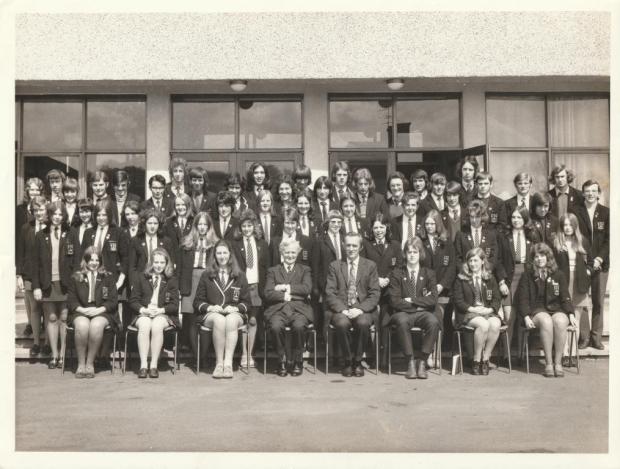
In 1966 Cumnock Academy was a large secondary school of around 1500 pupils. The initiation rite involved older boys dragging any new first years off to the toilets to duck their heads in the sinks. This went on for several days. After a miserable first day I worked out that if I wet my hair under a tap when I arrived then they would think I had already been ‘done’ and leave me in peace.
The belting of the innocents, begun in primary school, continued. It was obvious to the victims which teachers were most proficient in this art, and classroom discipline varied accordingly. In those days of large intakes many of our classes took place in prefabricated cabins which were unofficially referred to as ‘the huts.’ These were numbered, much like a prison camp. Ivie McCaig taught us Latin in one of these during our first two years. In his day he had been a fine academic and a wing three-quarter for Glasgow University. It was rumoured he had once chased a pupil through the local park until his quarry climbed a tree to escape him. His hare-and-hound days were well over by the time he taught us.
Ivie operated a heavy gender bias. Girls could do no wrong – but he considered boys evil disruptors of civilisation. Ivie kept his belt in his office. After bringing a boy to the front of the class for punishment he would raise the back of his hand theatrically to the side of his mouth, and tell the girls, ‘I’m just going to get my belt,’ at which they would gasp in simulated horror.
My usual crime was not writing out the Latin in ink before adding the translation in pencil underneath. Ivie would advance down the aisle between the desks and announce ponderously, ‘We’ll just see how much Stevenson and McDonald have done.’ John McDonald was my desk-mate and another future medical student. Picking up our jotters to confirm his suspicions, Ivie would glance at them, then throw them back onto our desks. ‘I thought so! “Sufficient unto the day is the evil thereof,” that’s Stevenson and McDonald’s motto,’ and off he would go to fetch his belt. In fact, as we all knew, he couldn’t really ‘draw the belt’ and it didn’t hurt much. The technical and PE teachers were a different matter. They could ‘draw the belt’ and the pain was intense and persistent.
Our prefab hut classroom was located on high ground above what had once been the flood plain of the nearby river on which a housing estate had been built. A steep grassy bank sloped down from the school to the houses. One day, during Latin class, there was a sudden loud noise from the window. Ivie wandered over to investigate whereupon there was a second noise. Two holes with a starburst of surrounding cracks had appeared in the window. One of the boys found a deformed airgun pellet on the floor. We were under fire from the council estate!
Ivie reacted instantly. ‘Get down girls! Get down! Someone is firing at us!’ He paid no attention to the boys. We crept over to the window and peered out over the sill to see what was happening. Now on his hands and knees, Ivie demanded to have the mutilated ‘slug’. ‘It’s evidence,’ he announced gravely. The police were called and a boy who had recently left the Academy was arrested. There were no casualties.
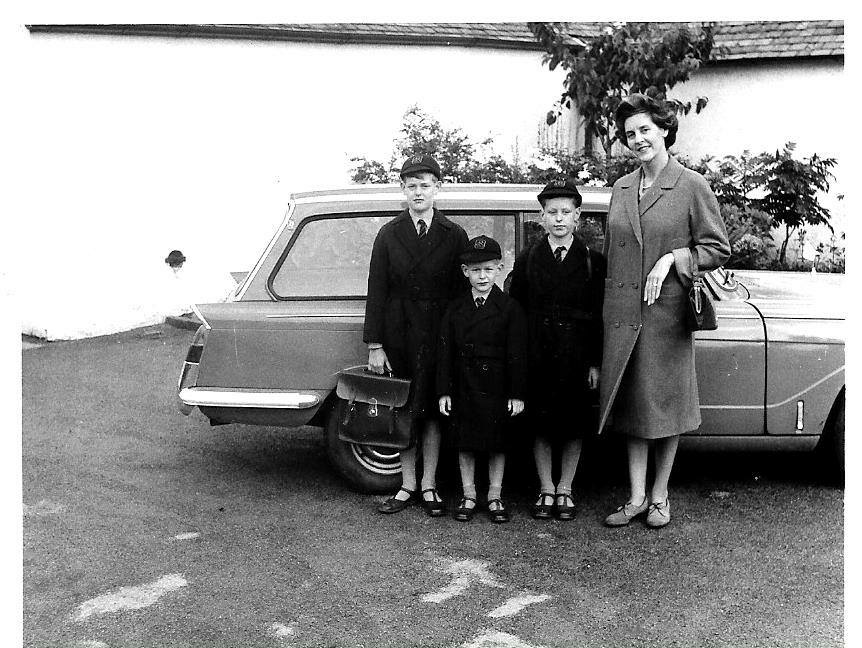
My father, who left school at 14, wanted us to get the proverbial ‘good start in life.’ By the time I started secondary school he was about sixty and mixing with other farmers and landowners successful in public life. Having attended a village school at Garrallan with a handful of pupils he had no idea where to start with independent education. He asked his acquaintances, who inevitably recommended Merchiston Castle School in Edinburgh (also known as Colditz). This was the traditional farmer’s son’s destination. A daunting prospectus arrived and I heard that only sixth year boys were allowed to wear long trousers. There were other, darker, rumours. I sensed that my mother was reluctant to lose us to a residential school but at 65 miles distance it would be necessary for us to board.
I was the product of a mixed marriage; my father was from Ayrshire and my mother from Edinburgh. The children of her middle class contemporaries from the East mostly attended independent schools as day pupils. These ladies were very concerned their offspring would acquire ‘dreadful local accents.’ Even at home in Ayrshire my father’s younger brother Willie had sent all three of his children to boarding school. I was duly entered for Merchiston.
On the fateful day I sat the common entrance exam the weather was very hot. We set off in my father’s Jaguar S-Type saloon. Through the open windows the soft tar sang under the tyres. I was nervous. I hadn’t been to a preparatory school. The extensive grounds with their mature trees and cricket pitches were intimidating. My father went off to have coffee with the headmaster while I was taken to a classroom with some other boys my age.
A short, bespectacled teacher came in with two senior boys. ‘The clever boys are over there.’ He gestured towards a small group on the far side of the room. ‘They are sitting the bursary. You thickies are sitting the common entrance exam. When you open the paper you will notice it includes New Maths. That’s the last time you will see any of that rubbish. We don’t believe in New Maths at Merchiston.’ I wondered how we had been sorted into academic sheep and goats, and why I was in with the ‘thickies.’ I must have failed some occult screening process. I immediately felt disinclined to find myself in Colditz. A prefect in cricket whites was left in the room to invigilate. He sat down in the teacher’s chair and put his feet up on the desk. We began.
At the break we were invited to walk around the grounds. I got talking to another farmer’s son, a boy called McColm. ‘How many pupils are there at your school?’ he asked. ‘Fifteen hundred,’ I answered (correctly). He scoffed at this. “That’s not possible. There are five hundred at my school and it’s a big school.’ I panicked and backed down. I said I thought it was only five hundred at my school too. Together we stared at the sunlit playing fields and the cricketers out in the middle. I really liked cricket and felt an unexpected pang of desire to attend this alien establishment.
We returned to the exam room and continued with the next paper. Not having been ‘prepped’ for this task I found most of the questions baffling. The cricketing invigilator was relieved by another. ‘Angus has made forty eight,’ remarked the newcomer before he too put his feet up on the desk. Eventually Dad came to get me and we went home. The headmaster had told him that the really important thing was that a boy should be good at games and that was what Merchiston offered. The headmaster had smelled of alcohol. My father, an elder of the kirk, was not impressed.
Eventually my modest exam results arrived. They didn’t seem to tally with my more acceptable performances at Cumnock. My parents confronted me. ‘Do you want to go?’ asked my father. ‘No,’ said I, and that was that. It was hinted that my father thought it bad public relations to send his children away from his home town for their education – but it hadn’t stopped other local professionals and businessmen doing so. I resumed my state school education and my mother had to endure the opprobrium of us having ‘dreadful local accents.’
Not much later, returning to Ayrshire after going to Murrayfield with my uncle, my mother turned to me in the back seat and asked if I had enjoyed it. I said I had but everyone around me had sounded very posh. Mum said, ‘Well, you should have showed them that you can speak nicely too.’ At this my father, at the wheel, exploded, ‘Don’t you feel ashamed of how you speak You speak exactly as you want.’ It was the only time I recall my parents arguing about such matters. I didn’t realise how much my accent contrasted with privately educated kids until I started university in Edinburgh. At first I thought the Edinburgh private school boys and girls I met were English.
Back at Cumnock Academy we didn’t even have changing rooms for outdoor games. We put on our kit in the technical classrooms before running through the town to the sports fields. Once we had our strips and boots on we set off, our aluminium studs clattering on the frosty pavements until we reached the playing fields over half a mile away. Afterwards, we ran back to school and washed the mud off in the cold water of the cloakroom sinks.
Half way through my secondary education the Academy moved to what had been Greenmill Primary School. It was a newer building anyway but it had also been extended. A footbridge crossed the river Lugar to the nearby playing fields at Broomfield, now equipped with a pavilion with proper changing rooms and showers. We were no longer ashamed to host other schools.
Monty Davidson, my old pal from Greenmill Primary (see Part One) had gone up to the ‘big school’ a year before me. As if his physical bulk wasn’t intimidating enough, Monty would march around the town with his white Alsation, Snowy. He was a very good rugby player. His position was prop forward. Before evening practice games, as a demonstration of his strength, Monty would jump up and grab the door lintel in the ‘techy’ classroom. He would then do twenty or so effortless chins before dropping to the floor.
Monty got invited to the Glasgow and District Trial, which greatly pleased the physical education teachers. Unfortunately, he was picked to play on the same side as a prop from another school with whom he’d had an altercation during the current season. Within moments of the start, Monty punched his new teammate in the face and was sent off. The PE teachers were horrified. Getting sent off in a trial game set a new benchmark.
Monty left school as soon as he could and joined the army. Legends then arose about his career in the armed forces: he had shot himself in the foot while on sentry duty; he took a bayonet with him on nights out in Birmingham; in a pub he had been taunted with ‘Soldier boy! Soldier boy!’ for having short hair, and had stabbed his tormentor; he was out of the army and in Barlinnie Prison. I have no idea if any of this was true. I never saw him again after he left school. If he is still out there somewhere, maybe he can set the record straight.
Meanwhile, I set a record as the first boy in third year to ‘get the belt.’ On day one, our new geography teacher told us he would belt any pupil who hadn’t covered their books by the following day. This involved getting brown paper out and parcelling the book boards. I somehow didn’t get round to it that night and so the following day I was punished.
On the upside, inter-scholar violence, and the associated fear, subsided as most of the really crazy boys departed, leaving those of us who had pretensions to a university education to carry on. In the early seventies that was a relatively small proportion of all pupils, but a big school like Cumnock produced many strong candidates. In time, use of the belt decreased and teachers were more prepared to tolerate our eccentricities. My favourite maths teacher was Mr Wilson, who never used the belt, and only had to say, ‘You can go off people, Stevenson,’ for me to settle down. I had a mental block for maths. Mr Wilson asked me what the problem was. ‘I don’t know what “the rate of change of dx by dy” means,’ I complained. ‘I can’t picture it.’ Mr Wilson advised me to forget about picturing mathematical formulae and just learn them up.
Mr Moffat, a South African english teacher was a very nice man. He took us for cricket and I suspected he harboured deep Christian belief. He had a large vocabulary and liked good order in class. Harry Kirkwood had a habit of chewing gum, which was not allowed. One day, Mr Moffat noticed this and demanded angrily, ‘Harry! Are you masticating?’ Harry glanced down at his lap in puzzlement. ‘Me sir? No sir.’
Mr Moffat praised me to the skies for an essay I wrote on Charles Dickens. He said it was the finest piece of work he had ever received from a pupil. In fact I had cribbed most of it from Heron Books’ Complete Works of Dickens to which my mother had subscribed at my request. I loved Dickens. The books came out in instalments between 1970 and 1972 and had an introduction by JB Priestley – which is where I got most of my text. Needless to say, it was an impressive essay. My plagiarism was never discovered.
In first and second year we did some Latin, but not enough to hurt us – amo, amas, amat – that sort of thing. Ian Biggart, a notable jester and miscreant, was caught talking at the back of the class during a French class taken by ‘Bull’ McIntyre, a formidably large and confident man who was in charge of school discipline. ‘Biggart, you are an ignoramus. Do you know what that means Biggart?’ demanded Mr McIntyre. ‘Eh… we are ignorant sir?’ came the reply. We all collapsed laughing, not realising, in our ignorance, that ignoramus did indeed mean ‘we do not know.’ When I eventually reached sixth year, the same Mr McIntyre remarked to me that I might be a big fish in a small pond in Cumnock but when I went up to Edinburgh I would be a very small fish in a very big pond.
My piano teacher, Mr Walker, also taught music at the Academy. To accompany school musical productions he would hire a Hammond organ with a Leslie speaker for the vibrato effect. I never had a starring role in any of these productions but I did once give the audience my Mr Bumble in Oliver! by Lionel Bart. I had to put an inflatable cushion down my front to simulate obesity. This tended to migrate during my performance. We used the music classrooms behind the stage as changing rooms. My part as Bumble the Beadle was over quickly and feeling bored, I started playing boogie on one of the classroom pianos. The door burst open and the stage manager shouted at me to stop as I could be heard ‘front of house.’
Later in school I was cajoled into playing Everyman in the eponymous fifteenth century religious play. The eventual performance took place in the Congregational Church in Ayr Road. I wore a black polo neck sweater for the part and ‘Good Deeds’ was played by my friend Dorothy Clark. In the play Everyman is summoned by Death and finds he cannot take any world goods with him. ‘Good Deeds’ tells him she is too weak to go but introduces her friend ‘Knowledge’ who says, ‘Everyman, I will go with thee and be thy guide, in thy most need be by thy side…’ It was a challenge to learn so many lines and I was dismayed when the minister introducing the performance said it should be treated as an act of worship and therefore there would be no applause at the end.
I’m not sure why they decided to make me Head Boy, or ‘School Captain’ as the school would have it. I must have been the worst choice in many years. Why they didn’t appoint David Watson, who excelled at football and basketball, I will never know.
All sixth years were automatically made prefects and given their own badges. The day after I was appointed they got access to the sixth year common room. The only available entertainment was a darts board. Excited by their promotion, the new prefects decided to take the trousers off the most vulnerable member of the year and push him out into the corridor for the amusement of the juniors. The headmaster immediately banned them from using the common room. When I arrived late, as usual, from lunch I was presented with a bag of prefect badges and the information that they were all on strike. Eventually privileges were restored, but the first time I walked into the common room after this affair, a group of my fellow office-bearers threw darts at me. A moment of panic subsided as they bounced harmlessly off me. They had unscrewed the metal points and thrown the flights at me. Would they have done that to David Watson?
As head boy I was supposed to join the head girl for coffee with the Rector every Friday morning but somehow I kept missing that and it soon became too embarrassing to turn up. She soldiered on alone to the end of the year. My father had donated an old Commer van for the school to use. In fifth year I was the only pupil who didn’t go on the sponsored walk to raise money for its upgrade and maintenance. I was nevertheless plastered all over the local paper receiving the van on behalf of the school.
One curiosity of the Academy which reflected the times was the strength of the Russian Department. It was the biggest single language group and they took school trips to Moscow. Vigorous left wing views were taken for granted and were expected to be displayed in school debates – otherwise you would be the object of ridicule. The headmaster, Robert Laughlin, was said to walk in the Woodroad Park with Emrys Hughes the local Labour MP so that they could practise their Russian conversation. Hughes was married to Nan Hardie, daughter of Keir Hardie, founder of the Labour Party, and former Cumnock resident. There is a fine bronze bust of him by Benno Schotz in front of the Town Hall. One of my father’s fellow elders of Old Cumnock Old Church was Provost Keir McTurk. Like some other politicians, he was named after the great man. Emrys Hughes would send my father copies of Hansard highlighting when he had spoken up for farmers in the House of Commons.
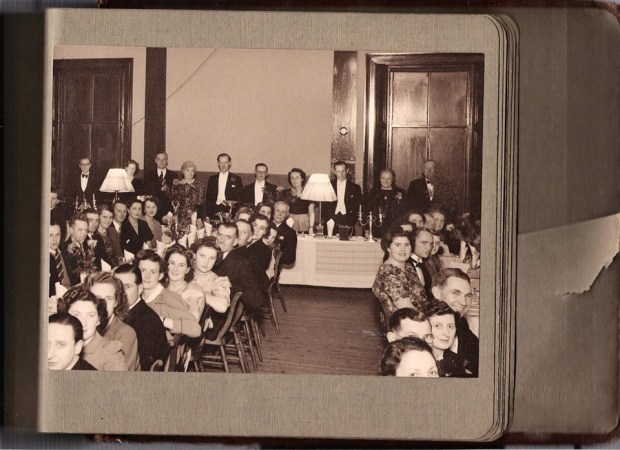
I played cricket throughout secondary school but had to drop rugby in third year as I couldn’t get into the Firsts or Seconds which were full of competent fifth and sixth year boys. By contrast, the cricket team I captained frequently couldn’t even find eleven boys prepared to play. Cricket was considered such a low status sport that ‘colours’ were not awarded. Colours were white edging added to your blazer to indicate you had played two seasons in the first team. It looked very smart. I had no white piping on my blazer, which was unusual for a Head Boy.
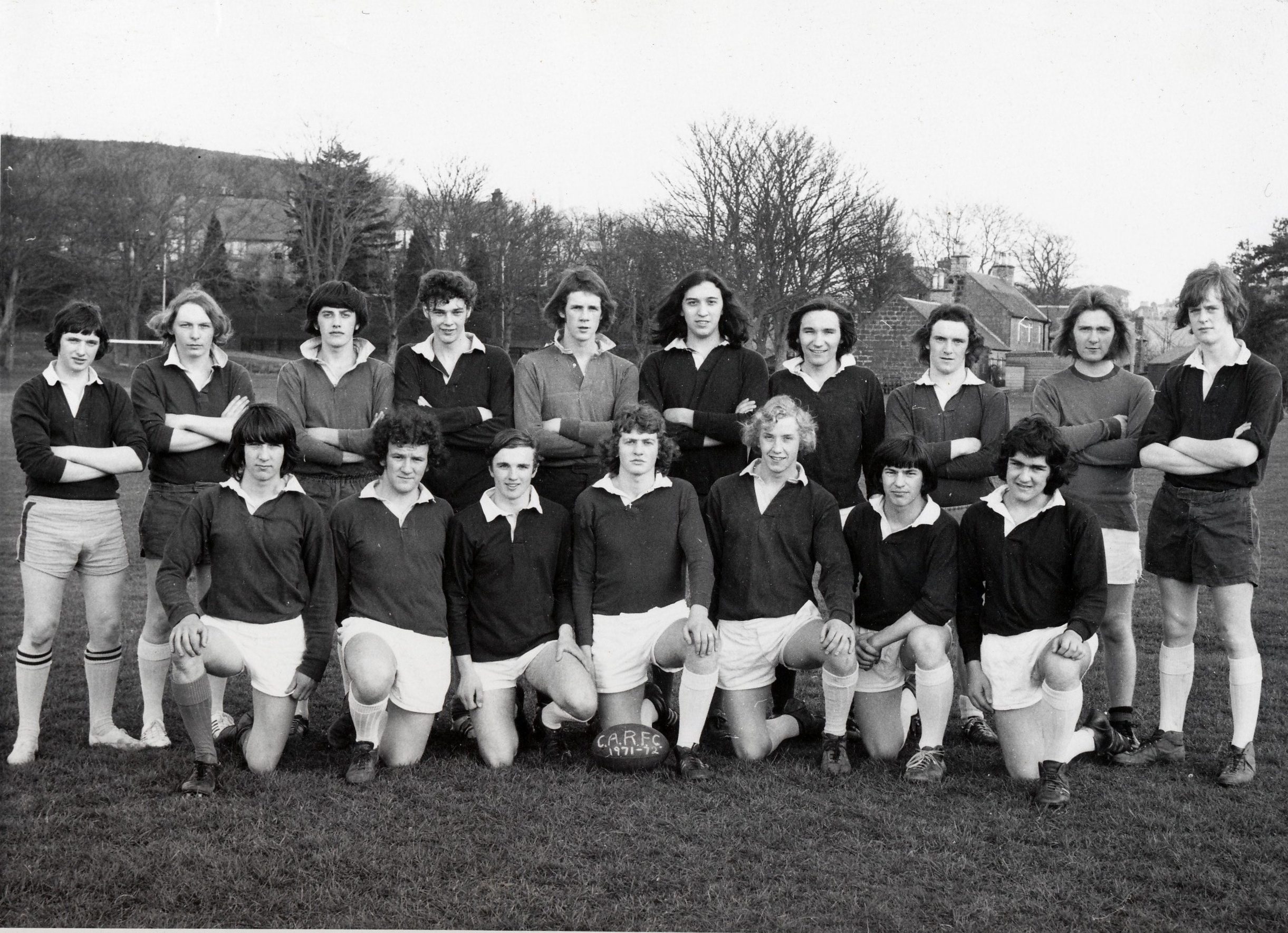
Our cricket pitch was a makeshift affair in the middle of the running track. The ground was extremely uneven and as a result our teachers didn’t let us play at home. We travelled to schools like Ayr Academy, Kilmarnock Academy and Marr College where the pitches were immaculate. We lost every match, of course, and on the way home in the bus my loyal team would sing, ‘We want Stevie with a rope around his neck and six feet off the ground!’ I was mainly a medium pace bowler. My best innings of 26 not out was made against the teachers’ team in sixth year. Mr Steinlet featured in that team. I forget what he taught; one of the sciences I think. He had played cricket to quite a high level in the north of England. He told us he had once put his partial denture into his back pocket for safekeeping while fielding. The batsman hit a towering shot and running backwards to catch it, Mr Steinlet had tripped over the boundary rope and fallen onto his behind; ‘Boys, I bit myself on the arse.’
I sat five highers in my fifth year and got adequate grades to apply for medical school. I was accepted for Edinburgh, my preference, conditional on passing higher physics in a year. I had never done physics before. Realising I only needed that one exam to be heading east, I went for a quiet sixth year. I sat Higher Physics and Higher Economics in a year, Sixth Year Studies Geography and ‘Recreational English.’ When Mr McIntyre, the master involved in selecting the winner of the dux medal, discovered how I had been slacking, he excluded me from consideration – which was just as well as I would have had no chance of beating my friend Ian, who did theoretical physics with Higgs in Edinburgh and ended up designing nuclear submarines. We shared a room in digs when we went up to Edinburgh and we listened to a lot of Wagner.
After passing my driving test at seventeen I was given a nine month old Mini Clubman 1275 GT. It was white with red stripes. I had already blown the engine on my father’s Hillman estate, which he needed for farm work, so he decided to give me my own car to stop me damaging his. I would later blow the engine of his Daimler Sovereign on the Edinburgh road. He bought me the mini without actually seeing it and had no idea what it was. The firm’s mechanic, my mentor in the chronic absence of my father, accompanied me to Kilmarnock to buy it. My father only realised what he had done after he was presented with a £250 bill for fully comprehensive insurance for a seventeen-year-old. The car was only worth £720. He drove it once, to take our cleaning lady home, and returned full of dark warnings about driving it with care.
The gear change was indistinct, like stirring a bucket of ballbearings with a stick. It had a ‘racing handbrake’ with no ratchets until fully engaged. This meant that pressing the button on the end fully released it allowing easier ‘hand-break turns.’ On returning to the farm in the early hours I would practise these in front of the hay shed where I parked the car overnight – to my father’s absolute fury. In fact, checking the zero-to-sixty figures for the 1275 now reveals a pedestrian performance easily bettered by many commercial vehicles these days.
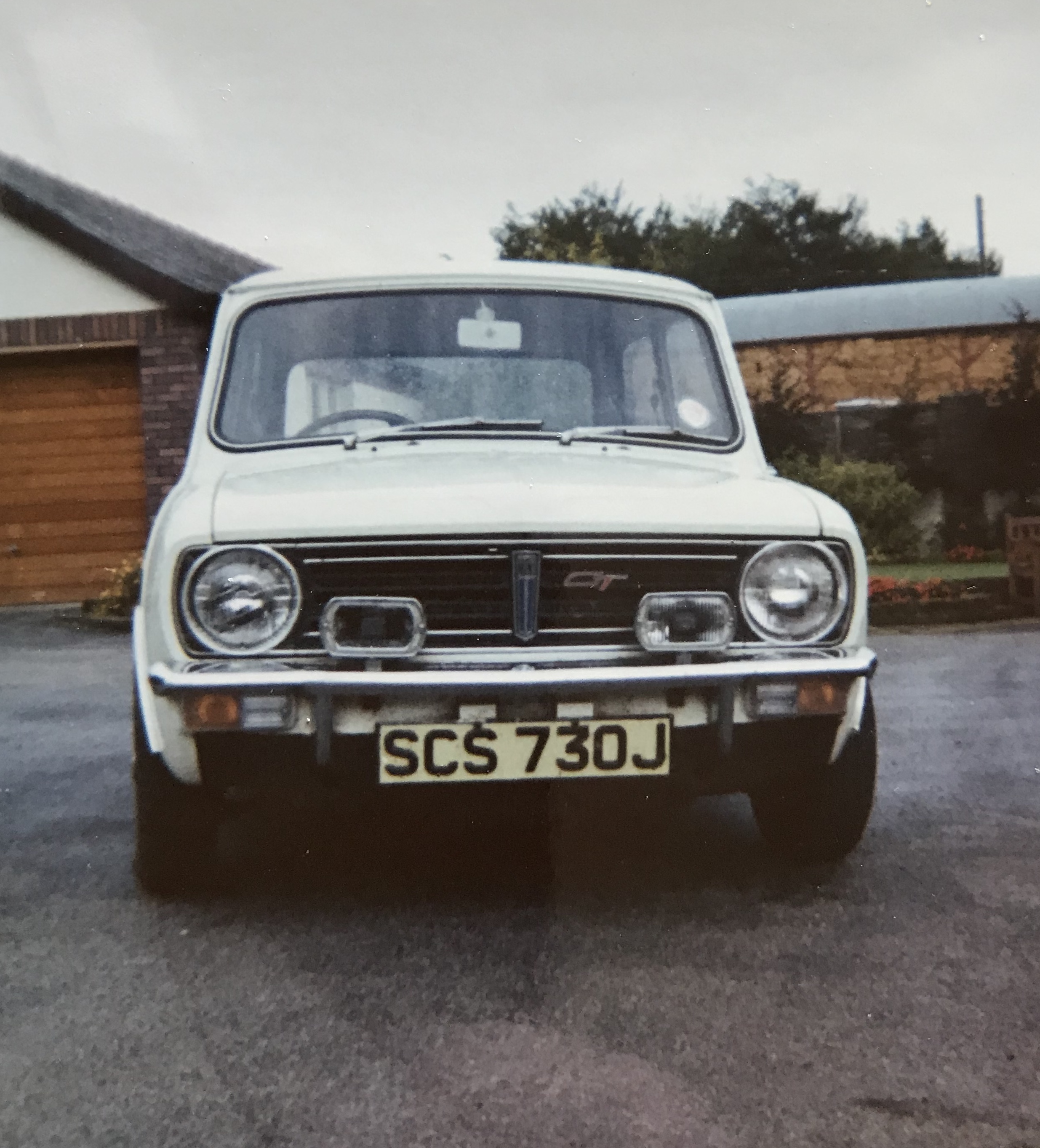
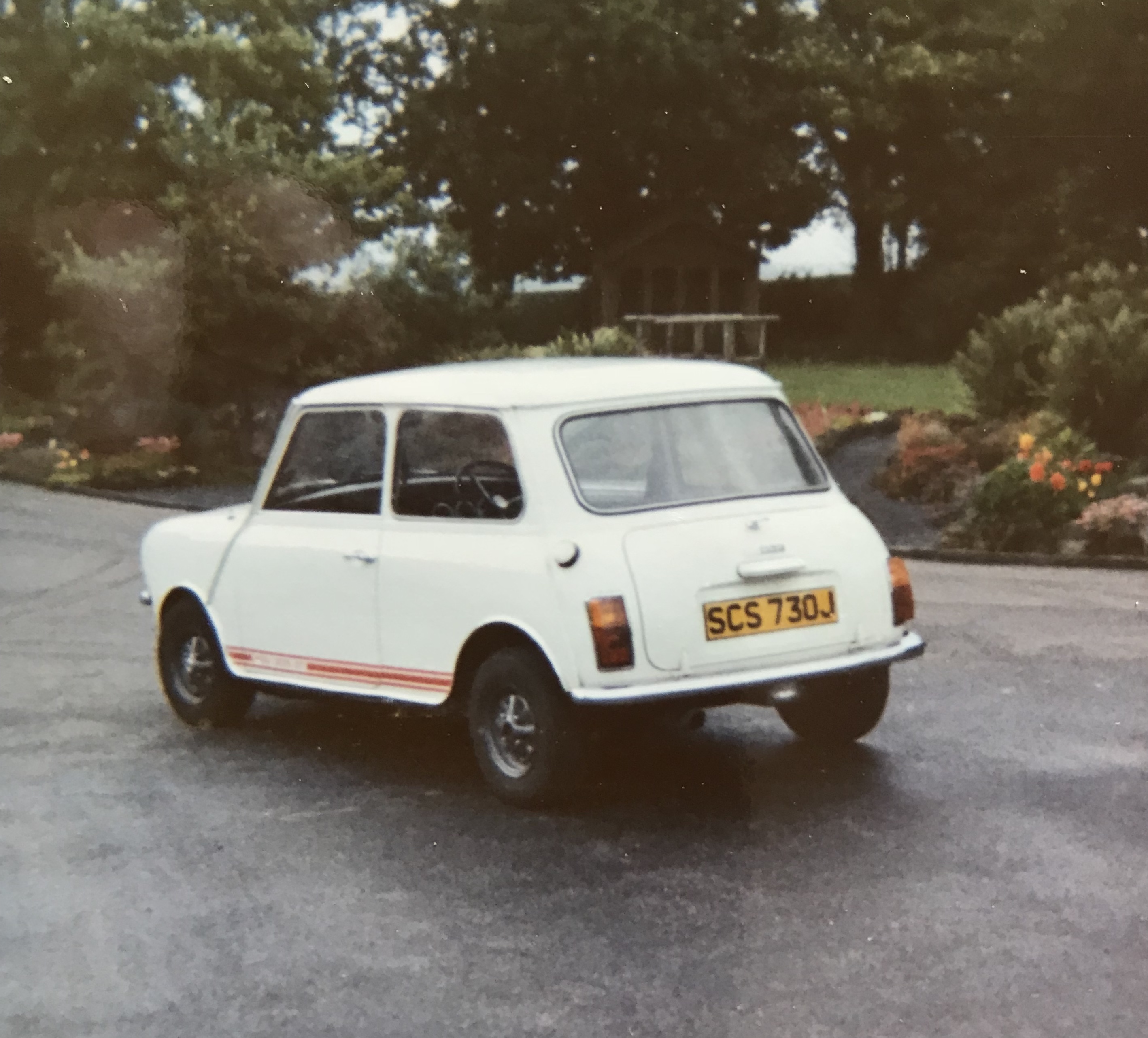
Arriving back at school after lunch, the juniors would line up to watch me generate wheel-spin changing from first to second gear until, thankfully, the discipline mistress stopped me. Mr McPherson, a physics teacher from the far north, had a much more tolerant attitude and asked if I would take him for ‘a spin’ in the Clubman. Myself and Ian the future dux obliged and we subjected him to a lunchtime sprint to Ochiltree and back at top speed, narrowly avoiding coming off on bends near Dumfries House. He demonstrated admirable sang froid throughout – but it turned out he had some form himself. I had five accidents with that car before selling it to a Norwegian dental student I shared a flat with at university. All the damage – including a completely new body shell after I rolled it – was repaired by my ever-tolerant surrogate father. In truth, I think he enjoyed it. Handing it back after it emerged from the paint shop he would wipe his hands on a rag and say, ‘Go on then, gie it the guttie!’*
The greatest gift our teachers gave us were the regular trips to the Citizens Theatre in Glasgow. We saw productions from the classic era such as: Hamlet, Mother Courage, Danton’s Death, and Rosencrantz and Guildenstern Are Dead. The bus trips were fun and we had chips on the way home. One night when we arrived in the Gorbals a bloke had parked his Morgan Plus 4 right outside the theatre. As we went in we admired it and noticed an urchin chatting to the driver. ‘Watch your car for you mister?’ he enquired. ‘No thanks,’ said the chap, brushing him aside. When we emerged at the end of the performance the same urchin was gleefully jumping up and down on the bonnet, inflicting major damage while giggling maniacally.
The school also took us to internationals at Murrayfield, another decent bus trip. We were not posh enough to be in the schoolboys’ enclosure next to the pitch and so took our chances on the terracing with the men. We were present at the Scotland vs Wales match in 1971 that ended 19-18 to the Welsh. We then went to Cardiff for the 1972 match, famous for the Gareth Edwards try that formed part of the opening sequence of Grandstand.
After Bloody Sunday in January, that 1972 season went unfinished when Scotland and Wales declined to travel to Dublin. England did travel in 1973 – and gained enormous credit from it. At the post match dinner John Pullin the English captain famously said, ‘We may not be very good – but at least we turn up.’
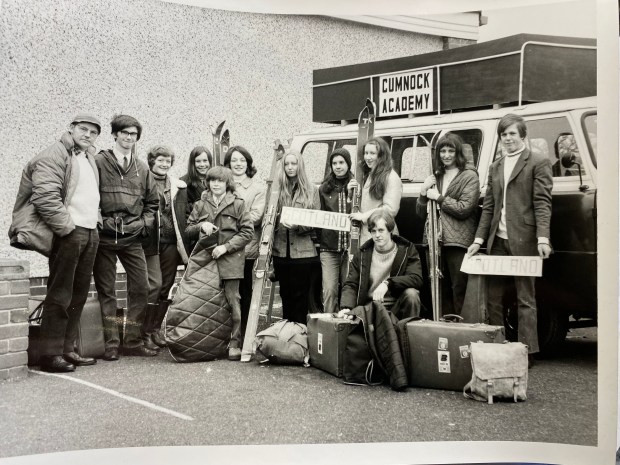
We had a memorable school trip to Norway using the aforementioned Commer van. We stayed inland at a youth hostel among stunning fjords. I later returned to Bergen when I sold Faceneck to Hans Kubon, my Norwegian flatmate, in 1974.
In addition to predicting our impending low status at university our teachers gave us other advice. A geography teacher, Mr B, warned us not to take amphetamines to stay awake and cram for exams. He said someone he knew had done this at Aberdeen University and had stayed awake for days. After the exam he discovered that instead of essay answers he had just written his name – hundreds of times. My friend Ian stuck his hand up, ‘Did you pass sir?’ ‘No I failed,’ said Mr B.
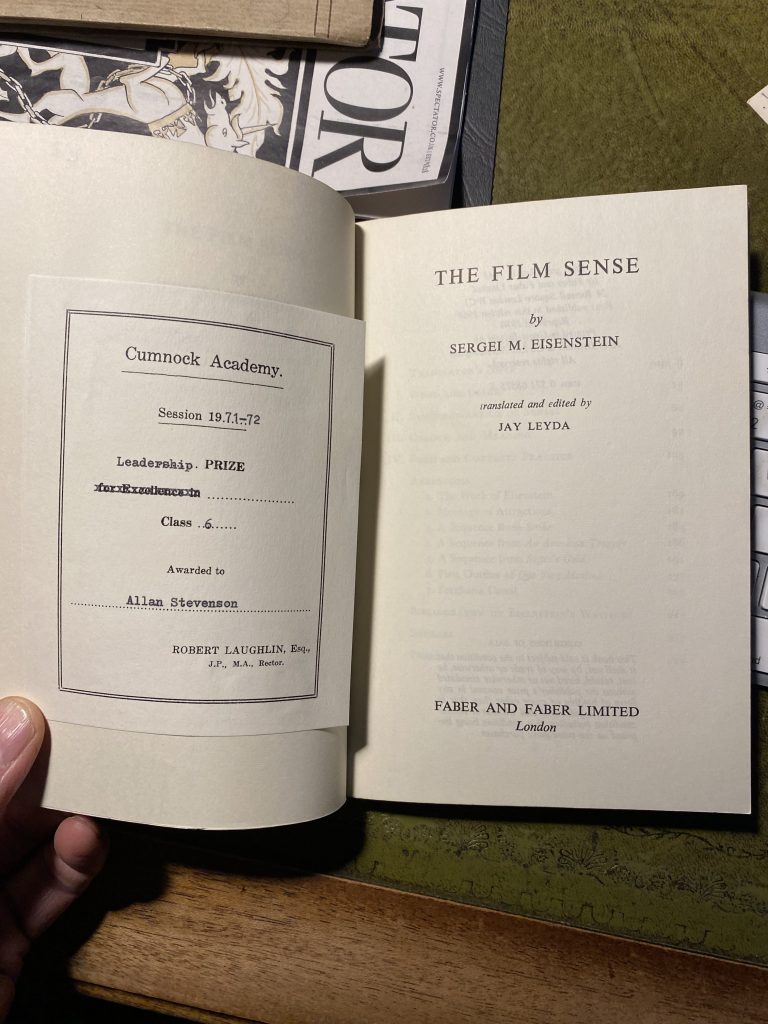
Not having exerted myself academically or sportingly I would not have featured in our final school prize-giving were it not for the ‘Leadership Prize’ which I suspect had been invented to spare my blushes. It was The Film Sense by Sergei Eisenstein. I have never read it.
My mother was often on the platform at these events and sometimes presented the prizes. On one occasion my father spoke. I was flattered that he asked me to listen to his speech the night before. It was good. Unfortunately, after I went to bed, he had further thoughts and doubled it in length. He also added quotes from the soundtrack of Oklahoma. It was a difficult listen as I stared at the floor trying to avoid eye contact with my classmates.
By now it was June 1972 and the height of The Troubles. This was before everybody had to have a prize and some boys who hadn’t troubled the scorers decided to enliven the proceedings by phoning in a bomb threat. We all ended up outside in the playground while the school hall was checked over. That evening we had our Sixth Year Dinner at the Dumfries Arms Hotel. There was an air of genuine excitement to this liminal event. We were about to be released into the world.
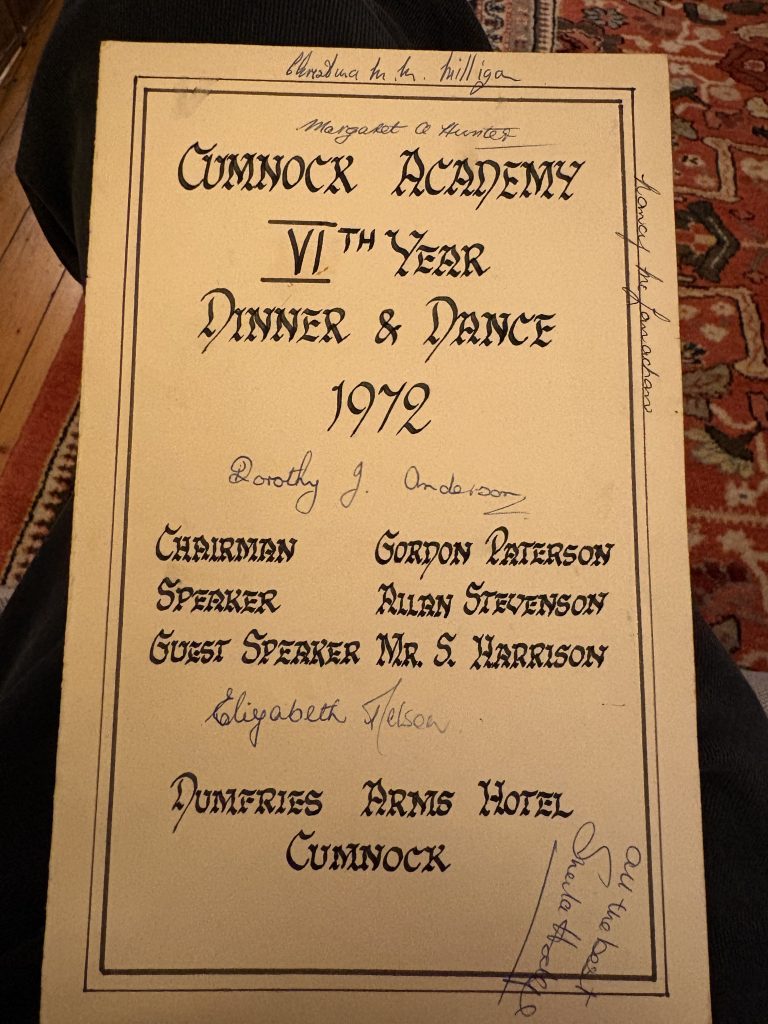
That year an outstanding footballer in our year had been involved in a serious car accident when his friend hit a bridge at high speed on the road between Muirkirk and Cumnock. The footballer, in the passenger seat, had his knee crushed by the parcel shelf. He had just signed for Rangers but his injuries were irreparable. Despite this he had wanted to attend and was brought along in a wheelchair. In the end it was all too much for him and he was taken home in tears.
It must have been a relief to my teachers to see the back of me. Predictions about my new life in Edinburgh turned out to be entirely correct and I was hopelessly homesick, travelling home every weekend in the mini to see my friends. By Christmas, to the great distress of my father, I was very upset. He had been worried that he might have to find farms for three sons and had been relieved that at least one of them was going to follow another career. ‘Well, if it’s that bad you’ll just have to come home to the farm,’ he said. That did the trick. I decided to stick it out.
- Bill Bunce the mechanic was a cockney, so his use of the Scottish vernacular was for comic effect. ‘Gie it the guttie’ means give it the gym shoe, i.e. foot-to-the-floor. Guttie is short for gutta-percha, the natural rubber formerly used for the soles of gym shoes. My vision of gutties is those black slip-on shoes with the elasticated panel in the front.