All Teachers Great and Small Part Two

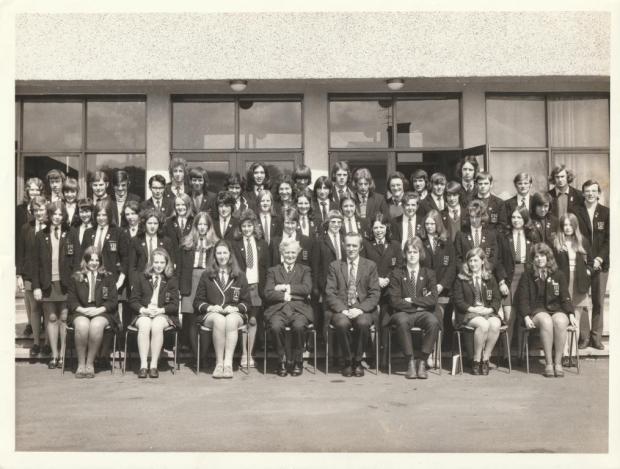
Front row: L to R: Mr Laughlin, Mr Hunter and myself, 1972.

In 1966 Cumnock Academy was a large secondary school of around 1500 pupils. The initiation rite involved older boys dragging any new first years off to the toilets to duck their heads in the sinks. This went on for several days. After a miserable first day I worked out that if I wet my hair under a tap when I arrived then they would think I had already been ‘done’ and leave me in peace.

The belting of the innocents, begun in primary school, continued. It was obvious to the victims which teachers were most proficient in this art, and classroom discipline varied accordingly. In those days of large intakes many of our classes took place in prefabricated cabins which were unofficially referred to as ‘the huts.’ These were numbered, much like a prison camp. Ivie McCaig taught us Latin in one of these during our first two years. In his day he had been a fine academic and a wing three-quarter for Glasgow University. It was rumoured he had once chased a pupil through the local park until his quarry climbed a tree to escape him. His hare-and-hound days were well over by the time he taught us.

Ivie operated a heavy gender bias. Girls could do no wrong – but he considered boys evil disruptors of civilisation. Ivie kept his belt in his office. After bringing a boy to the front of the class for punishment he would raise the back of his hand theatrically to the side of his mouth, and tell the girls, ‘I’m just going to get my belt,’ at which they would gasp in simulated horror.

My usual crime was not writing out the Latin in ink before adding the translation in pencil underneath. Ivie would advance down the aisle between the desks and announce ponderously, ‘We’ll just see how much Stevenson and McDonald have done.’ John McDonald was my desk-mate and another future medical student. Picking up our jotters to confirm his suspicions, Ivie would glance at them, then throw them back onto our desks. ‘I thought so! “Sufficient unto the day is the evil thereof,” that’s Stevenson and McDonald’s motto,’ and off he would go to fetch his belt. In fact, as we all knew, he couldn’t really ‘draw the belt’ and it didn’t hurt much. The technical and PE teachers were a different matter. They could ‘draw the belt’ and the pain was intense and persistent.

Our prefab hut classroom was located on high ground above what had once been the flood plain of the nearby river on which a housing estate had been built. A steep grassy bank sloped down from the school to the houses. One day, during Latin class, there was a sudden loud noise from the window. Ivie wandered over to investigate whereupon there was a second noise. Two holes with a starburst of surrounding cracks had appeared in the window. One of the boys found a deformed airgun pellet on the floor. We were under fire from the council estate!

Ivie reacted instantly. ‘Get down girls! Get down! Someone is firing at us!’ He paid no attention to the boys. We crept over to the window and peered out over the sill to see what was happening. Now on his hands and knees, Ivie demanded to have the mutilated ‘slug’. ‘It’s evidence,’ he announced gravely. The police were called and a boy who had recently left the Academy was arrested. There were no casualties.

My father, who left school at 14, wanted us to get the proverbial ‘good start in life.’ By the time I started secondary school he was about sixty and mixing with other farmers and landowners successful in public life. Having attended a village school at Garrallan with a handful of pupils he had no idea where to start with independent education. He asked his acquaintances, who inevitably recommended Merchiston Castle School in Edinburgh (also known as Colditz). This was the traditional farmer’s son’s destination. A daunting prospectus arrived and I heard that only sixth year boys were allowed to wear long trousers. There were other, darker, rumours. I sensed that my mother was reluctant to lose us to a residential school but at 65 miles distance it would be necessary for us to board.

I was the product of a mixed marriage; my father was from Ayrshire and my mother from Edinburgh. The children of her middle class contemporaries from the East mostly attended independent schools as day pupils. These ladies were very concerned their offspring would acquire ‘dreadful local accents.’ Even at home in Ayrshire my father’s younger brother Willie had sent all three of his children to boarding school. I was duly entered for Merchiston.

On the fateful day I sat the common entrance exam the weather was very hot. We set off in my father’s Jaguar S-Type saloon. Through the open windows the soft tar sang under the tyres. I was nervous. I hadn’t been to a preparatory school. The extensive grounds with their mature trees and cricket pitches were intimidating. My father went off to have coffee with the headmaster while I was taken to a classroom with some other boys my age.

A short, bespectacled teacher came in with two senior boys. ‘The clever boys are over there.’ He gestured towards a small group on the far side of the room. ‘They are sitting the bursary. You thickies are sitting the common entrance exam. When you open the paper you will notice it includes New Maths. That’s the last time you will see any of that rubbish. We don’t believe in New Maths at Merchiston.’ I wondered how we had been sorted into academic sheep and goats, and why I was in with the ‘thickies.’ I must have failed some occult screening process. I immediately felt disinclined to find myself in Colditz. A prefect in cricket whites was left in the room to invigilate. He sat down in the teacher’s chair and put his feet up on the desk. We began.

At the break we were invited to walk around the grounds. I got talking to another farmer’s son, a boy called McColm. ‘How many pupils are there at your school?’ he asked. ‘Fifteen hundred,’ I answered (correctly). He scoffed at this. “That’s not possible. There are five hundred at my school and it’s a big school.’ I panicked and backed down. I said I thought it was only five hundred at my school too. Together we stared at the sunlit playing fields and the cricketers out in the middle. I really liked cricket and felt an unexpected pang of desire to attend this alien establishment.

We returned to the exam room and continued with the next paper. Not having been ‘prepped’ for this task I found most of the questions baffling. The cricketing invigilator was relieved by another. ‘Angus has made forty eight,’ remarked the newcomer before he too put his feet up on the desk. Eventually Dad came to get me and we went home. The headmaster had told him that the really important thing was that a boy should be good at games and that was what Merchiston offered. The headmaster had smelled of alcohol. My father, an elder of the kirk, was not impressed.

Eventually my modest exam results arrived. They didn’t seem to tally with my more acceptable performances at Cumnock. My parents confronted me. ‘Do you want to go?’ asked my father. ‘No,’ said I, and that was that. It was hinted that my father thought it bad public relations to send his children away from his home town for their education – but it hadn’t stopped other local professionals and businessmen doing so. I resumed my state school education and my mother had to endure the opprobrium of us having ‘dreadful local accents.’

Not much later, returning to Ayrshire after going to Murrayfield with my uncle, my mother turned to me in the back seat and asked if I had enjoyed it. I said I had but everyone around me had sounded very posh. Mum said, ‘Well, you should have showed them that you can speak nicely too.’ At this my father, at the wheel, exploded, ‘Don’t you feel ashamed of how you speak You speak exactly as you want.’ It was the only time I recall my parents arguing about such matters. I didn’t realise how much my accent contrasted with privately educated kids until I started university in Edinburgh. At first I thought the Edinburgh private school boys and girls I met were English.

Back at Cumnock Academy we didn’t even have changing rooms for outdoor games. We put on our kit in the technical classrooms before running through the town to the sports fields. Once we had our strips and boots on we set off, our aluminium studs clattering on the frosty pavements until we reached the playing fields over half a mile away. Afterwards, we ran back to school and washed the mud off in the cold water of the cloakroom sinks.

Half way through my secondary education the Academy moved to what had been Greenmill Primary School. It was a newer building anyway but it had also been extended. A footbridge crossed the river Lugar to the nearby playing fields at Broomfield, now equipped with a pavilion with proper changing rooms and showers. We were no longer ashamed to host other schools.

Monty Davidson, my old pal from Greenmill Primary (see Part One) had gone up to the ‘big school’ a year before me. As if his physical bulk wasn’t intimidating enough, Monty would march around the town with his white Alsation, Snowy. He was a very good rugby player. His position was prop forward. Before evening practice games, as a demonstration of his strength, Monty would jump up and grab the door lintel in the ‘techy’ classroom. He would then do twenty or so effortless chins before dropping to the floor.

Monty got invited to the Glasgow and District Trial, which greatly pleased the physical education teachers. Unfortunately, he was picked to play on the same side as a prop from another school with whom he’d had an altercation during the current season. Within moments of the start, Monty punched his new teammate in the face and was sent off. The PE teachers were horrified. Getting sent off in a trial game set a new benchmark.

Monty left school as soon as he could and joined the army. Legends then arose about his career in the armed forces: he had shot himself in the foot while on sentry duty; he took a bayonet with him on nights out in Birmingham; in a pub he had been taunted with ‘Soldier boy! Soldier boy!’ for having short hair, and had stabbed his tormentor; he was out of the army and in Barlinnie Prison. I have no idea if any of this was true. I never saw him again after he left school. If he is still out there somewhere, maybe he can set the record straight.

Meanwhile, I set a record as the first boy in third year to ‘get the belt.’ On day one, our new geography teacher told us he would belt any pupil who hadn’t covered their books by the following day. This involved getting brown paper out and parcelling the book boards. I somehow didn’t get round to it that night and so the following day I was punished.

On the upside, inter-scholar violence, and the associated fear, subsided as most of the really crazy boys departed, leaving those of us who had pretensions to a university education to carry on. In the early seventies that was a relatively small proportion of all pupils, but a big school like Cumnock produced many strong candidates. In time, use of the belt decreased and teachers were more prepared to tolerate our eccentricities. My favourite maths teacher was Mr Wilson, who never used the belt, and only had to say, ‘You can go off people, Stevenson,’ for me to settle down. I had a mental block for maths. Mr Wilson asked me what the problem was. ‘I don’t know what “the rate of change of dx by dy” means,’ I complained. ‘I can’t picture it.’ Mr Wilson advised me to forget about picturing mathematical formulae and just learn them up.

Mr Moffat, a South African english teacher was a very nice man. He took us for cricket and I suspected he harboured deep Christian belief. He had a large vocabulary and liked good order in class. Harry Kirkwood had a habit of chewing gum, which was not allowed. One day, Mr Moffat noticed this and demanded angrily, ‘Harry! Are you masticating?’ Harry glanced down at his lap in puzzlement. ‘Me sir? No sir.’

Mr Moffat praised me to the skies for an essay I wrote on Charles Dickens. He said it was the finest piece of work he had ever received from a pupil. In fact I had cribbed most of it from Heron Books’ Complete Works of Dickens to which my mother had subscribed at my request. I loved Dickens. The books came out in instalments between 1970 and 1972 and had an introduction by JB Priestley – which is where I got most of my text. Needless to say, it was an impressive essay. My plagiarism was never discovered.

In first and second year we did some Latin, but not enough to hurt us – amo, amas, amat – that sort of thing. Ian Biggart, a notable jester and miscreant, was caught talking at the back of the class during a French class taken by ‘Bull’ McIntyre, a formidably large and confident man who was in charge of school discipline. ‘Biggart, you are an ignoramus. Do you know what that means Biggart?’ demanded Mr McIntyre. ‘Eh… we are ignorant sir?’ came the reply. We all collapsed laughing, not realising, in our ignorance, that ignoramus did indeed mean ‘we do not know.’ When I eventually reached sixth year, the same Mr McIntyre remarked to me that I might be a big fish in a small pond in Cumnock but when I went up to Edinburgh I would be a very small fish in a very big pond.

My piano teacher, Mr Walker, also taught music at the Academy. To accompany school musical productions he would hire a Hammond organ with a Leslie speaker for the vibrato effect. I never had a starring role in any of these productions but I did once give the audience my Mr Bumble in Oliver! by Lionel Bart. I had to put an inflatable cushion down my front to simulate obesity. This tended to migrate during my performance. We used the music classrooms behind the stage as changing rooms. My part as Bumble the Beadle was over quickly and feeling bored, I started playing boogie on one of the classroom pianos. The door burst open and the stage manager shouted at me to stop as I could be heard ‘front of house.’

Later in school I was cajoled into playing Everyman in the eponymous fifteenth century religious play. The eventual performance took place in the Congregational Church in Ayr Road. I wore a black polo neck sweater for the part and ‘Good Deeds’ was played by my friend Dorothy Clark. In the play Everyman is summoned by Death and finds he cannot take any world goods with him. ‘Good Deeds’ tells him she is too weak to go but introduces her friend ‘Knowledge’ who says, ‘Everyman, I will go with thee and be thy guide, in thy most need be by thy side…’ It was a challenge to learn so many lines and I was dismayed when the minister introducing the performance said it should be treated as an act of worship and therefore there would be no applause at the end.

I’m not sure why they decided to make me Head Boy, or ‘School Captain’ as the school would have it. I must have been the worst choice in many years. Why they didn’t appoint David Watson, who excelled at football and basketball, I will never know.

All sixth years were automatically made prefects and given their own badges. The day after I was appointed they got access to the sixth year common room. The only available entertainment was a darts board. Excited by their promotion, the new prefects decided to take the trousers off the most vulnerable member of the year and push him out into the corridor for the amusement of the juniors. The headmaster immediately banned them from using the common room. When I arrived late, as usual, from lunch I was presented with a bag of prefect badges and the information that they were all on strike. Eventually privileges were restored, but the first time I walked into the common room after this affair, a group of my fellow office-bearers threw darts at me. A moment of panic subsided as they bounced harmlessly off me. They had unscrewed the metal points and thrown the flights at me. Would they have done that to David Watson?

As head boy I was supposed to join the head girl for coffee with the Rector every Friday morning but somehow I kept missing that and it soon became too embarrassing to turn up. She soldiered on alone to the end of the year. My father had donated an old Commer van for the school to use. In fifth year I was the only pupil who didn’t go on the sponsored walk to raise money for its upgrade and maintenance. I was nevertheless plastered all over the local paper receiving the van on behalf of the school.

One curiosity of the Academy which reflected the times was the strength of the Russian Department. It was the biggest single language group and they took school trips to Moscow. Vigorous left wing views were taken for granted and were expected to be displayed in school debates – otherwise you would be the object of ridicule. The headmaster, Robert Laughlin, was said to walk in the Woodroad Park with Emrys Hughes the local Labour MP so that they could practise their Russian conversation. Hughes was married to Nan Hardie, daughter of Keir Hardie, founder of the Labour Party, and former Cumnock resident. There is a fine bronze bust of him by Benno Schotz in front of the Town Hall. One of my father’s fellow elders of Old Cumnock Old Church was Provost Keir McTurk. Like some other politicians, he was named after the great man. Emrys Hughes would send my father copies of Hansard highlighting when he had spoken up for farmers in the House of Commons.
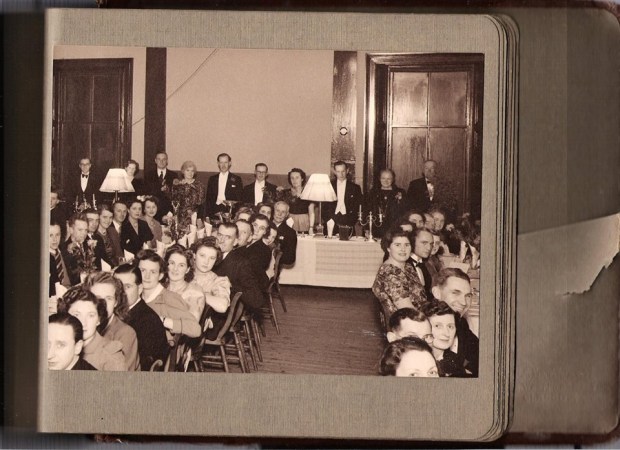
Stevensons Dairy Farms Dinner in the Town Hall. Emrys and Nan Hughes are on my Dad’s right. The smiling gentleman fourth from front right is Alec Paterson the father of Sandy Paterson the boy fourth from the right, back row, in the rugby photo below.

I played cricket throughout secondary school but had to drop rugby in third year as I couldn’t get into the Firsts or Seconds which were full of competent fifth and sixth year boys. By contrast, the cricket team I captained frequently couldn’t even find eleven boys prepared to play. Cricket was considered such a low status sport that ‘colours’ were not awarded. Colours were white edging added to your blazer to indicate you had played two seasons in the first team. It looked very smart. I had no white piping on my blazer, which was unusual for a Head Boy.
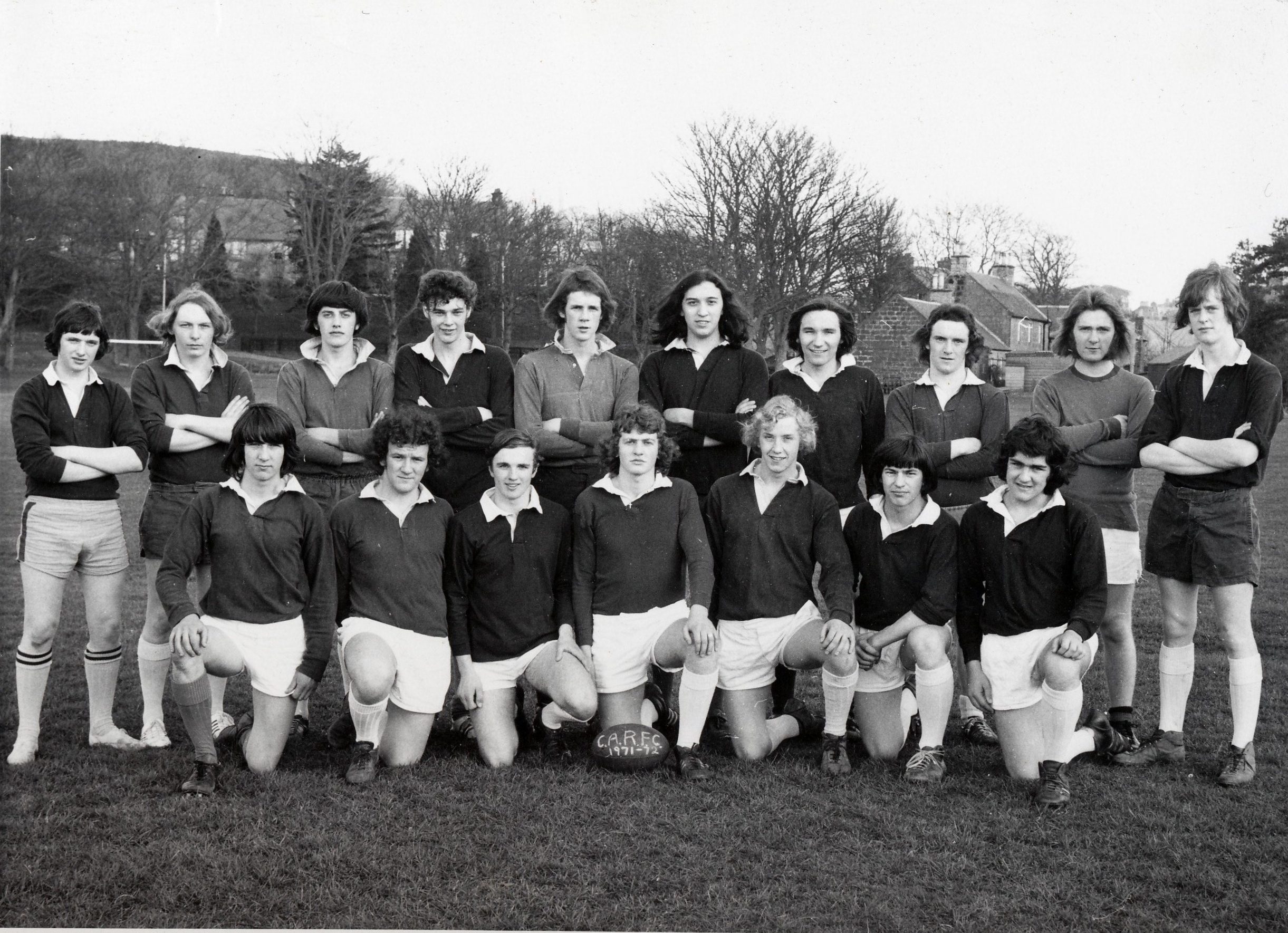
The First Fifteen, a motley crew. John McDonald, Latin scholar, was captain. I am back right.

Our cricket pitch was a makeshift affair in the middle of the running track. The ground was extremely uneven and as a result our teachers didn’t let us play at home. We travelled to schools like Ayr Academy, Kilmarnock Academy and Marr College where the pitches were immaculate. We lost every match, of course, and on the way home in the bus my loyal team would sing, ‘We want Stevie with a rope around his neck and six feet off the ground!’ I was mainly a medium pace bowler. My best innings of 26 not out was made against the teachers’ team in sixth year. Mr Steinlet featured in that team. I forget what he taught; one of the sciences I think. He had played cricket to quite a high level in the north of England. He told us he had once put his partial denture into his back pocket for safekeeping while fielding. The batsman hit a towering shot and running backwards to catch it, Mr Steinlet had tripped over the boundary rope and fallen onto his behind; ‘Boys, I bit myself on the arse.’

I sat five highers in my fifth year and got adequate grades to apply for medical school. I was accepted for Edinburgh, my preference, conditional on passing higher physics in a year. I had never done physics before. Realising I only needed that one exam to be heading east, I went for a quiet sixth year. I sat Higher Physics and Higher Economics in a year, Sixth Year Studies Geography and ‘Recreational English.’ When Mr McIntyre, the master involved in selecting the winner of the dux medal, discovered how I had been slacking, he excluded me from consideration – which was just as well as I would have had no chance of beating my friend Ian, who did theoretical physics with Higgs in Edinburgh and ended up designing nuclear submarines. We shared a room in digs when we went up to Edinburgh and we listened to a lot of Wagner.

After passing my driving test at seventeen I was given a nine month old Mini Clubman 1275 GT. It was white with red stripes. I had already blown the engine on my father’s Hillman estate, which he needed for farm work, so he decided to give me my own car to stop me damaging his. I would later blow the engine of his Daimler Sovereign on the Edinburgh road. He bought me the mini without actually seeing it and had no idea what it was. The firm’s mechanic, my mentor in the chronic absence of my father, accompanied me to Kilmarnock to buy it. My father only realised what he had done after he was presented with a £250 bill for fully comprehensive insurance for a seventeen-year-old. The car was only worth £720. He drove it once, to take our cleaning lady home, and returned full of dark warnings about driving it with care.

The gear change was indistinct, like stirring a bucket of ballbearings with a stick. It had a ‘racing handbrake’ with no ratchets until fully engaged. This meant that pressing the button on the end fully released it allowing easier ‘hand-break turns.’ On returning to the farm in the early hours I would practise these in front of the hay shed where I parked the car overnight – to my father’s absolute fury. In fact, checking the zero-to-sixty figures for the 1275 now reveals a pedestrian performance easily bettered by many commercial vehicles these days.
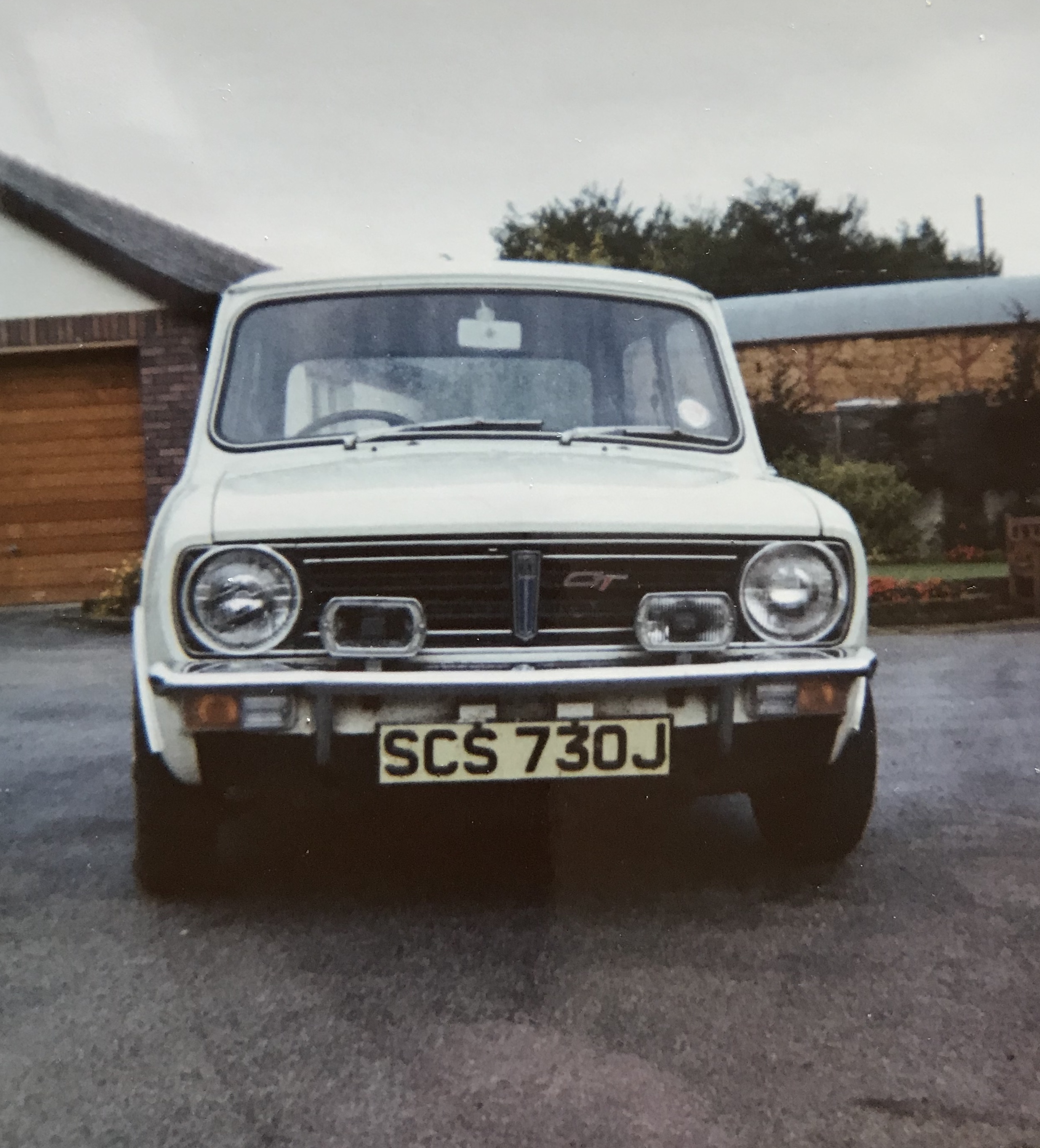
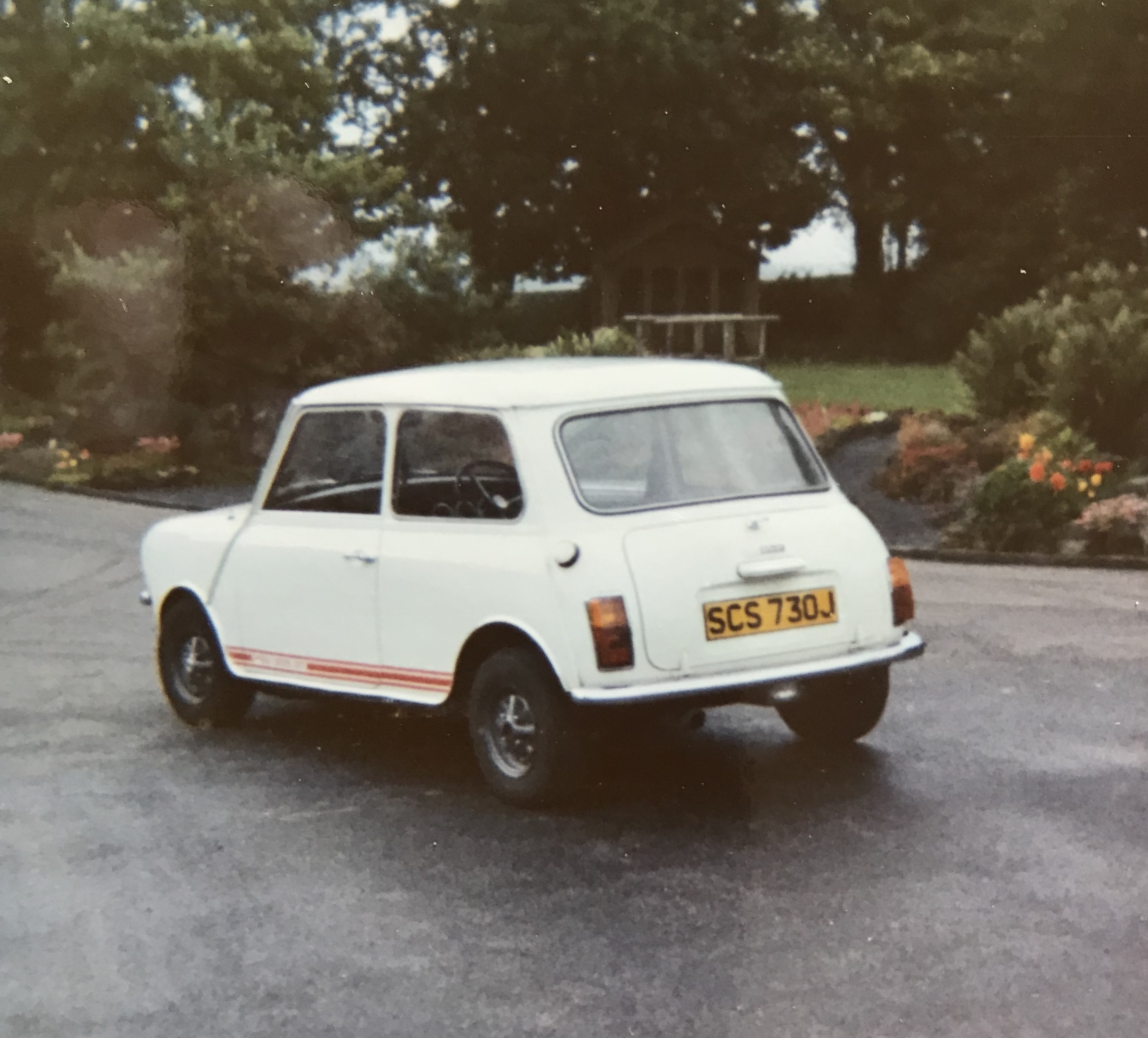
The much-adored and much-abused Faceneck

Arriving back at school after lunch, the juniors would line up to watch me generate wheel-spin changing from first to second gear until, thankfully, the discipline mistress stopped me. Mr McPherson, a physics teacher from the far north, had a much more tolerant attitude and asked if I would take him for ‘a spin’ in the Clubman. Myself and Ian the future dux obliged and we subjected him to a lunchtime sprint to Ochiltree and back at top speed, narrowly avoiding coming off on bends near Dumfries House. He demonstrated admirable sang froid throughout – but it turned out he had some form himself. I had five accidents with that car before selling it to a Norwegian dental student I shared a flat with at university. All the damage – including a completely new body shell after I rolled it – was repaired by my ever-tolerant surrogate father. In truth, I think he enjoyed it. Handing it back after it emerged from the paint shop he would wipe his hands on a rag and say, ‘Go on then, gie it the guttie!’*

The greatest gift our teachers gave us were the regular trips to the Citizens Theatre in Glasgow. We saw productions from the classic era such as: Hamlet, Mother Courage, Danton’s Death, and Rosencrantz and Guildenstern Are Dead. The bus trips were fun and we had chips on the way home. One night when we arrived in the Gorbals a bloke had parked his Morgan Plus 4 right outside the theatre. As we went in we admired it and noticed an urchin chatting to the driver. ‘Watch your car for you mister?’ he enquired. ‘No thanks,’ said the chap, brushing him aside. When we emerged at the end of the performance the same urchin was gleefully jumping up and down on the bonnet, inflicting major damage while giggling maniacally.

The school also took us to internationals at Murrayfield, another decent bus trip. We were not posh enough to be in the schoolboys’ enclosure next to the pitch and so took our chances on the terracing with the men. We were present at the Scotland vs Wales match in 1971 that ended 19-18 to the Welsh. We then went to Cardiff for the 1972 match, famous for the Gareth Edwards try that formed part of the opening sequence of Grandstand.

After Bloody Sunday in January, that 1972 season went unfinished when Scotland and Wales declined to travel to Dublin. England did travel in 1973 – and gained enormous credit from it. At the post match dinner John Pullin the English captain famously said, ‘We may not be very good – but at least we turn up.’
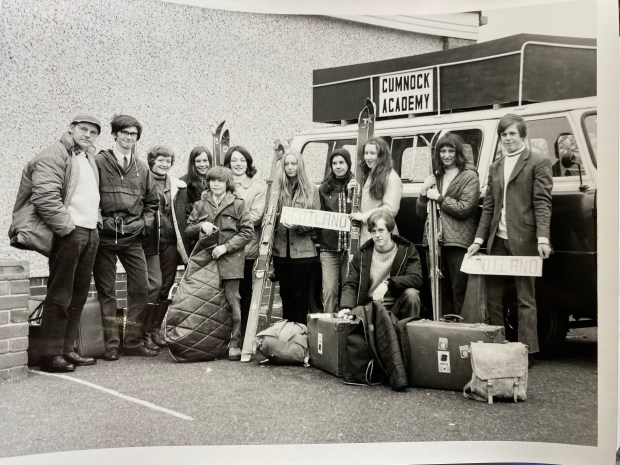
Norway or bust. ‘Good Deeds’ is fourth from the left. Davy Coltart, my oldest friend, is on the right holding one of the SCOTLAND banners.

We had a memorable school trip to Norway using the aforementioned Commer van. We stayed inland at a youth hostel among stunning fjords. I later returned to Bergen when I sold Faceneck to Hans Kubon, my Norwegian flatmate, in 1974.

In addition to predicting our impending low status at university our teachers gave us other advice. A geography teacher, Mr B, warned us not to take amphetamines to stay awake and cram for exams. He said someone he knew had done this at Aberdeen University and had stayed awake for days. After the exam he discovered that instead of essay answers he had just written his name – hundreds of times. My friend Ian stuck his hand up, ‘Did you pass sir?’ ‘No I failed,’ said Mr B.

Not having exerted myself academically or sportingly I would not have featured in our final school prize-giving were it not for the ‘Leadership Prize’ which I suspect had been invented to spare my blushes. It was The Film Sense by Sergei Eisenstein. I have never read it.
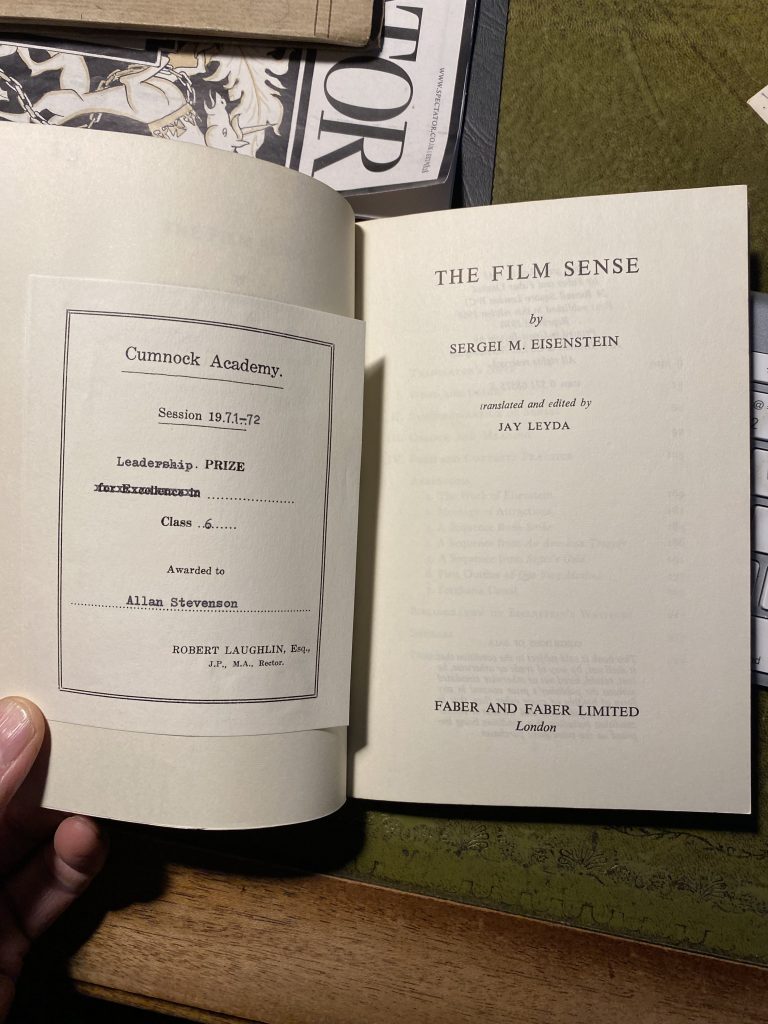
My mother was often on the platform at these events and sometimes presented the prizes. On one occasion my father spoke. I was flattered that he asked me to listen to his speech the night before. It was good. Unfortunately, after I went to bed, he had further thoughts and doubled it in length. He also added quotes from the soundtrack of Oklahoma. It was a difficult listen as I stared at the floor trying to avoid eye contact with my classmates.

By now it was June 1972 and the height of The Troubles. This was before everybody had to have a prize and some boys who hadn’t troubled the scorers decided to enliven the proceedings by phoning in a bomb threat. We all ended up outside in the playground while the school hall was checked over. That evening we had our Sixth Year Dinner at the Dumfries Arms Hotel. There was an air of genuine excitement to this liminal event. We were about to be released into the world.
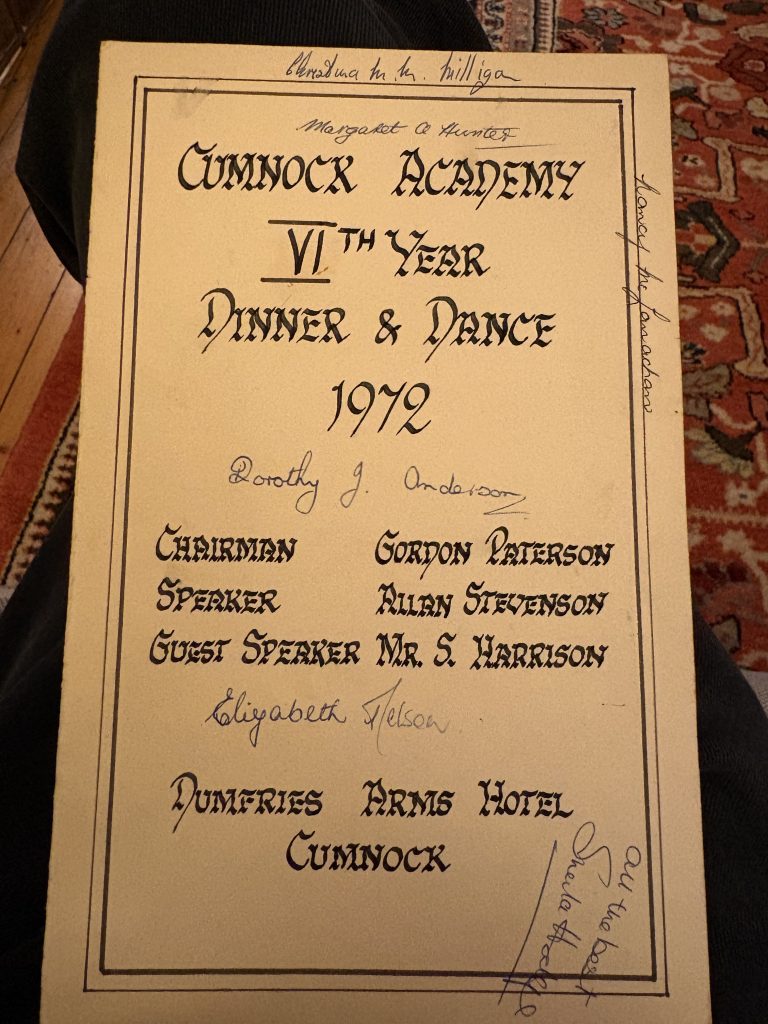
That year an outstanding footballer in our year had been involved in a serious car accident when his friend hit a bridge at high speed on the road between Muirkirk and Cumnock. The footballer, in the passenger seat, had his knee crushed by the parcel shelf. He had just signed for Rangers but his injuries were irreparable. Despite this he had wanted to attend and was brought along in a wheelchair. In the end it was all too much for him and he was taken home in tears.

It must have been a relief to my teachers to see the back of me. Predictions about my new life in Edinburgh turned out to be entirely correct and I was hopelessly homesick, travelling home every weekend in the mini to see my friends. By Christmas, to the great distress of my father, I was very upset. He had been worried that he might have to find farms for three sons and had been relieved that at least one of them was going to follow another career. ‘Well, if it’s that bad you’ll just have to come home to the farm,’ he said. That did the trick. I decided to stick it out.

  • Bill Bunce the mechanic was a cockney, so his use of the Scottish vernacular was for comic effect. ‘Gie it the guttie’ means give it the gym shoe, i.e. foot-to-the-floor. Guttie is short for gutta-percha, the natural rubber formerly used for the soles of gym shoes. My vision of gutties is those black slip-on shoes with the elasticated panel in the front.
All Teachers Great and Small Part One

I can still recall the dismay of realising primary school was the end of it: the end of the carefree world of childhood and the beginning of a lifetime of toil and trouble. Our dairy farm stood 600 ft above sea level on a hill in East Ayrshire. The Gaelic translation of its name is supposedly ‘hill shoulder’ which seems to fit the location. It lay about a mile from the East Ayrshire town of Cumnock, below us in the Lugar valley. To the north, our land bordered the Marquis of Bute’s Dumfries House, and the Auchinleck estate that once belonged to James Boswell. My father and his two brothers ran three dairy farms: Changue, Bankend and Crofthead. To the south, we also had two hill farms, Muirdyke and Newfield, which had some in-bye land, but mostly consisted of large areas of upland moor where blackface sheep roamed. There was a surreal quality to the landscape up there, like an endless rolling sea of grass, moss and rashes. Now, most of that land has been completely destroyed by open-cast coal operations. Picturesque white-walled steadings with their sheltering ash trees swept away. These included farms my ancestors worked. The overburden was carelessly replaced, leaving a churned up wasteland.

In 1950 the workings at the Knockshinnoch colliery at New Cumnock came too close to the surface and there was an inrush of liquid peat and moss trapping 135 miners underground. 13 died. My father attended the rescue effort with food and drink for the men. On YouTube you can see a very superficial, almost jaunty, Pathé News piece about it, which gives an idea of the landscape and climate of my home county.

Our Ayrshires were a renowned herd. We bottled our own milk and that of several neighbouring farms, collecting it using our own tanker. Later I drove that tanker, which lacked any internal baffles. When you stopped at a junction, the milk slopped back and forth, and you could feel the movement transmitted to the driver’s cab. I used to wonder if I was producing butter back there. 

Having spent five years at my mother’s side, surrounded by adults, most of whom were employed by my father, I was reluctant to leave this comfortable bubble and meet my contemporaries in the town. Aside from my younger brother, I had little experience of children my own age. One immediate problem was the way I spoke. I spoke like my mother and the other children didn’t. Only a quarter of the kids had a TV in the house and they didn’t listen to the Home Service. I had to learn how to speak like them very quickly or remain a cultural outcast.

The headmaster of the local primary school was James T Cree, a very large and impressive man, later to become president of the EIS (Educational Institute of Scotland). Corporal punishment using ‘the belt’ or ‘the strap’ was commonplace in senior and even junior state schools at the time. It was known elsewhere as the ‘tawse’ or Lochgelly – after its place of manufacture – but I never heard those terms used locally. At my primary and secondary schools it was always referred to as ‘the belt.’

As a public relations exercise my father would occasionally hold ‘at homes’ when the farm and dairy were opened to the general public. Hundreds would attend. Tables were laid out on the lawn, the hotel staff served teas, and the Scottish Milk Marketing Board ‘Dairy Princess’ would pose for the press handing out ice creams from a van.

At one of these events my parents were entertaining Mr Cree and other dignitaries in the drawing room. As a pre-school child, one of my favourite games was ‘lions and lion-tamers’ where I would get any persuadable adult to brandish a leather strap at me from one of my mother’s old handbags, while I pretended to be a fierce lion they could scarcely keep at bay. Excited by all the strangers in the house, I fetched the strap from the toy cupboard and strode into the drawing room. I handed the strap to James T Cree with the instruction that he should be the lion-tamer. I had no idea who he was, and certainly did not know how proficient he was in the use of that other kind of strap. I gambolled about on the carpet on all-fours while he flicked it at me, harmlessly. He looked at my father, laughed, and said, ‘Shades of things to come!’

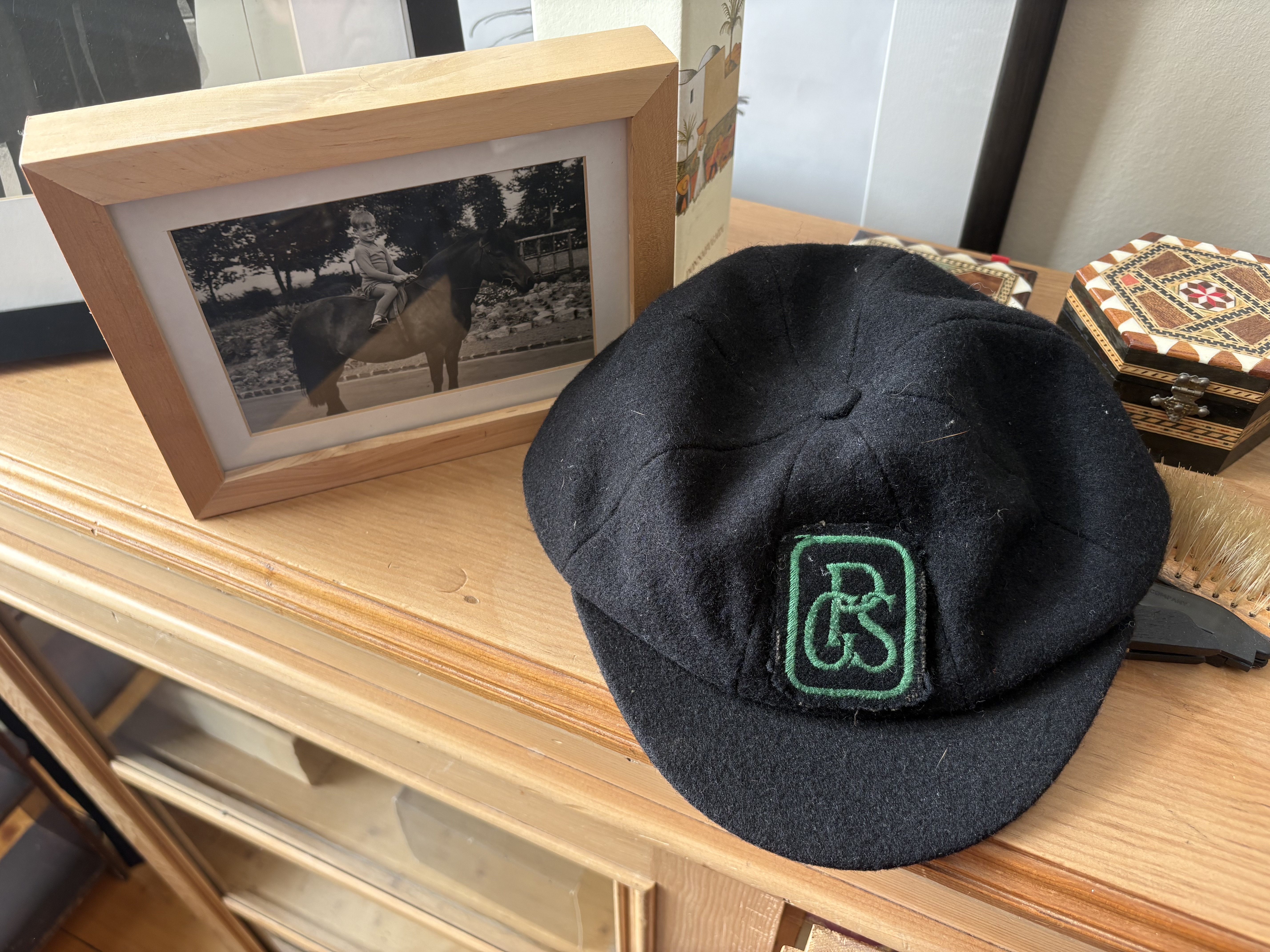
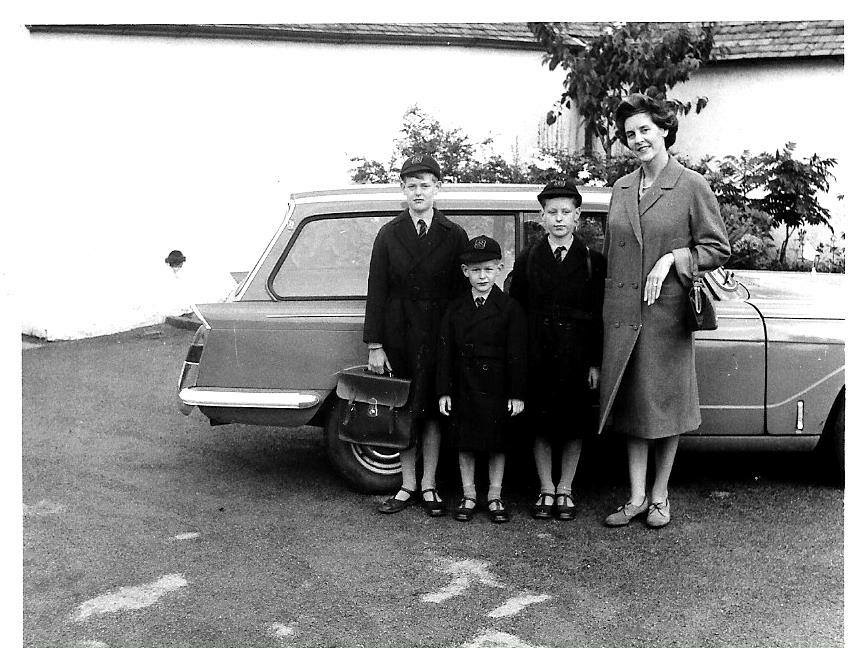
The local primary school was called Greenmill, and if your parents could afford it, there was a school uniform. The blazer pocket and cap were marked with the school’s ‘GPS’ monogram. We wore grey cotton shirts and black and green striped ties, usually with a grey wool v-neck pullover.

Mum and the three of us, about to board the Triumph Herald. I was six years older than my youngest brother, so we had one year when we were all at Greenmill together.

As one changes jobs and status, life seems to be made up of a succession of ‘first days at school.’ The first of these is your first day at school. Aged five, I was petrified. Everything was strange and threatening. I have a vivid memory of refusing to leave my mother’s side. She pointed to our business manager’s daughter, a year older than me and in her second year, standing in the queue, and said, ‘Look, Jennifer isn’t scared to go in.’

My first teacher was Mrs Cree, wife of the aforementioned James T. She was pleasant enough. We sat at wooden and tubular metal desks with hinged lids and stained, defunct inkwells. Inside the desk we had little blackboards and square dusters to clean them with. The boards had white lines to aid your callow calligraphy. The desks were full of chalk dust. The teachers had a large blackboard at the front, either attached to the wall or on a stand with a rolling fabric surface, some of which was squared off for ‘sums.’ If we were good, we got to play in the percussion band on a Friday afternoon. The best behaved pupils were given the drums.

I eventually overcame my fear of the unknown and settled into Primary 1, but always lurking in the background was the threat of physical punishment. The ‘belting’ of primary school children for minor misdemeanours still amazes me. A bunch of us boys once got belted for sitting on the wall between the school and my uncle’s farm, Bankend. I protested that the wall belonged to a family member but that made no difference. In the intensely egalitarian west of Scotland it might even have made matters worse. Mr Davidson belted me along with the rest.

Mr Davidson (known as ‘Rumpy’ for some reason) was the ‘discipline master’. He kept two belts on his person, hung over his shoulders and concealed under his tweed jacket. The larger, thicker, paler, and more painful one he called Big Bad John. The other smaller and darker one he named Little Black Sambo. There was a tense moment as you worked out which one he was reaching for prior to the assault. Heaven help you if you moved your hands apart as he swung the belt down. You’d get twice the number of blows for evasion.

The large classes were of mixed ability but no effort was made to sort us into groups of similar potential. As a result the entire class would have to sit quietly while the slowest reader struggled through a story that most of us had already read. The teacher would say encouraging things like, ‘Sound it out, David.’ My attention would wander and I was caught gazing out of the window. ‘What word are we at Allan Stevenson?’ I had no idea. ‘Ah, you see? Allan Stevenson is too good to study with the rest of us. Well, he can come down to the front where I can see him and make sure he joins in.’

After a few years my mother became dissatisfied with my academic performance. I came consistently half way between the top and bottom of a class of about 35. It appears she went to see the assistant Head, Miss Taylor, to ask why I was doing so badly. I seemed to get on pretty well with English composition and grammar (I just asked myself what my mother would say and filled that in). I was OK at art too – but arithmetic and spelling were not so great.

I soon found myself sitting an intelligence test in Miss Taylor’s office. The questions seemed very silly. I was shown a picture of a man and woman sitting on deck chairs in the rain and asked what was wrong with it. Then I had to look out of the window and name everything I could see. Later, my mother received the official analysis: It seems I was not in fact stupid – just lazy. However it wasn’t until much later when my teacher, a Mrs Bradford, took me aside and told me, ‘You shouldn’t let all those girls beat you,’ that I roused myself to greater efforts.

Once, when the district nurse came to give us all a medical she pushed a piece of paper across the desk and said ‘I hear you can draw a horse in three lines. Let me see you do it.’ I had no idea what the three line thing meant but I drew her a horse anyway.

Fighting was commonplace among both boys and girls at primary school. If a fight broke out, a mob of excited, noisy children would form around the combatants and a teacher would wade through the crowd to reach and separate the fighters. Like any hierarchy within a herd of animals, everyone knew exactly where they stood in pugilistic proficiency. It was only when two kids were of similar ability and the outcome uncertain that prolonged or serious fighting occurred. The biggest, toughest, boys in the school would inevitably have to fight from time to time to establish their status. These types even had henchmen that accompanied them, a bit like having seconds. Obviously these fights would be stopped by teachers if they occurred in the playground or ‘behind the bike sheds’. In order that they be fought to a clear conclusion serious fights therefore took place off-site. Behind the nearby bus station was a favoured location.

I only had minor skirmishes at primary school and did not have the skillset to take on anyone seriously good with their fists. I had been given a new football and took it to school for my year group to play with. This was appreciated by my contemporaries. One Friday, for some reason, the toughest boy in the year above, Montgomery ‘Monty’ Davidson, decided he would take the ball away from us. I snatched it back, stopping the game. I hadn’t appreciated that in doing this I had shown him public disrespect.

My parents would collect me from school at about four in the afternoon but I was often late leaving the grounds because I was playing with friends. As I walked across the empty playground Monty Davidson came towards me with his entourage of thugs. I had one rather meek pal with me, and the ball under my arm. As Monty reached us he said, ‘Right Stevenson, get your jacket off,’ and he hit me very hard in the upper abdomen.

The ball dropped to the ground and my pal Peter picked it up. My knees sagged. Trying not to cry I staggered on towards the school gates as the henchmen taunted me for cowardice, yelling in my ears, but they backed off once my parents’ car was in sight. It was obvious to my mother that something had happened. I gave her an accurate account of the day’s events. All weekend I worried about what would happen on Monday when I had to go back to school.

That morning I hung back after ‘the bell’ as lines formed at the various school entrances and the playground quickly cleared of pupils, leaving Monty standing in the middle of the playground, waiting. I couldn’t avoid him. As I came past I blurted out, ‘I won’t fight you Monty!’ ‘That’s OK,’ he said cheerfully and slipped an arm round my shoulders. ‘We’re fighting buddies now.’

Before morning break, Mr Cree came to my class and asked to see me outside in the corridor. ‘Did you challenge Montgomery Davidson to a fight?’ he asked. ‘Of course not! That would be mad.’ I said, wondering what was afoot. ‘That’s fine,’ said the headmaster. ‘That’s all I wanted to know.’ Later I heard Monty had been given ‘six of the best’ by Mr Cree. In spite of this he remained extremely friendly towards me. He had demonstrated his physical superiority and withstood his punishment with stoicism. I decided to invite him to come and play on the farm. We had hay sheds, gardens, woods, dogs and horses for entertainment.

Garrallan, the mansion house on the estate and the former home of the Douglas-Boswells, had a large overgrown orchard complete with chestnut and damson trees. There were beehives there that we allowed a local man to set up. He paid his rent in honey.

In the orchard I used my pony as a platform to climb into a large chestnut tree in order to shake down the nuts to make conkers. A group of us, including Monty, had gone there for that purpose. I would stand on the saddle and haul myself up onto the lower branches. Monty joined me aloft. High up in the tree I was bouncing on a branch when it suddenly broke and I was left hanging by my fingertips from the branch above. Far below my dangling legs I could see the white upturned faces of the others who were wondering what would happen. I wasn’t strong enough to hold on for very long or pull myself up. The main trunk of the tree was just out of reach and I wasn’t sure of supporting myself with just one arm, however briefly. Acrobatically, Monty ran along the branch he was on without using his hands, threw one arm around the trunk of the tree and reached out to grab me round the waist with the other. He lifted me back to safety.

The other benefit of being own good terms with Monty was that I had no further trouble from any other belligerents as I was clearly under his protection.

At the end of primary school in 1966 we sat what was then referred to as the Eleven-Plus. It was not the actual Eleven-Plus, but some Scottish equivalent, and was taken at age 12. On the basis of these results we were streamed into secondary school classes. The bands were A to F in descending status so you knew exactly where you stood in the intellectual hierarchy. The new entrants were all gathered in the gymnasium, seated on the floor, and from the front the headmaster read out the classes we were to enter at Cumnock Academy. I remember gripping my best friend’s hand as we waited to see if we were in the same class. We were.

Not Becoming a Shrink

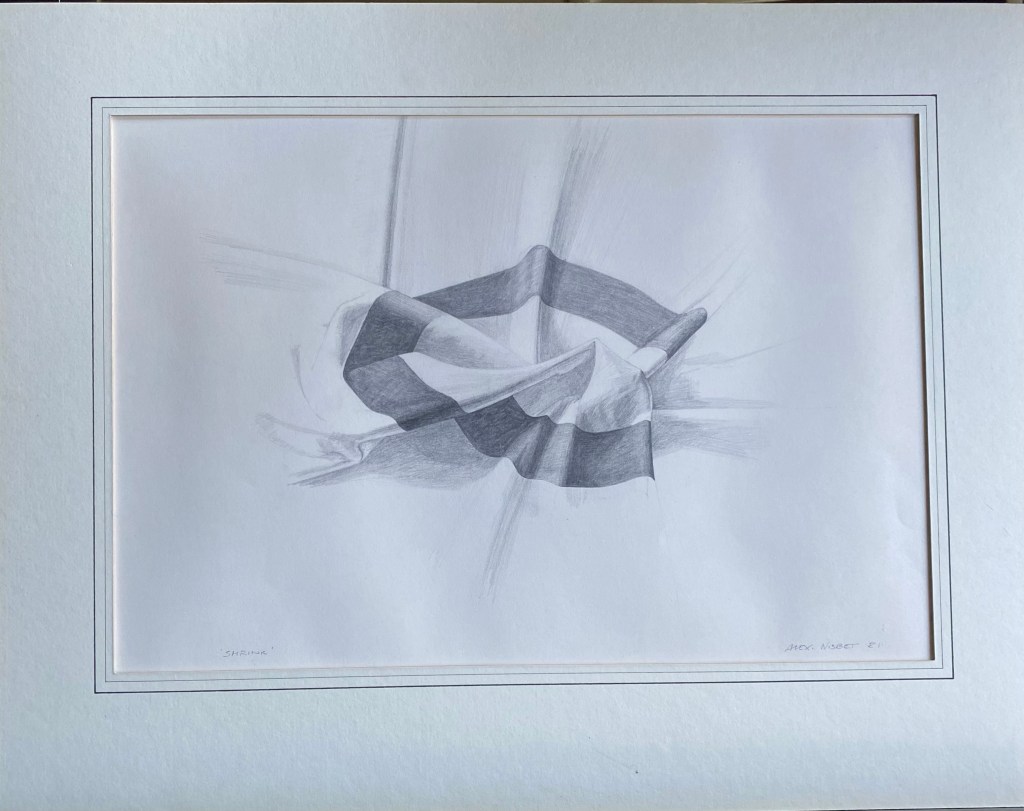
‘Shrink’ by Alex Nisbet, 1981: a gift from the artist

I

As my premature departure from the training scheme in psychiatry approached I attended my last Grand Round in the ivory tower of the Royal Edinburgh Hospital. These events consisted of a couple of half-hour talks or case presentations from psychiatrists of variable seniority given to the assembled hospital staff. Earlier in the year I delivered one of these talks, on the topic of the madness of George III.

The most memorable presentation during my year on the scheme concerned a patient who came to the attention of the authorities after a fire at his digs. He was an Australian national, not known to psychiatric services. Suffering from chronic varicose leg ulcers, he was entitled to various benefits. He moved around the country, signing up with local GP practices and receiving money to pay for his accommodation. Rescued from the fire and suffering from smoke inhalation he was admitted to a general medical ward.

In the course of his admission it became clear to the medical staff that he harboured a number of unusual beliefs. He thought himself to be a Venusian who, as a child, had come to earth in a spacecraft. Cut off from his people and culture, he wished to preserve the memory of his home planet and spent his time in libraries filling notebooks with drawings of Venusian cities and landscapes and writing copious tracts in his native Venusian. The books were of some artistic merit. He was perfectly happy and had never been treated with any antipsychotic medication. Nevertheless, he was clearly a schizophrenic with complex delusions. The question arose; should he be treated? Unlike Richard Dadd the patricide, he had done no one any harm and the general feeling was that he shouldn’t be medicated.

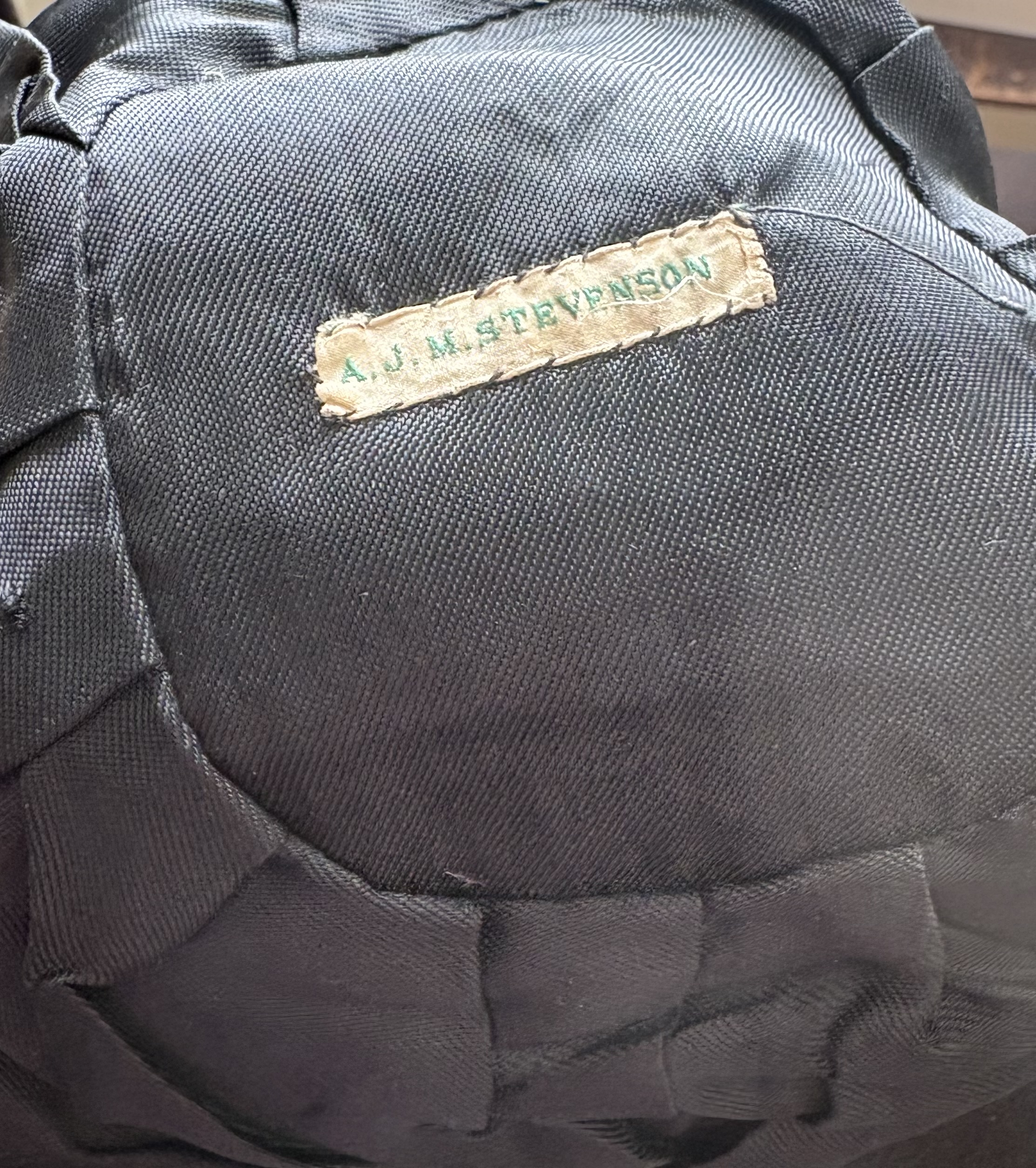
In contrast to that intriguing case, the last talk I attended was not very engaging, and bored, I contemplated the wooden writing tablet in front of me.The tablet is the shelf where you rest your notes. It was covered in graffiti incised into the surface with ballpoint pen; a jumble of initials, dates and scurrilous comments left by medical students over the years. On an impulse, knowing I was leaving, I wrote, ‘Psychiatry is bunk.’ Then, thinking it would be craven to leave that comment anonymously, I added ‘AJMS 83-84,’ confident that no one would actually identify me from such cryptic information.

How did I end up a square peg in that particular round hole? A year earlier, confronted by the necessity of doing a MD and probably a fellowship abroad in order just to stay in general medicine, I decided to follow my schoolboy plan to become a psychiatrist. In my boyish imagination this would be the perfect combination of science and the arts – and it would allow me to stay in Edinburgh for a bit longer.

It was not an entirely unconsidered choice. At secondary school I had read some clinical psychology books and my fifth year student elective in 1978 had been in psychiatry, with Eve Johnstone at Northwick Park Hospital in Harrow, a heavily academic unit. She was later to occupy the Chair at Edinburgh. I was sent off to nearby Victorian asylums to carry out Hinton and Withers Present State Examinations on chronic schizophrenics as part of an on-going study of ‘dementia in dementia praecox.’ Dementia praecox is the old name for schizophrenia. The test included things like serial 7s (subtracting 7 from 101 until you reach zero) and remembering the Babcock Sentence: One thing a nation must have to be rich and great is a large secure supply of wood.

This didn’t turn out to be the onerous task I had anticipated since most of the patients couldn’t even tell you their name. One cynical charge nurse was amused when I turned up to interview an aged Polish patient. ‘She hasn’t said a word in English for 30 years!’ he cackled. In one institution I discovered a piano on a stage in a little concert hall (nineteenth century asylums were very well appointed) and filled in the time playing that until I was picked up and taken back to Northwick Park.

By 1983 I had completed three years in general medicine and qualified as a physician. I had considered radiology for a career but the idea of joining a non ‘bed-holding’ specialty with its perceived low status put me off. Having said that, the image of psychiatry within the profession wasn’t an entirely positive one either. However, armed with Membership of the Royal College of Physicians I was confident the psychiatrists would have me. On the day of the interview everything went to plan. When they asked me why I wanted to do psychiatry I answered jokingly (but secretly truthfully) that watching Gregory Peck in Hitchcock’s Spellbound had inspired me. That went down well.

Previous new jobs had always begun in August, but for some reason the psychiatry training scheme started in October. This left me with two months to kill. I decided not to do locum work but instead ‘sign on’ and attempt some creative writing at the state’s expense. The break kicked off with a week in New York visiting old friends. We went to a chic Japanese restaurant in Midtown Manhattan on the night Yoko Ono happened to be eating there. The food was excellent but after I returned to Edinburgh I became ill. Assuming it was a simple tummy bug I attempted to tough it out but I started losing weight and couldn’t keep anything down. Soon I had symptoms typical of malabsorption and I thought I had contracted something truly awful. Making my way up the Mound to see a Festival performance of Ane Satyre of the Thrie Estaitis at the Assembly Hall I found I could barely walk and had to stop and cling onto the railings.

My GP was confident he knew what was wrong with me. He said he himself had contracted the same condition in St Petersburg and that New York was another ‘hot spot.’ Sure enough, live Giardia lamblia, a protozoan infection, were found in my specimen. Under a microscope they look like animated badminton rackets. A course of metronidazole and a home visit from a Public Health consultant followed. This left me very little time to write The Great Novel. I roughed out a plot, the usual semi-autobiographical guff, and showed it to my then wife who pronounced it awful. Early one morning, unable to sleep, I burned it in the living room fireplace.

II

October duly arrived and relieved of the burden of creativity I reported to the Royal Edinburgh Hospital in Morningside. I found I was attached to the Professorial Unit, Ward 2. I appeared to have been diverted there from an original placement in psychogeriatrics. I wasn’t given any reason for this change but the rumour was that Professor Kendall had something to do with it.

By this time R.D. Laing’s novel theories about the genesis of psychotic illness had been largely discredited but the rivalry between the psychiatrists who practised talking therapies, and the peddlers of pharmacological treatments raged on. The intake of trainees reflected this. We were all aware of each other’s backgrounds. At that time I was driving an Audi Coupé and one of my new colleagues remarked on this. ‘When we saw your car we thought, here comes the medical model,’ she sneered. I suppose I did favour a more physical approach but I resented being judged on such flimsy evidence.

One notorious study, much discussed then, compared the treatment of three groups of patients with depression. One group received psychotherapy, another psychotherapy combined with antidepressant drugs and a third only drugs. The patients who only had drugs did best while those on psychotherapy alone had the worst outcome, from which it was concluded that adding psychotherapy to drugs actually reduced their benefit!

I began to learn basic psychiatric information such as the difference between a neurosis and a psychosis. A patient with a neurosis comes to you asking for help because they are distressed by their symptoms. Perhaps they can’t go outside, or stop worrying, or stop checking things or stop washing their hands. They are upset by these thoughts and perceive them to be a problem. A psychotic patient on the other hand has no such insight into their much deeper delusions. They are unaware that they are being irrational and help is usually sought by their relatives – or the police. It did seem to me to be interesting work, at first.

Ward 2 where I was based contained a wide variety of cases severe enough to require inpatient assessment. There were the usual schizophrenics and psychotic depressives plus a few very severe neuroses including gravely ill anorexics and bulimics. I had just missed the very long admission of the ‘Fish Man’ a teenager so crippled by obsessional rituals he could no longer function. He was fixated on fat in his diet and insisted on boiling up fish to eat on the ward then scooping off any fat he found floating on top. He would time when to start and stop eating using a stopwatch then calculate his calorie intake generating reams of statistics. The ward had stunk of fish for weeks. His father kept telling the staff his son was ‘professorial material’ and seemed unable to grasp how handicapped he was.

Professor Robert E Kendell was the senior consultant on Ward 2 and occupied the Chair of Psychiatry at Edinburgh University. He would go on to become Dean of the Faculty of Medicine at Edinburgh, President of the Royal College of Psychiatrists and eventually Chief Medical Officer for Scotland. He was an impressive man of conservative appearance and a somewhat unnerving presence. His inaugural address considered whether you needed a medical degree to treat mental illness. His conclusion was that if you were going to prescribe drugs or treat conditions that were the result of degenerative changes in the brain, you did. However if you were purely acting as a psychotherapist, you didn’t. He was pragmatic and used electroconvulsive therapy (ECT), where appropriate, without hesitation. I witnessed its transformative effects in very severe depression. All trainees were expected to administer it (to the non-dominant hemisphere) assisted by an anaesthetist.

My first patient interview was with a young male paranoid schizophrenic. He had been visiting brothels in town and as his illness progressed he had been involved in some violent behaviour which brought him to the attention of the police followed by his admission. As recommended in the textbooks I asked him how he was feeling. After a pause he said, ‘You look like a giant.’
‘And how does that make you feel?’ I asked.
‘It makes me feel like killing you.’
Alone in the room with him I glanced at my watch. ‘Well, I think it’s time for lunch,’ I offered cheerfully. ‘Why don’t you pop back to your room?’

Another early case was Lawrence, an elderly Jewish man who was admitted with depression. He had no appetite and had become emaciated. The skin in his axillae was deeply pigmented. I was quite convinced he had advanced malignancy and presented my diagnosis to Professor Kendall. He himself was a former physician, a neurologist, but made great show of deferring to my more recent qualifications. I thought he might be mocking me. Reluctantly he allowed me to transfer Lawrence to the Royal Infirmary for investigation, while he himself remained convinced the problem was psychotic depression. About two weeks later Lawrence returned from the Royal, the physicians having found nothing physically wrong with him. ‘Now will you let me treat his depression?’ asked Kendall with a twinkle in his eye. Lawrence eventually went home after a course of ECT completely recovered and back to his normal weight. Even his pigmentation resolved.

Unfortunately as the year wore on we trainees were given only minimal supervision and the lecture course seemed random and impractical. Nevertheless we were expected to see and manage both in- and out-patients ourselves. The nursing staff at least were helpful and pragmatic. An acute psychiatric ward is a very hands-on place to work. It takes enormous skill and patience to manage such challenging patients. On the morning housekeeping ward rounds with the nursing staff there was no point labouring technical diagnostic points. You needed to know how things were going – but briefly. ‘How’s John then?’ would be greeted by, ‘Still very mad.’ There was no need to say more. But this practical approach could be misinterpreted. A new social worker straight off a university course arrived on the ward. She was full of good intentions and theory but no experience. After her first ward round she turned to me and said, ‘I look around this place and I ask myself, who is giving these patients love?’

I loved the elderly secretary on Ward 2. Apart from being a first rate source of gossip, she took shorthand then typed up my letters, improving my prose style in the process. It was my only experience of dictating to a human being, all other jobs made use of small hand-held tape recorders. As she scribbled away, her cigarette never left her mouth and the smoked curled up through her glasses leaving her brow and forelock lightly tar-stained. She knew everything about the Royal Ed and the psychiatrists who worked there going back decades.

Arch humour was the norm among the experienced nursing and medical staff. It often took the form of a feigned callousness or deliberate contrariness. I claimed that if you said good morning to someone at the Royal Ed you’d be asked what you meant by that. One aphorism circulating in 1983 was that ‘neurotic’ had become a term of endearment. It was being applied to almost everyone and hence had become quite meaningless.

That Christmas of 1983 there was a Ward 2 night out to the notorious Armenian Restaurant in Holyrood where the highly eccentric owner insisted we all get up and dance to Armenian folk music. RE Kendall got very enthusiastic, attempting a sort of Cossack dance and ended up crashing into the stereo system.

Studying psychiatry was a social minefield. Asked what you did for a living at a dinner party the response to the information that you were training in psychiatry was unpredictable. Your dining companion might launch into a prolonged history of their sibling’s mental health issues assuming you’d be fascinated – or else they might become hostile because of some previous negative experience or philosophical dislike of the specialty. ‘Who decides if someone is mad? I mean, what would happen if you decided I was mad?’ was a common challenge. I would try to explain that the patients I dealt with were mad in the colloquial sense. A few brief moments in their company would convince any lay person of their insanity. They were obviously mad, not matter-of-opinion mad. I started saying simply that I worked in a hospital.

Within a few weeks I had become convinced that psychiatry was the wrong career move for me. This disaffection added to a background dissatisfaction with life and relationships in general. A deep gloom descended. I decided to look elsewhere for a job as soon as the opportunity arose but in the meantime I carried on in case I was mistaken and simply suffering from my own little unhappy psychiatric disorder.

Ward work and lectures continued. I began to get the hang of dealing with psychotic patients. Once they recovered they usually wanted nothing more to do with you, even crossing the street to avoid you as if merely being seen with you in public was humiliating. One patient in particular illustrated this problem.

Keith was a clever boy from a modest social background, the first of his family to go to university, and his parents’ pride and joy. After starting the first year of his physics course at Edinburgh University he experimented with marijuana at a party. This seemed to trigger his first bout of psychotic illness. It took the form of what used to be called schizoaffective disorder, a psychosis that combines features of schizophrenia and manic-depressive psychosis. Keith formed the conviction that he’d discovered the Fifth Force in the universe. He was unable to sleep.

Clearly unwell, his parents had taken him home from university but shortly after that he interrupted a physics class at his old high school, one that contained his younger brother, and addressed the class on the subject of the Fifth Force. The physics teacher didn’t like to stop him, perhaps imagining that like the sleepwalker myth it would be a mistake to interrupt him. Having come to the attention of the mental health services in this way he was admitted to the ward. His parents were very unhappy about it, feeling it would damage his career prospects. Eventually they demanded his release from the ward. Reluctantly we agreed, but his symptoms deteriorated further culminating in him vandalising the family car after which he was readmitted, this time under Section 28 of the Mental Health Act 1959.

Keith was ill for many weeks. His parents were devastated. When I arrived on the ward in the morning he would shout his delusional ideas in my ear and demand his release as I walked down the corridor. Each night I prayed, ‘Please make Keith better tomorrow.’ Eventually the storm subsided. Some insight crept into his conversations with me and finally he was released to out-patient follow up. He eventually defaulted from review, but on his last visit to out-patients he informed me that he didn’t believe any of the things he said to me while on the ward. ‘I just said that stuff to wind you up. I was laughing at you,’ he said, scornfully.

Meanwhile, my cohort of out-patients with neuroses began to grow. Every time I suggested they might be well enough to return to their GP for onward care they threatened to harm themselves. On one of the rare occasions I got to discuss this with my consultant he told me I was ‘encouraging dependency.’ My archaic medical model-type thinking tripping me up again.

III

However unhelpful, the lecture course was at least interesting. One highly anticipated session was the annual talk on hypnosis given by Professor Ian Oswald. The rumour was that he would attempt to hypnotise the whole class of trainees. Exciting stuff. Came the day and the Prof’s introduction:

‘Now, we all know that it’s easy to make fun of things and have a bit of a laugh, but we will never learn anything with that sort of approach, so I would like you all to take what is to follow seriously so that we may benefit from the experience.’ A frisson ran round the room. I was sitting next to my old university friend Jamie, also on the training scheme. Prof Oswald continued at a brisk pace. ‘Would you all now put both your arms above your heads and clasp the fingers of your hands together as hard as you can. That’s good. Now keep pressing as hard as you can. I’m going to suggest to you that when I tell you to unclasp your hands you will be unable to do so, no matter how hard you try… OK, now unclasp your hands.’

Jamie and I and most of rest of the class immediately released our fingers and looked around, relieved to have retained control of ourselves. However, a couple of our number were stuck with their hands locked together. Prof Oswald homed in on his victim, a quiet, diffident female colleague. He told her she would now be able to release her hands, which she did, then he told her to come to the front of the class. He sat her on a chair facing us and placed her in some kind of waking trance. He demonstrated a number of subjective phenomena such as telling her she could feel nothing on one side of her body. Finally, he woke her up and asked her if she thought she’d been asleep. She said no she hadn’t, she had been fully aware during the entire experiment but unable to do other than comply with his instructions.

Hypnosis as a public entertainment was legal in Scotland. Some of these performers offered other services such as cessation of smoking. One client became suspicious of the therapist’s motives when he suggested they meet at her home. Her brother-in-law was a policeman and arranged for officers to be present secretly inside the house. Although the hypnotist was arrested for attempted sexual assault and came to trial he got off on the basis that the police tactics amounted to entrapment. Prof Oswald was an expert witness at the trial. Fascinating stuff.

A less enjoyable incident occurred during a lecture on psychotherapy from Professor Henry Walton. Walton is now famous for his modern art collection, donated to Edinburgh galleries. At that time he was better known for his thoughts on the suitability of medical students to do psychiatry based on their ‘tolerance of ambiguity.’ He had authored a popular science book called Know Your Own Mind. I remember a lecture he gave to us as medical students which involved him taking a sexual history from some poor man in a dressing gown in front of a large audience. The man stared at the floor throughout as Walton asked about masturbation etc. and didn’t answer him. ‘Do you always experience such difficulty discussing sexual matters?’ asked the professor. I did a cartoon of this appalling scene and questioned whether I wanted to be a doctor at all.

Walton was notorious within the medical school for an episode of shoplifting in Harrods which he eventually attributed to a fugue state. When asked by the trial judge what a man in his position was thinking of being caught shoplifting he said, ‘I don’t know, I must have been mad.’ Private Eye pounced on this exchange. A period of gardening leave followed, incompletely observed, then he was reinstated. By the time I attended this lecture I was battle scarred and thoroughly disillusioned with the training scheme. At the end of his exposition Prof Walton invited questions. I raised my hand.

‘Professor, we are very junior trainees who have only a few months of experience but on-call we are invited to see acute patients and offer short term psychotherapy if appropriate. They often have massive thick notes indicating they have seen many, more experienced, psychiatrists in the past. I’m afraid I feel a bit of a fraud offering my services to them.’ The professor’s face darkened, ‘If you said that to me in an examination I would fail you and trust you would take up some other branch of medicine.’ I thanked him for his reply.

About a week later I bumped into Chris Freeman one of the other consultants on Ward 2. By this time I had moved to Ward 4 for my next six month attachment.
‘I wanted to speak to you Allan,’ he began.
‘You want to know how I’m getting on in Ward 4?’ I offered cheerfully.
‘No, I don’t care about that,’ he said (more psychiatric humour) ‘I wanted to talk to you about what the Prof said to you in the lecture last week.’ Somehow the exchange had come to his attention.
‘I want you to know that it will have no bearing on your future career in psychiatry.’
‘No I suspect it won’t, but thanks for telling me,’ I replied.

On-call work at the Royal Ed could be challenging. Two trainees were available on any given evening, one was based at the Royal Ed itself. After 10pm the other trainee would make their way to Craighouse Hospital, a spooky Victorian long-term asylum on a nearby hill that looked more like the set for a horror movie. It had originally been built to house wealthy patients and their servants in gothic luxury but had since become an NHS facility. Sleeping there and hearing the ‘noises off’ was unsettling but at least you weren’t at the mercy of acute admissions.

Back at the main hospital you waited to be summoned. There was a mixture of outside referrals and in-patient crises to deal with. One night before my colleague had left for the Addams Family Mansion I got a phone call from switchboard. I had a call waiting. A weary-voiced woman informed me that she thought she’d killed her baby. She refused to tell me who she was or where she was calling from. In the background a large dog barked incessantly. Despite the information that ‘the wean’s no’ breathing’ the woman wanted to discuss other issues. I covered the mouthpiece and whispered to my colleague, ‘Can you trace this call?’ She shrugged then picked up the other phone in the room. Eventually the woman became impatient with my amateurish advice and rang off. ‘You’ve been nae help tae me!’ she chided. My colleague told me the police had traced the call.

Half an hour later the police called me. ‘We’re at the property now doctor. The door’s locked and we can hear a dog barking inside. How should we proceed?’ I was well into uncharted waters now. ‘I don’t know. You’re the guys on the spot.’ I said. ‘All I know is that she claimed to have killed her baby.’
‘OK, doc we’ll let you know what happens.’ They rang off.

About 15 minutes after that they were back on the phone. ‘Eh, we broke down the door and there was just a dog inside the house, no baby, and now the owner’s come back from the pub. She’s very unhappy about the damage to her property.’

In-patients would often harm themselves overnight. At times basic first aid was required but often the damage was more serious. A rugby player, a front row forward with a local club, was admitted with his first psychotic illness. The ward called me to say he had stripped himself naked and was jumping off his bed onto the tiled floor head-first because, ‘God is telling me to have epileptic fits.’ The burly charge nurses from the high security Ward 10 were already on the case and I was required to complete the formalities.

When I got there the man seemed calm and I began completing a Section 28 and countersigning the drugs that had already been administered to the patient by the nurses. The patient and his escorting posse walked down the ward and out of sight towards the stairs. Suddenly a young female nurse came running back towards the duty room shouting for me to come quickly as there had been ‘an incident.’

The patient had made a break for freedom at the top of the stairs, the nurses had restrained him and hauled him to the floor. In bare feet, one foot had stuck on the tiled floor as they piled on and he had sustained the worst fracture dislocation of his ankle I had ever seen. The foot was up one side of his tibia, the skin stretched tightly over the bone end. Despite this appalling injury the prop forward was still trying to get up! More sedation was given and I hurried off to phone casualty at the Royal Infirmary. ‘I’ve got an interesting one for you,’ was my opening remark.

By 4 am after several other calls I had fallen asleep in the horrible on-call room. There was a plastic sheet under the actual sheet which made it slide about in an unpleasant way and the big cast iron Victorian radiator was broken, stuck at maximum flow. The room was sweltering and you had to open the window wide to try to cool off. The phone rang. It was Ward 10. ‘Can you come and write up some analgesia for your patient with the broken ankle?’
‘What? He’s not at the Infirmary?’
‘They bivalved his plaster and sent him back. He’s OK, it’s just that he’s awake now and in quite a lot of pain. He’d had so much sedation before he went over there they didn’t give him anything else.’

After Christmas I was still miserable and wanted to escape from this first career misstep. Seeking certainties I applied to the radiology scheme and was accepted. I decided to complete the full year in psychiatry rather than bail out to some other temporary job. After all, I might change my mind.

I completed my year in psychiatry with six months in Ward 4. The senior consultant there, whom I won’t name, was less helpful than REK. Once when reminiscing about his career he said, ‘At the time I had a number of sexual skittles in the air,’ a phrase that I’ve never forgotten. It proved pointless asking him for help with my now huge out-patient load.

Towards the end of the Five Nations rugby tournament of 1984 Scotland found themselves in a Grand Slam decider with France at home. My brother got us tickets at the last minute but I was on call that weekend. In the registrar’s room I spotted the new trainee who had just arrived from Singapore. I asked him if he would swap on-call, and having nothing to do and no interest in Rugby Union, he agreed. I got to stand on the North Terracing and witness a Scottish victory. Jerome Gallion the French scrum half was knocked unconscious in a collision with David Leslie and admitted to the Infirmary for a CT scan in the department I was soon to join. It was the only time I’ve seen supporters throw their hats in the air.

Exeunt

When Jamie and I announced our departure from the scheme there was a certain amount of reflection on the part of the trainers. We were asked to explain ourselves at the Friday afternoon ‘sensitivity meeting.’ Having secured new jobs we did not really want to explain ourselves and instead blamed personal issues such as our emotional unsuitability to the cut and thrust of mental health. Beyond that Friday afternoon session I was summoned to Professor Kendell’s office to explain myself. He seemed disappointed in me and I felt uncomfortable. He plonked me in a very low armchair then sat perched on his desk high above me.

‘Why are you leaving us, Allan?’
I struggled to form a sensible response. ‘Well, I find the patients awful,’ I offered lamely, reluctant to say that I felt completely unsupported.
‘What’s awful about them?’
‘Well they seem to get better or worse irrespective of what I do for them.’
‘You don’t find them interesting in themselves? You will be aware that before psychiatry even existed as a science the great descriptions of psychological illness were found in literature; in Shakespeare and Dickens. What interests you in medicine?’
‘Structure and function I suppose,’ said I.
‘Well, we could be a hundred years away from that in psychiatry,’ said Kendall. ‘And why radiology for goodness sake? Radiologists lead an etiolated existence.’ He sighed. ‘Write to me and let me know how you get on.’ With that I was dismissed and went home to look up etiolated.

After a few months of happy structure and function in radiology – the plumbing and wiring of medicine – I decided I should indeed write to REK and tell him that I was satisfied I’d done the right thing. I sent him an anodyne note thanking him for his counsel and the reference he had written for me.

A few days later I got a reply:

Dear Allan,

I do hope you settle down in your chosen metier soon. Should you have any doubts about your decision I suggest you recall what you inscribed on one of our lecture theatre desks not six months ago: Psychiatry is bunk. AJMS 83-84.

I trust this was an accurate reflection of your feelings at the time.

Robert E Kendall.

I was horrified. When I told his friend Judy Greenwood about it she dismissed it, ‘Oh he’s a bugger,’ she laughed. ‘I’ll have a word with him.’

Years later when I had become a consultant radiologist I discovered REK had been taken off my ultrasound list by a senior colleague who felt I wouldn’t want to scan my ‘old boss.’ Some time after that I met him leaving outpatients and he recognised me. ‘You had a lucky escape Prof. You were nearly on my ultrasound list.’ I said, grinning. ‘You’re the one who missed out,’ he replied. ‘I am an interesting case.’